

Safety poster
Updated · Free to print and share
Risk assessment matrix poster (5 x 5)
A risk assessment matrix ranks a hazard by multiplying how severe its harm could be by how likely that harm is, then reads the score against bands that say what to do. This poster prints the 5 x 5 grid with every score worked out, the scale words for severity and likelihood, and four example bands from low to very high with the action for each. The bands match the free risk assessment matrix template and the risk matrix calculator on this site; your own risk policy sets the ones you use.
Download the poster
The PNG is free to download now. The print-ready vector PDFs open after a short form, once.
Free to print and share with your team. Enter your name and work email once to download.
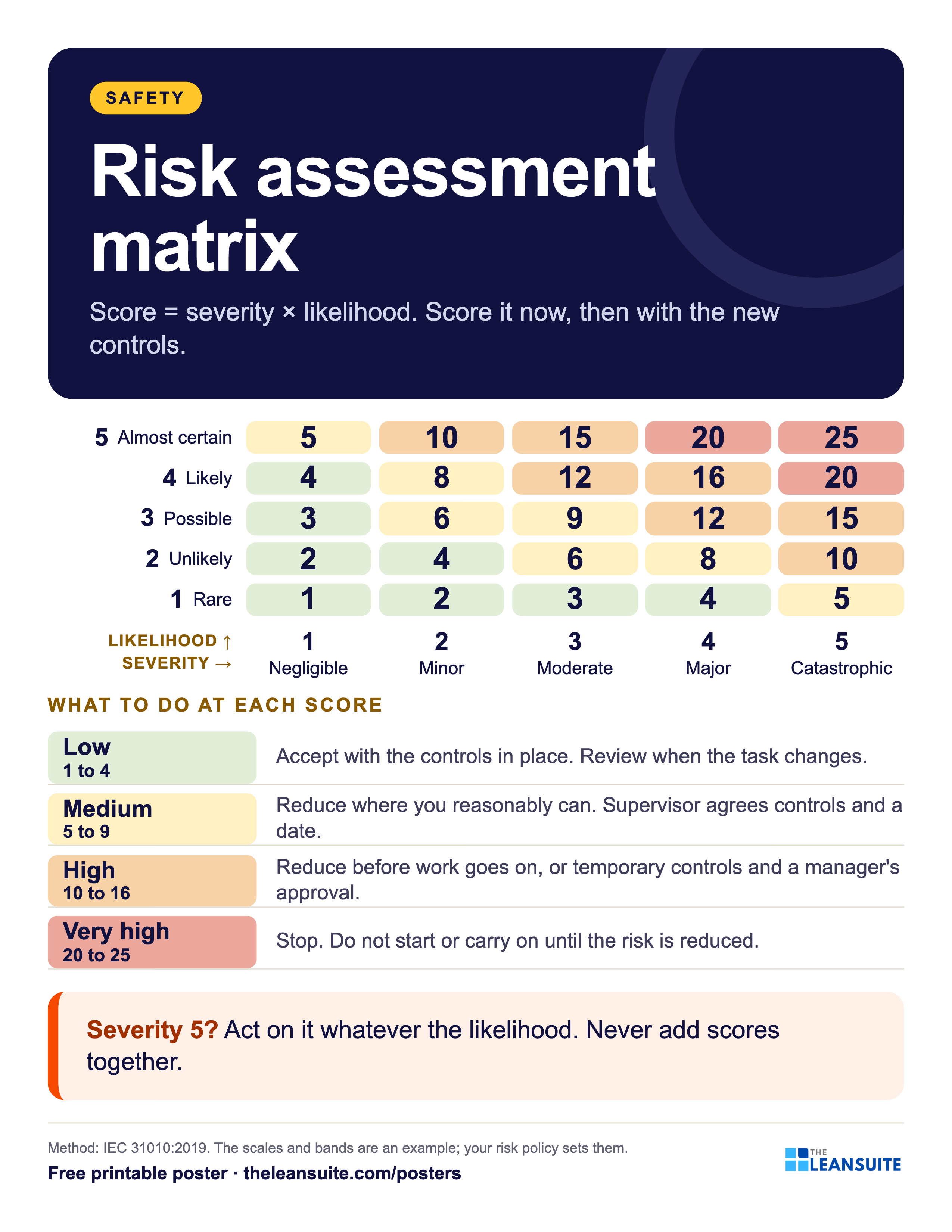
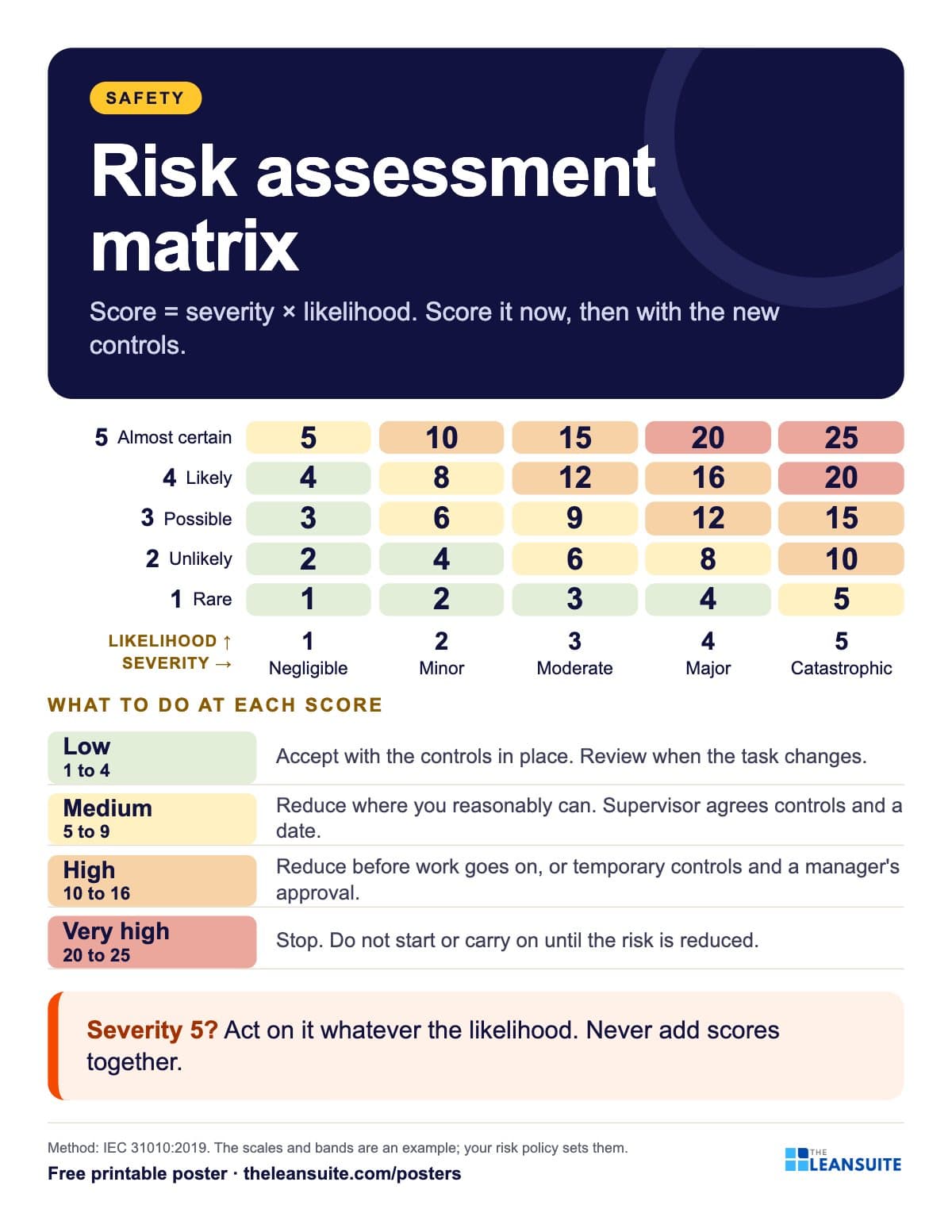 A 5 by 5 grid of severity against likelihood with every score shown and four colored risk bands with actions.
The words on the poster
Risk assessment matrix
Score = severity × likelihood. Score it now, then with the new controls.
Risk score = severity (1 to 5) × likelihood (1 to 5)
- Low: 1 to 4 Accept with the controls in place. Review when the task changes.
- Medium: 5 to 9 Reduce where you reasonably can. Supervisor agrees controls and a date.
- High: 10 to 16 Reduce before work goes on, or temporary controls and a manager's approval.
- Very high: 20 to 25 Stop. Do not start or carry on until the risk is reduced.
- Severity 1 Negligible, 2 Minor, 3 Moderate, 4 Major, 5 Catastrophic.
- Likelihood 1 Rare, 2 Unlikely, 3 Possible, 4 Likely, 5 Almost certain.
- Severity 5? Act on it whatever the likelihood. Never add scores together.
Method: IEC 31010:2019. The scales and bands are an example; your risk policy sets them.
On the floor
How to use it
Putting the Risk assessment matrix poster (5 x 5) poster to work
- 1
Hang it where risk assessments and job safety analyses are done, so everyone scores with the same words.
- 2
Score with today's controls, then again with the new controls, and record both.
- 3
If your site uses different bands or scale words, write them on the poster before you put it up.
- 4
Read the severity as well as the score: a possible fatality needs action even when it is rare.
Which size to print
- 24 x 36 in or A2: a main wall or team board, read from a few metres away.
- 18 x 24 in or A3: a station or notice board. The A3 file also fits 11 x 17 in paper.
- Letter or A4: a clipboard, binder or handout, on any office printer.
Every PDF is vector, so it stays sharp at full size. Nothing runs to the edge of the page, so no bleed is needed.
Sources and notes
Risk matrices are simple and widely used, and they have known limits: very different hazards can share a score, a rare but fatal hazard can land in the same band as a frequent cut, and people read words like likely in different ways (Cox, 2008). Use written scale definitions, score as a group, and look at the severity on its own as well as the score. Never add scores together.
- IEC 31010:2019, Risk management: risk assessment techniques, describes the consequence and likelihood matrix. No standard fixes the scales or bands.
- Bands, scale words and actions: the free risk assessment matrix template on this site (an example banding: low 1 to 4, medium 5 to 9, high 10 to 16, very high 20 to 25).
- L. A. Cox Jr. (2008), What's Wrong with Risk Matrices?, Risk Analysis 28(2), on the method's limits.
Templates, decks and guides to go with it
- Risk assessment matrix template (5×5)A color-coded 5 × 5 severity and likelihood matrix, a scoring guide and a risk register.
- Job safety analysis (JSA) templateJob steps, hazards, risk scored before and after the controls, the hierarchy of controls, PPE and sign-off.
- Risk register templateOne scored list of operational risks with owners, actions and dates, a heat map and a review log.
- Preliminary hazard analysis (PHA) worksheetFind and score the hazards of a new line, machine or process before design is fixed, then choose controls and re-score.
- Topic: Safety managementEvery guide we have on the subject, sorted.
Terms on this poster
More safety posters
All posters PPE by zone poster
 Lockout tagout (LOTO) steps poster
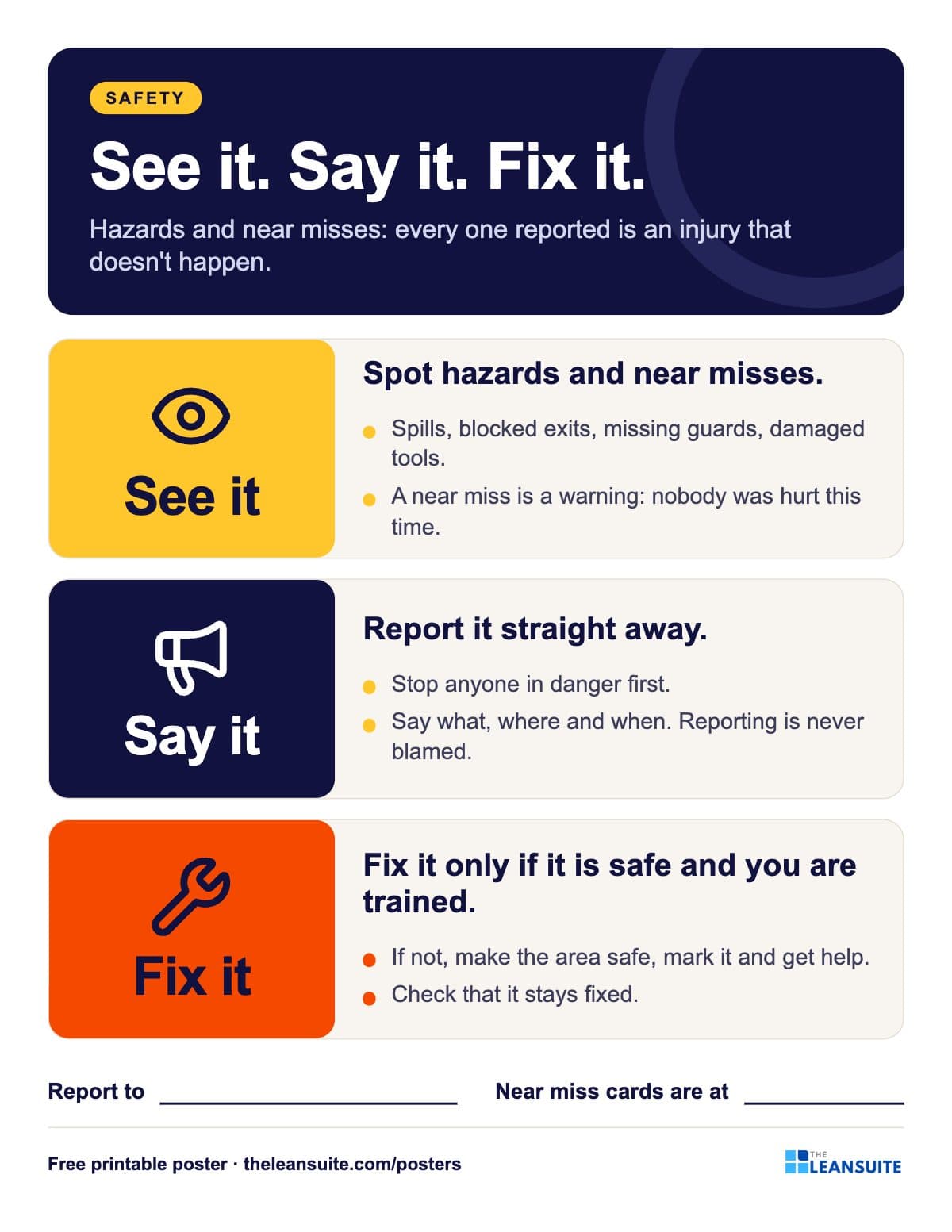 See it, say it, fix it safety poster
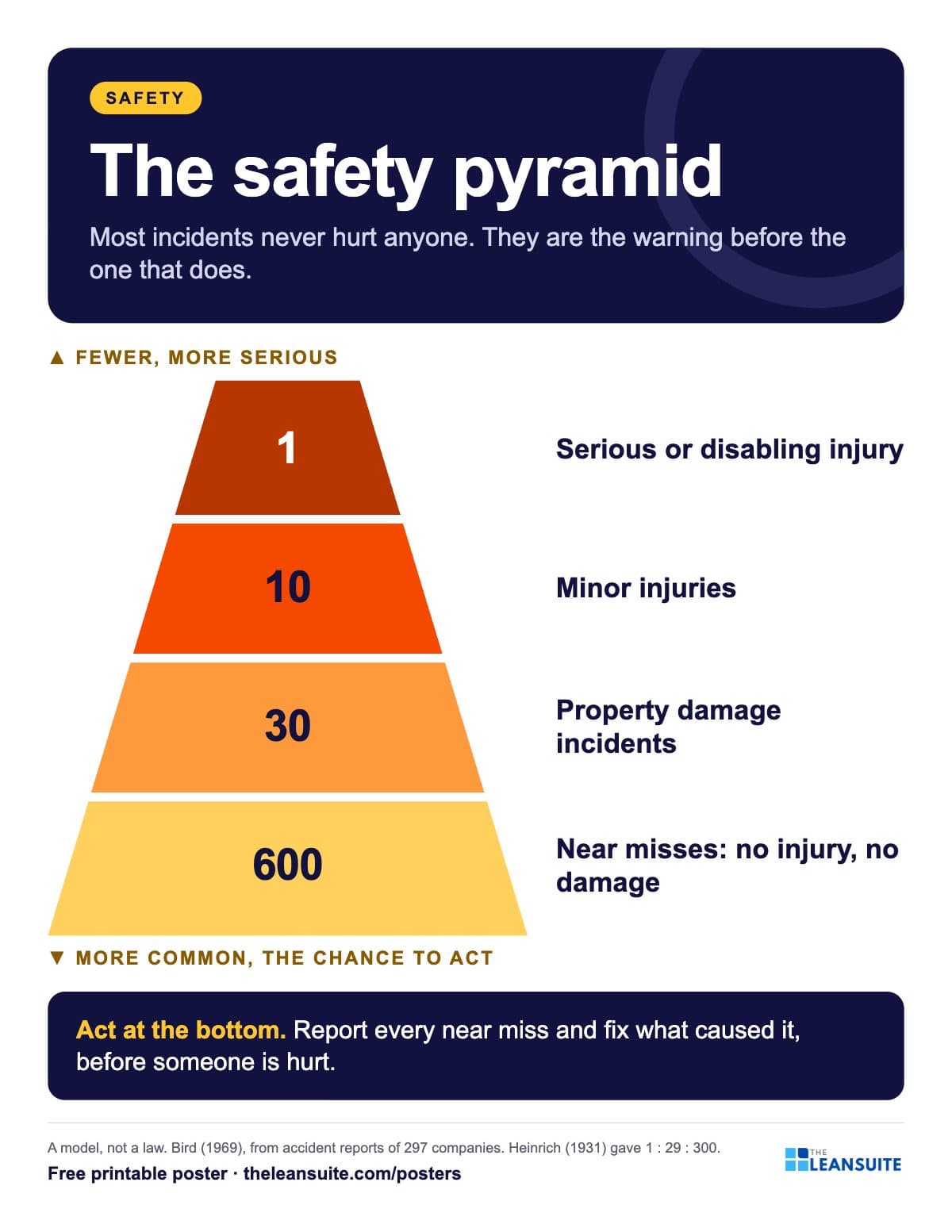 Safety pyramid poster (Bird's triangle)
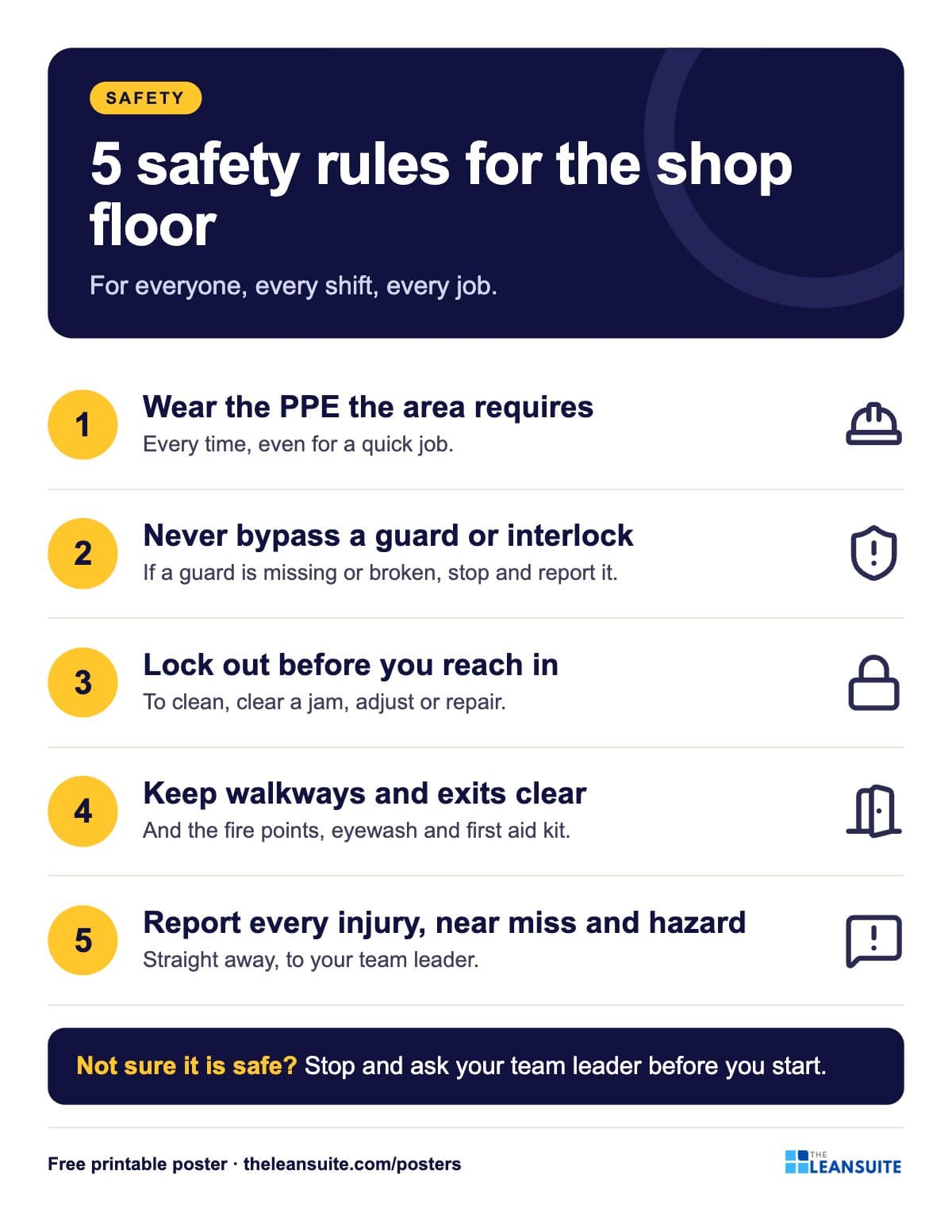 5 shop floor safety rules poster
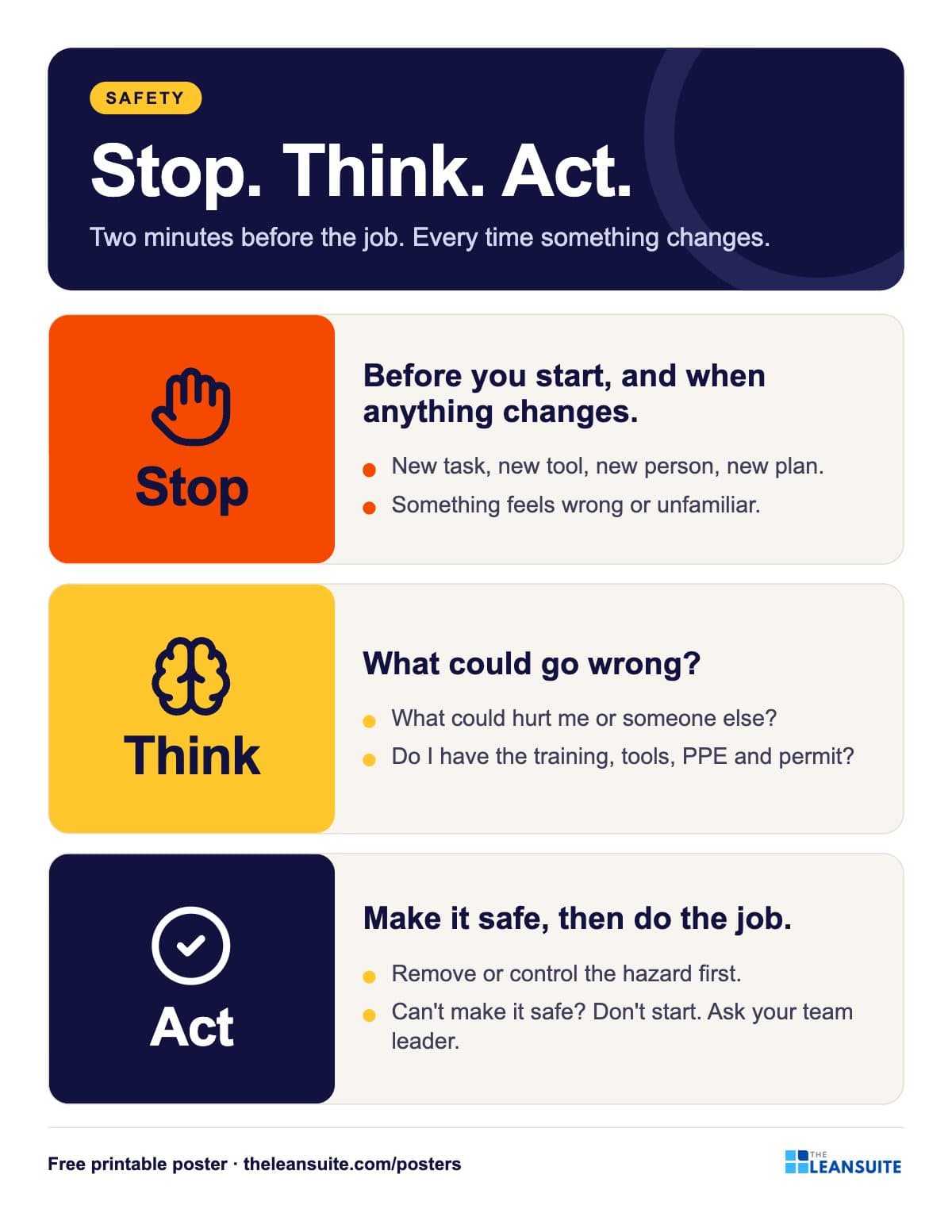 Stop, think, act safety poster
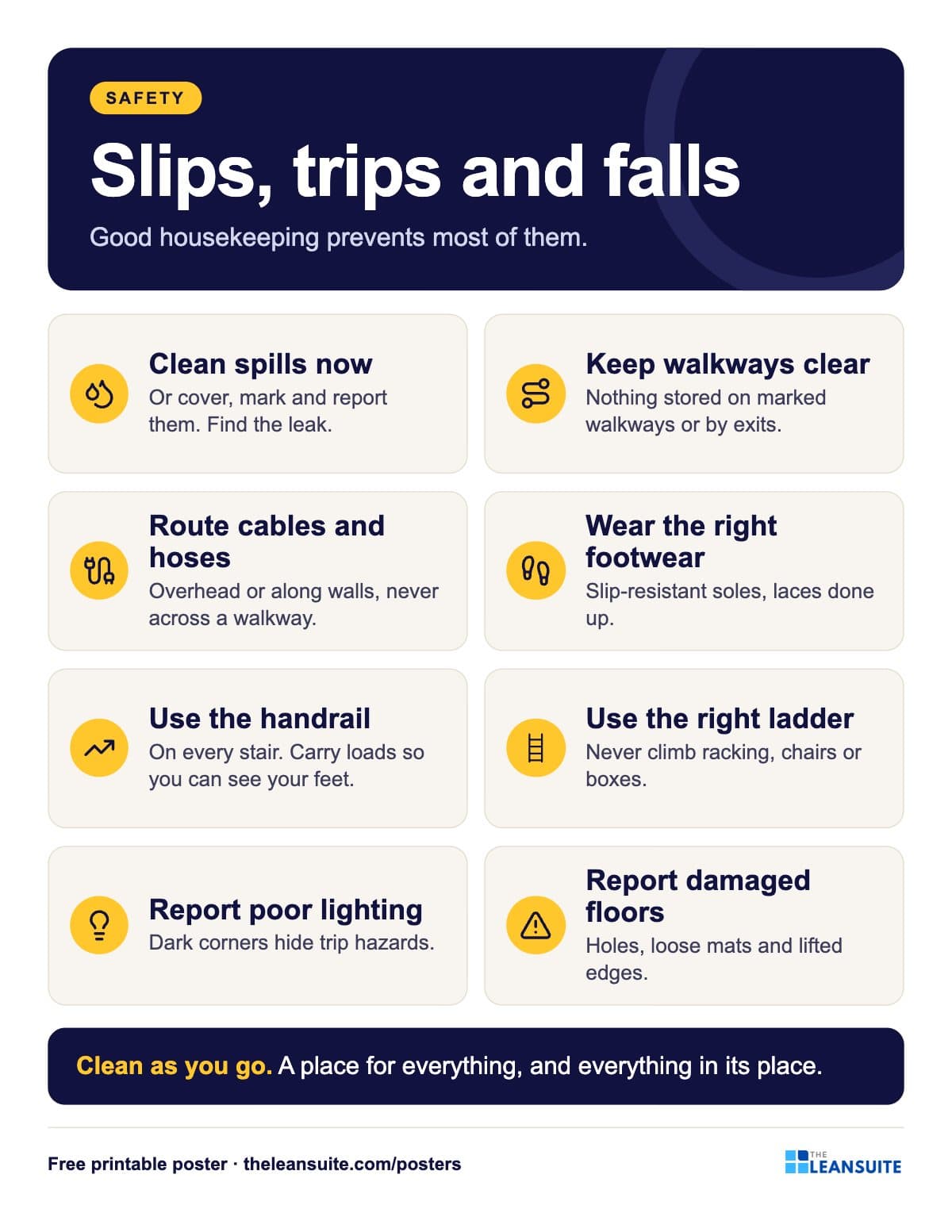 Slips, trips and falls housekeeping poster
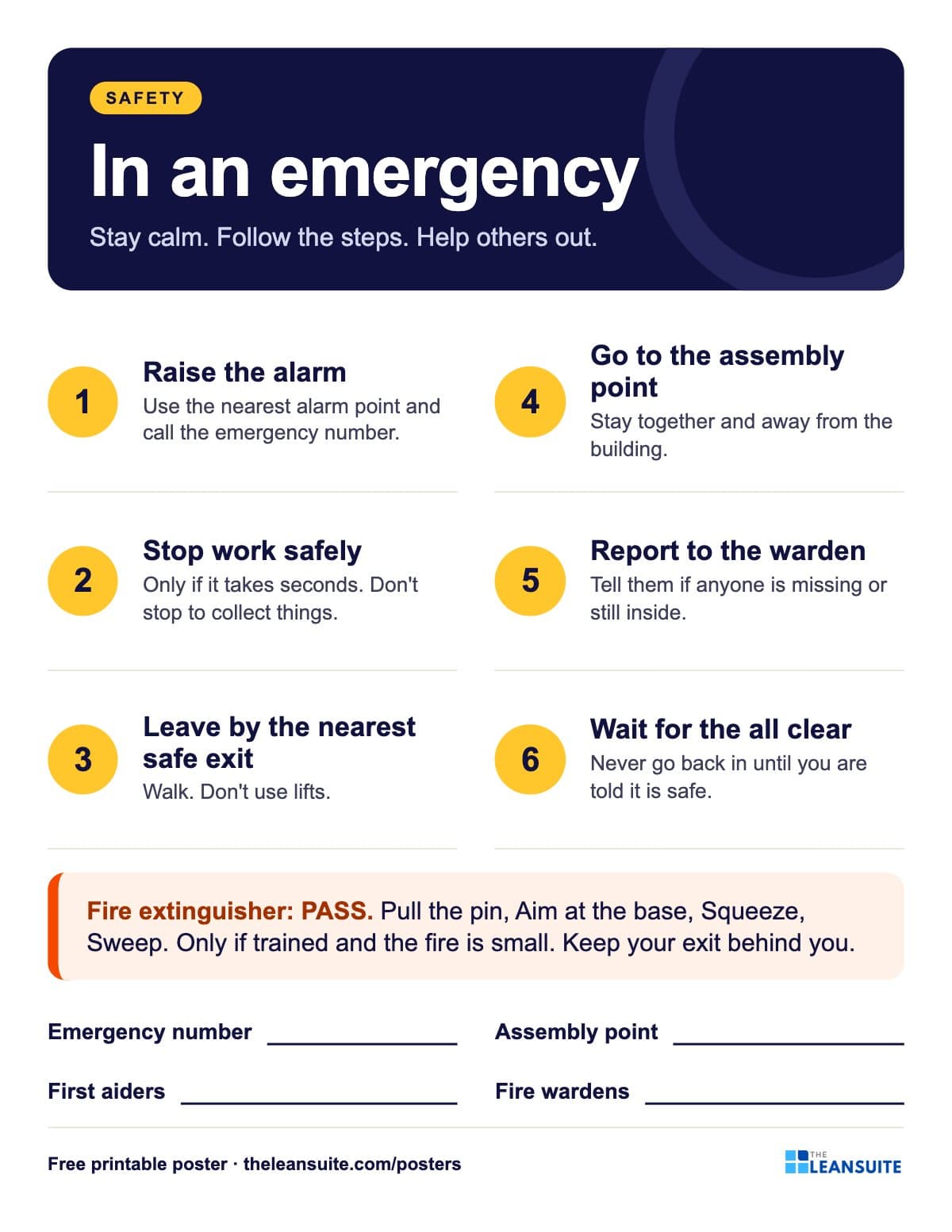 Emergency response poster
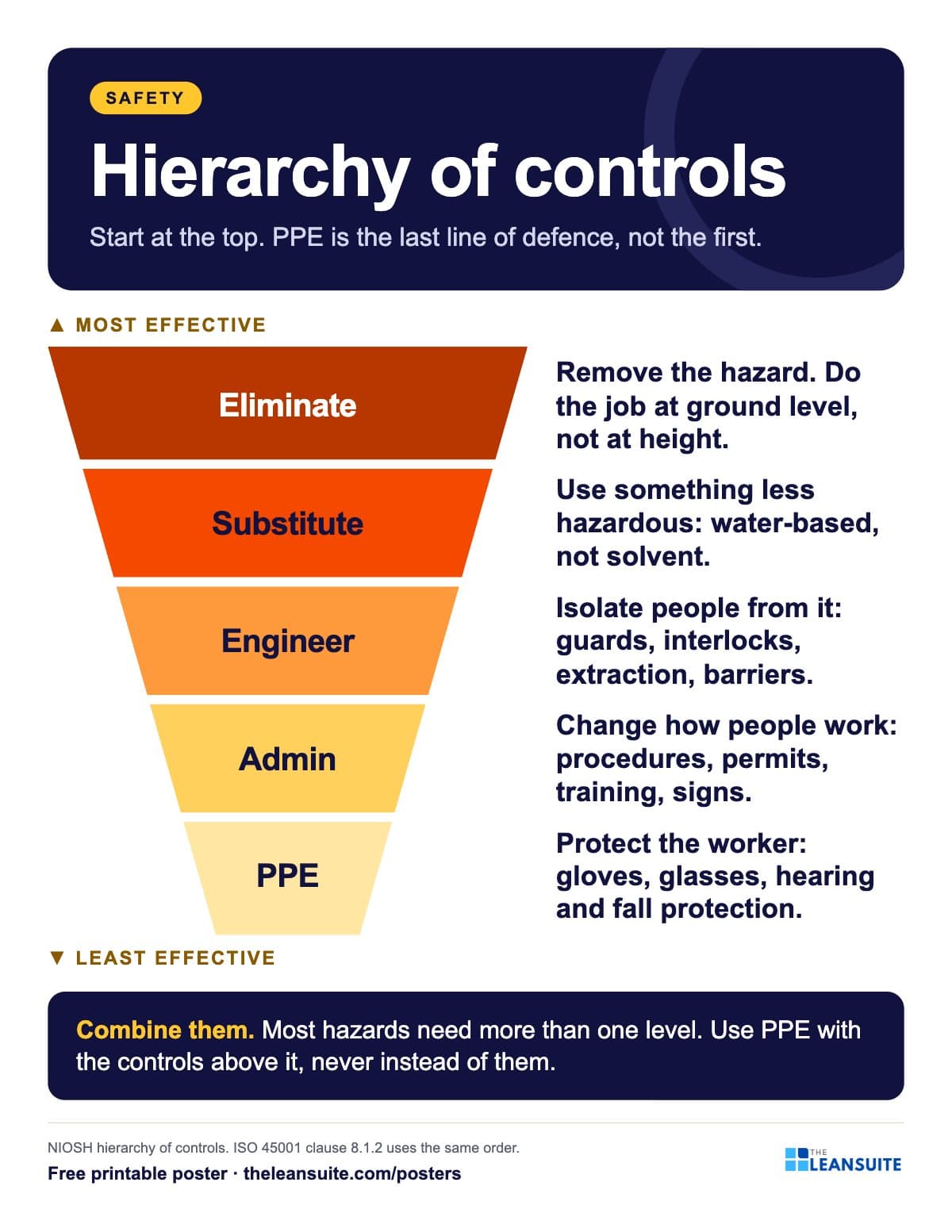 Hierarchy of controls poster
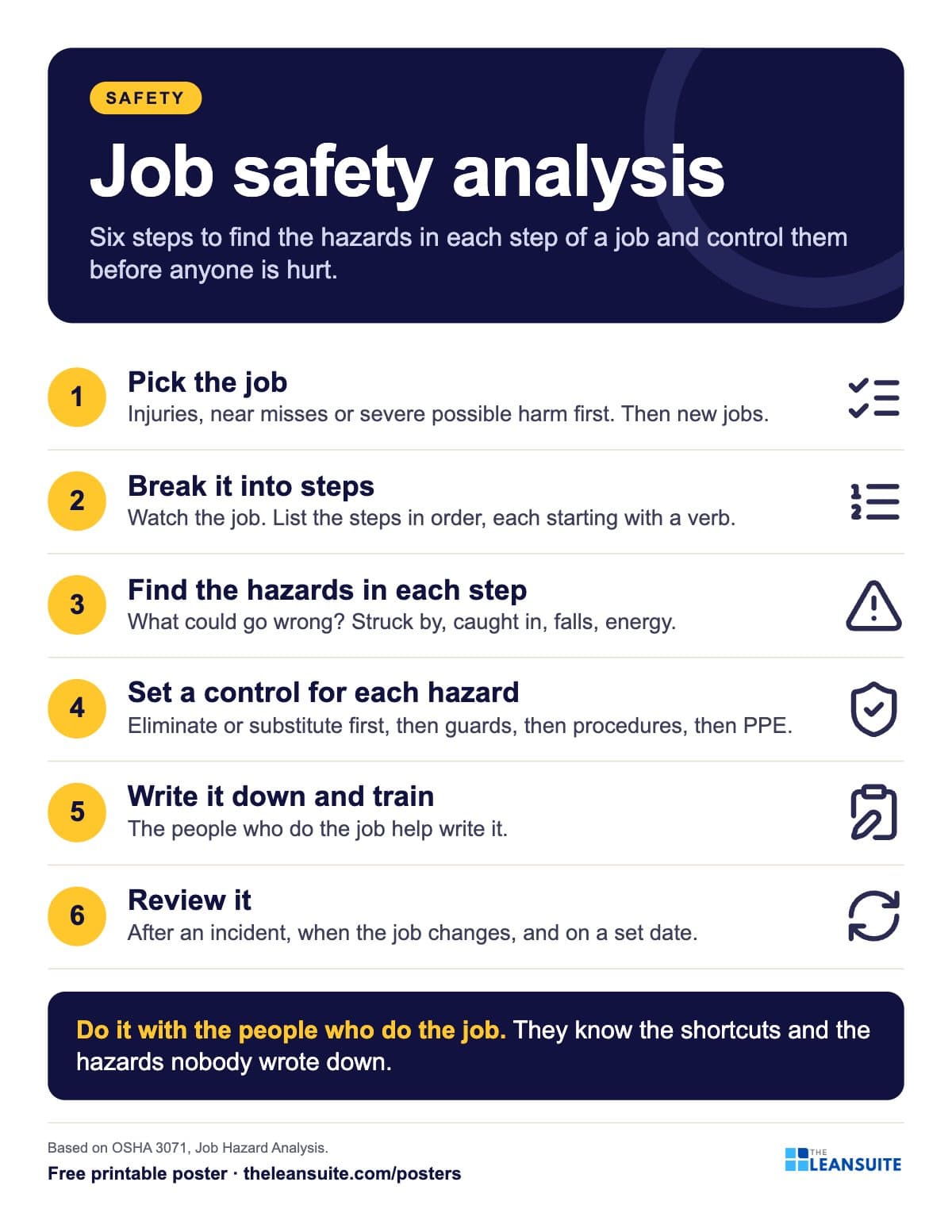 Job safety analysis (JSA) steps poster
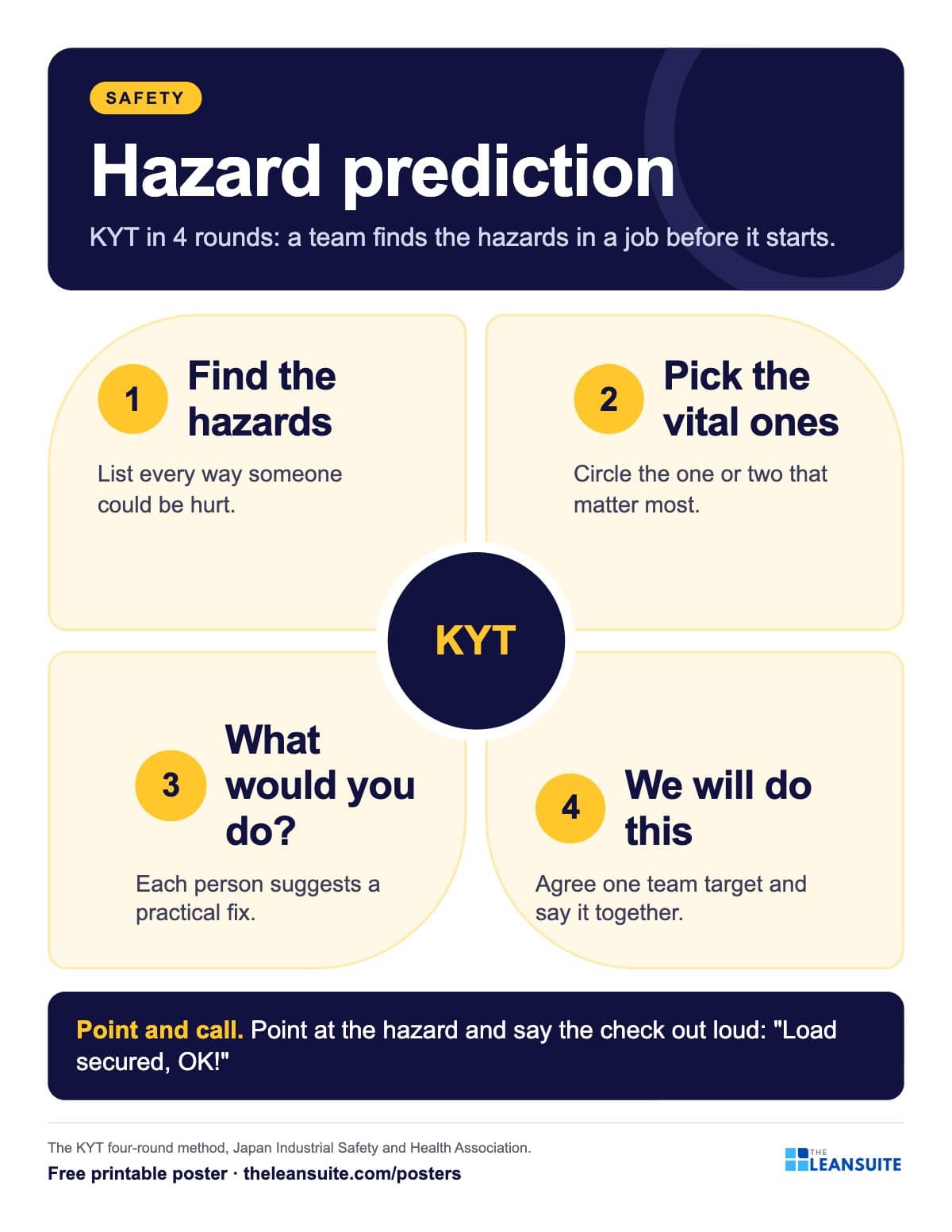 Hazard prediction (KYT) 4 rounds poster
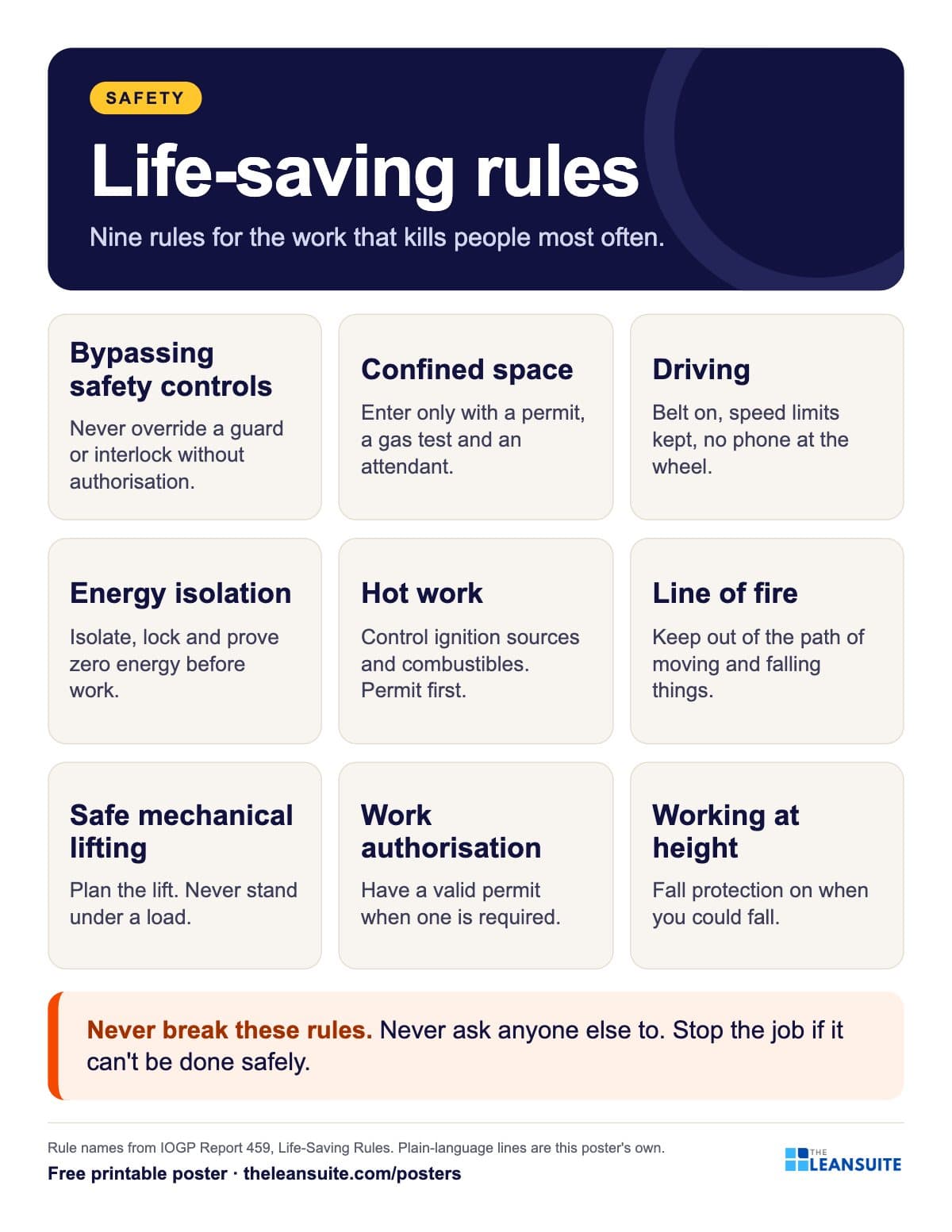 Life-saving rules poster
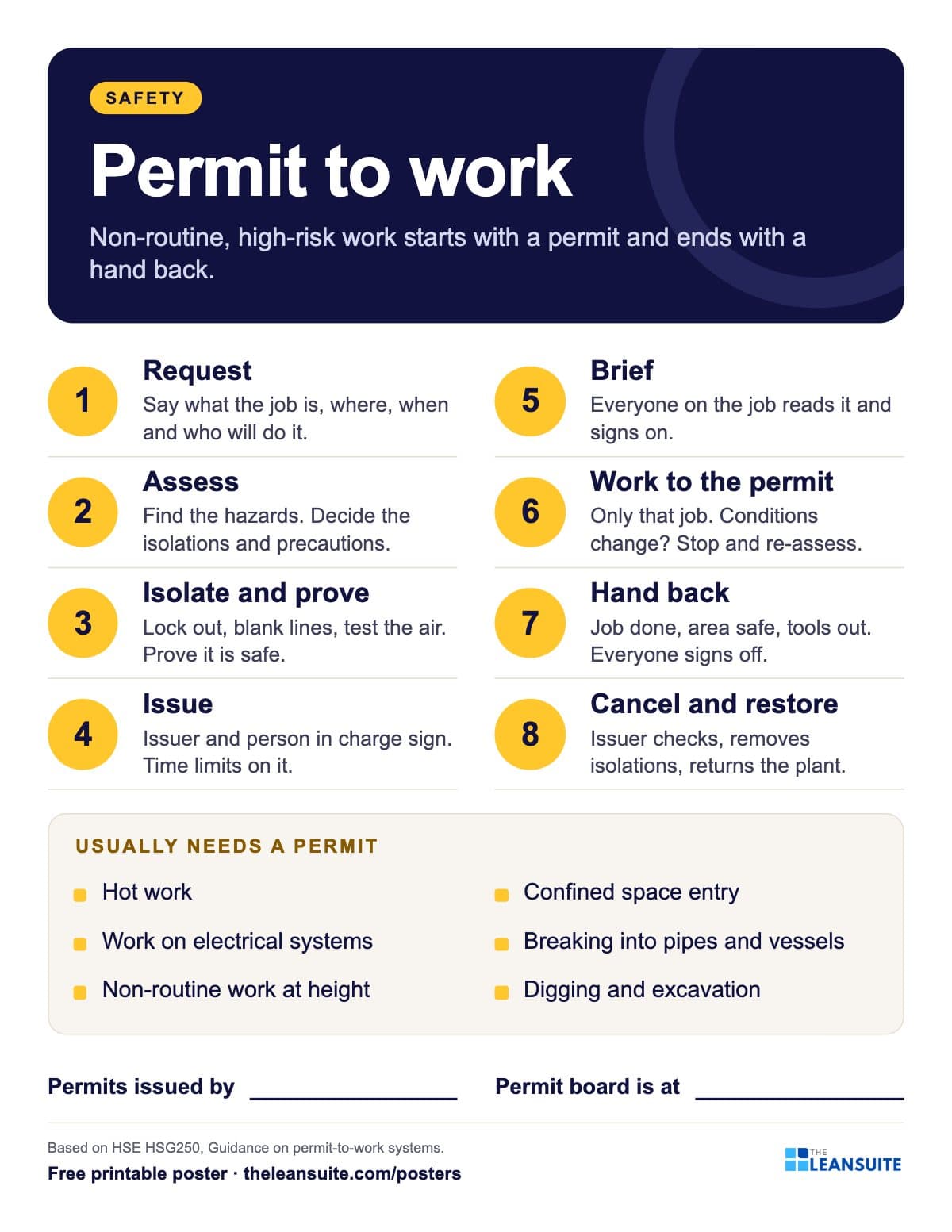 Permit to work poster
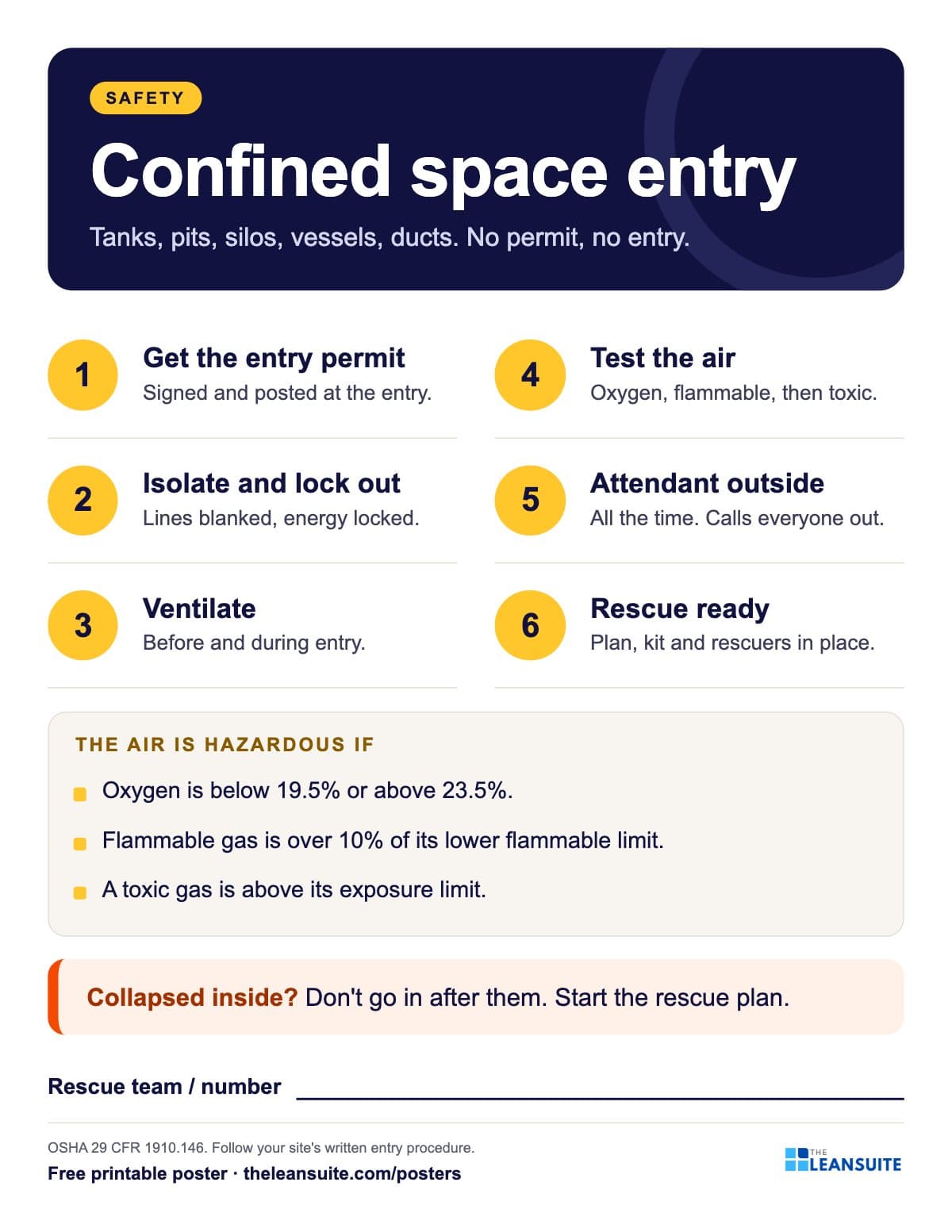 Confined space entry poster
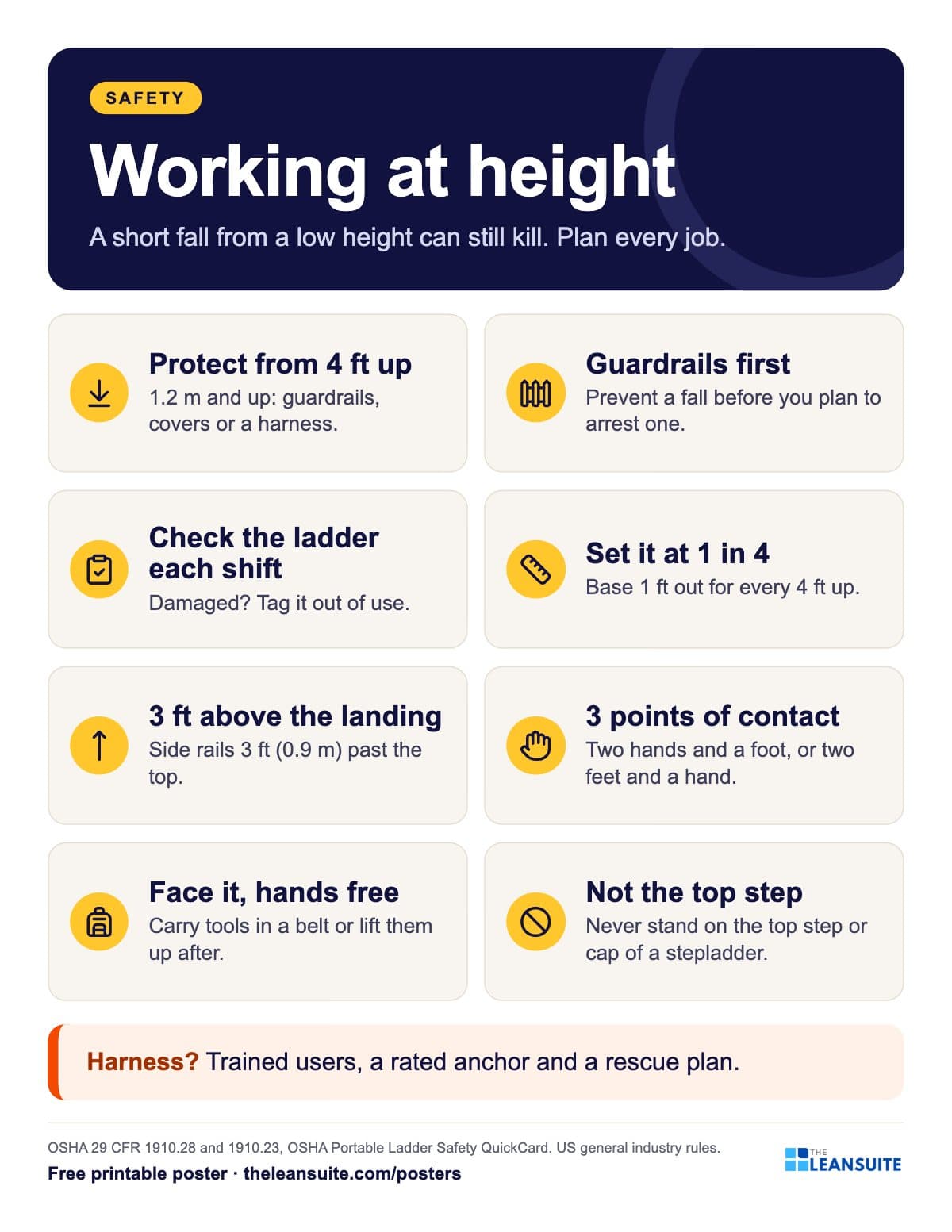 Working at height and ladder safety poster
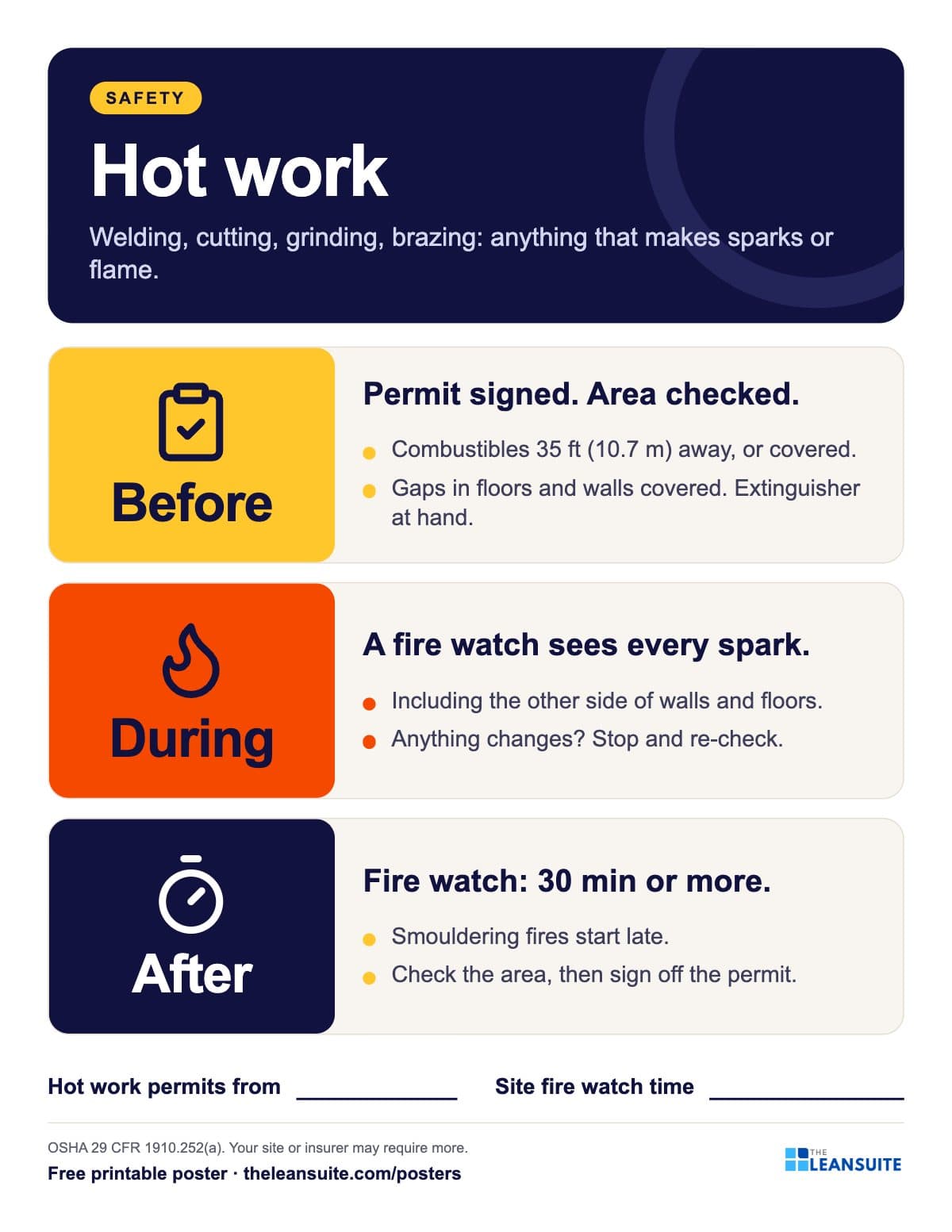 Hot work safety poster
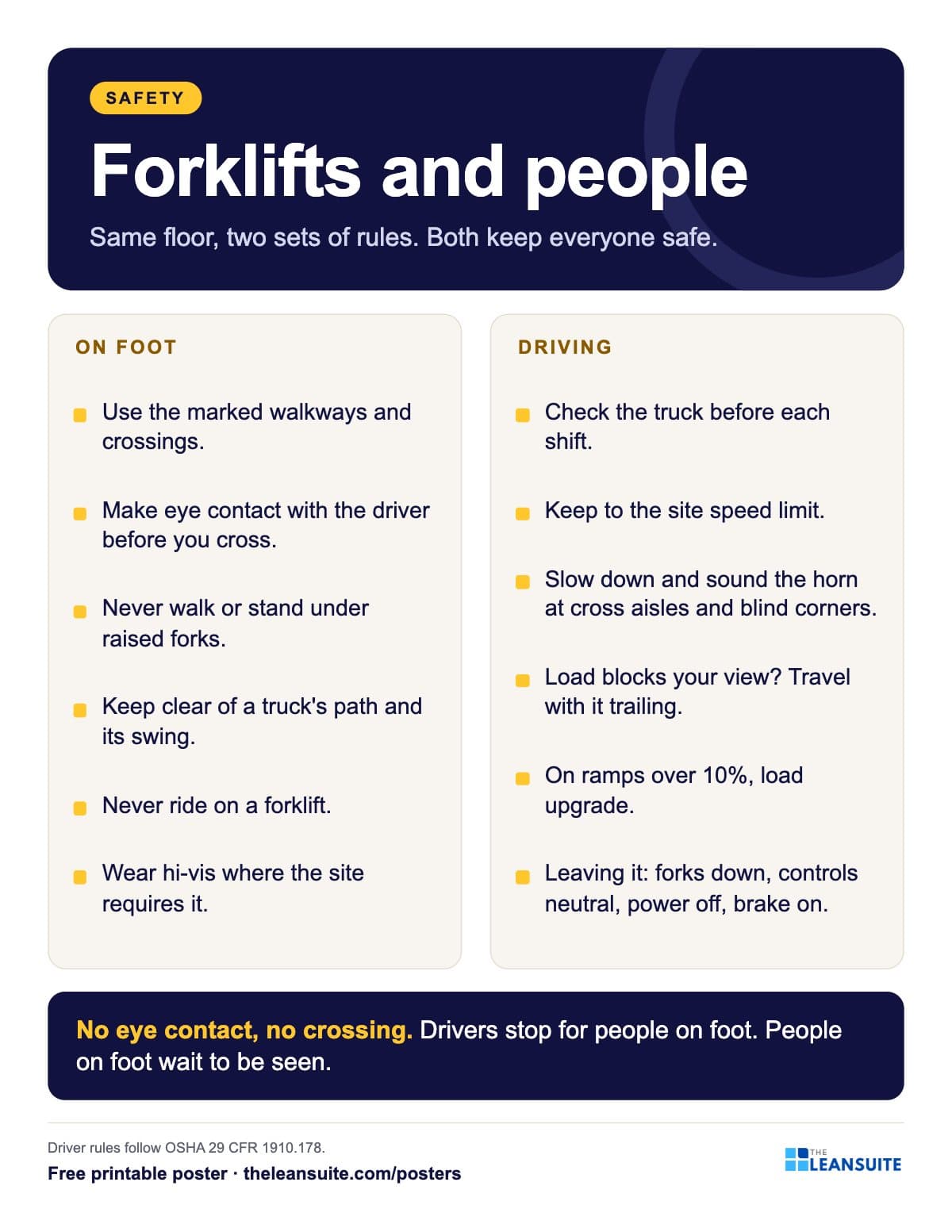 Forklift and pedestrian safety poster
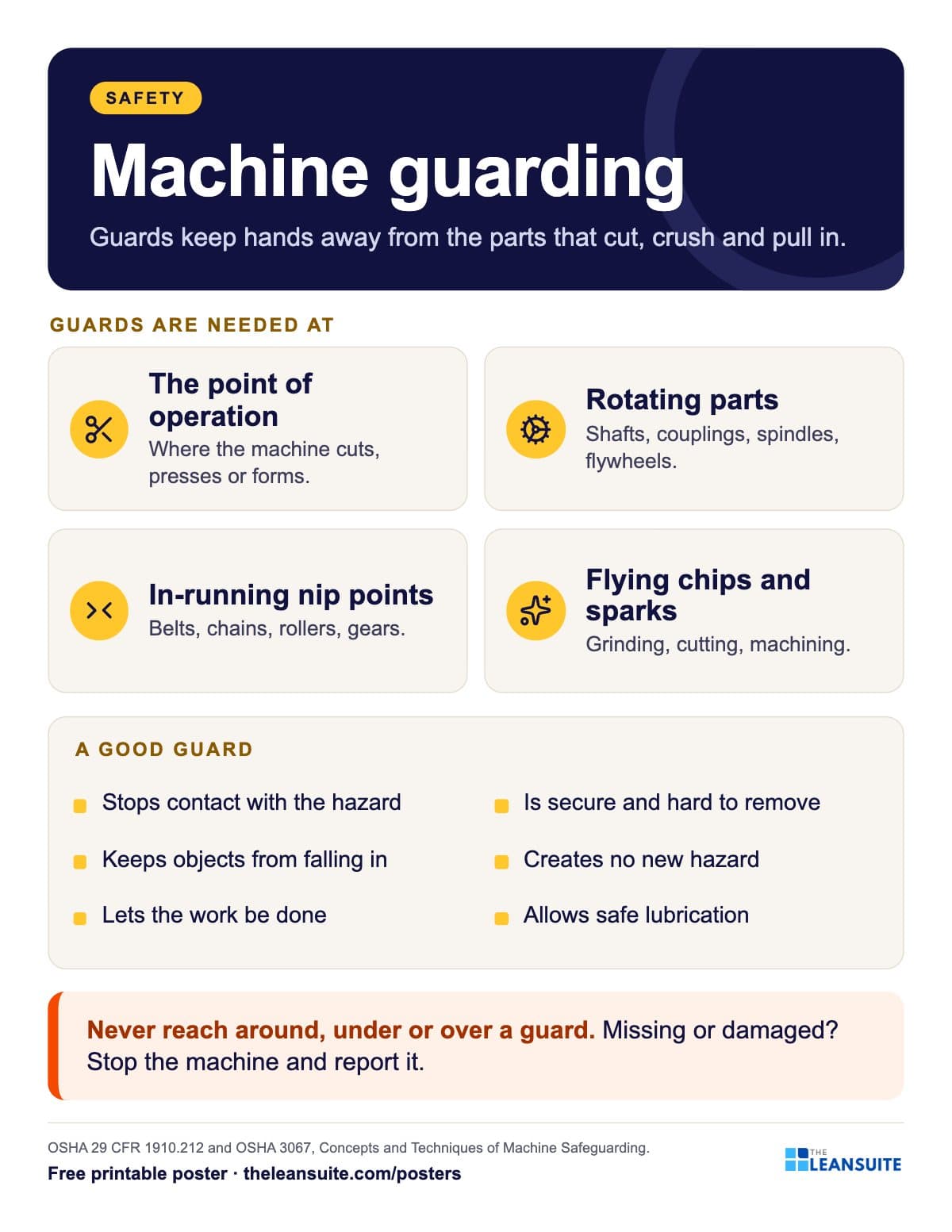 Machine guarding poster
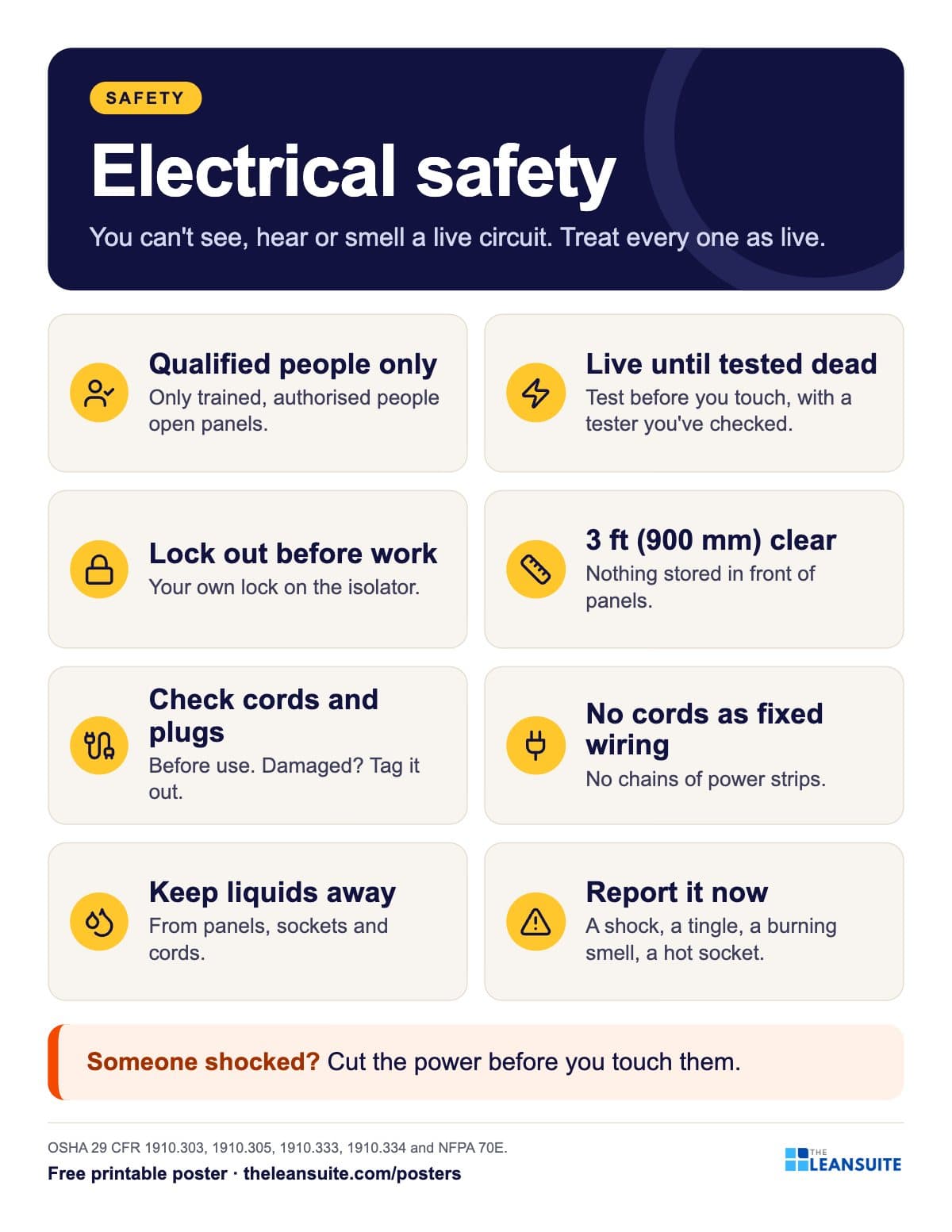 Electrical safety basics poster
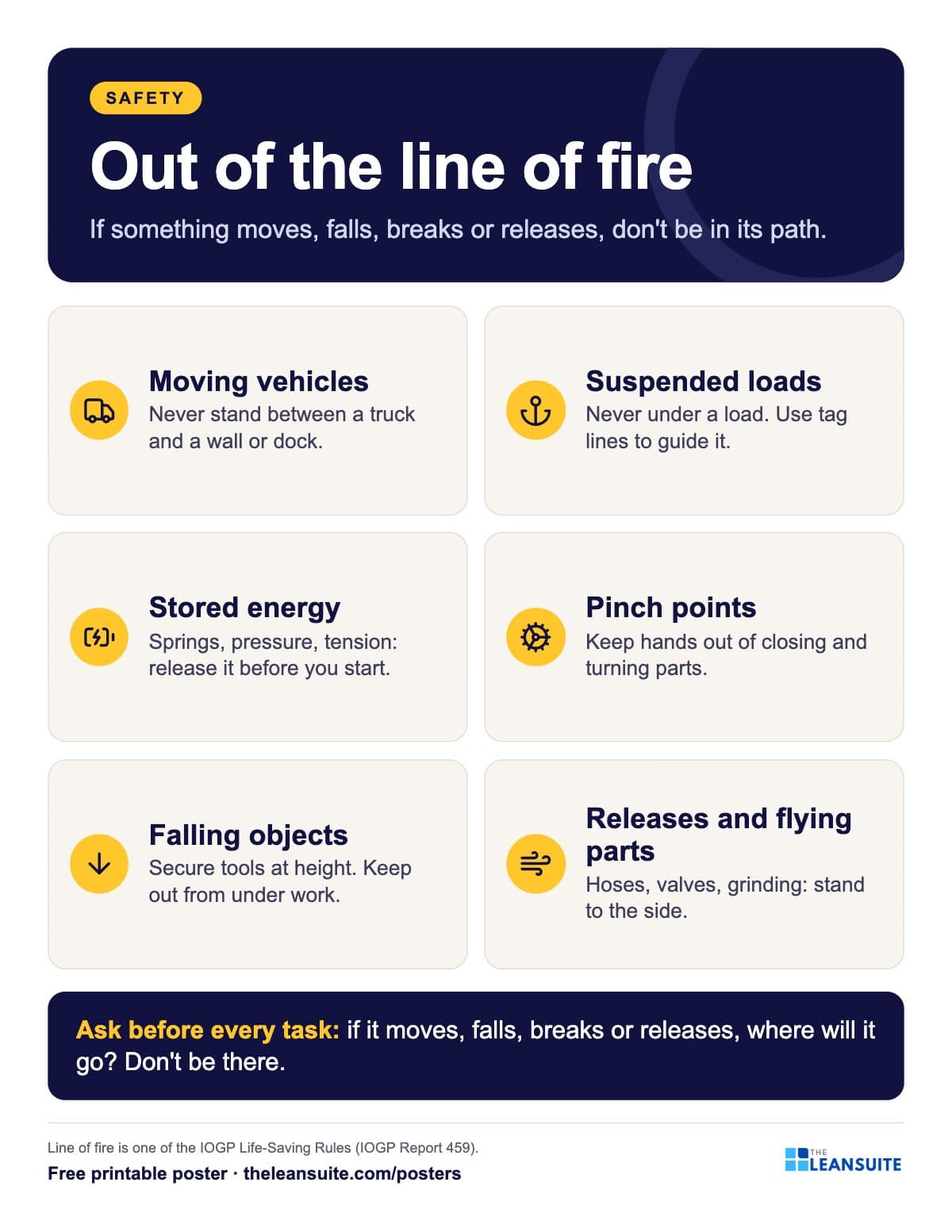 Line of fire poster
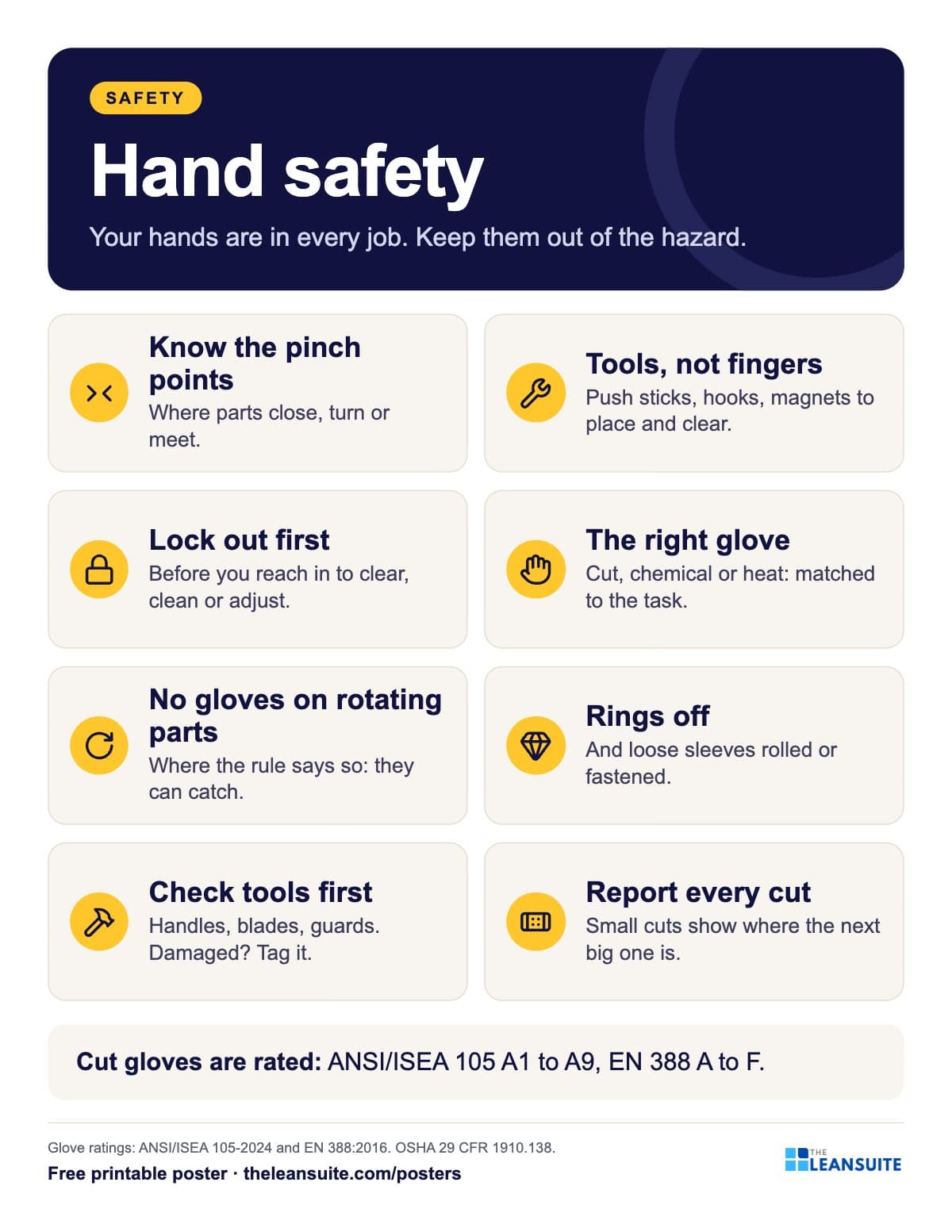 Hand safety poster
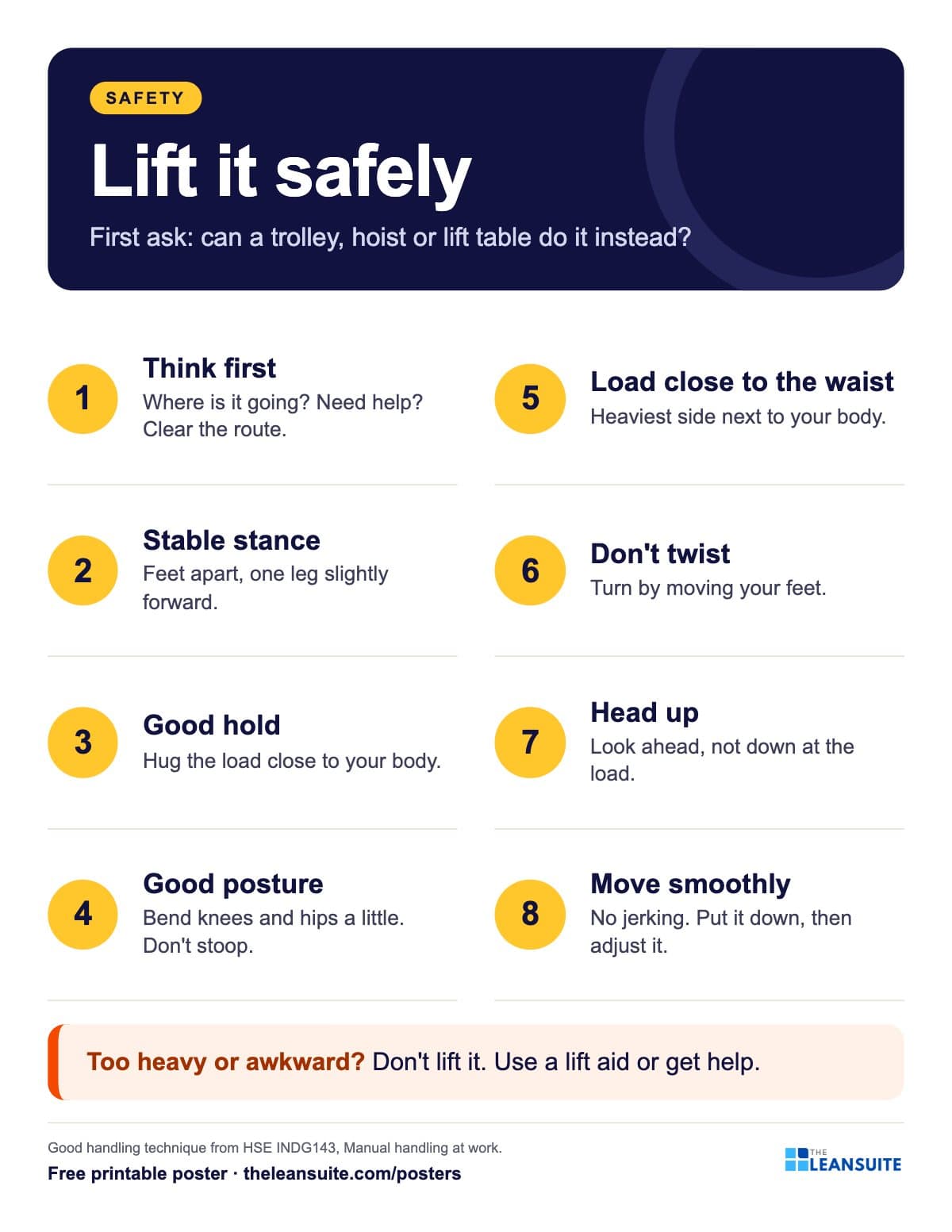 Safe lifting (manual handling) poster
 Workstation ergonomics poster
 Hearing protection poster
 Heat stress poster
 GHS hazard pictograms poster
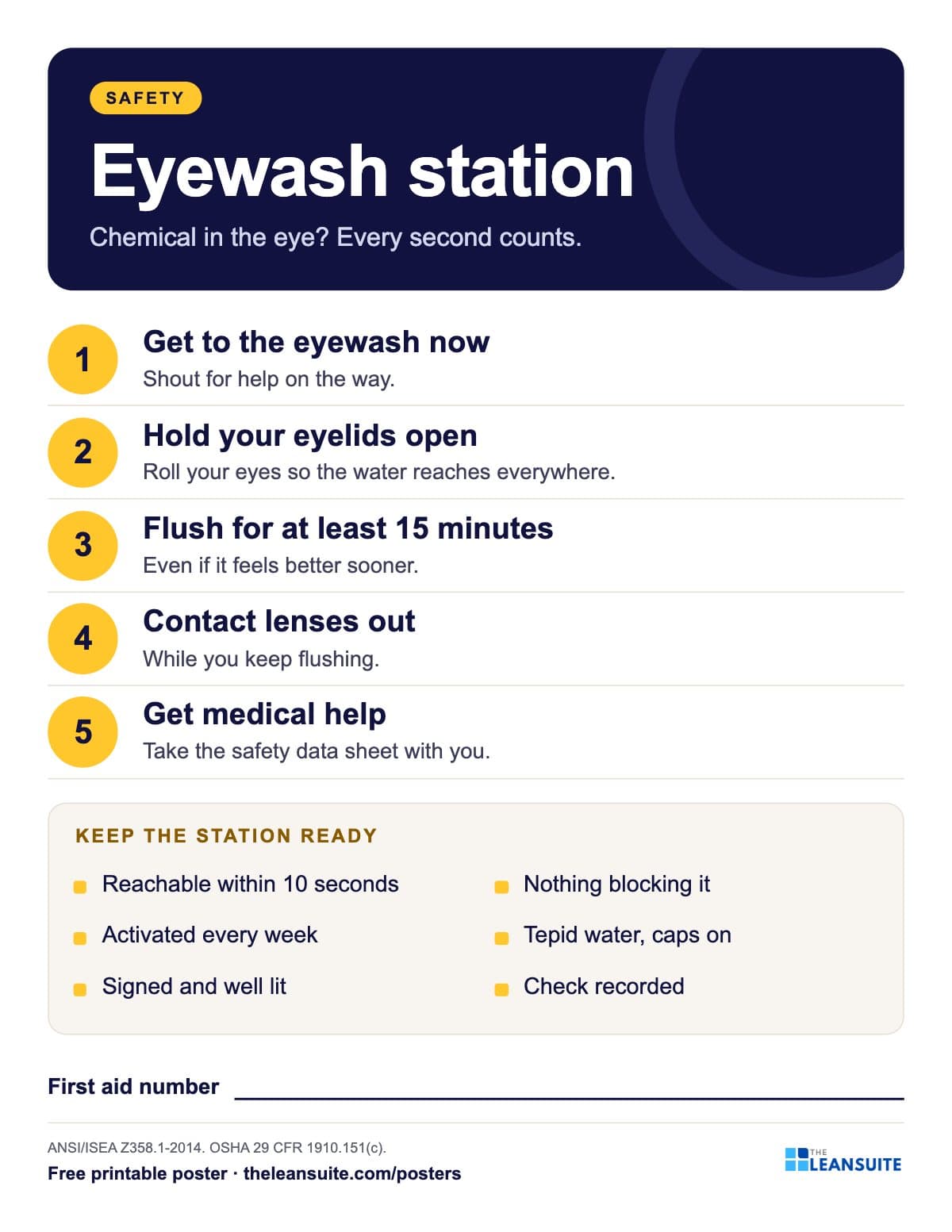 Eyewash station poster
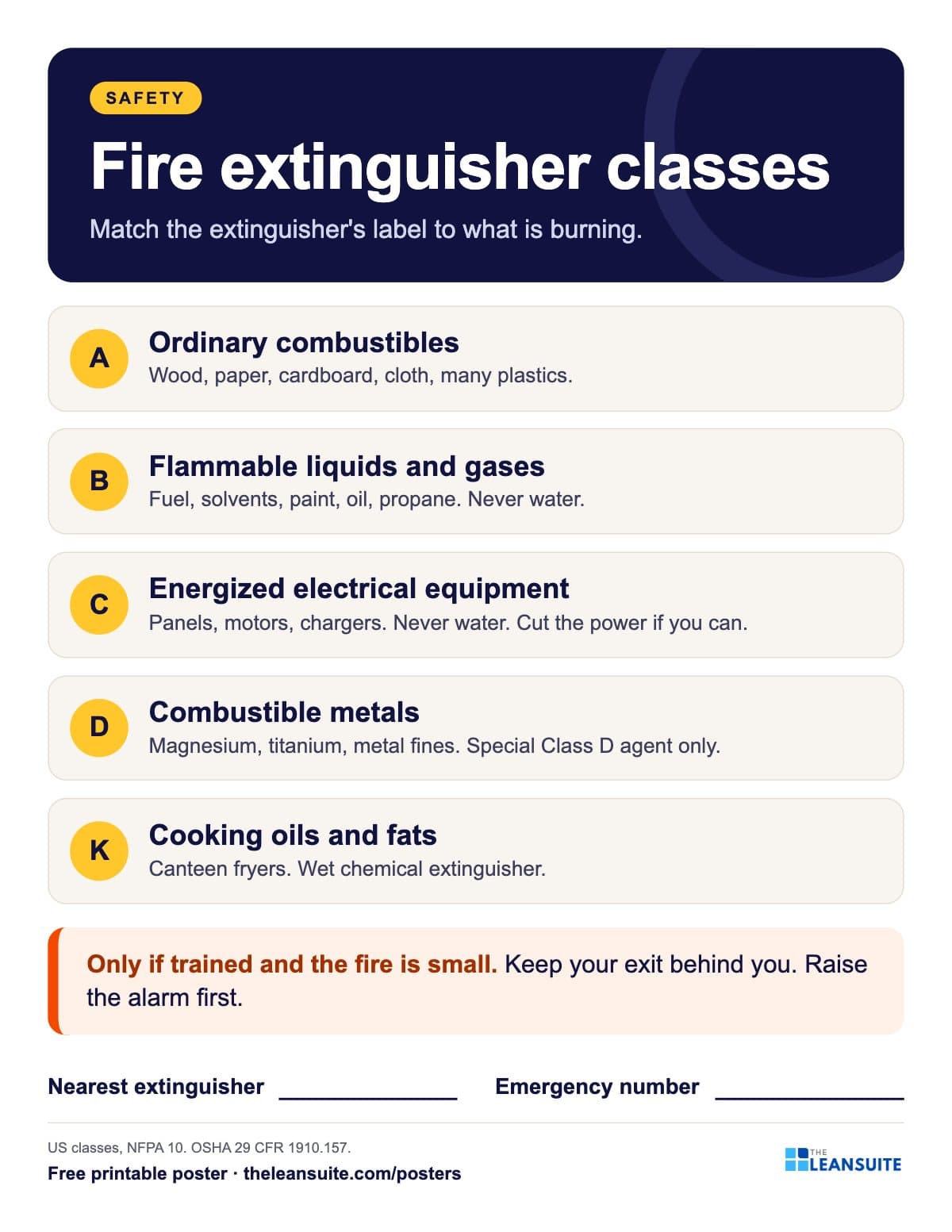 Fire extinguisher classes poster
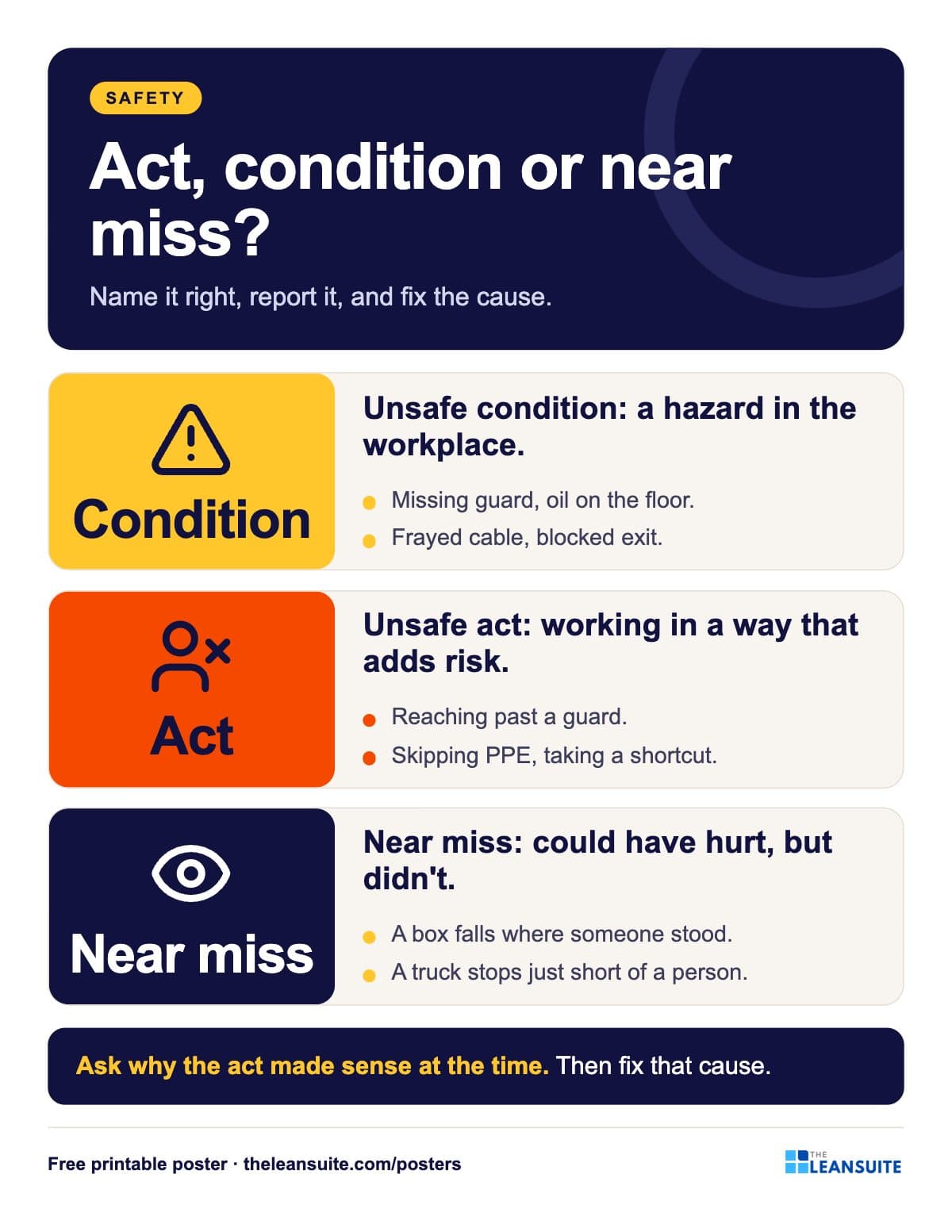 Unsafe acts and unsafe conditions poster
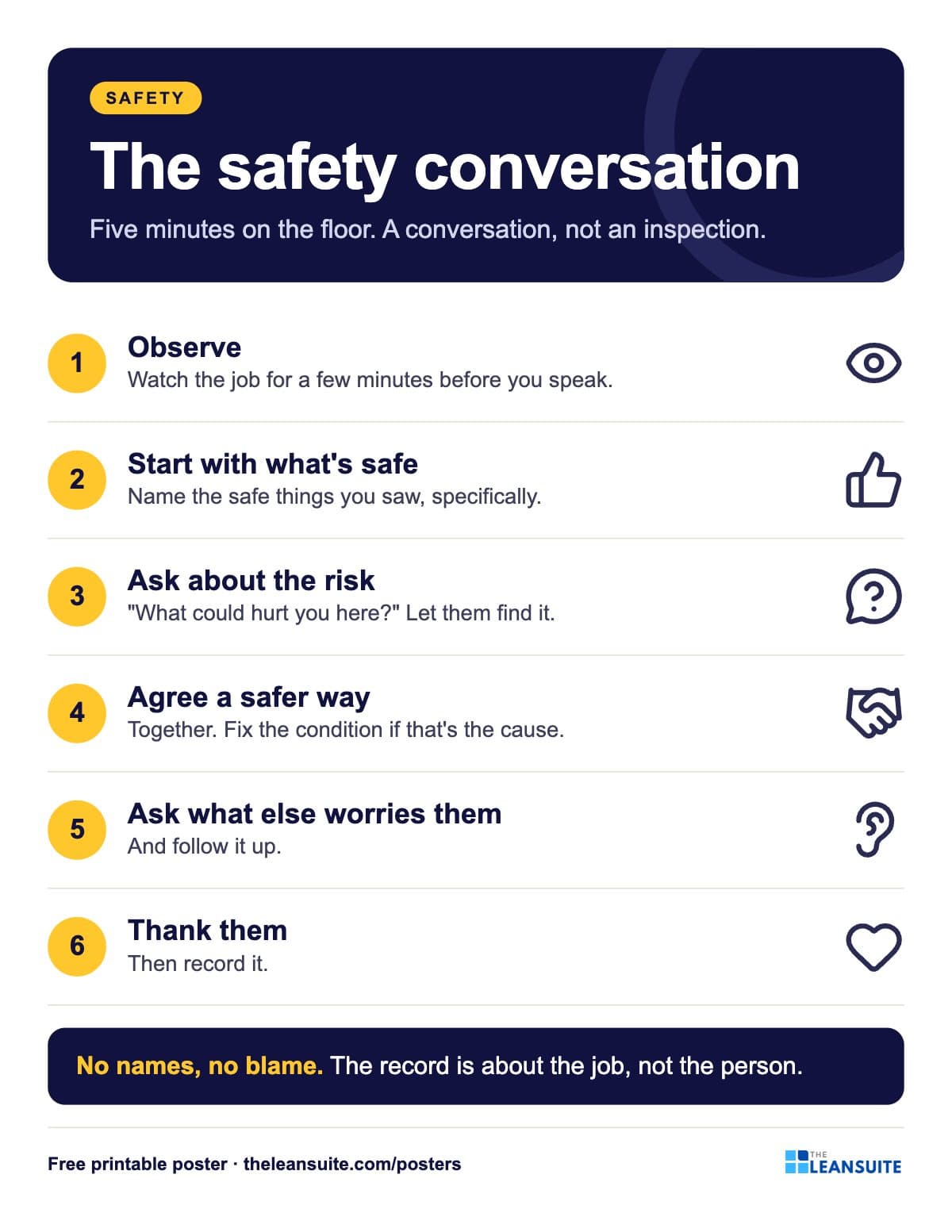 Safety observation conversation poster
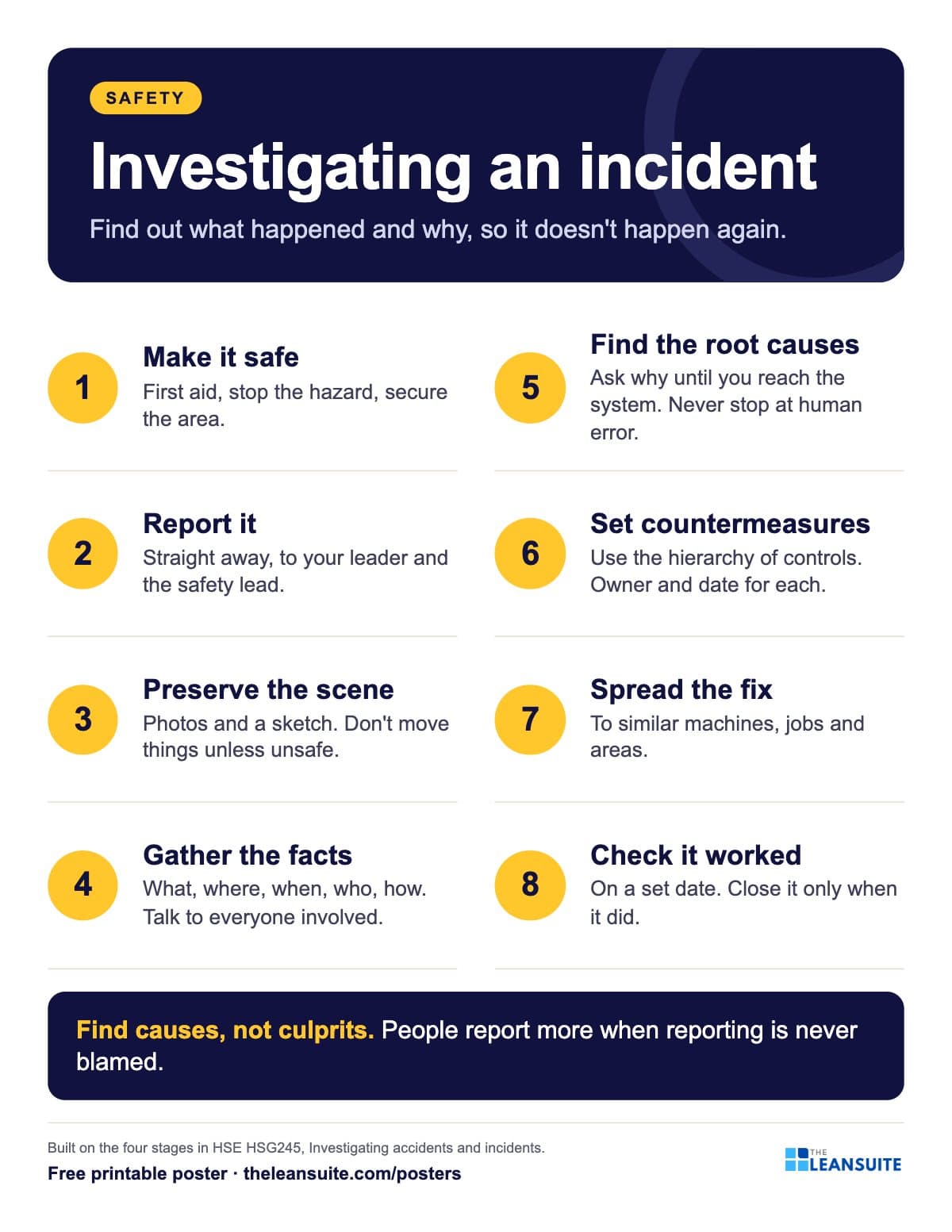 Incident investigation steps poster
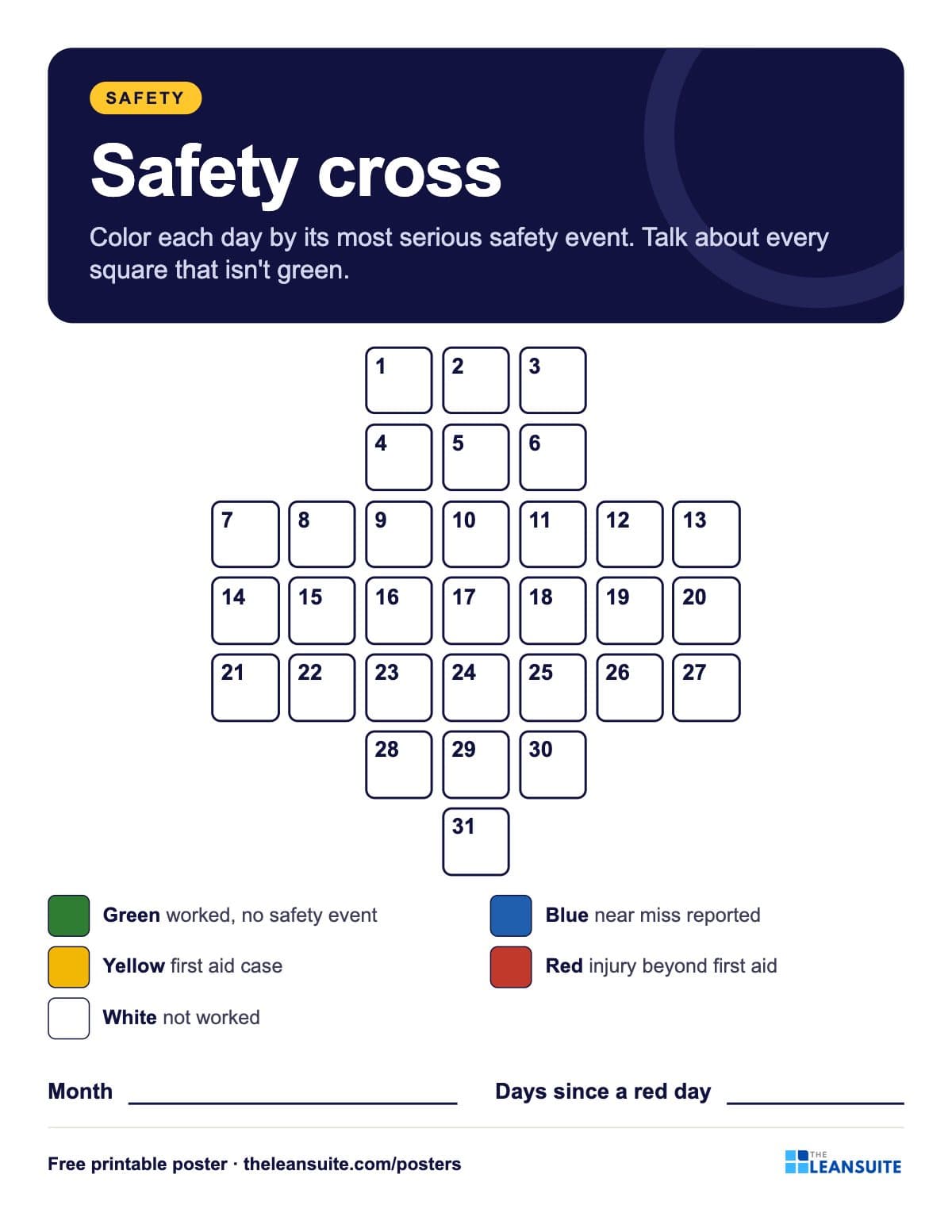 Safety cross calendar poster
A poster reminds. A routine makes it stick.
See how plants run their audits, improvements and follow-ups in LeanSuite, on a call built around your own problem.
Book a 45-minute demo