
Safety poster
Updated · Free to print and share
Safety pyramid poster (Bird's triangle)
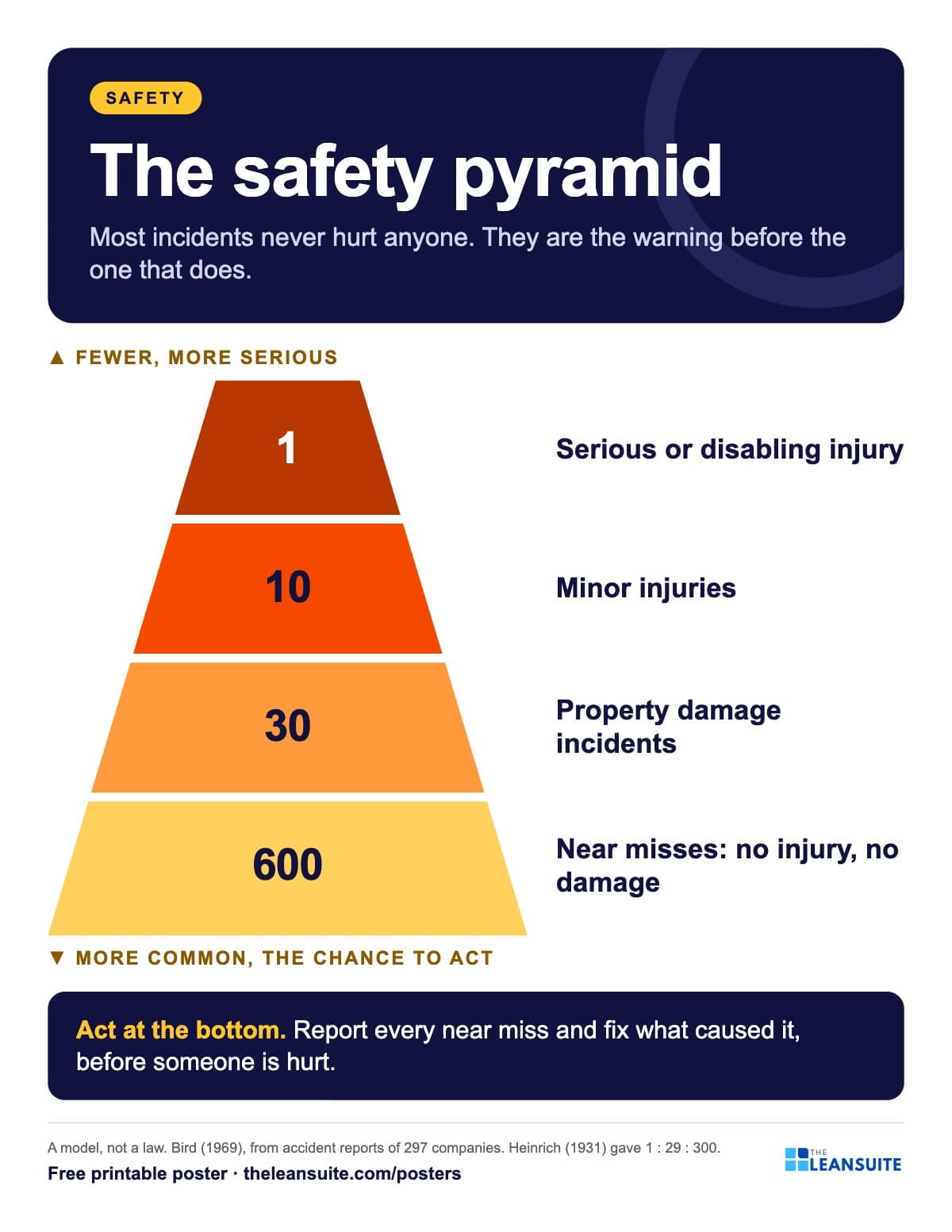
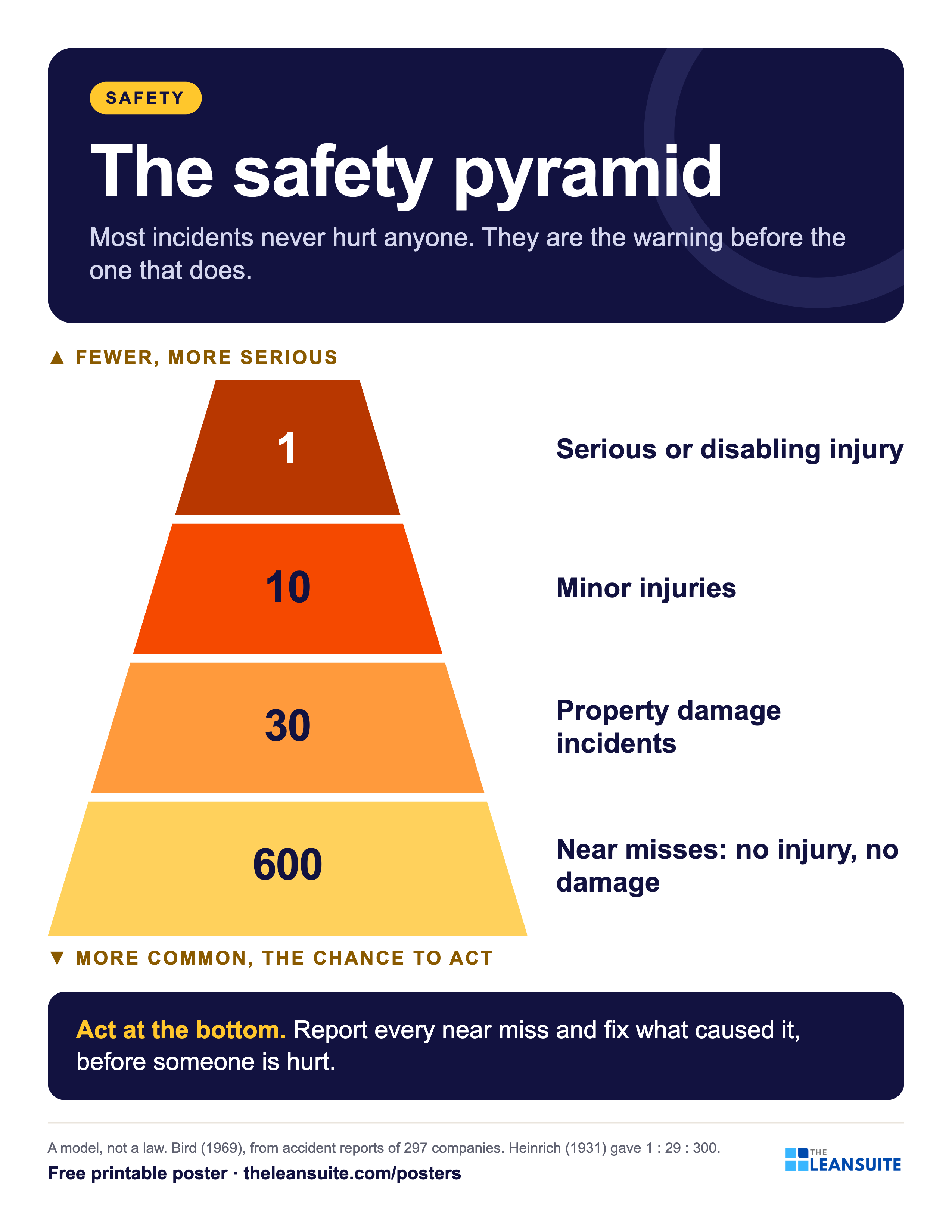
The safety pyramid, also called the accident triangle, is a model of how serious injuries relate to minor ones and to near misses. Frank Bird's 1969 version, from accident reports of 297 companies, puts it at 1 serious injury to 10 minor injuries, 30 property damage incidents and 600 near misses. This poster shows Bird's pyramid with its source and Heinrich's earlier 1 : 29 : 300, and uses it for one message: most incidents never hurt anyone, so reporting and fixing them is the chance to act early.
Download the poster
The PNG is free to download now. The print-ready vector PDFs open after a short form, once.
Free to print and share with your team. Enter your name and work email once to download.
The words on the poster
The safety pyramid
Most incidents never hurt anyone. They are the warning before the one that does.
Fewer, more serious to more common, the chance to act
- 1 Serious or disabling injury
- 10 Minor injuries
- 30 Property damage incidents
- 600 Near misses: no injury, no damage
- Act at the bottom. Report every near miss and fix what caused it, before someone is hurt.
A model, not a law. Bird (1969), from accident reports of 297 companies. Heinrich (1931) gave 1 : 29 : 300.
On the floor
How to use it
- 1
Use it to explain why near miss reporting matters, then show where to report.
- 2
Hang it by the safety board, next to your own near miss count for the month.
- 3
Say what it is: a model from old insurance data, not a law that predicts your plant's numbers.
- 4
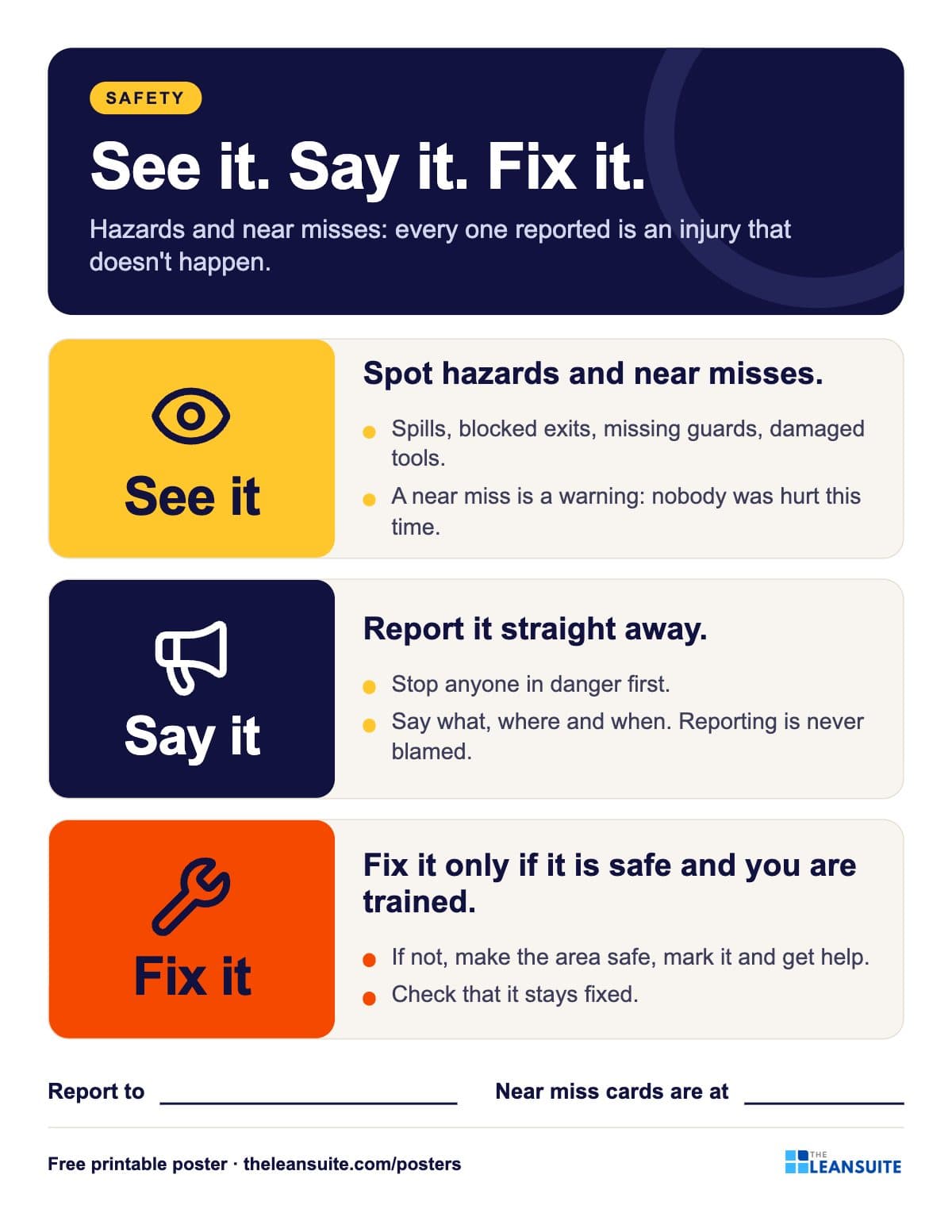
Pair it with the see it, say it, fix it poster.
Which size to print
- 24 x 36 in or A2: a main wall or team board, read from a few metres away.
- 18 x 24 in or A3: a station or notice board. The A3 file also fits 11 x 17 in paper.
- Letter or A4: a clipboard, binder or handout, on any office printer.
Every PDF is vector, so it stays sharp at full size. Nothing runs to the edge of the page, so no bleed is needed.
Sources and notes
The pyramid is useful for one point: near misses and minor incidents are far more common than serious injuries, so they are the chance to learn early. It is also widely criticised. The ratios come from old insurance claim data and are not stable from one workplace to another, and research on serious injuries and fatalities (SIF) shows that many of them have different causes from minor injuries. Cutting minor injuries does not on its own cut fatalities, so a plant should also look for the precursors of serious injuries, such as work at height, stored energy and mobile equipment, whatever its minor injury rate. That is why the poster calls it a model and gives its source.
- Frank E. Bird Jr. (1969), analysis of 1,753,498 accidents reported by 297 companies: 1 serious or disabling injury, 10 minor injuries, 30 property damage accidents, 600 incidents with no visible injury or damage.
- H. W. Heinrich (1931), Industrial Accident Prevention: 1 major injury, 29 minor injuries, 300 no-injury accidents.
- Fred A. Manuele (2011), Reviewing Heinrich: Dislodging Two Myths From the Practice of Safety, Professional Safety, October 2011.
Templates, decks and guides to go with it
- Near miss report formA two-page near miss report from the first report to closure, and an Excel log with status and days open.
- Incident investigation report templateWhat happened, people, evidence and timeline, root cause with 5 Whys and contributing factors, actions and sign-off.
- Safety observation card templateFour behavior-based safety cards per sheet, with safe and at-risk checks, the conversation and a tally sheet.
- Topic: Safety managementEvery guide we have on the subject, sorted.
A poster reminds. A routine makes it stick.
See how plants run their audits, improvements and follow-ups in LeanSuite, on a call built around your own problem.
Schedule Demo