
Free training deck
Updated · About 30 minutes
Kanban training presentation
Kanban is a signal system for pull production: an empty container or a returned card tells the upstream process what to make or move next, and nothing is made without that signal. This free deck teaches it in about 30 minutes. Its 16 editable slides cover push versus pull, how a kanban loop works, the main card types, the rules that make it work, how to work out the number of cards with a worked example, where kanban fits and where it does not, the common mistakes, a two-bin activity and four check questions with answers. Every slide has speaker notes.
Free to use: print it, copy it and edit it for your team. Enter your name and work email once to download.
 The title Kanban, make only what is used, on a navy background with the LeanSuite logo.
A look inside
What is in the 16 slides
For operators, material handlers, planners, team leaders and supervisors. Widescreen, in plain language, with speaker notes on every slide.
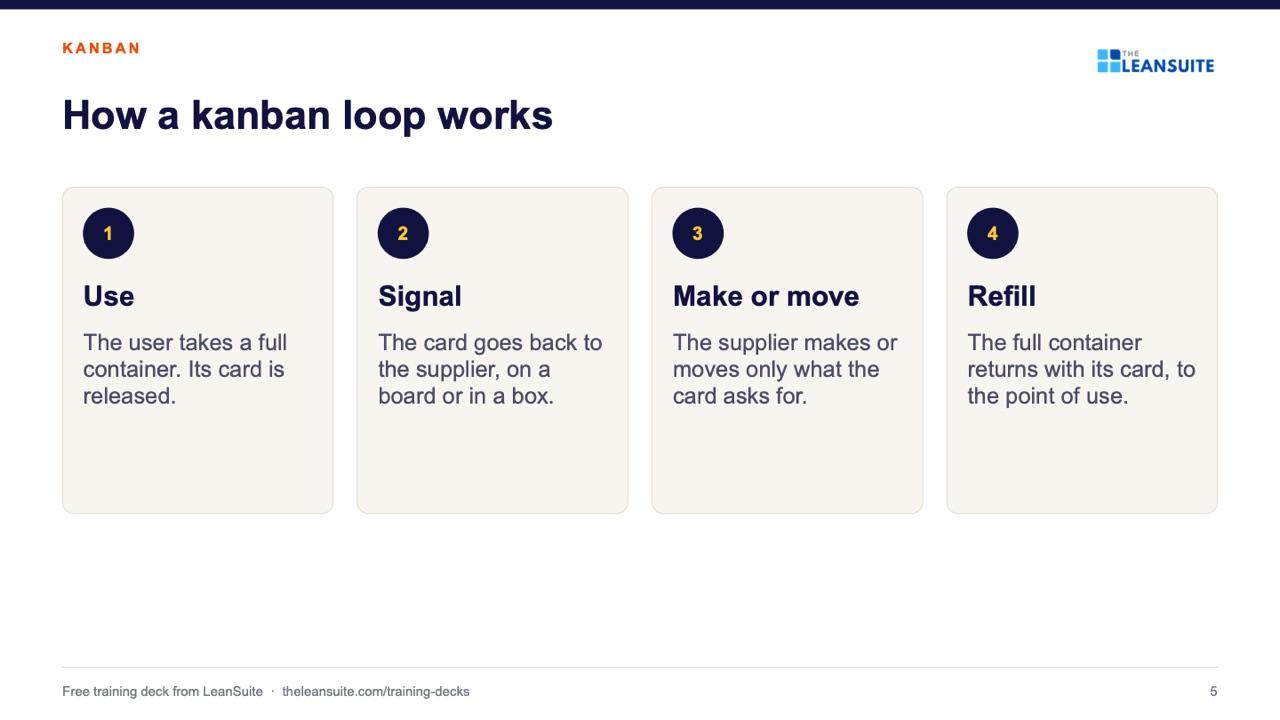
Slide 5: How a kanban loop works 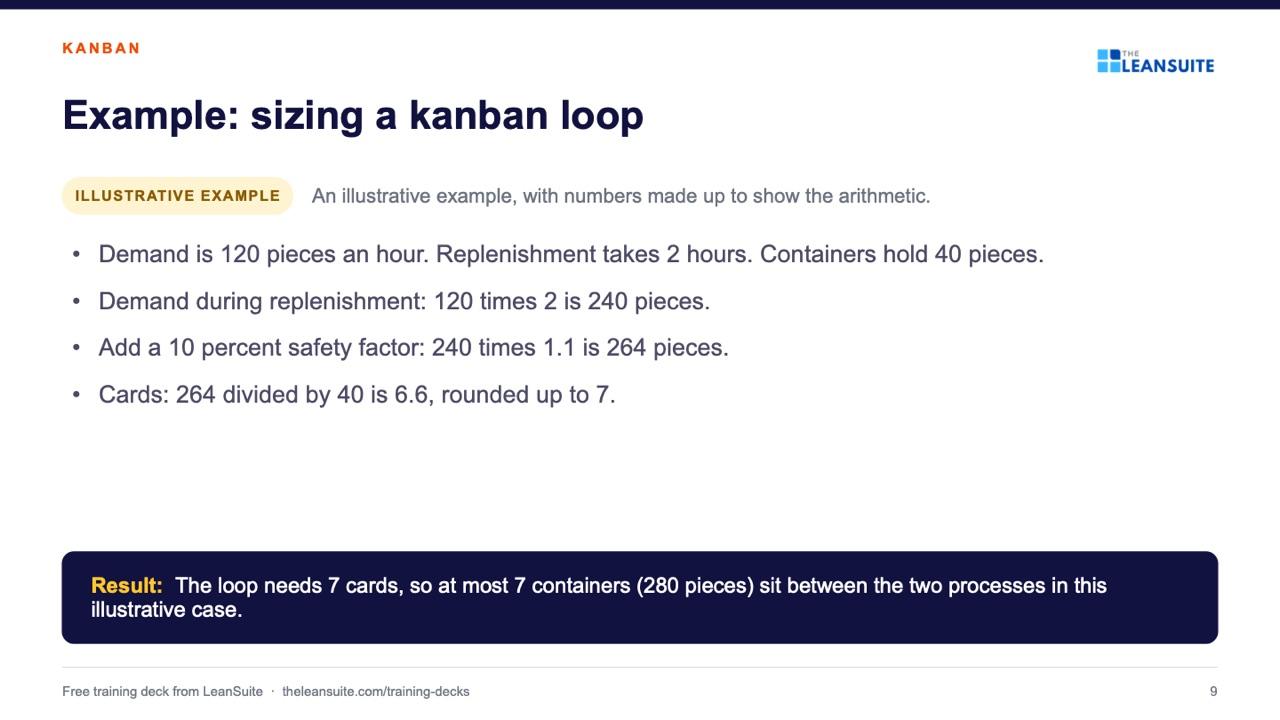
Slide 9: Example: sizing a kanban loop 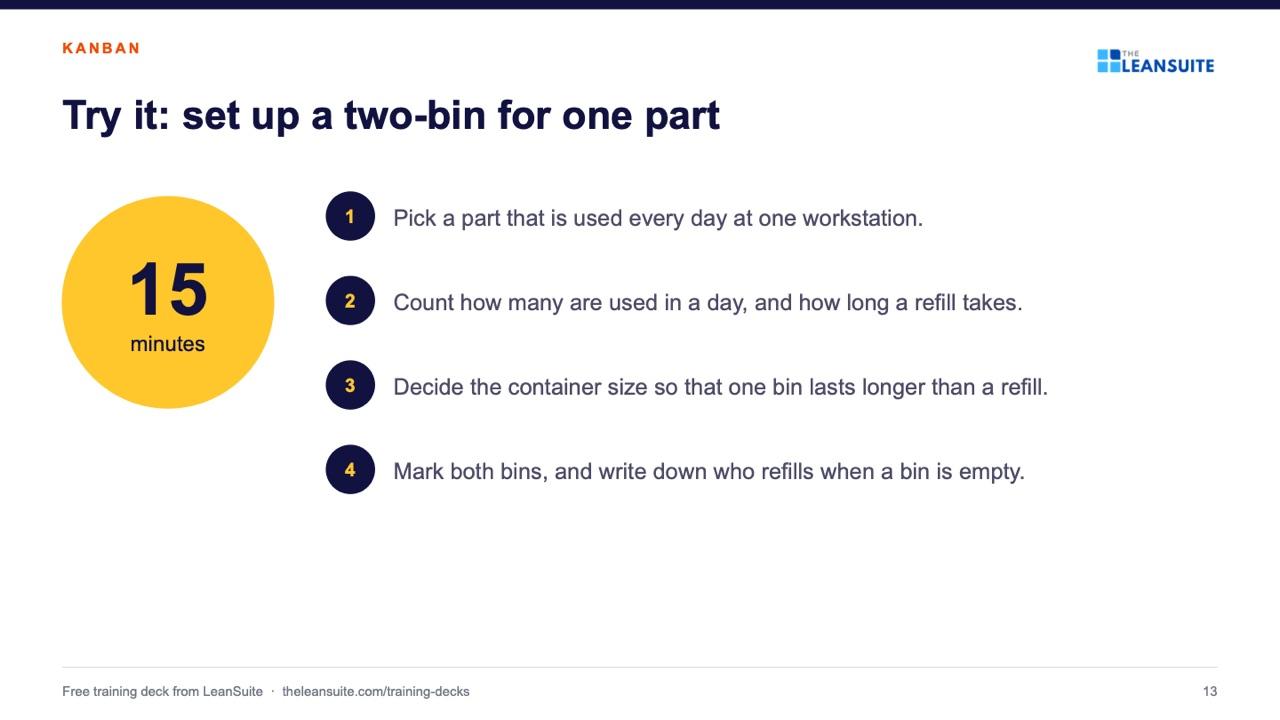
Slide 13: Try it: set up a two-bin for one part
- 1Kanban: make only what is usedCover
- 2AgendaWhat kanban is · How a loop works and the card types · The rules and card sizing · Example, mistakes, activity and check questions
- 3What kanban isKanban is a signal that tells the upstream process what to make or move, and when.
- 4Push and pullPush and pull
- 5How a kanban loop worksUse, Signal, Make or move, Refill
- 6Types of kanbanWithdrawal, Production, Signal, Two-bin
- 7Rules that make it workThe next step takes only what it needs, when it needs it.
- 8How many cards?A simple sizing rule for a loop between two processes.
- 9Example: sizing a kanban loopAn illustrative example, with numbers made up to show the arithmetic.
- 10Where kanban fitsGood fit: parts used every day in steady amounts, with a repeating pattern.
- 11Reading the boardCards or empty slots sit on a board in order of arrival.
- 12Common mistakesToo many cards at the start, so the loop never shows its problems.
- 13Try it: set up a two-bin for one partA 15-minute team activity
- 14Check your understanding4 check questions
- 15AnswersThe answers, to discuss
- 16Key points and next stepsNext: start with one two-bin at one workstation.
The 30-minute session, slide by slide
- Slides, about: 15 minutes
- Activity (slide 13): 15 minutes
Present · 12 slides
- 1Kanban: make only what is used
- 2Agenda
- 3What kanban is
- 4Push and pull
- 5How a kanban loop works
- 6Types of kanban
- 7Rules that make it work
- 8How many cards?
- 9Example: sizing a kanban loop
- 10Where kanban fits
- 11Reading the board
- 12Common mistakes
Do the activity · 1 slide
- 13Try it: set up a two-bin for one part
Check and follow up · 3 slides
- 14Check your understanding
- 15Answers
- 16Key points and next steps
About 15 minutes of slides and 15 minutes of activity. Present: slides 1 to 12 (Kanban: make only what is used; Agenda; What kanban is; Push and pull; How a kanban loop works; Types of kanban; Rules that make it work; How many cards?; Example: sizing a kanban loop; Where kanban fits; Reading the board; Common mistakes). Do the activity: slide 13 (Try it: set up a two-bin for one part). Check and follow up: slides 14 to 16 (Check your understanding; Answers; Key points and next steps).
How to run it
Running the session
- 1
Prepare
Read the speaker notes once and swap the illustrative example for one from your own area if you have it. Print the PDF if people like a handout.
- 2
Present
The slides take about 15 minutes. Every slide has notes, so you can talk from them rather than read the slide.
- 3
Do the activity
Pick a part that is used every day at one workstation. The activity slide takes the team through it step by step; allow 15 minutes.
- 4
Check and follow up
Ask the check questions before showing the answers, then agree one next step with an owner and a date before people leave.
The check questions
- 1. What starts production in a kanban system?
- A signal from use: an empty container or a returned card. Nothing is made without it.
- 2. What is the difference between push and pull?
- Push makes to a forecast or schedule. Pull makes only what the next step has used.
- 3. How do you work out the number of cards?
- Demand per hour times replenishment time times one plus a safety factor, divided by the container quantity, rounded up.
- 4. Which parts are a poor fit for kanban?
- Rarely used parts, custom parts and parts with very uneven demand.
Templates and guides to go with it
- Kanban card templateSix production and six withdrawal kanban cards to print and cut out, with loop sizing and a card register.
- Kanban sizing calculatorHow many kanban cards each loop needs, per part, with the change from today's cards and what the loop holds in days.
- Topic: Value stream mapping and flowEvery guide we have on the subject, sorted.
- Topic: Lean manufacturing fundamentalsEvery guide we have on the subject, sorted.
Read more
Terms in this deck
FAQ
Kanban training presentation: common questions
It is Japanese for a signal card or sign. In manufacturing it is a signal that tells an upstream process what to make or move, and when.
About 30 minutes: roughly 15 minutes of slides, a 15-minute two-bin activity and the check questions.
No. It is about kanban for manufacturing and materials: cards, bins and replenishment signals between processes. The idea of limiting work in progress is shared, but the examples are from the plant.
Yes. The PowerPoint file is fully editable, including the speaker notes. Many teams replace the illustrative example with a part from their own plant.
More free training decks
- 5S training presentationSort, set in order, shine, standardize and sustain in 16 slides, with a 15-minute sort activity and a quiz.View deck
- Kaizen training presentationWhat kaizen is, its principles, PDCA and four steps to a first improvement in 17 slides, with an activity and a quiz.View deck
- Autonomous maintenance training presentation: the 7 stepsThe 7 steps of jishu hozen, who does what and how step audits work, in 19 slides with notes and a quiz.View deck
- 8 wastes of lean training presentationValue vs waste, the 8 wastes (TIMWOODS) with examples, muda, mura and muri and a waste walk, in 17 slides.View deck
- Gemba walk training presentationGo see, ask why, show respect: how to plan, run and follow up a gemba walk, in 16 slides with a practice walk.View deck
- Root cause analysis training presentation: 5 whys and fishboneDefine, contain, the 5 whys, the fishbone diagram and verifying the cause, in 18 slides with a team activity.View deck
- TPM training presentation: the 8 pillarsWhat TPM is, the six big losses, OEE and the 8 pillars, in 19 slides with a loss-spotting activity.View deck
- Manufacturing excellence pillars training presentationThe 20 pillars, cost deployment, the 7-step approach, model areas and audits, in 17 slides.View deck
- Obeya room training presentationWhat an obeya is, what goes on its walls and how to run the meetings, in 15 slides with a design activity.View deck
- DMAIC training presentationDefine, measure, analyze, improve and control, with the main tools of each phase, in 16 slides.View deck
- SMED training presentationInternal and external setup, the four SMED stages and how to halve a changeover, in 16 slides.View deck
- FMEA training presentationDFMEA and PFMEA, severity, occurrence and detection, RPN and action priority, in 16 slides.View deck
- Lockout tagout (LOTO) training presentationHazardous energy, lockout versus tagout and the six steps in order, with a walk-round activity, in 17 slides.View deck
Training is the start. Keeping it going is the hard part.
See how plants run their audits, improvements and follow-ups in LeanSuite, on a call built around your own problem.
Book a 45-minute demo