

Free training deck
Updated · About 35 minutes
Lockout tagout (LOTO) training presentation
Lockout tagout (LOTO) is the set of steps that isolate a machine from its energy and lock it off before anyone services it, so it cannot start up or release stored energy while a person is working on it. This free deck introduces it in about 35 minutes. Its 17 editable slides cover the types of hazardous energy, lockout versus tagout, authorized and affected employees, the six steps in the order OSHA 29 CFR 1910.147 sets out, stored energy, group lockout and shift changes, restoring power, what the program must include, an illustrative example, the common mistakes, a walk-round activity and four check questions with answers. Every slide has speaker notes.
Free to use: print it, copy it and edit it for your team. Enter your name and work email once to download.
 The title Lockout tagout, control hazardous energy, on a navy background with the LeanSuite logo.
A look inside
What is in the 17 slides
For maintenance technicians, operators, setup staff, supervisors and safety leads. Widescreen, in plain language, with speaker notes on every slide.
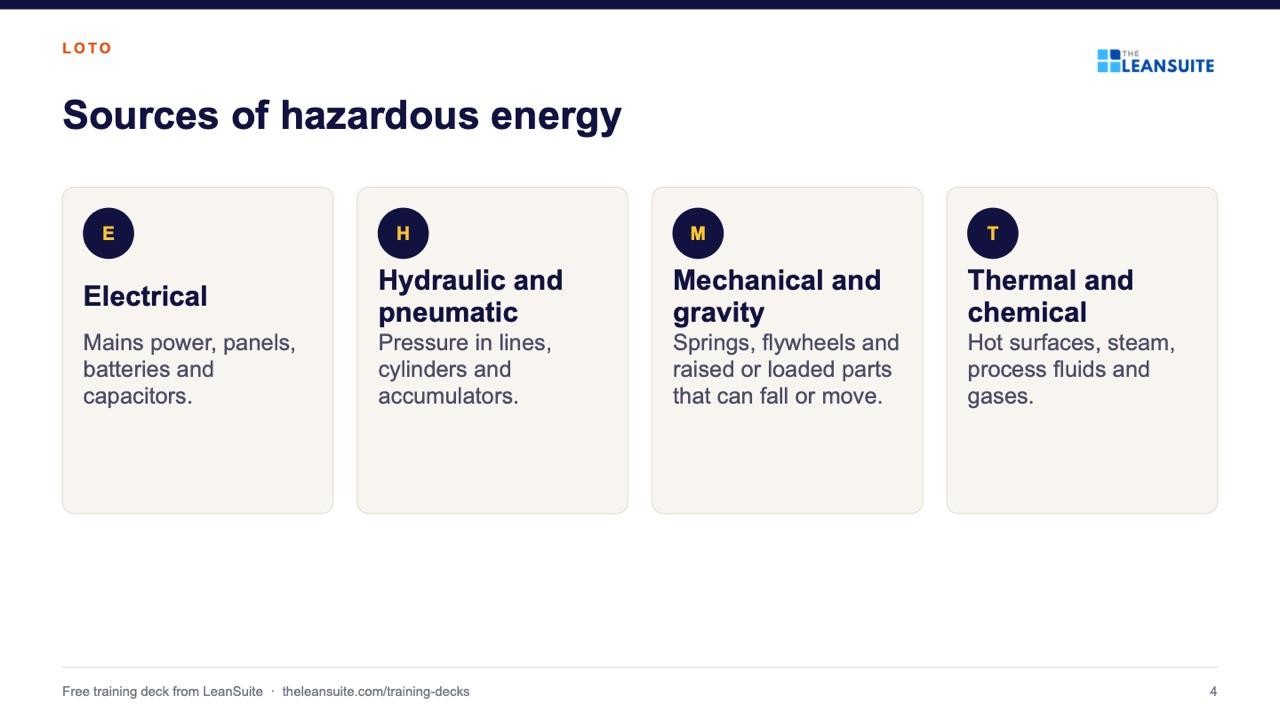
Slide 4: Sources of hazardous energy 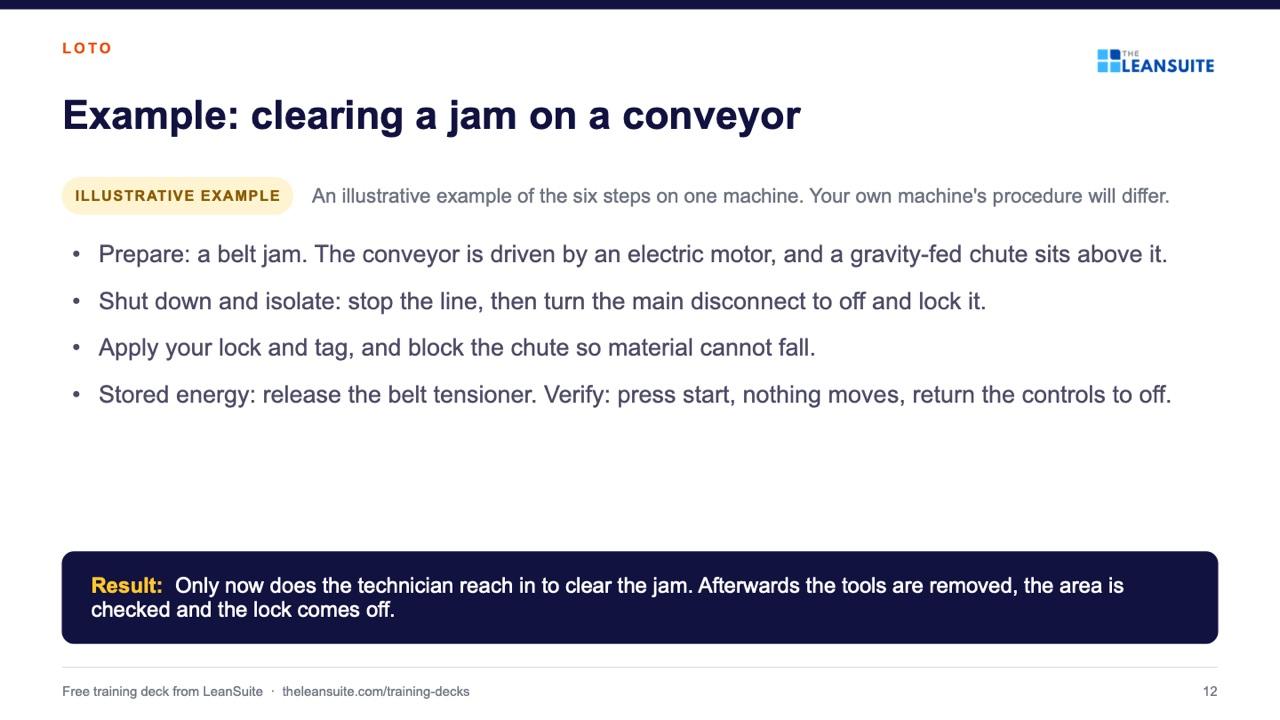
Slide 12: Example: clearing a jam on a conveyor 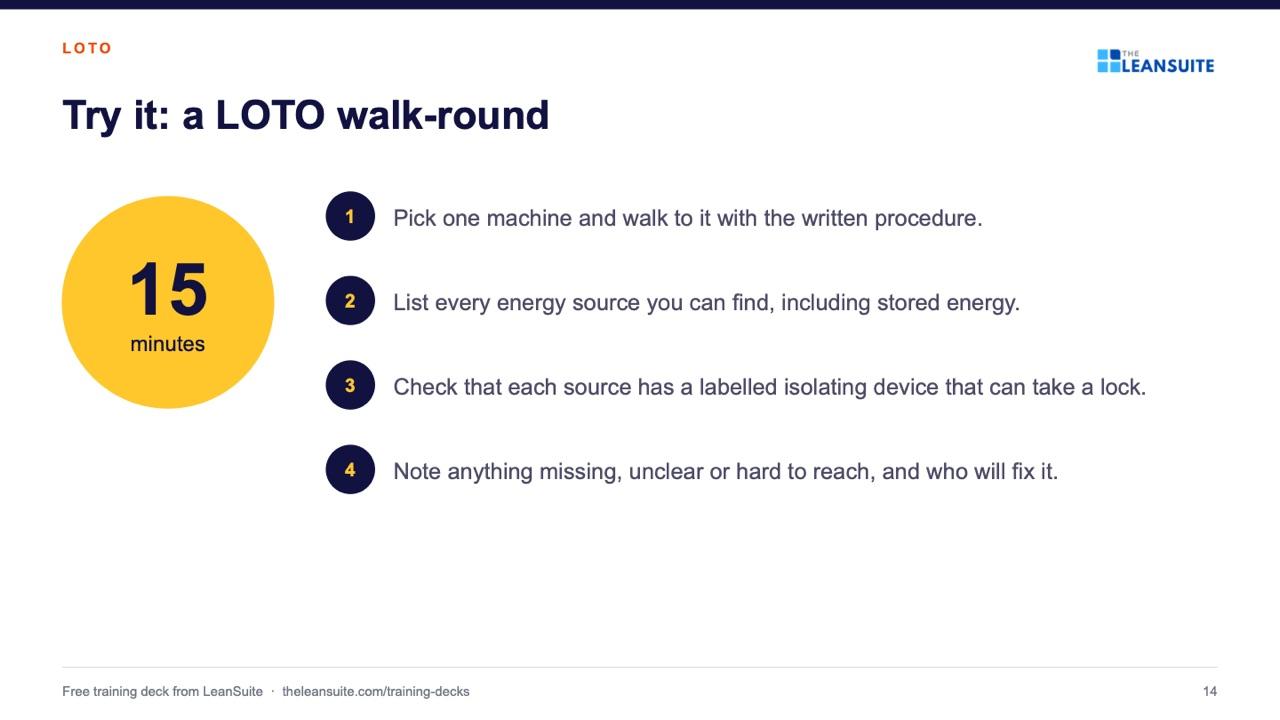
Slide 14: Try it: a LOTO walk-round
- 1Lockout tagout: control hazardous energyCover
- 2AgendaHazardous energy and why it matters · Lockout, tagout and who does what · The six steps · Group lockout, restoring power and the program · Example, mistakes, activity and check questions
- 3What lockout tagout isLockout tagout is how a machine is made safe to service: isolate it from its energy, lock it off and prove it is dead.
- 4Sources of hazardous energyElectrical, Hydraulic and pneumatic, Mechanical and gravity, Thermal and chemical
- 5Lockout and tagoutLockout and tagout
- 6Who is whoAuthorized employee and affected employee
- 7The six steps, in order29 CFR 1910.147(d) sets out the sequence for applying lockout or tagout.
- 8Stored energy and verificationAfter locks are on, relieve, disconnect or restrain stored energy: bleed pressure, block raised parts, discharge capacitors, release springs.
- 9Group lockout and shift changesWhen a crew works on one machine, the group must have protection equal to a personal lock.
- 10Taking locks off and restoring powerCheck the machine: tools and nonessential items removed, guards back on, parts intact.
- 11What the energy control program includesWritten energy control procedures for the machines and equipment.
- 12Example: clearing a jam on a conveyorAn illustrative example of the six steps on one machine. Your own machine's procedure will differ.
- 13Common mistakesTreating the stop button or an interlock as isolation.
- 14Try it: a LOTO walk-roundA 15-minute team activity
- 15Check your understanding4 check questions
- 16AnswersThe answers, to discuss
- 17Key points and next stepsNext: walk one machine's procedure with its operators.
The 35-minute session, slide by slide
- Slides, about: 20 minutes
- Activity (slide 14): 15 minutes
Present · 13 slides
- 1Lockout tagout: control hazardous energy
- 2Agenda
- 3What lockout tagout is
- 4Sources of hazardous energy
- 5Lockout and tagout
- 6Who is who
- 7The six steps, in order
- 8Stored energy and verification
- 9Group lockout and shift changes
- 10Taking locks off and restoring power
- 11What the energy control program includes
- 12Example: clearing a jam on a conveyor
- 13Common mistakes
Do the activity · 1 slide
- 14Try it: a LOTO walk-round
Check and follow up · 3 slides
- 15Check your understanding
- 16Answers
- 17Key points and next steps
About 20 minutes of slides and 15 minutes of activity. Present: slides 1 to 13 (Lockout tagout: control hazardous energy; Agenda; What lockout tagout is; Sources of hazardous energy; Lockout and tagout; Who is who; The six steps, in order; Stored energy and verification; Group lockout and shift changes; Taking locks off and restoring power; What the energy control program includes; Example: clearing a jam on a conveyor; Common mistakes). Do the activity: slide 14 (Try it: a LOTO walk-round). Check and follow up: slides 15 to 17 (Check your understanding; Answers; Key points and next steps).
How to run it
Running the session
- 1
Prepare
Read the speaker notes once and swap the illustrative example for one from your own area if you have it. Print the PDF if people like a handout.
- 2
Present
The slides take about 20 minutes. Every slide has notes, so you can talk from them rather than read the slide.
- 3
Do the activity
Pick one machine and walk to it with the written procedure. The activity slide takes the team through it step by step; allow 15 minutes.
- 4
Check and follow up
Ask the check questions before showing the answers, then agree one next step with an owner and a date before people leave.
The check questions
- 1. Why is the stop button not isolation?
- It only shuts the machine down. The energy source is still connected, so the machine can be restarted or can release stored energy.
- 2. What is the last of the six steps before work starts?
- Verifying that the machine is isolated, by trying to start it from the normal controls.
- 3. Who removes a lock?
- The person who put it on. Any exception must be in the written procedure, with training.
- 4. How often must a procedure be inspected under 29 CFR 1910.147?
- At least annually, by an authorized employee other than the one using the procedure.
Templates and guides to go with it
- Lockout/tagout (LOTO) procedure templateA machine-specific LOTO procedure: energy sources and isolation points, the steps from shutdown to restart, and the annual review.
- Safety audit checklistThirty-four plant-wide safety checks answered Yes, No or N/A, scored by area, with a risk rating and an action for every No.
- Machine guarding inspection sheetA machine register with due dates and a status per machine, 21 checks tied to OSHA 1910.212, .219 and .147, a guard opening check against Table O-10, and an action log.
- Topic: Safety managementEvery guide we have on the subject, sorted.
FAQ
Lockout tagout (LOTO) training presentation: common questions
Lockout tagout. It is the set of steps that isolate a machine from its energy and lock it off before anyone services it.
About 35 minutes: roughly 20 minutes of slides, a 15-minute walk-round activity and the check questions.
No. It is general awareness training. OSHA requires employers to train authorized and affected employees on the energy control procedures for their own machines, so use this deck alongside your written procedures, not instead of them.
Yes. The PowerPoint file is fully editable, including the speaker notes. Many teams replace the illustrative example with a machine from their own plant and add their own procedure.
More free training decks
- 5S training presentationSort, set in order, shine, standardize and sustain in 16 slides, with a 15-minute sort activity and a quiz.View deck
- Kaizen training presentationWhat kaizen is, its principles, PDCA and four steps to a first improvement in 17 slides, with an activity and a quiz.View deck
- Autonomous maintenance training presentation: the 7 stepsThe 7 steps of jishu hozen, who does what and how step audits work, in 19 slides with notes and a quiz.View deck
- 8 wastes of lean training presentationValue vs waste, the 8 wastes (TIMWOODS) with examples, muda, mura and muri and a waste walk, in 17 slides.View deck
- Gemba walk training presentationGo see, ask why, show respect: how to plan, run and follow up a gemba walk, in 16 slides with a practice walk.View deck
- Root cause analysis training presentation: 5 whys and fishboneDefine, contain, the 5 whys, the fishbone diagram and verifying the cause, in 18 slides with a team activity.View deck
- TPM training presentation: the 8 pillarsWhat TPM is, the six big losses, OEE and the 8 pillars, in 19 slides with a loss-spotting activity.View deck
- Manufacturing excellence pillars training presentationThe 20 pillars, cost deployment, the 7-step approach, model areas and audits, in 17 slides.View deck
- Obeya room training presentationWhat an obeya is, what goes on its walls and how to run the meetings, in 15 slides with a design activity.View deck
- DMAIC training presentationDefine, measure, analyze, improve and control, with the main tools of each phase, in 16 slides.View deck
- SMED training presentationInternal and external setup, the four SMED stages and how to halve a changeover, in 16 slides.View deck
- FMEA training presentationDFMEA and PFMEA, severity, occurrence and detection, RPN and action priority, in 16 slides.View deck
- Kanban training presentationPull instead of push: how a kanban loop works, the card types, the rules and how to size it, in 16 slides.View deck
Training is the start. Keeping it going is the hard part.
See how plants run their audits, improvements and follow-ups in LeanSuite, on a call built around your own problem.
Book a 45-minute demo