

Free training deck
Updated · About 30 minutes
Manufacturing excellence pillars training presentation
Manufacturing excellence pillars are a structured way to find and remove losses across a whole plant, built on TPM, total quality, lean and safety methods: ten technical pillars do the improvement work and ten managerial pillars check that leadership supports it. The best-known version was developed by Professor Hajime Yamashina with Fiat from the mid-2000s. This free deck introduces it in about 30 minutes. Its 17 editable slides cover the 10 technical and 10 managerial pillars, cost deployment, causal and resultant losses, the 7-step approach, model areas, audits, how the pillars relate to lean, an illustrative example, the common mistakes, a loss-ranking activity and four check questions with answers, all with speaker notes. The PDF copy works as a handout.
Free to use: print it, copy it and edit it for your team. Enter your name and work email once to download.
 The title Manufacturing excellence pillars, on a navy background with the LeanSuite logo.
A look inside
What is in the 17 slides
For plant managers, pillar leaders, CI and TPM coordinators and team leaders. Widescreen, in plain language, with speaker notes on every slide.
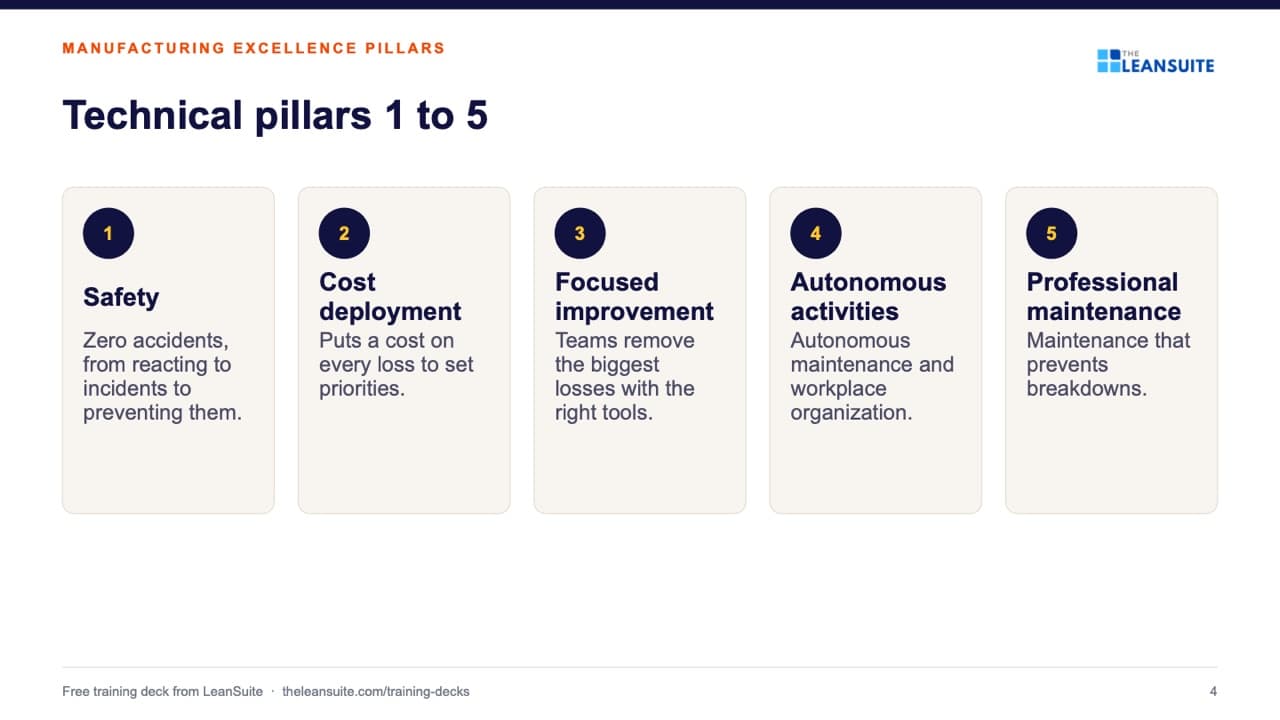
Slide 4: Technical pillars 1 to 5 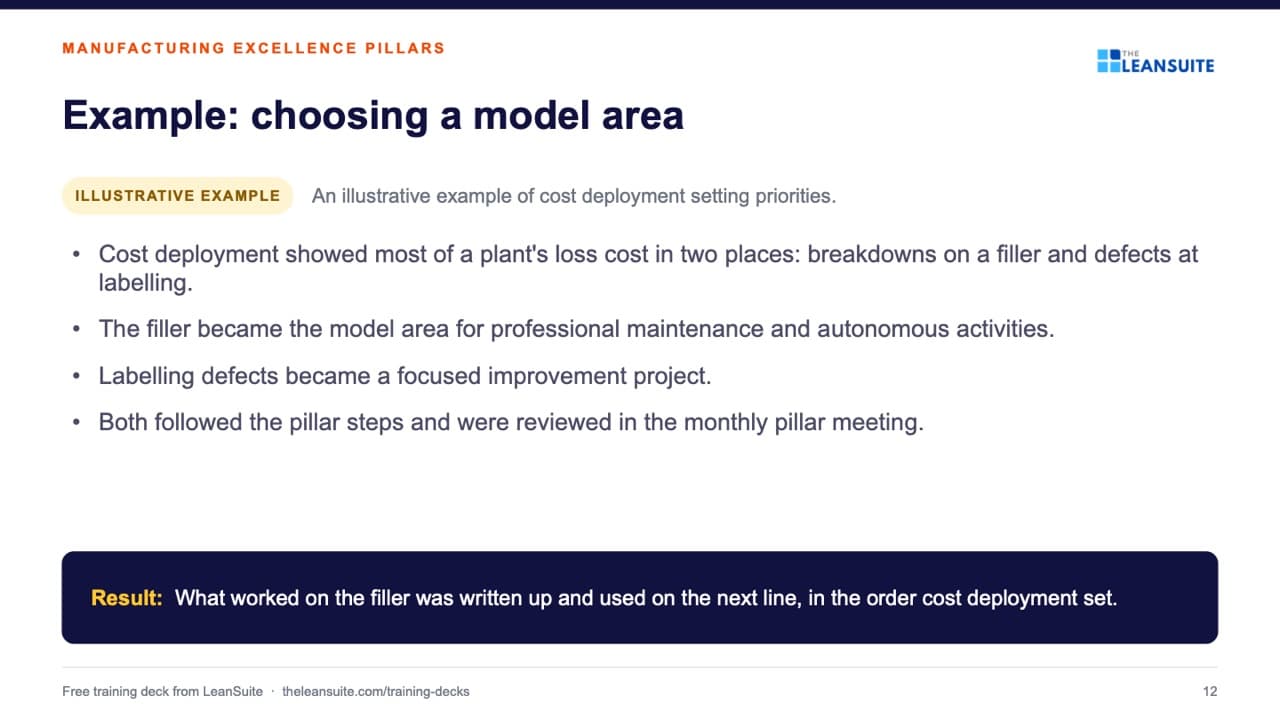
Slide 12: Example: choosing a model area 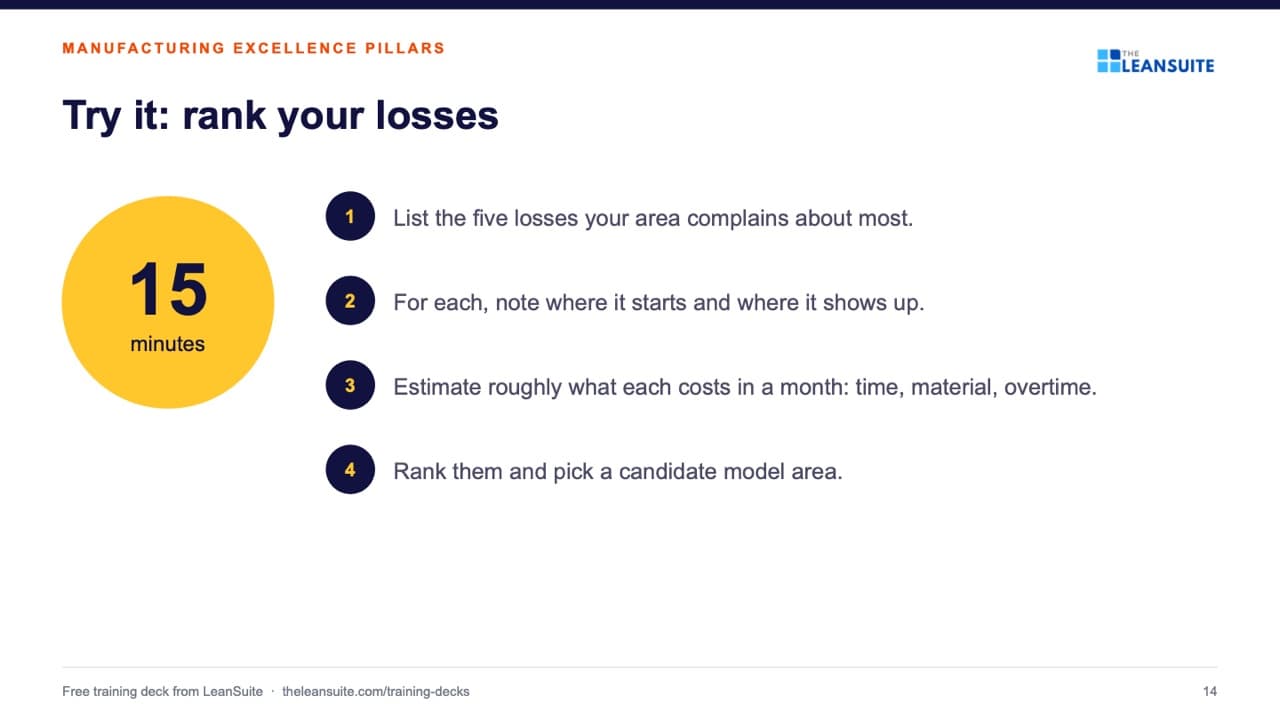
Slide 14: Try it: rank your losses
- 1Manufacturing excellence pillarsCover
- 2AgendaWhat the pillar system is · The 10 technical and 10 managerial pillars · Cost deployment and the 7-step approach · Model areas, audits and how the pillars relate to lean · Example, activity and check questions
- 3What the pillar system isA structured system for finding and removing losses across a whole plant.
- 4Technical pillars 1 to 5Safety, Cost deployment, Focused improvement, Autonomous activities, Professional maintenance
- 5Technical pillars 6 to 10Quality control, Logistics, Early management, People development, Environment and energy
- 6The 10 managerial pillarsThe managerial pillars measure how well leadership supports the technical work.
- 7Cost deploymentCost deployment links losses to money, so the plant works on the losses that cost most.
- 8The 7-step approachEach technical pillar is developed in seven steps, grouped into three phases.
- 9Model areas and expansionStart in a model area chosen by cost deployment: where the biggest losses are.
- 10Pillar auditsPlants are audited on all 20 pillars, each scored from 0 to 5, for a total out of 100.
- 11The pillars and leanShared with lean and TPM and what the pillar system adds
- 12Example: choosing a model areaAn illustrative example of cost deployment setting priorities.
- 13Common mistakesLaunching every pillar in every area at once.
- 14Try it: rank your lossesA 15-minute team activity
- 15Check your understanding4 check questions
- 16AnswersThe answers, to discuss
- 17Key points and next stepsNext: check our loss ranking with real data.
The 30-minute session, slide by slide
- Slides, about: 15 minutes
- Activity (slide 14): 15 minutes
Present · 13 slides
- 1Manufacturing excellence pillars
- 2Agenda
- 3What the pillar system is
- 4Technical pillars 1 to 5
- 5Technical pillars 6 to 10
- 6The 10 managerial pillars
- 7Cost deployment
- 8The 7-step approach
- 9Model areas and expansion
- 10Pillar audits
- 11The pillars and lean
- 12Example: choosing a model area
- 13Common mistakes
Do the activity · 1 slide
- 14Try it: rank your losses
Check and follow up · 3 slides
- 15Check your understanding
- 16Answers
- 17Key points and next steps
About 15 minutes of slides and 15 minutes of activity. Present: slides 1 to 13 (Manufacturing excellence pillars; Agenda; What the pillar system is; Technical pillars 1 to 5; Technical pillars 6 to 10; The 10 managerial pillars; Cost deployment; The 7-step approach; Model areas and expansion; Pillar audits; The pillars and lean; Example: choosing a model area; Common mistakes). Do the activity: slide 14 (Try it: rank your losses). Check and follow up: slides 15 to 17 (Check your understanding; Answers; Key points and next steps).
How to run it
Running the session
- 1
Prepare
Read the speaker notes once and swap the illustrative example for one from your own area if you have it. Print the PDF if people like a handout.
- 2
Present
The slides take about 15 minutes. Every slide has notes, so you can talk from them rather than read the slide.
- 3
Do the activity
List the five losses your area complains about most. The activity slide takes the team through it step by step; allow 15 minutes.
- 4
Check and follow up
Ask the check questions before showing the answers, then agree one next step with an owner and a date before people leave.
The check questions
- 1. How many pillars does the system have?
- Twenty: 10 technical and 10 managerial.
- 2. What is cost deployment for?
- Putting a cost on losses, so the plant attacks the most expensive first.
- 3. What is the difference between a causal and a resultant loss?
- A causal loss is where the problem starts; a resultant loss is its effect elsewhere.
- 4. How is a pillar audit scored?
- Each of the 20 pillars from 0 to 5, for a total out of 100.
Templates and guides to go with it
- Cost deployment matrixWCM cost deployment on paper and in Excel: loss quantities by process, causal and resultant losses, the cost of each loss, a Pareto and the projects that recover them.
- QA matrix templateDefect modes against stations in flow order: where each is made and first caught, a weight × occurrence × detection score, an AA to C class and the escapes flagged.
- Six big losses worksheetWhere a machine's planned time goes: the six big losses in minutes, ranked, with A, P, Q and OEE worked out.
- Equipment criticality analysisAssets scored 1 to 5 on six criteria with your own weights, ranked and sorted into classes A, B and C with a safety override and a suggested maintenance strategy.
- Operational excellence assessment templateThe ten principles of operational excellence as 30 behaviors and practices you can see, scored 1 to 5 by several people, with the spread, the three lowest principles and an action plan.
- Topic: Lean manufacturing fundamentalsEvery guide we have on the subject, sorted.
- Topic: TPM and maintenanceEvery guide we have on the subject, sorted.
Read more
- Manufacturing Excellence Pillars: A Beginner's Guide
- Loss Prioritization: Finding the Highest-Impact Losses
- The 8 Pillars of TPM: A Manufacturing Guide
- In LeanSuite, operational excellence runs on five tools: issue tags, Kaizen projects, the Document Builder for best practices, KPI dashboards and a suggestion platform
After the session
Put it on the wall
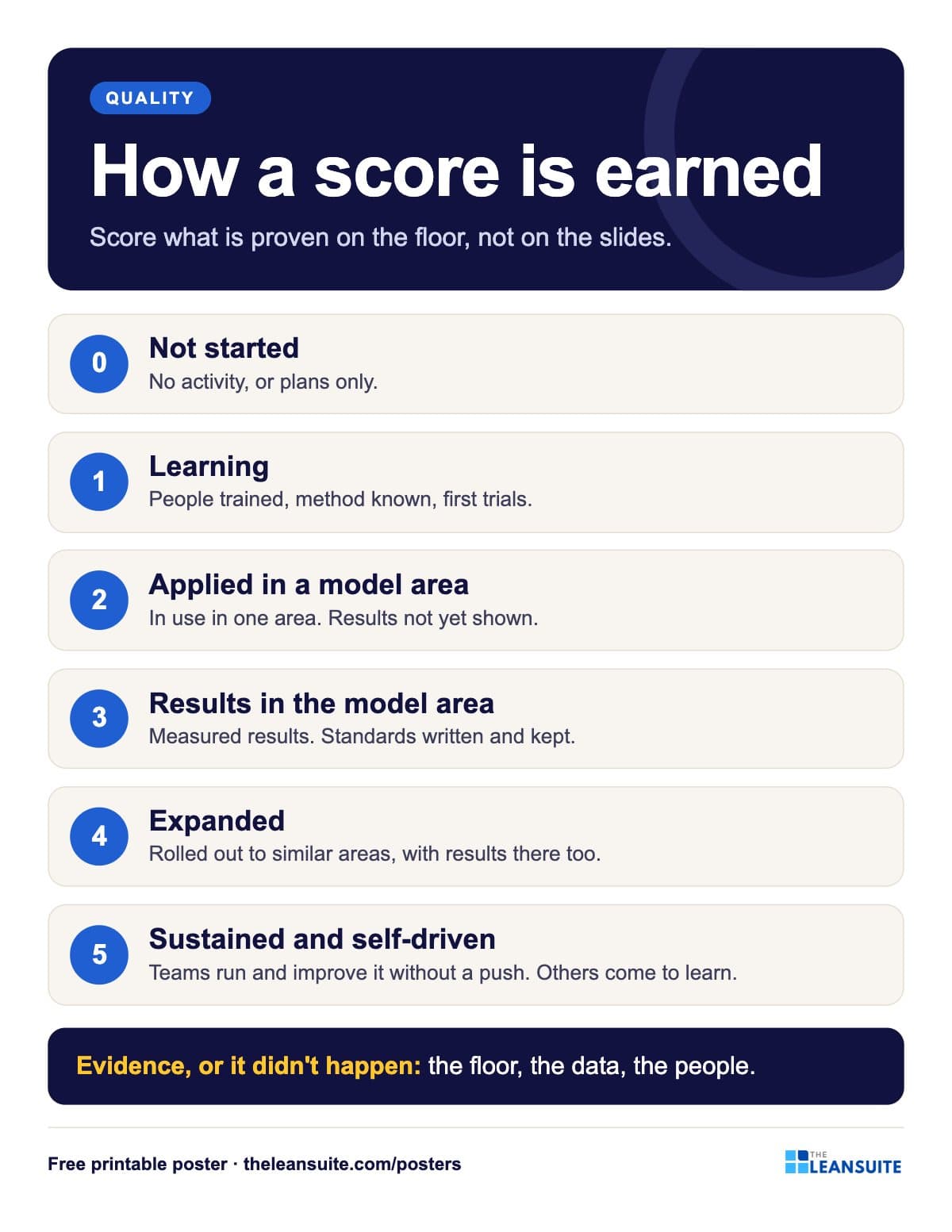
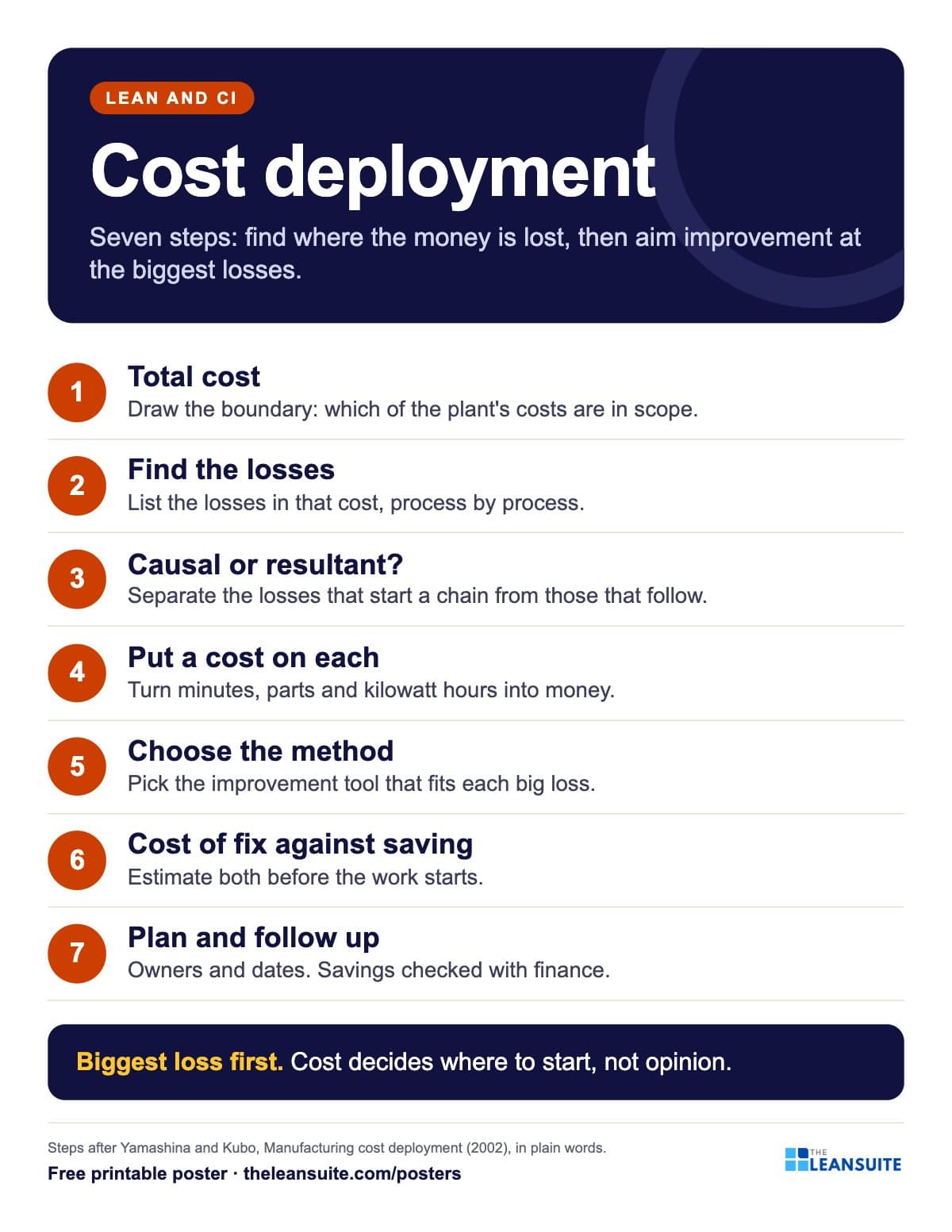
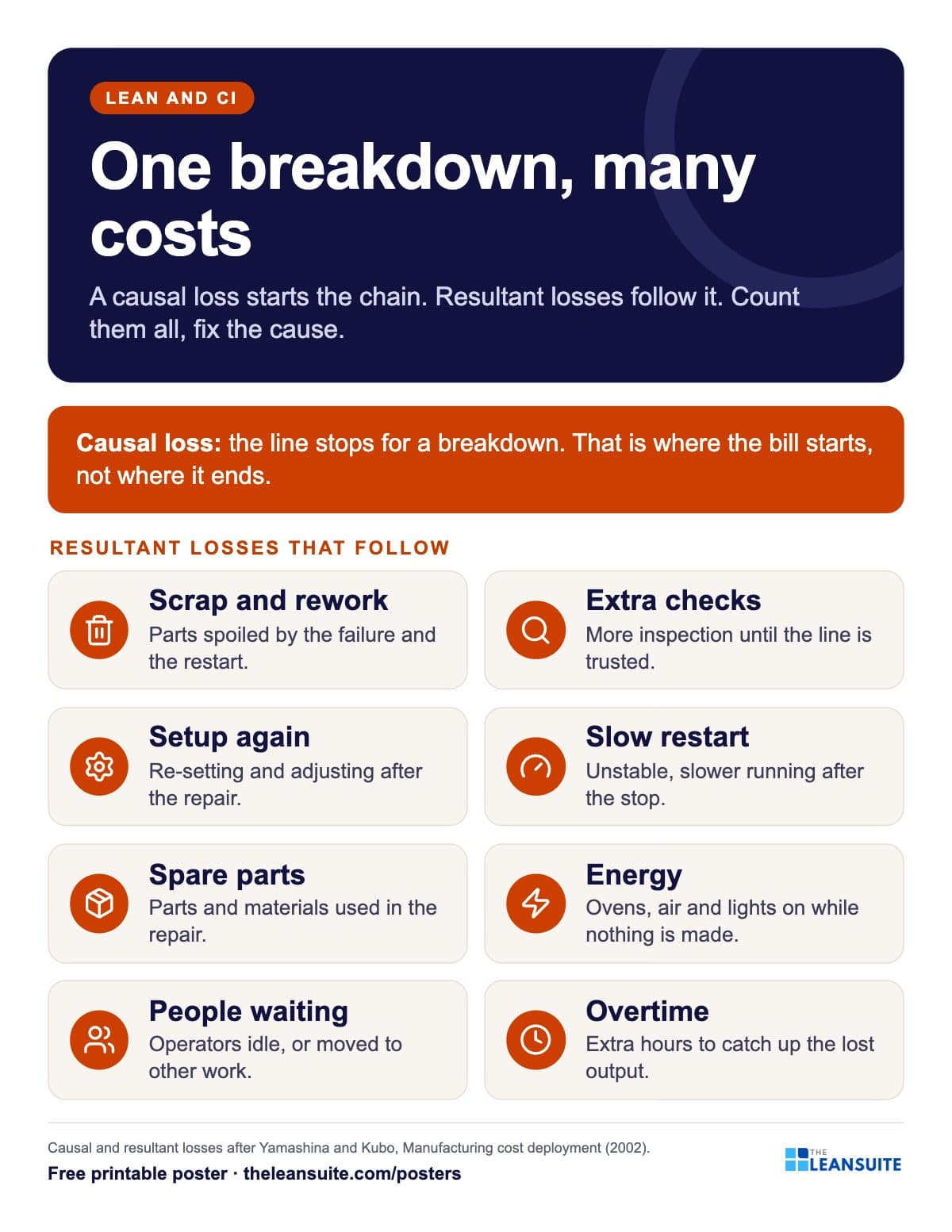
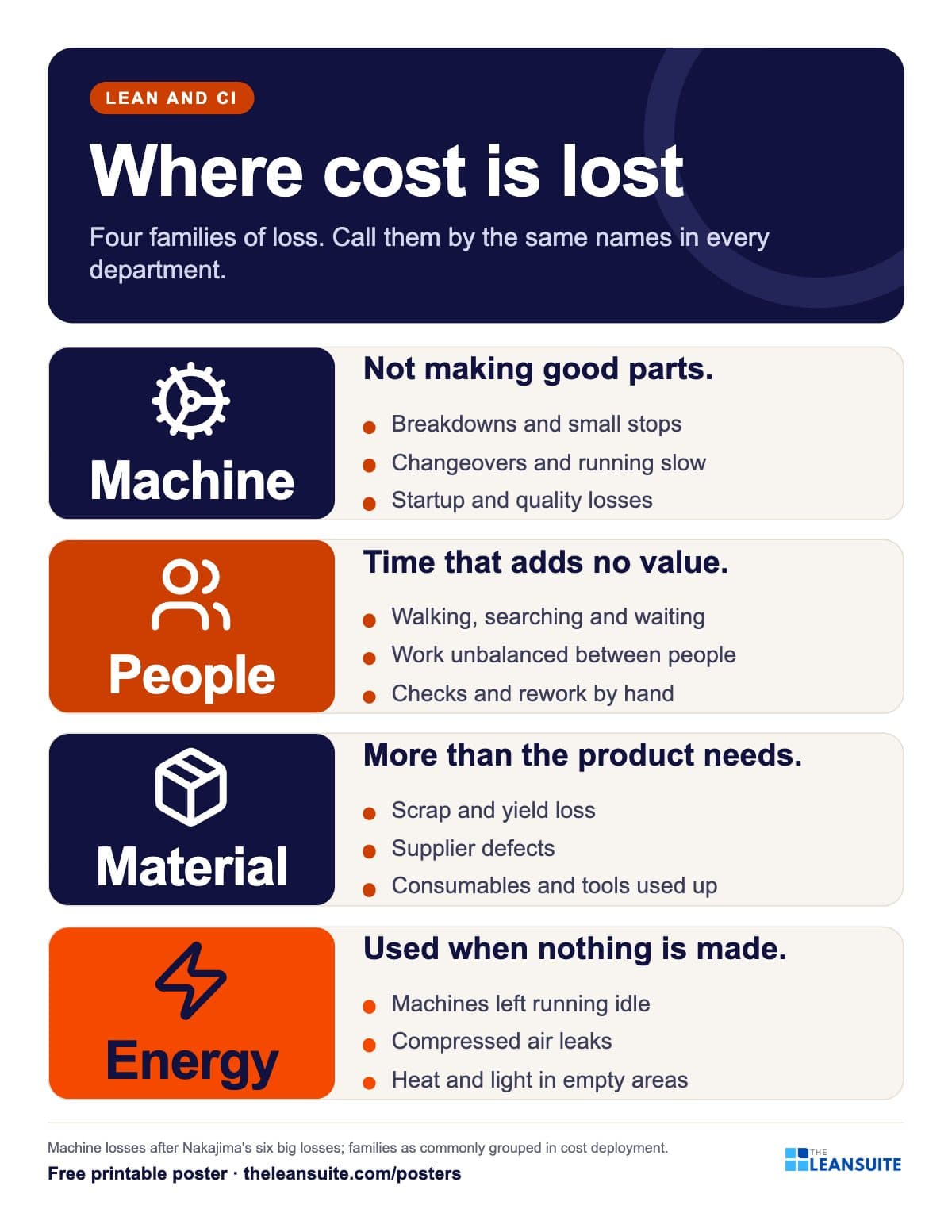
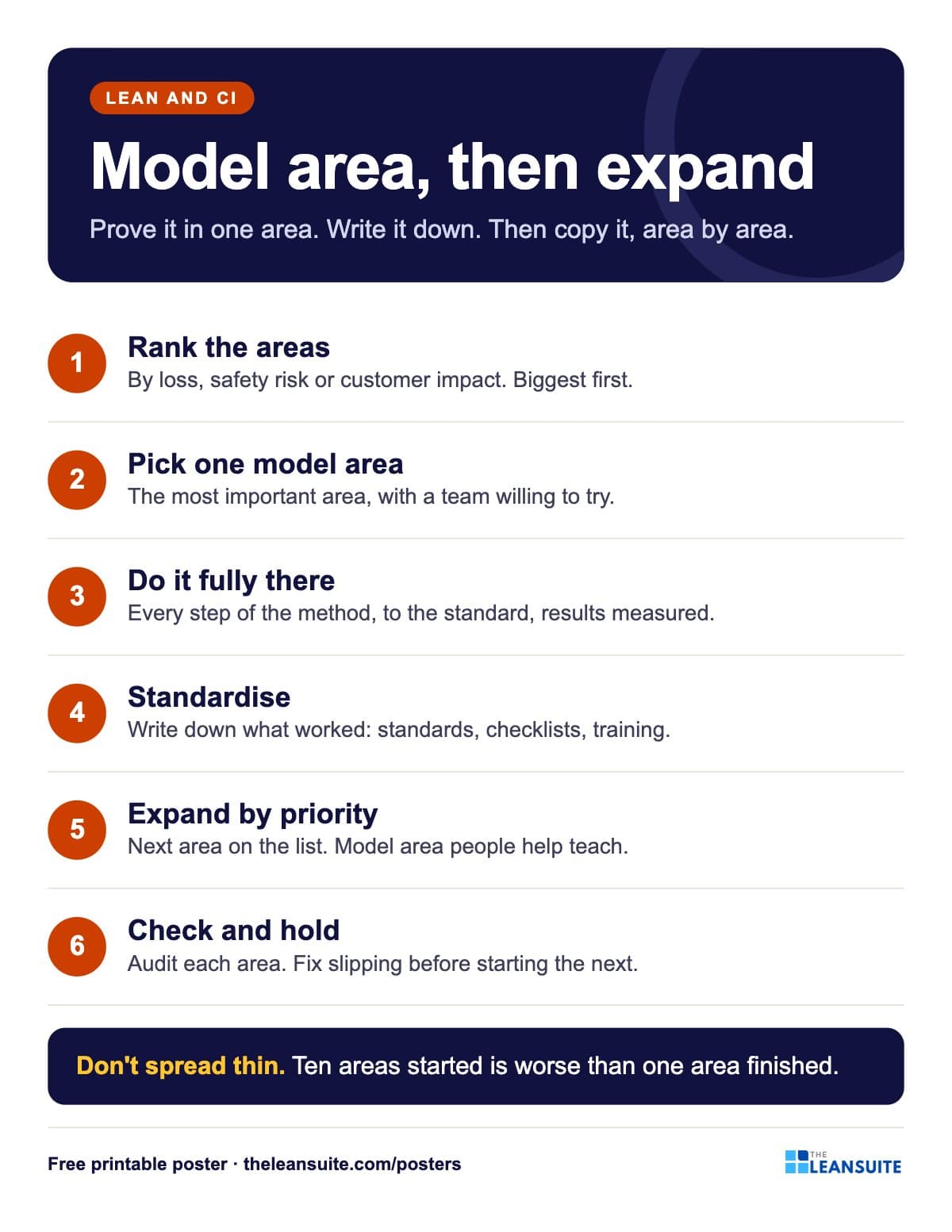
Free printable posters on the same subject, so the team sees it every day: a PNG to download now, and print-ready PDFs from Letter to 24 x 36 in.
FAQ
Manufacturing excellence pillars training presentation: common questions
A structure of ten technical and ten managerial pillars for finding and removing losses across a plant, with cost deployment to set priorities and scored audits to check progress. The best-known version was developed by Professor Hajime Yamashina with Fiat from the mid-2000s.
Yes. The download includes a PDF copy of all 17 slides to print or share, as well as the editable PowerPoint file with speaker notes.
Safety, cost deployment, focused improvement, autonomous activities, professional maintenance, quality control, logistics and customer service, early equipment management, people development and environment. The ten managerial pillars include management commitment, route map, time and budget, level of detail and level of expansion.
Yes. The PowerPoint file is fully editable, including the speaker notes. Plants often add their own pillar names, model areas and audit dates.
More free training decks
- 5S training presentationSort, set in order, shine, standardize and sustain in 16 slides, with a 15-minute sort activity and a quiz.View deck
- Kaizen training presentationWhat kaizen is, its principles, PDCA and four steps to a first improvement in 17 slides, with an activity and a quiz.View deck
- Autonomous maintenance training presentation: the 7 stepsThe 7 steps of jishu hozen, who does what and how step audits work, in 19 slides with notes and a quiz.View deck
- 8 wastes of lean training presentationValue vs waste, the 8 wastes (TIMWOODS) with examples, muda, mura and muri and a waste walk, in 17 slides.View deck
- Gemba walk training presentationGo see, ask why, show respect: how to plan, run and follow up a gemba walk, in 16 slides with a practice walk.View deck
- Root cause analysis training presentation: 5 whys and fishboneDefine, contain, the 5 whys, the fishbone diagram and verifying the cause, in 18 slides with a team activity.View deck
- TPM training presentation: the 8 pillarsWhat TPM is, the six big losses, OEE and the 8 pillars, in 19 slides with a loss-spotting activity.View deck
- Obeya room training presentationWhat an obeya is, what goes on its walls and how to run the meetings, in 15 slides with a design activity.View deck
- DMAIC training presentationDefine, measure, analyze, improve and control, with the main tools of each phase, in 16 slides.View deck
- SMED training presentationInternal and external setup, the four SMED stages and how to halve a changeover, in 16 slides.View deck
- FMEA training presentationDFMEA and PFMEA, severity, occurrence and detection, RPN and action priority, in 16 slides.View deck
- Kanban training presentationPull instead of push: how a kanban loop works, the card types, the rules and how to size it, in 16 slides.View deck
- Lockout tagout (LOTO) training presentationHazardous energy, lockout versus tagout and the six steps in order, with a walk-round activity, in 17 slides.View deck
- Quality management system (QMS) training presentationWhat a quality management system is, the ISO 9001 clauses, procedures and records, corrective action and audits, in 18 slides.View deck
- SPC and Cpk training presentationCommon and special cause variation, X-bar and R limits, reading signals, Cp and Cpk, with worked numbers, in 19 slides.View deck
- MSA and Gage R&R training presentationThe five measurement properties, how a gage R&R study works, %GRR and ndc with worked numbers, and attribute gauges, in 19 slides.View deck
- PPAP and APQP training presentationThe five APQP phases, gates, the 18 PPAP elements, the five submission levels and the capability criteria, in 19 slides.View deck
- OEE training presentationHow to calculate OEE and read the six big losses in 19 slides, with one worked shift, a 20-minute exercise and a quiz.View deck
- Leader standard work training presentationWhat leader standard work is, the routine at each level, five steps to build it and how to keep it going, in 19 slides with an exercise and a quiz.View deck
- Daily management and tier meetings training presentationTier meetings, boards, huddles and escalation in 19 slides, with a worked example, a 20-minute huddle exercise and a quiz.View deck
- 5 Whys training presentationOhno's machine example, how to ask good whys, when to stop and where the method falls short, in 20 slides with a team exercise.View deck
- A3 problem solving training presentationThe seven boxes, the three kinds of A3, how to write and coach one, with two worked example slides and a 30-minute exercise, in 20 slides.View deck
- Poka-yoke (mistake-proofing) training presentationMistakes versus defects, the contact, fixed-value and motion-step methods, control and warning devices and how to design and test one, in 18 slides.View deck
- Layered process audit (LPA) training presentationWhat a layered process audit is, the layers, how to write and ask good questions, handle a no and read the results, in 19 slides.View deck
- Standard work training presentationTakt time, work sequence and standard WIP, how to write a standard with the operators and how to keep it alive, in 18 slides.View deck
- Value stream mapping (VSM) training presentationHow to map the current state, read lead time, design the future state with the eight questions and turn it into a plan, in 19 slides.View deck
- TWI job instruction training presentationThe four steps of TWI job instruction and the job breakdown sheet, from the original wartime card, with a worked example and a practice session.View deck
- 8D problem solving training presentationD0 to D8, containment, the root cause and the escape point, proving a fix and preventing repeats, in 20 slides with a team exercise.View deck
- Forklift safety training presentationOperator training rules, stability and load center, travel and dock rules and the daily exam, each tied to 29 CFR 1910.178, in 20 slides.View deck
- Hazard communication (HazCom, GHS) training presentationLabels, the eight GHS pictograms, the 16 SDS sections, employee training and the 2026 and 2028 dates, each tied to 29 CFR 1910.1200, in 20 slides.View deck
- New-hire safety orientation training presentationA day-one safety orientation for plants and warehouses: reporting, emergencies, PPE, chemicals, machines and trucks, with the OSHA paragraph behind each, in 17 slides.View deck
- 4M change management training presentationMan, machine, material and method changes, rating the risk, extra checks, the change point board and closing a change, in 19 slides.View deck
Training is the start. Keeping it going is the hard part.
See how plants run their audits, improvements and follow-ups in LeanSuite, on a call built around your own problem.
Book a 45-minute demo