Skip to content
Try LeanSuite for 90 days for $3,000
LeanSuite - Lean Manufacturing Software

Compare

Build or buy: LeanSuite vs homegrown software

Short answer: Most plants don't run their lean program on paper. They run it on an Excel workbook with macros, an Access database, a SharePoint list, a Power App or a small web app that one person inside the company built. It works while that person is there and has time. The costs come later: every change waits in their queue, security and hosting are somebody's side job, there is no mobile app unless they build one, and when they leave, nobody can change it. Build your own when the process is truly unique and you have a development team that will own the tool for years. Otherwise, buying gets you a product team, regular releases and support.

This page is for plants whose ideas, kaizen, audits or daily issues run on a tool someone inside the company built. LeanSuite publishes it, so we have also said plainly when building your own is the better call.

Last reviewed September 2026. LeanSuite facts come from our own product pages and help center; tell us if something has changed at info@theleansuite.com.

What an in-house tool really costs

The build is the cheap part. These costs arrive over the years that follow, and most of them land on the one person who built it.

  • One person holds the knowledge

    The builder knows why each column exists, which macro runs on Monday and where the data really lives. It is rarely written down. When they change roles or leave, the tool keeps running until the first thing breaks, and then nobody knows how to fix it.

  • Every change waits in one queue

    A new field on the audit form, a new approval step, a second plant, a different report: each one is a request to the same person, on top of their actual job. Small asks wait, and people start keeping side spreadsheets instead.

  • Security, access and hosting are a side job

    Someone has to add and remove users, patch the server or tidy the file share, back up the data and answer IT's security questions. In a homegrown tool that work usually has no owner until an auditor or a customer asks.

  • No mobile app unless someone builds one

    Operators on the floor need something that works on a phone or a shared tablet, without a company email. That is a separate project, and most in-house tools never get it, so input goes through a supervisor or a paper form first.

  • Reports break when the builder leaves

    Dashboards often depend on queries, linked files and refresh steps only the builder understands. Rename a column or move a file and the numbers stop updating, and nobody can tell why.

  • Migrations land on your team

    A server is retired, a file share is reorganized, the database needs a new version, another plant wants in. Each move is a project for your people, and years of history have to come along without breaking.

When building your own makes sense

  • The process is truly unique to your business and no product models it, even with configuration.
  • You have an internal development team, not one person, that will own the tool for years: fixes, security, hosting and handover.
  • The tool has to live inside in-house systems that only your own developers can reach.
  • The scope is small and stable: one area, a few users, a form that rarely changes.
  • You have budgeted for the upkeep, not just the build, and written down how the tool works.

When buying makes more sense

  • One person built the tool and one person maintains it.
  • Change requests sit in that person's queue, and teams have started keeping side spreadsheets.
  • Operators can't use it on the floor, so input goes through supervisors or paper.
  • A second shift or plant wants it, and it wasn't built for that.
  • IT or a customer asks security questions about the tool that nobody can answer.
  • The builder has already left, and nobody wants to touch it.

What LeanSuite gives you instead

A product team that maintains the software, so your people run the lean program instead of the tool.

  • Ready-made modules

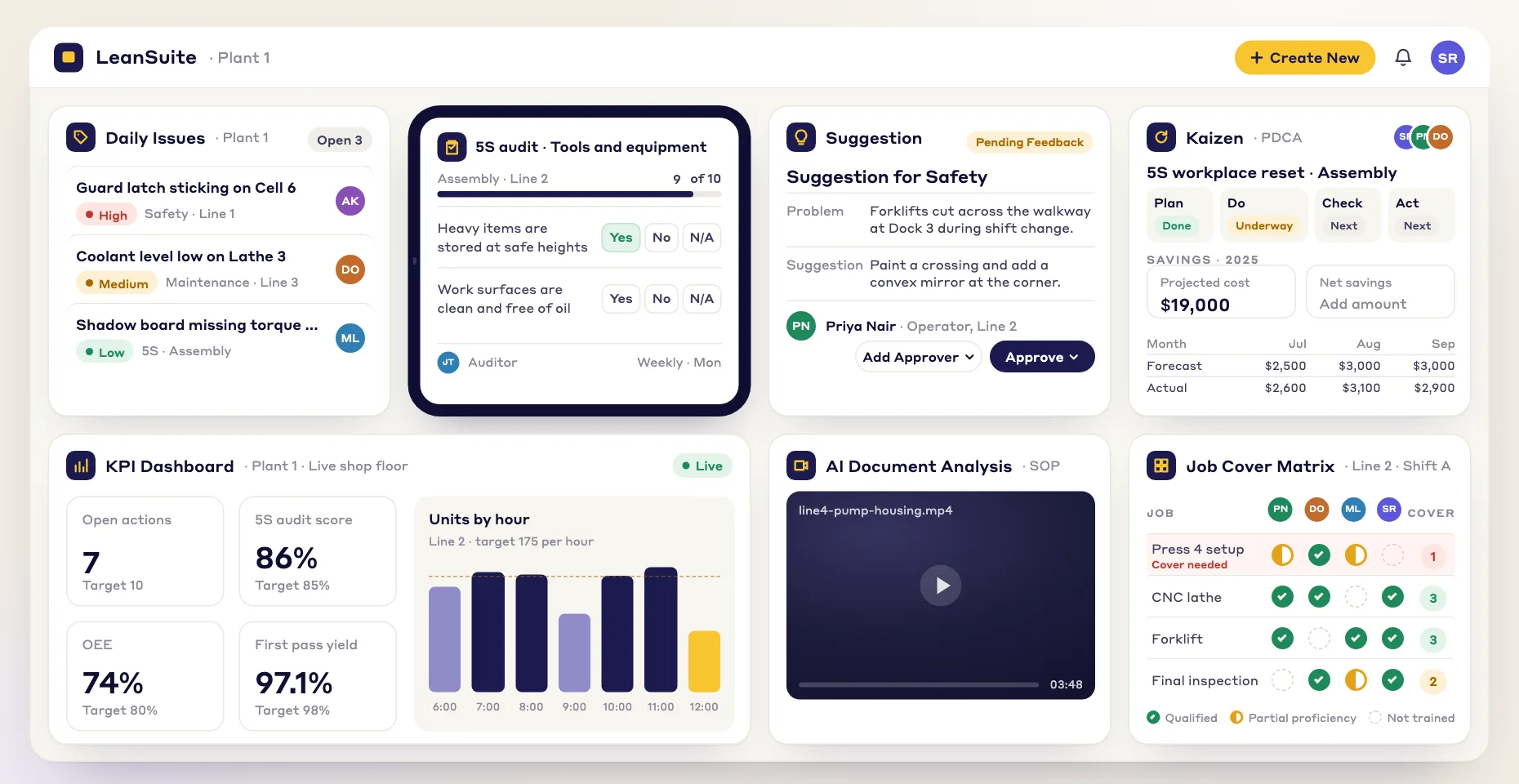
    Daily issues, audits and 5S, ideas, kaizen and projects, tiered meetings, skills and training, SOPs and work instructions, and KPI dashboards, built and maintained by LeanSuite. Forms and checklists are built without code, and workflow rules route work and set due dates.

    Continuous improvement software

  • Our team does the setup

    We set LeanSuite up and train your core team. Your first module is typically live in under a week, and onboarding runs for 90 days with regular check-ins.

    How implementation works

  • Feature requests and regular releases

    Customers send feature requests to support or their customer success manager, and the product team weighs them for the roadmap. We don't promise to build any particular request or give a date for one. New features ship in regular releases, and the release notes are published in the help center.

    Release notes

  • Support and uptime

    The help desk is open 24 hours a day, 5 days a week, and critical issues are answered within 24 hours. The service agreement commits to 99.5% uptime each month.

    Security and uptime

  • Security and sign-in

    LeanSuite has a SOC 2 Type 1 report. Office staff use single sign-on with Microsoft Entra ID or Okta, roles limit each person to their own data, and operators sign in with an employee ID.

    Security

  • Your spreadsheets and reports can stay

    Native connectors for Excel on OneDrive and SharePoint, Google Sheets, Power BI and Looker Studio. KPI values can be pulled on a schedule or uploaded as a CSV with column mapping, and Power BI or Looker Studio reports sit on the same board.

    KPI Dashboards

  • Apps for the floor

    Web, iOS and Android apps. Operators sign in with an employee ID, so nobody needs a company email to raise an issue or complete an audit.

    Connected worker platform

  • One price per facility

    Per-facility pricing with unlimited users, so adding a shift's operators doesn't add seats. The 90-day pilot costs $3,000 per facility. Vision AI is priced separately and is not part of the pilot.

    The 90-day pilot

In-house tool vs LeanSuite

The in-house column describes how a tool one person built usually runs, whatever it was built in. The LeanSuite column says only what our own pages and help center say; the sources are listed at the bottom of the page.

Swipe the table sideways to see every column.

An in-house continuous improvement tool compared with LeanSuite
QuestionIn-house toolLeanSuite
Ownership
Who maintains itThe person who built it, alongside their day job. After they leave, whoever inherits it.LeanSuite's product team, with regular releases and release notes published in the help center.
ChangesEvery new field, step, report or plant is a request to the builder.Forms, checklists and workflow rules are set up in the app without code. Requests for new features go to the product team, which weighs them for the roadmap.
How it works, written downWhatever the builder documented.Help center articles, and an AI assistant in the app that answers how-to questions and can raise a support ticket.
Keeping it running
Security and accessUsers, permissions, patches and backups handled by whoever owns the server, database or file share.SOC 2 Type 1 report, single sign-on with Microsoft Entra ID or Okta, and custom roles per module.
SupportThe builder, when they have time.Help desk 24 hours a day, 5 days a week; critical issues answered within 24 hours; 99.5% monthly uptime commitment.
Hosting and upgradesYour servers or tenant. Version upgrades, server moves and new plants are your projects.Cloud hosted, with new features arriving as releases. Several plants can share one workspace, each keeping its own data.
On the floor and in the meeting
OperatorsUsually a PC and a company account, unless someone builds a mobile app.Web, iOS and Android apps. Operators sign in with an employee ID, no company email needed.
ReportsQueries, linked files and refresh steps that the builder set up.KPI dashboards update as forms, checklists and audits are submitted. Excel on OneDrive and SharePoint, Google Sheets, Power BI and Looker Studio connect natively.
Cost
What you payNo license fee for the tool itself. The builder's hours, hosting and every change are paid in time that rarely shows on a budget line.Per facility with unlimited users; quote on request. 90-day pilot at $3,000 per facility.

Details: the 90-day pilot, how implementation works and security.

What customers say

  • “Great user-friendly software! It's covering everything that WCM or similar Lean Programs are asking to do, in a very effective way.”
    Marelli logoElena M.Global Head of Marelli Manufacturing System Automotive, Marelli
  • “The Project Tracking System generates significant savings while ensuring seamless delivery... The Global Kaizen Power Pitch completely transformed our ability to share best practices.”
    WhirlpoolRamsey AljahmiSr. Director of NAR Operations Excellence, Whirlpool Corporation
    Read the case study

FAQ

Build vs buy: common questions

Sources

Last reviewed September 2026. LeanSuite facts come from our own product pages and help center; tell us if something has changed at info@theleansuite.com.

Stuck with a tool nobody can change?

Show us the tracker, database or app you run today. We will show you how the same process works in LeanSuite and what a 90-day pilot would cover.