5 safety rules for the shop floor
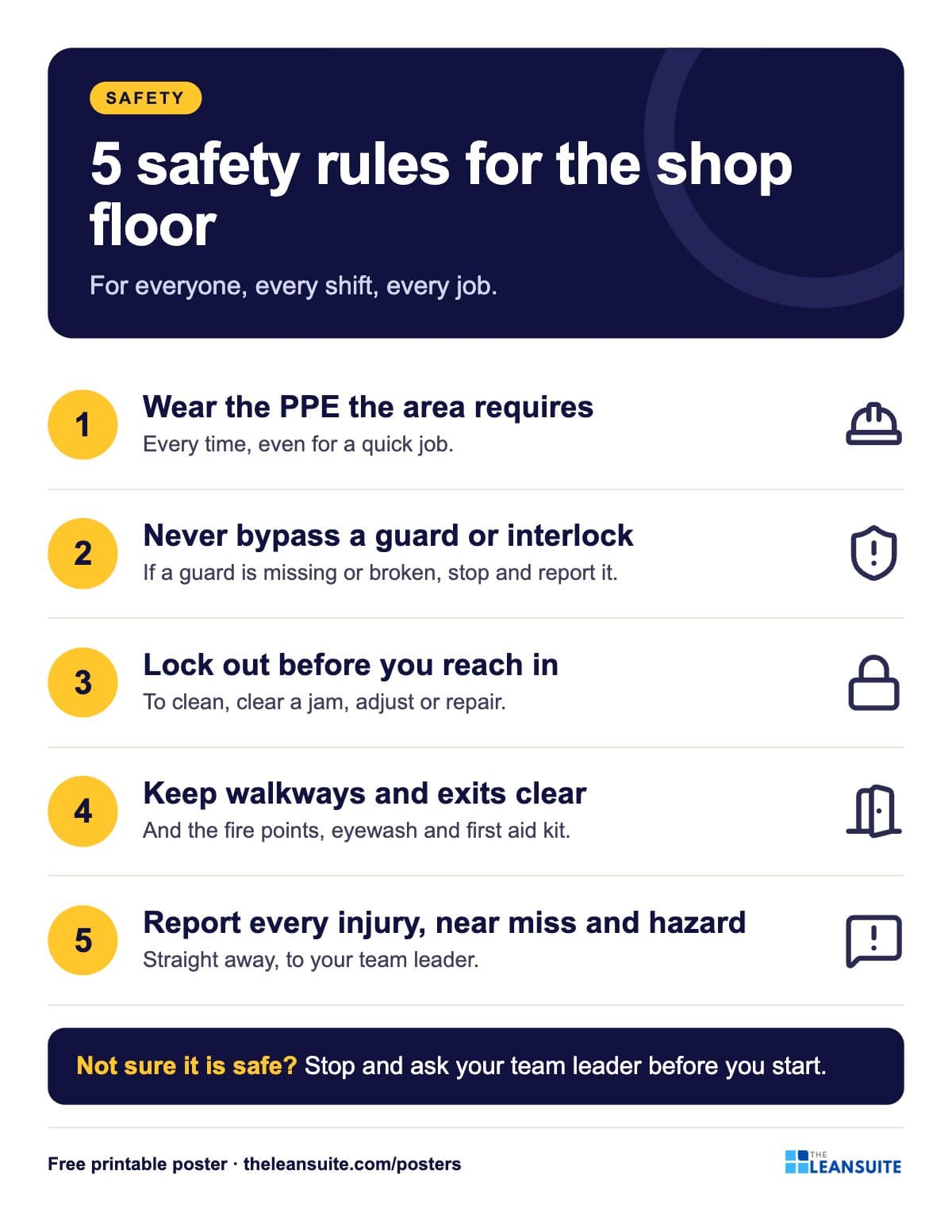
Five basic safety rules that apply in almost every plant, in big type for the wall.
Where to hang it
Put it at the main entrance to the floor and in the break room.
Safety posters
Last updated · Free to print and share
33 safety posters for plants and warehouses, from the rules every wall needs to lockout tagout, forklifts, hot work and chemical labels. Each one below says what it is for and where to hang it. Print one, or all of them as a single PDF.
One vector PDF per size, one poster per page, 6.0 MB at A3. Opens after a short form, once.
Free to use: print it, copy it and edit it for your team. Enter your name and work email once to download.
The 33 posters
Six groups, from general rules to incident follow-up. Each card shows the poster, what it covers and where to put it. Open a poster for its sources, a free PNG and print sizes up to 24 x 36 in.
General rules, PPE, housekeeping and what to do in an emergency.
Five basic safety rules that apply in almost every plant, in big type for the wall.
Where to hang it
Put it at the main entrance to the floor and in the break room.
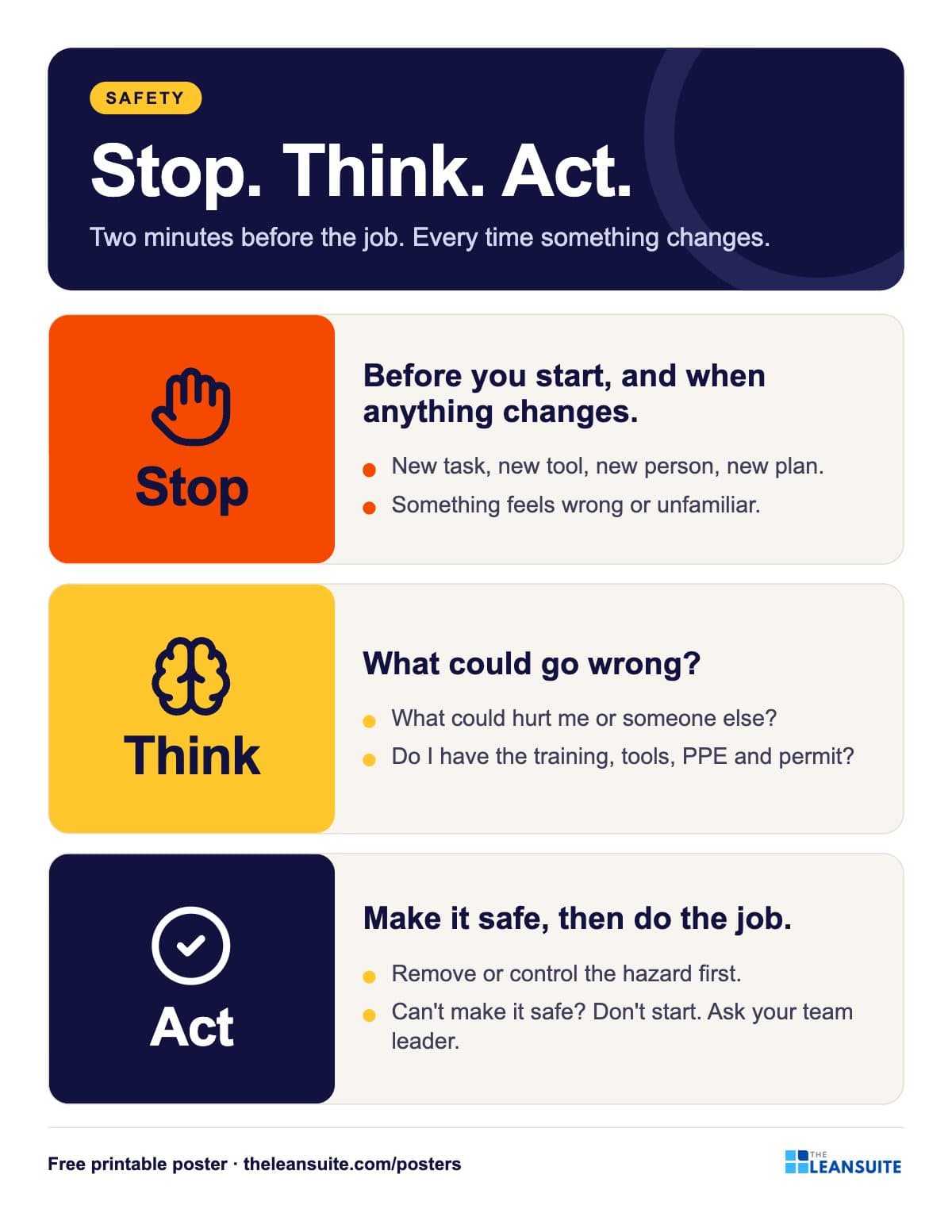
A two-minute check before any task: stop, think about what could go wrong, then act.
Where to hang it
Put it where jobs start: maintenance benches, permit boards, changeover points.
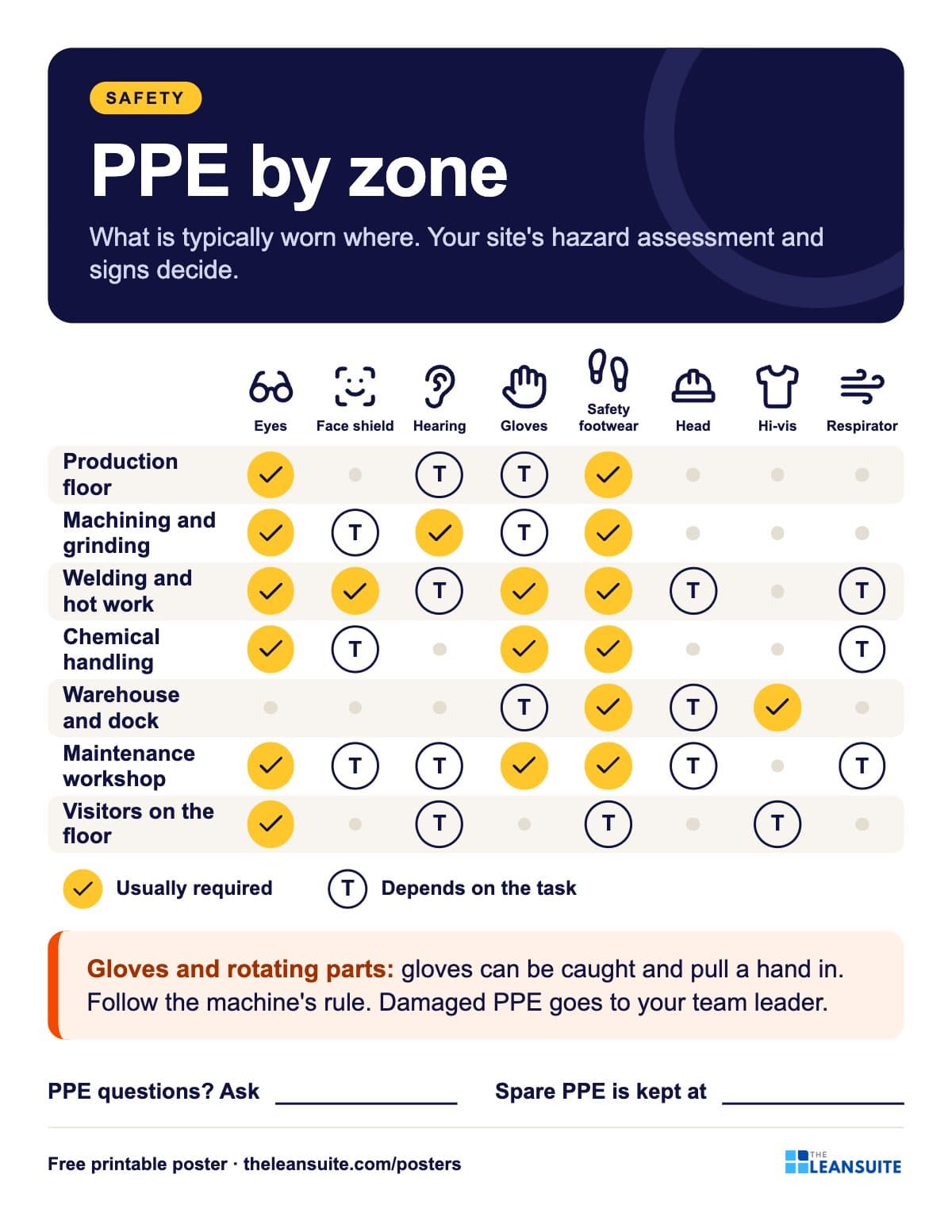
The PPE typically worn in seven work zones, as a chart you can check at the door.
Where to hang it
Put it at the entrance to the production area, where people put PPE on.
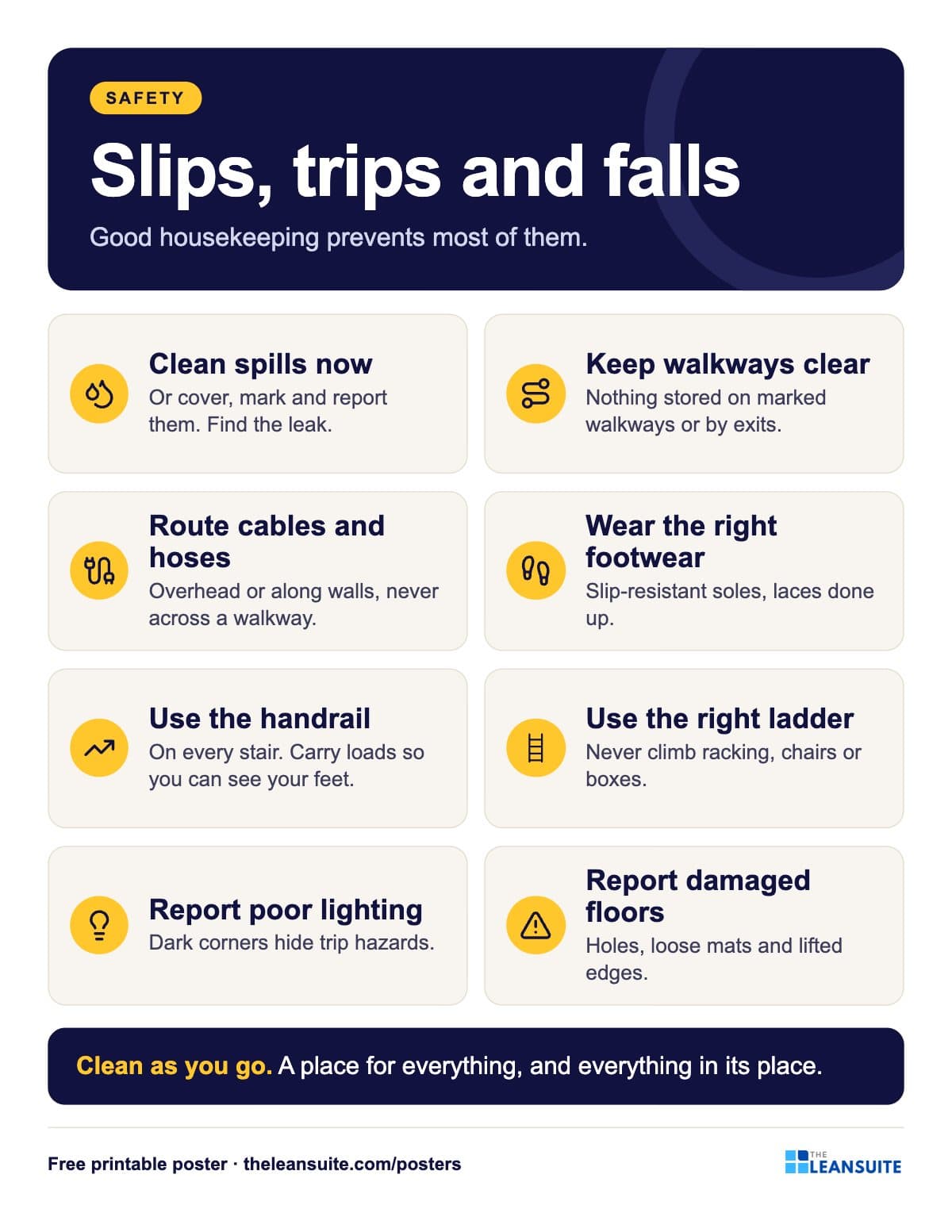
Eight housekeeping habits that prevent slips, trips and falls, from spills to ladders.
Where to hang it
Hang it in corridors, at stair landings and near wash-down or wet areas.
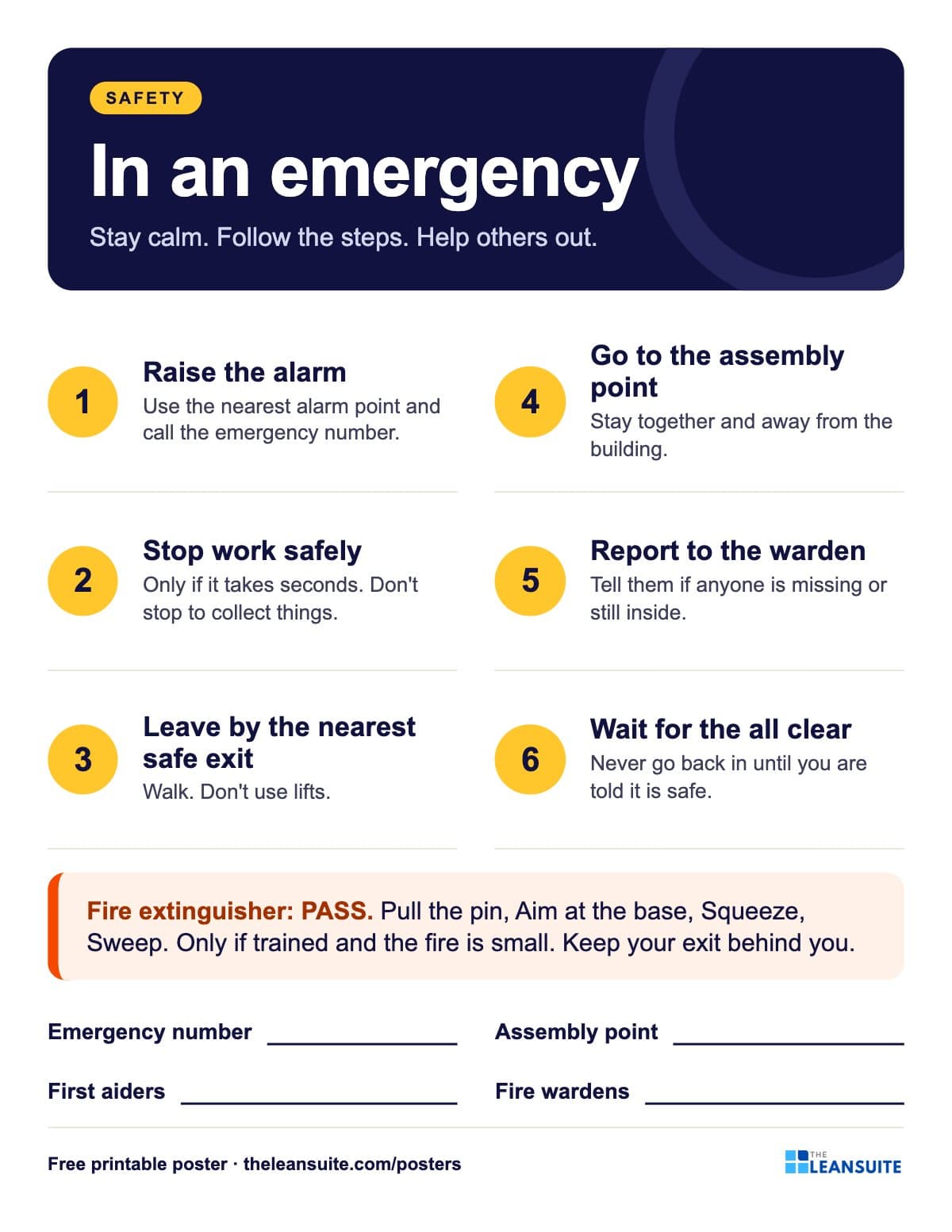
Six steps in an emergency, the PASS extinguisher method and blanks for your site's details.
Where to hang it
At exits, in break rooms and by every alarm point, with the blanks filled in first.
How to rank a hazard, pick the fix and plan a job before it starts.
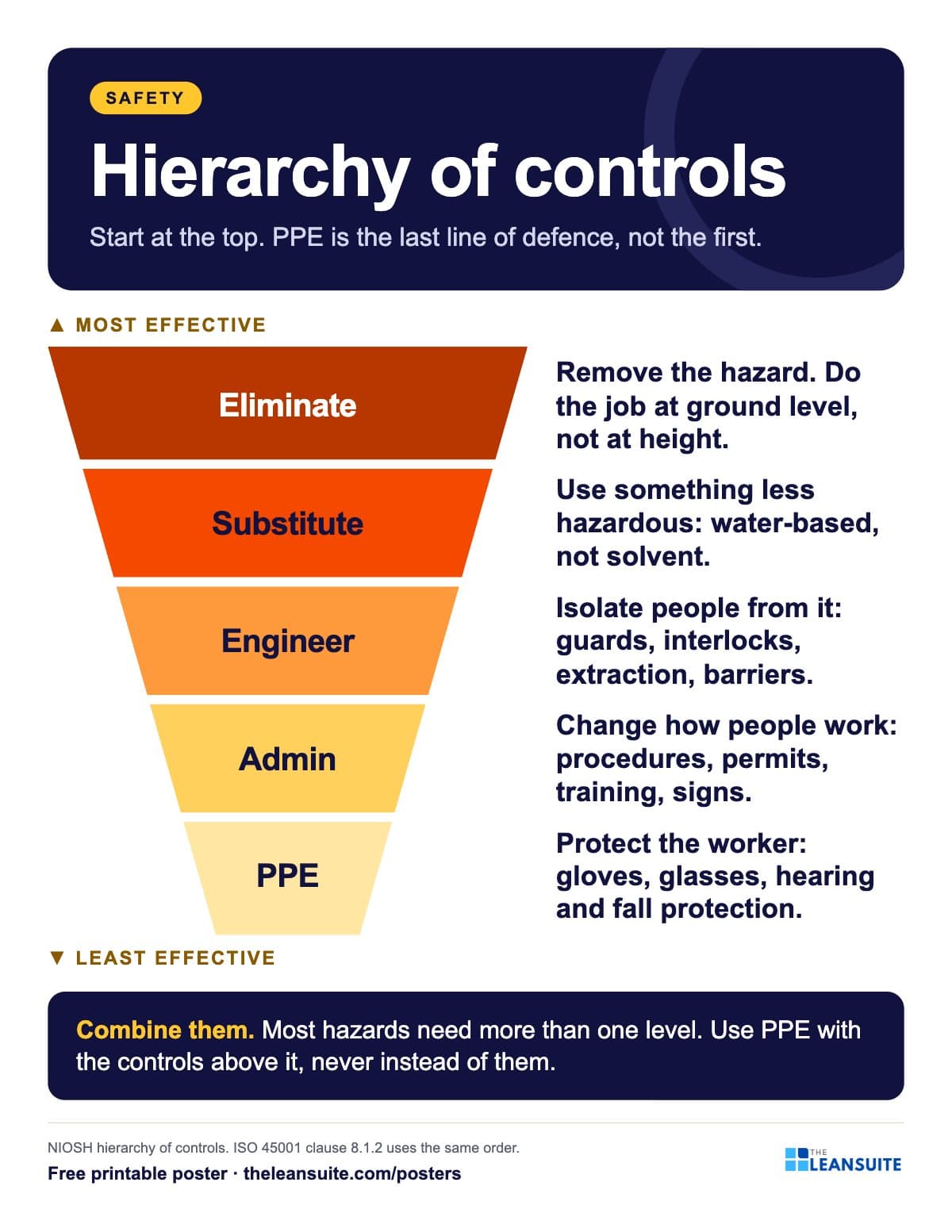
The five levels of control from most to least effective, each with a plant example.
Where to hang it
Put it where countermeasures are agreed: the safety board, the maintenance office, the risk assessment room.
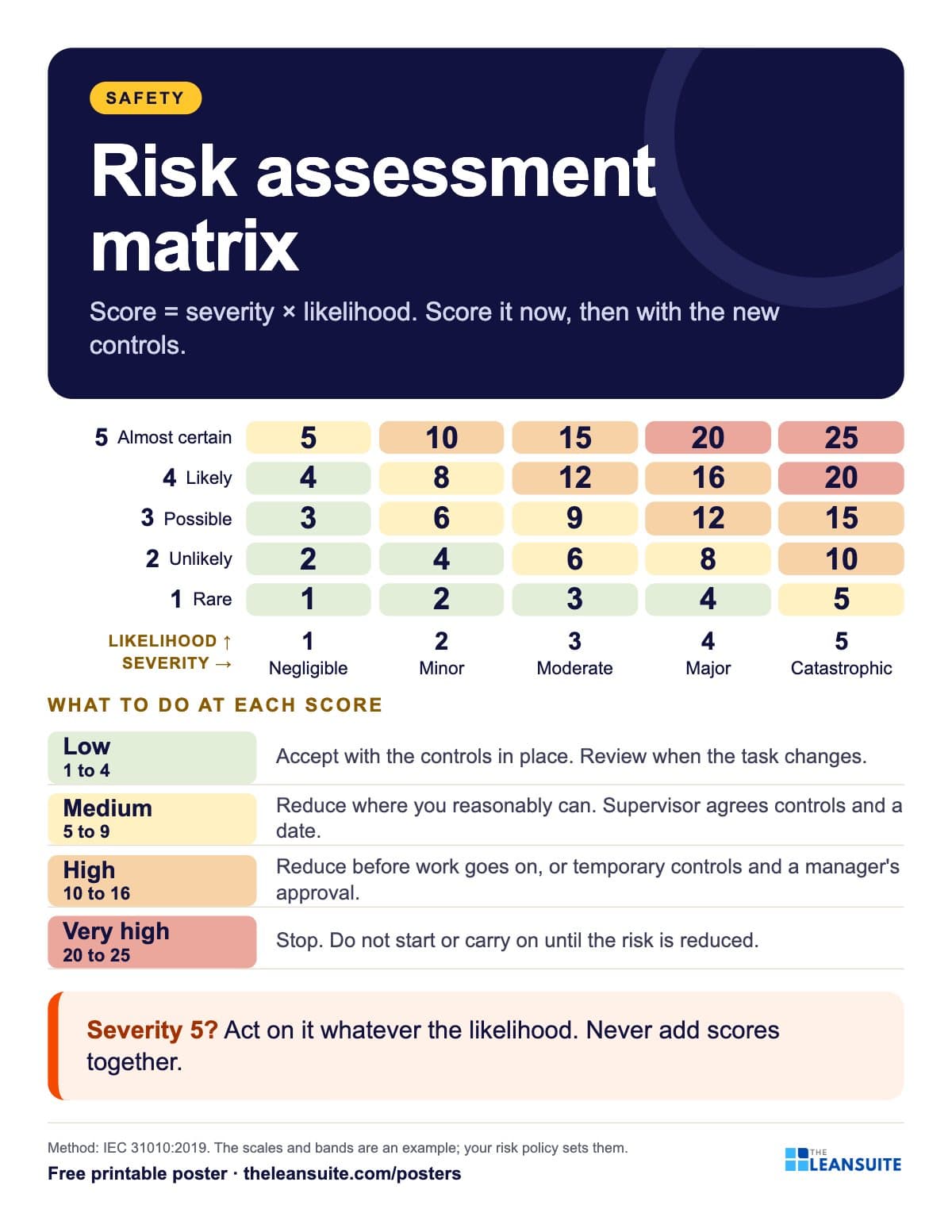
A 5 x 5 severity and likelihood grid, the four risk bands and what to do at each.
Where to hang it
Hang it where risk assessments and job safety analyses are done, so everyone scores with the same words.
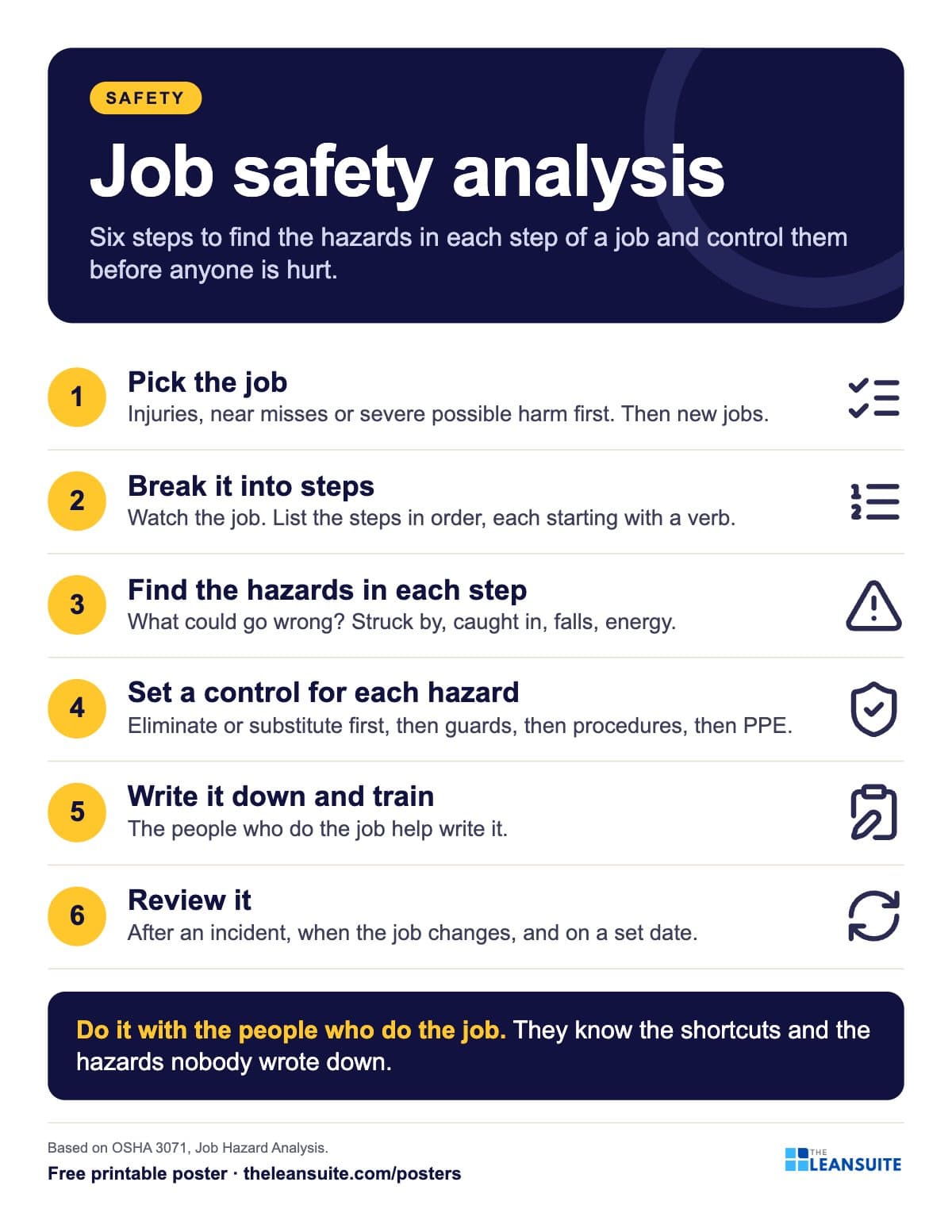
Six steps of a job safety analysis, from picking the job to keeping it up to date.
Where to hang it
Post it where JSAs are written and reviewed: the safety office, the maintenance shop, the team area.
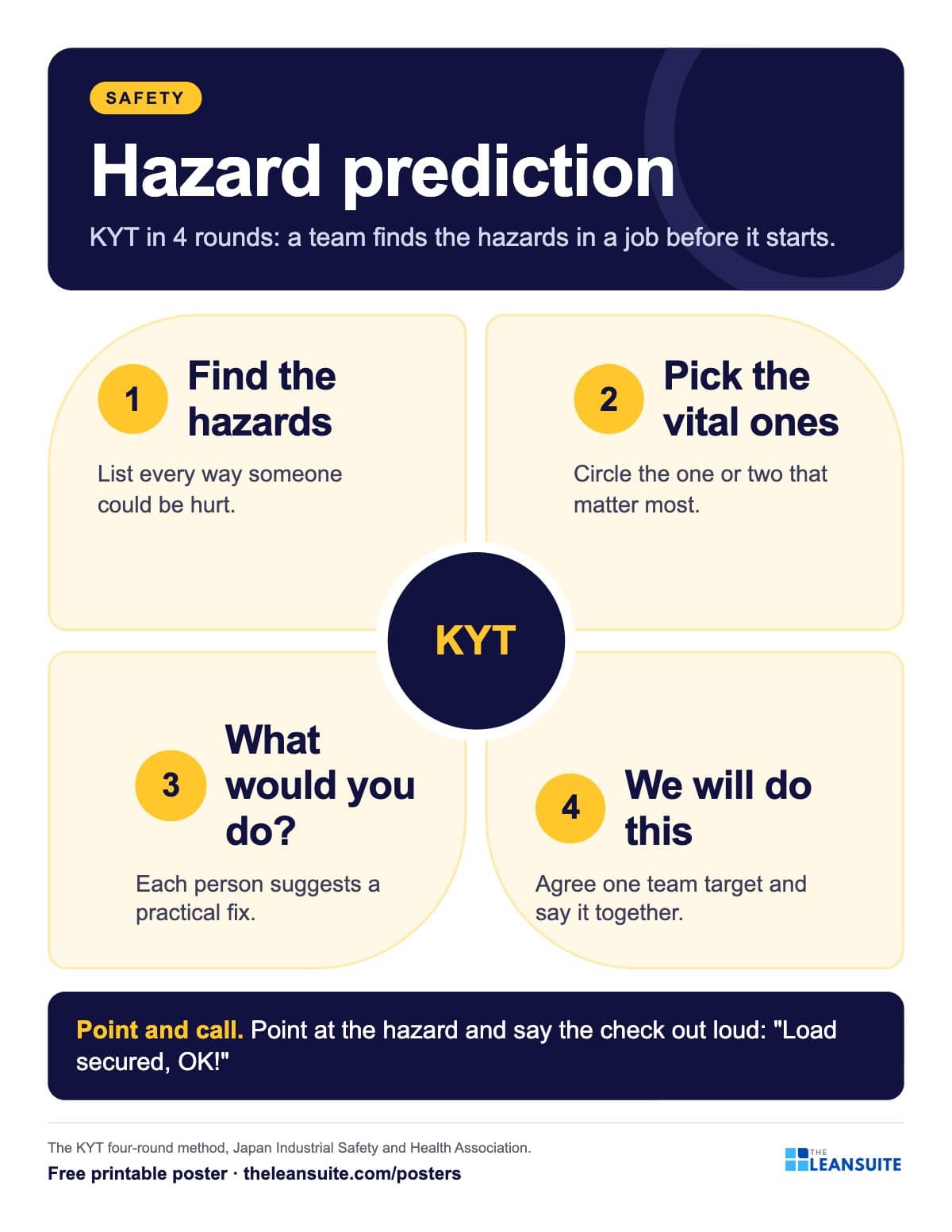
The four rounds of hazard prediction training (KYT), done by a team before the job starts.
Where to hang it
At the job: the start of a non-routine job or a changeover, around a photo or the real machine.
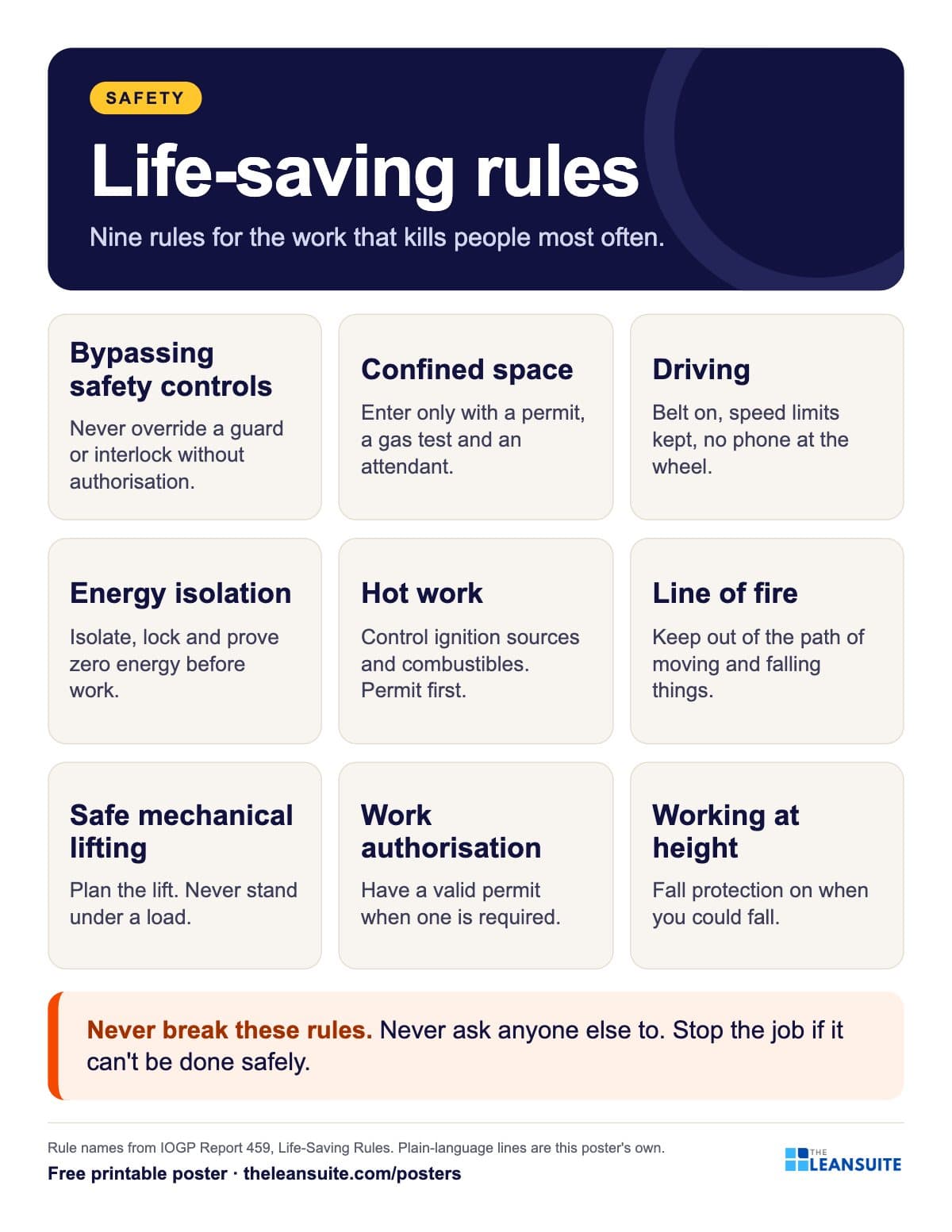
The nine IOGP life-saving rules, each with what it means on a plant floor.
Where to hang it
Post it at the entrance and at the permit board, and use it in induction for employees and contractors.
Stored energy, permits, heights, hot work, trucks, guards and electricity.
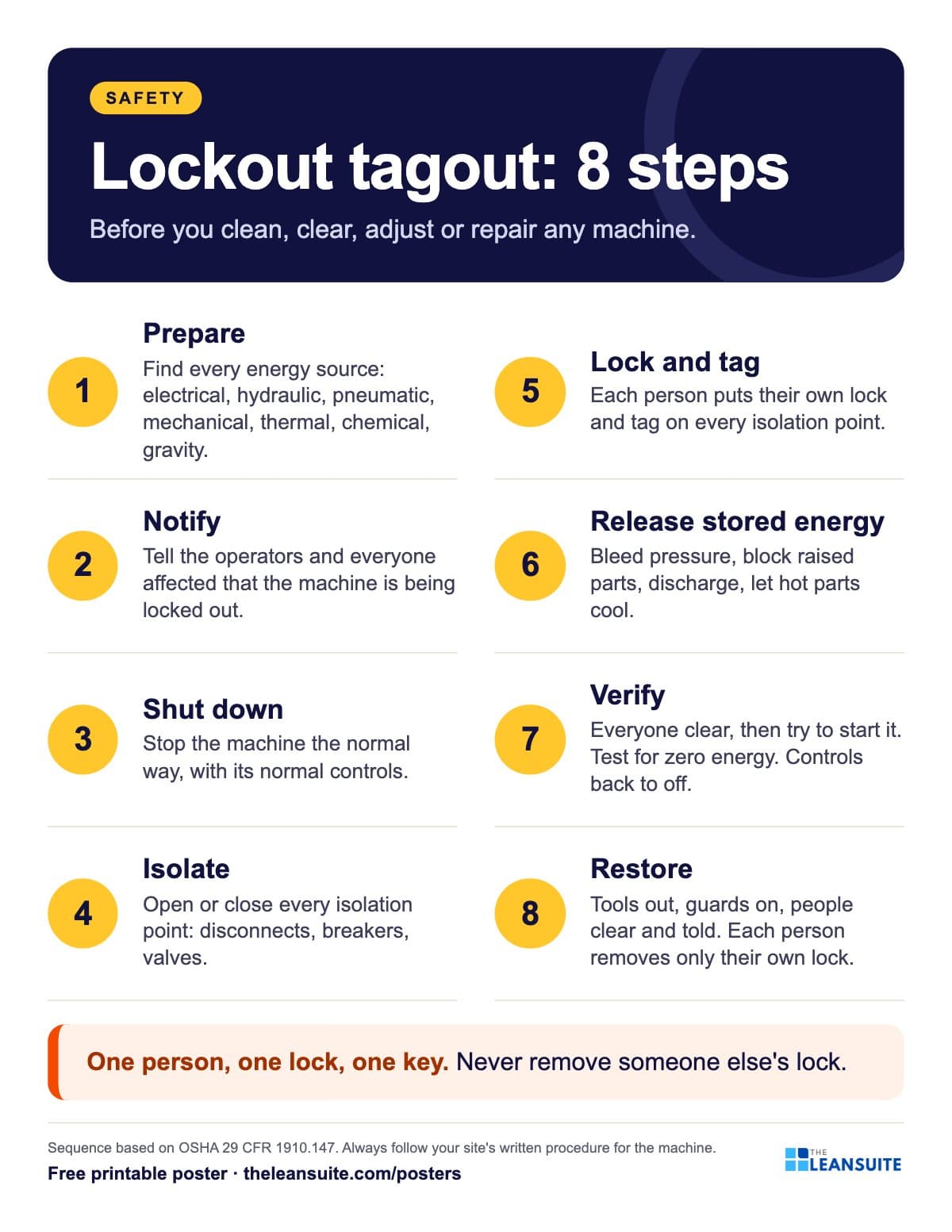
The eight lockout tagout steps, from preparing to restoring, for every machine with stored energy.
Where to hang it
Post it at maintenance benches, lock stations and machines that are often cleared or cleaned.
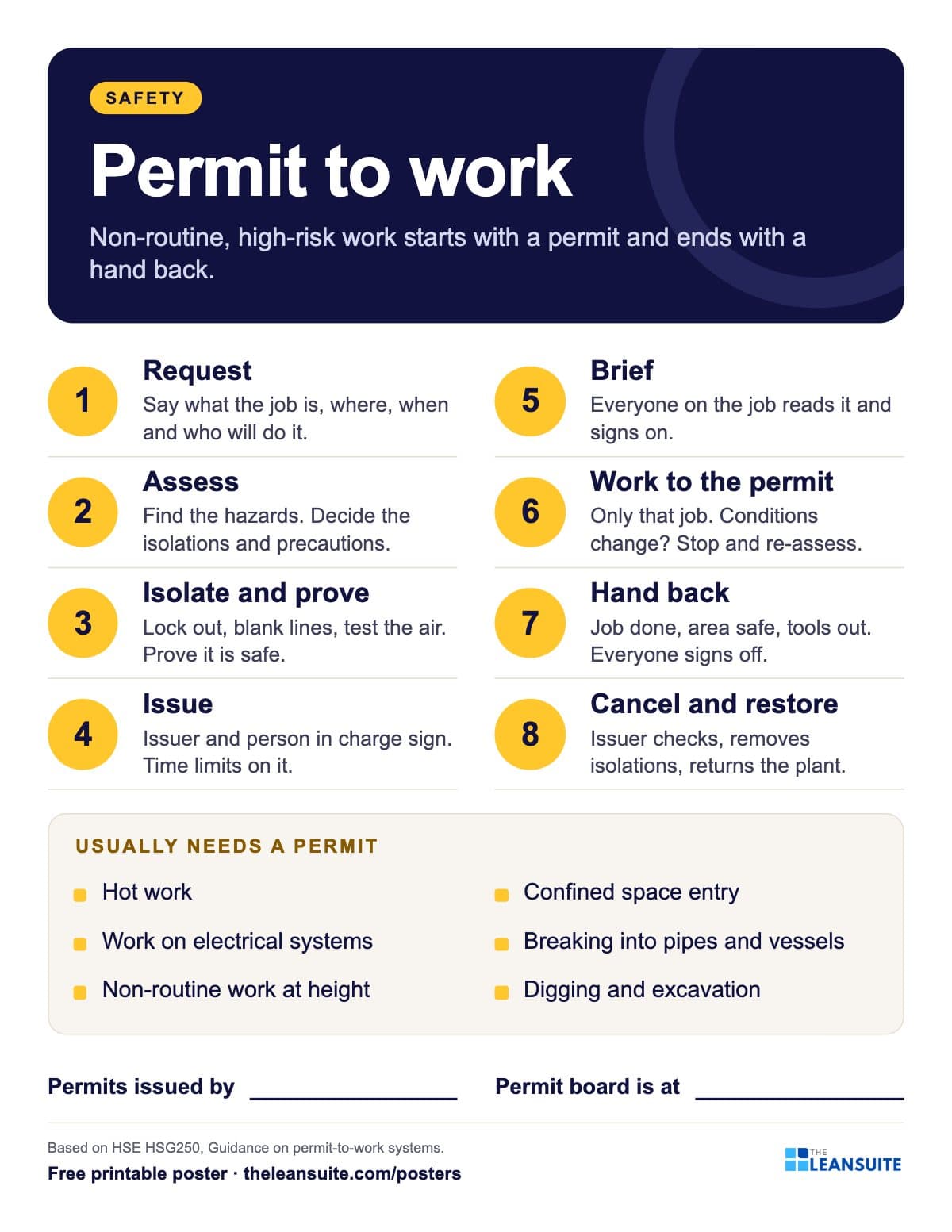
The permit to work cycle in eight steps, from request to cancel, and which jobs need one.
Where to hang it
Post it at the permit board or control room where permits are issued and handed back.
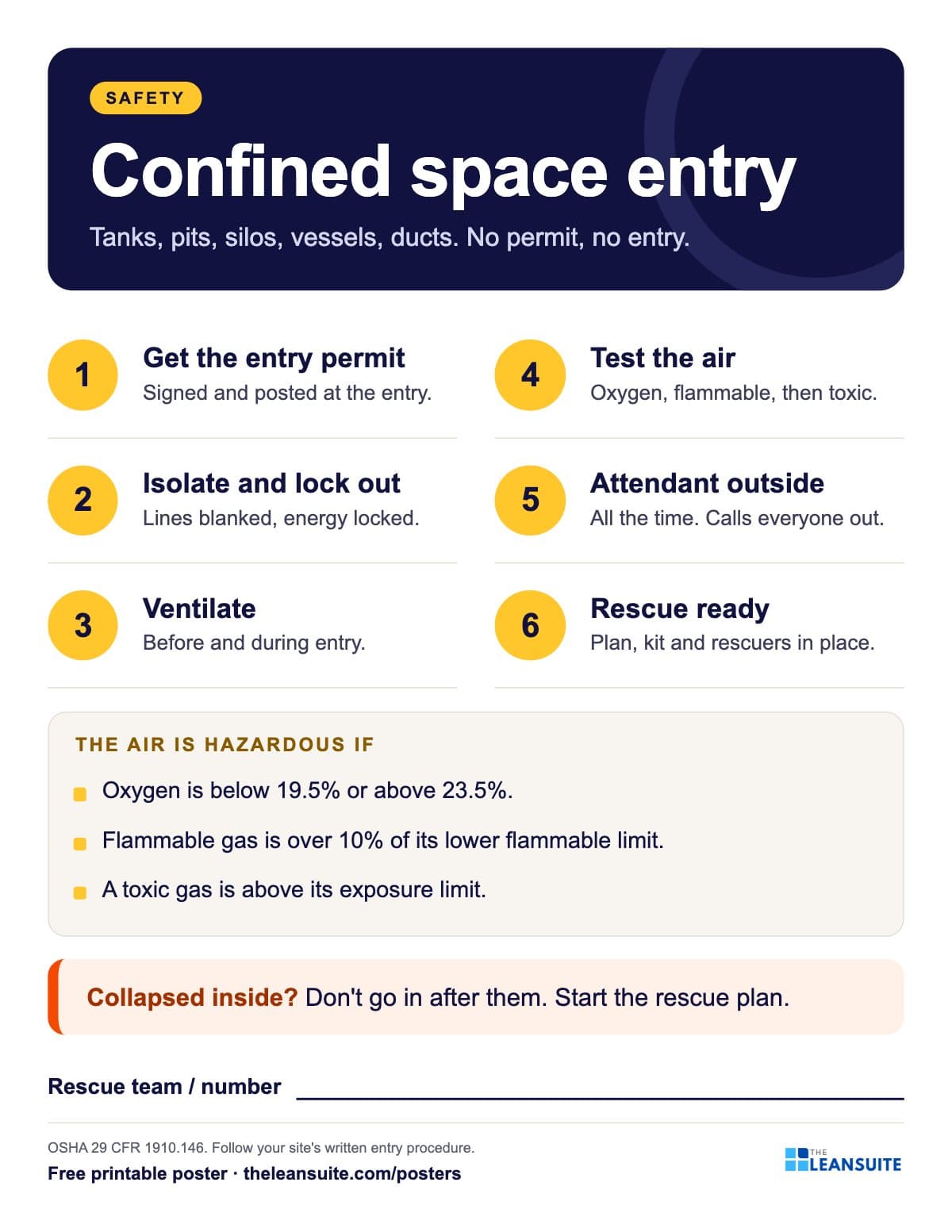
Six steps before anyone enters a confined space, the air test order and the atmosphere limits.
Where to hang it
Post it at the entry points of confined spaces and where entry permits are issued.
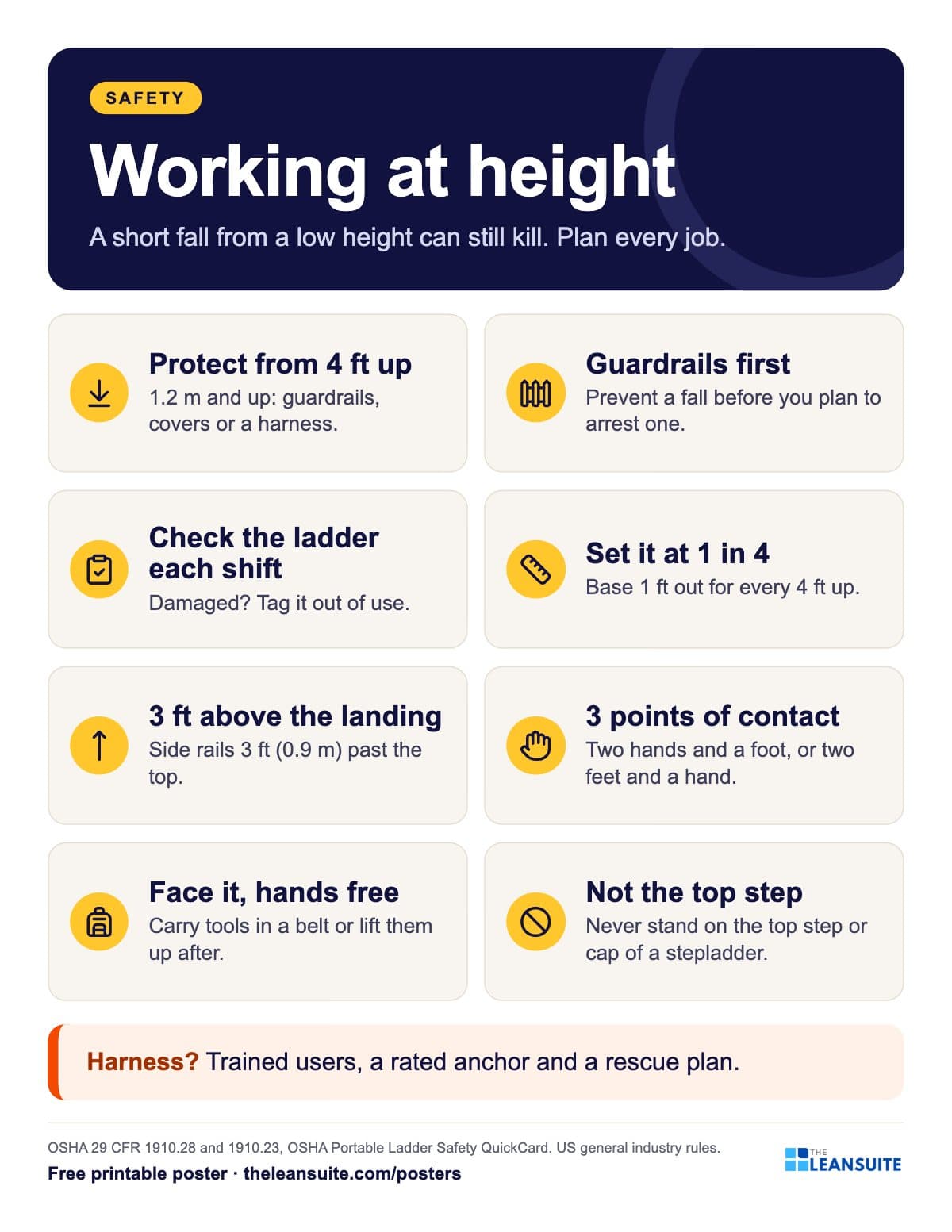
Fall protection and ladder rules: 4 ft, 1 in 4, 3 ft above the landing, three points of contact.
Where to hang it
Post it where ladders are stored and at mezzanines, platforms and racking.
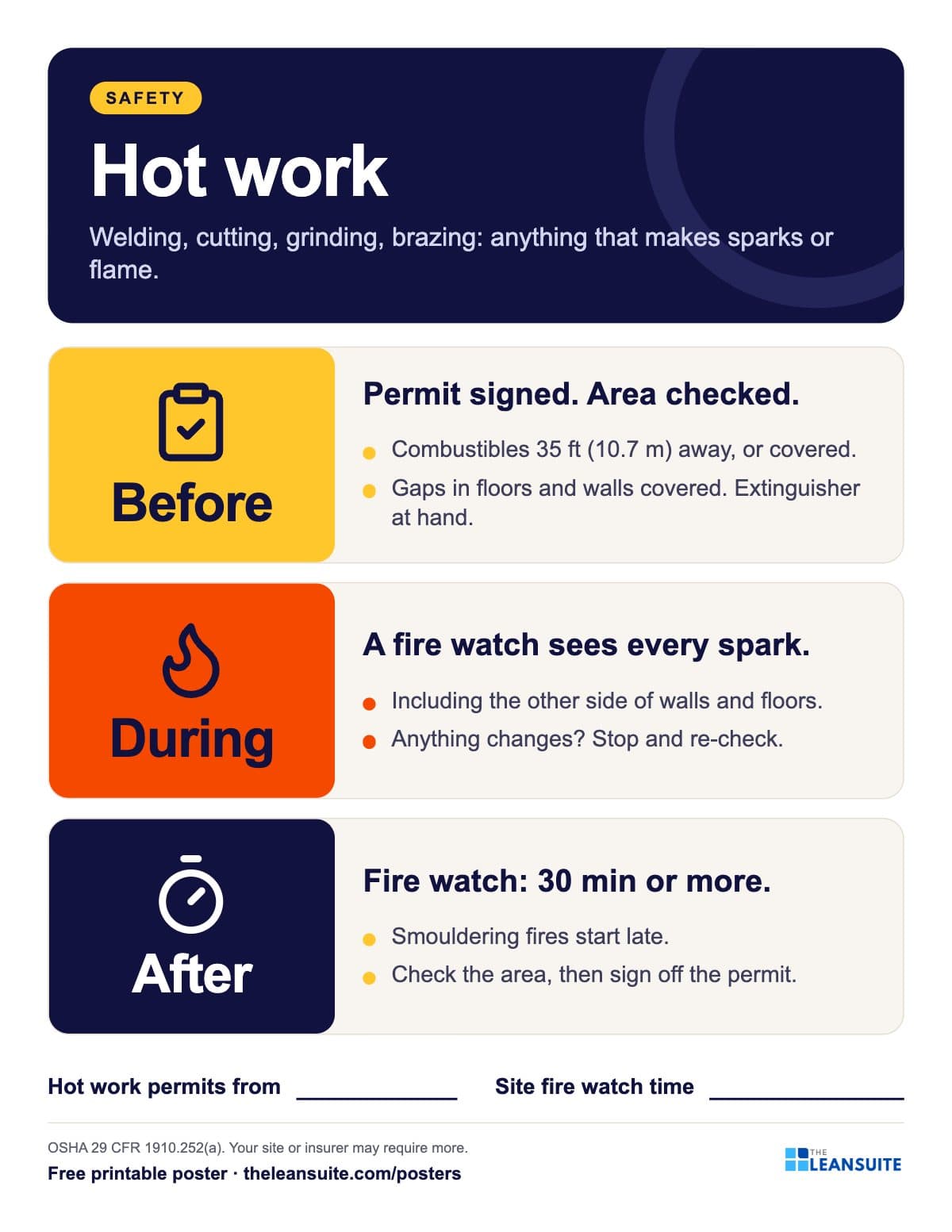
Before, during and after welding, cutting or grinding: the 35 ft rule and the fire watch.
Where to hang it
Post it at welding bays and where hot work permits are issued.
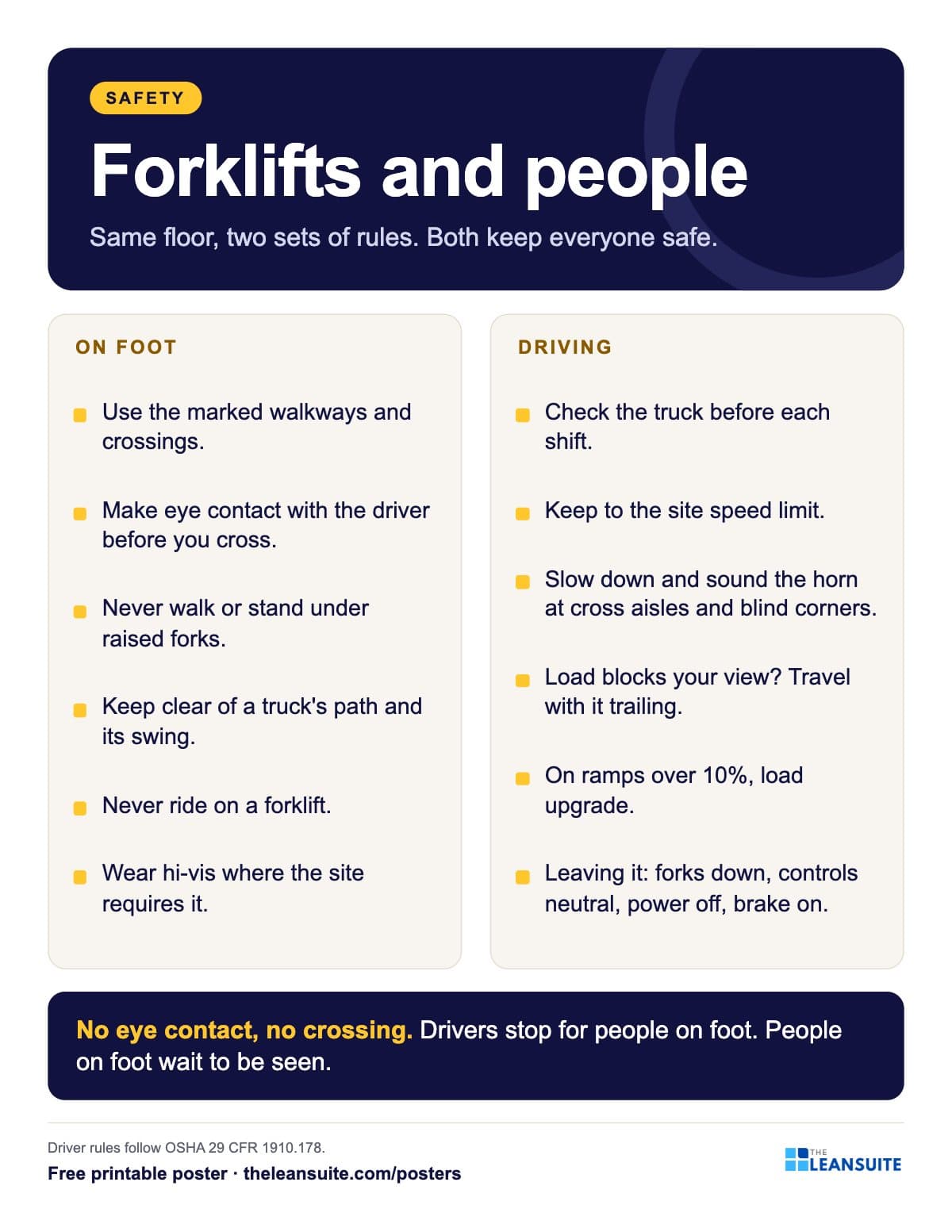
Rules for people on foot and for forklift drivers, side by side, where they share the floor.
Where to hang it
Post it at walkway crossings, dock doors and the forklift charging area.
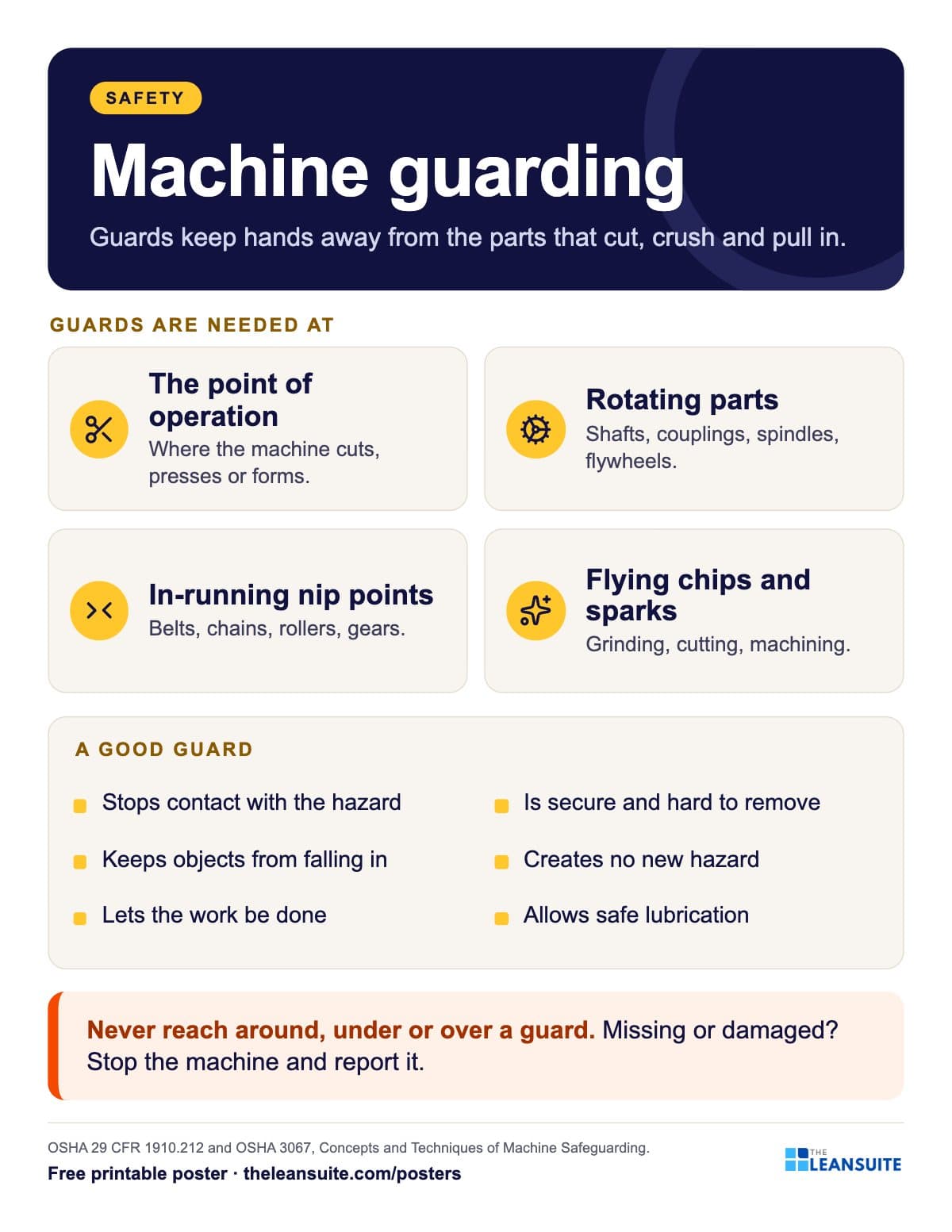
Where guards are needed, what a good guard must do, and what to do if one is missing.
Where to hang it
Post it on machines in the production area and at the maintenance bench.
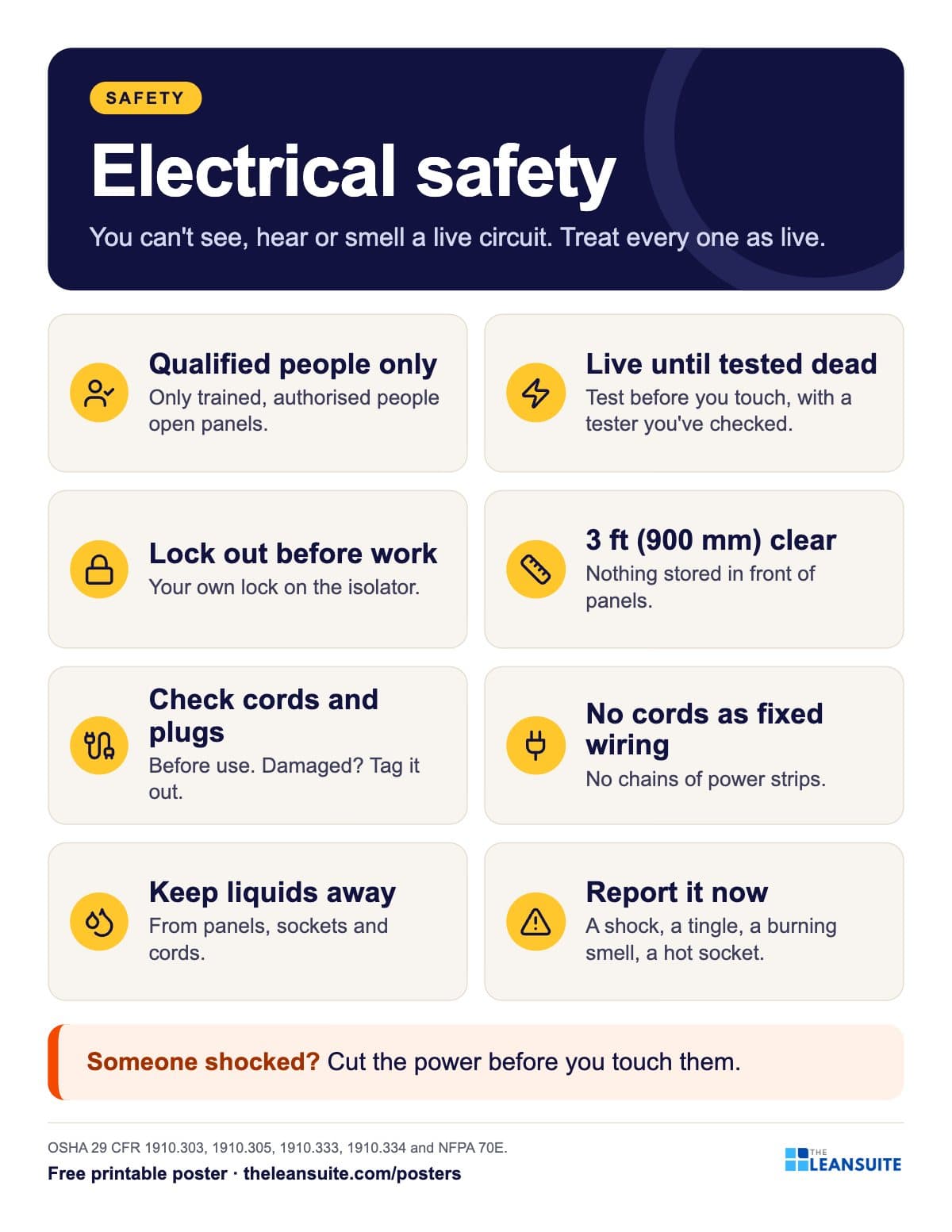
Eight electrical safety basics for everyone on the floor, not only electricians.
Where to hang it
Post it near electrical rooms, panels and charging areas, and in the maintenance shop.
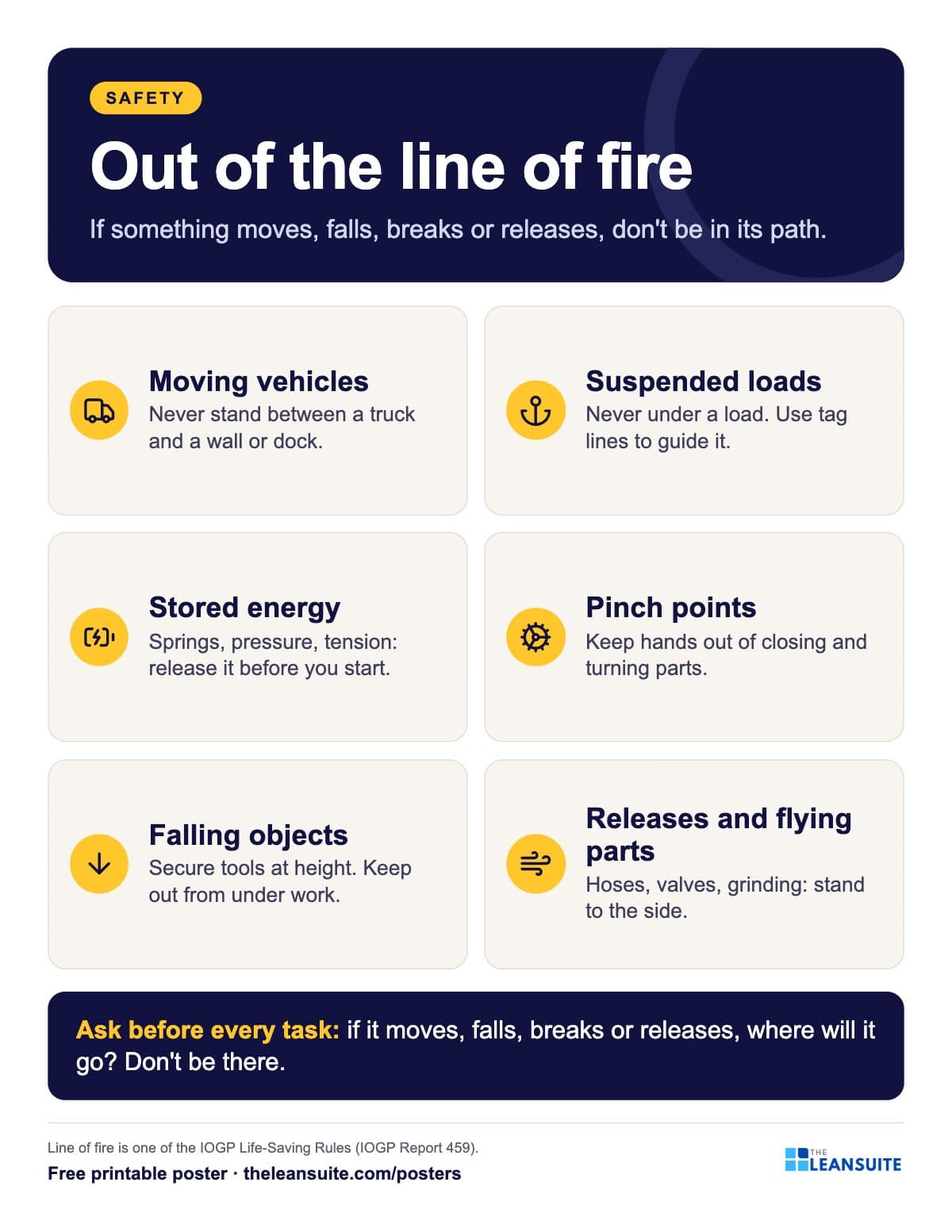
Six line of fire hazards, from suspended loads to stored energy, and the question to ask first.
Where to hang it
Post it at maintenance benches, docks, crane areas and test rigs.
Hands, lifting, workstations, noise and heat.
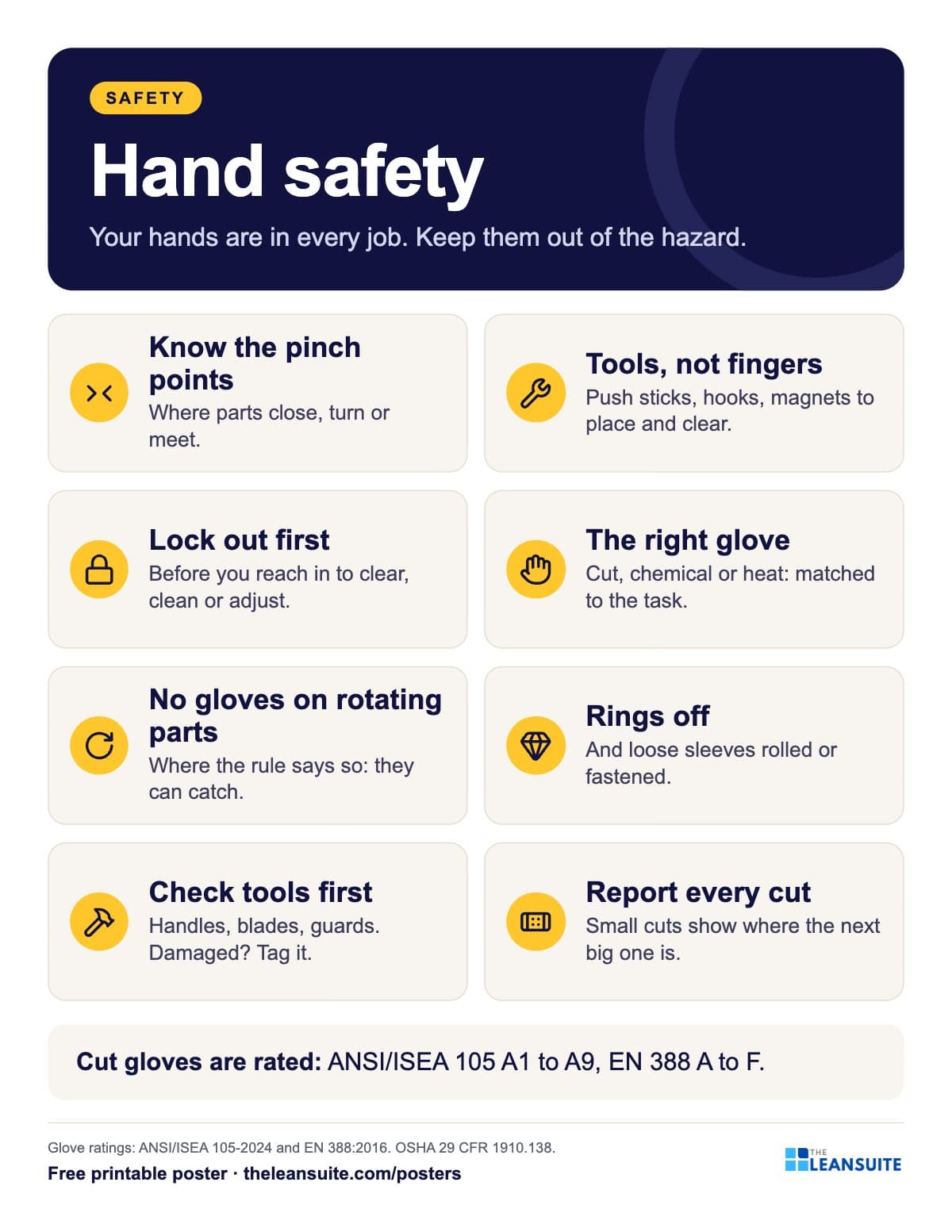
Eight habits that prevent hand injuries, and how cut-resistant gloves are rated.
Where to hang it
Post it at workstations with sharp parts, presses and rotating equipment.
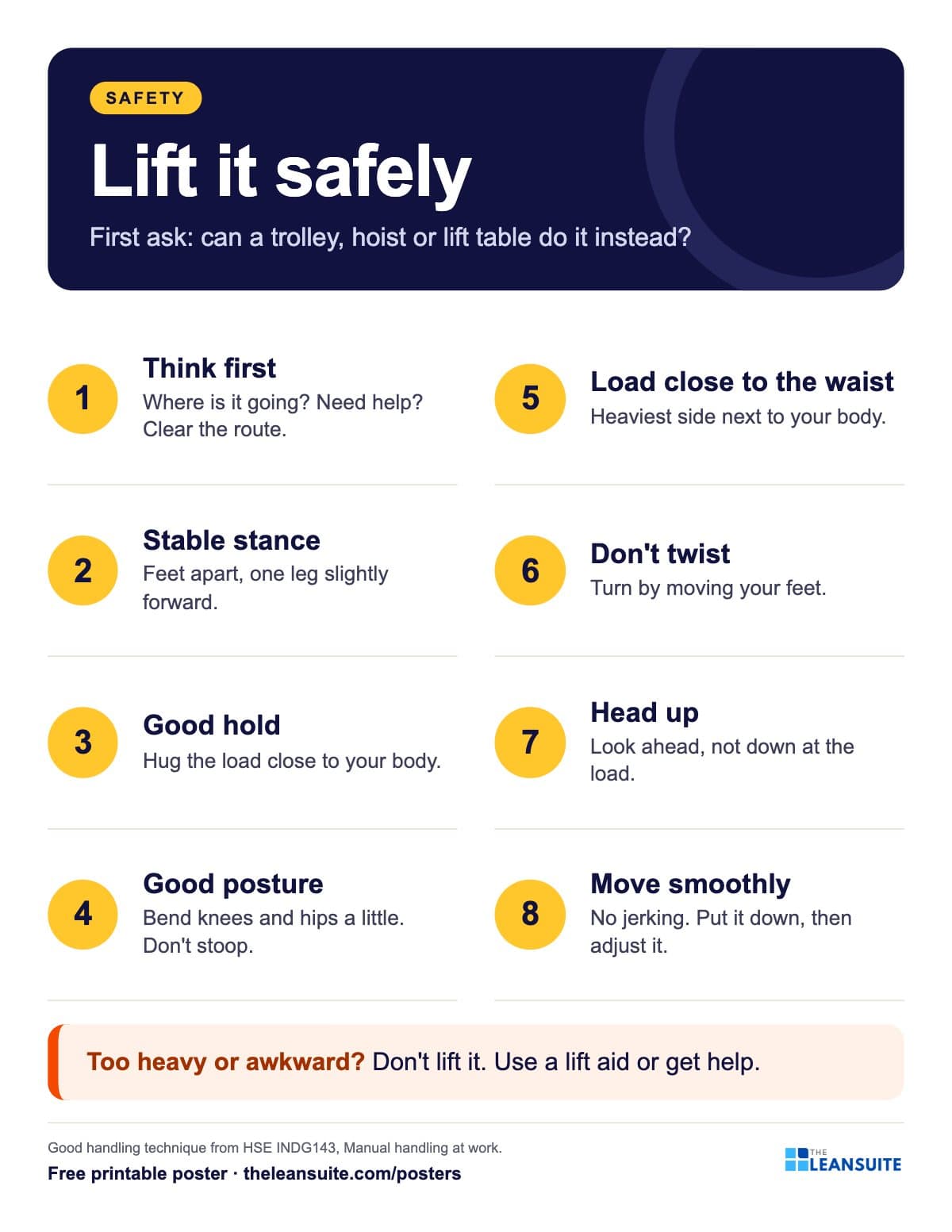
Eight steps of a good lift, from planning it to putting the load down.
Where to hang it
Post it where loads are lifted by hand: stores, docks, line feeding and kitting.
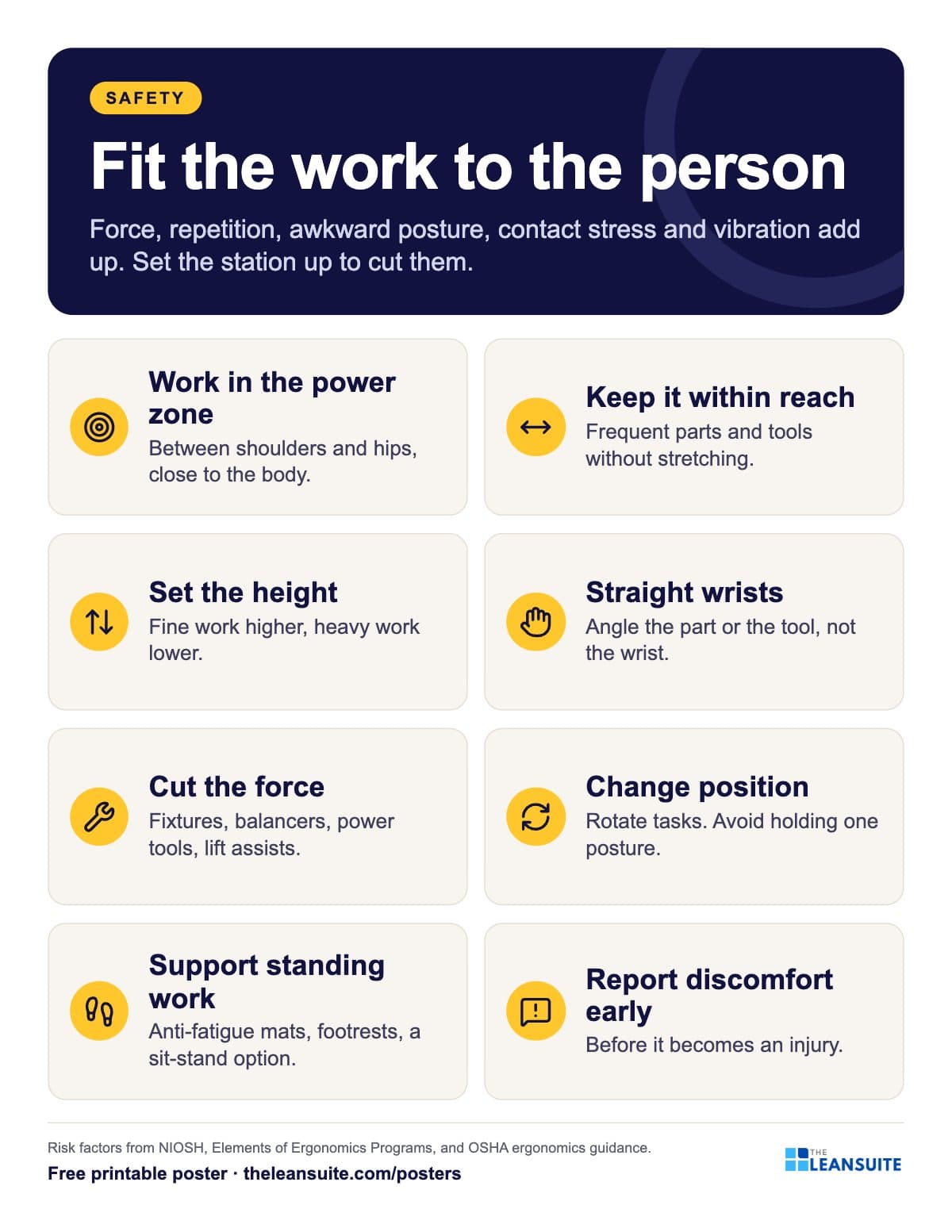
The ergonomic risk factors and eight ways to make a workstation fit the person.
Where to hang it
Post it at assembly, packing and inspection stations.
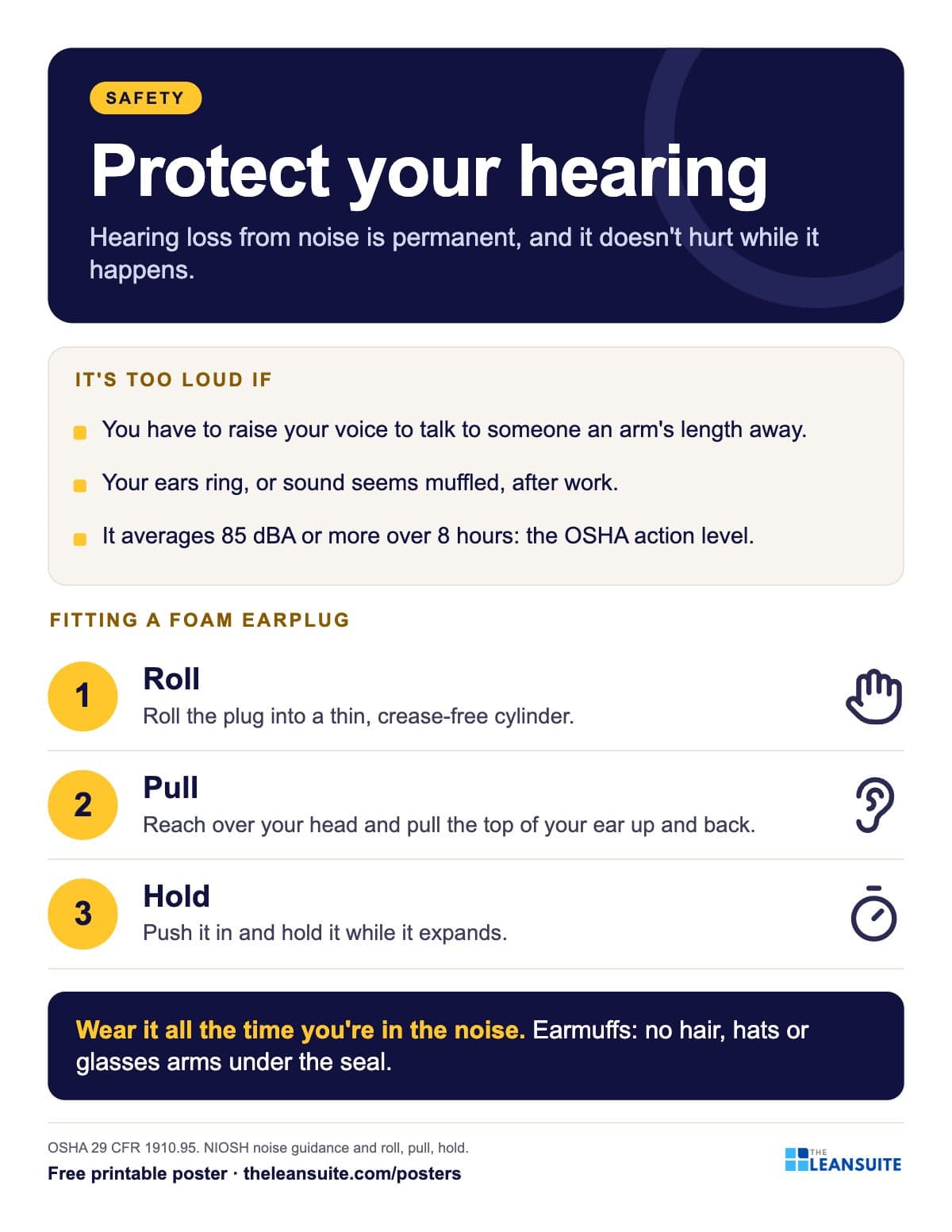
How to tell noise is too loud, the 85 dBA action level, and roll, pull, hold for foam earplugs.
Where to hang it
Post it at the entrance to noisy areas and next to earplug dispensers.
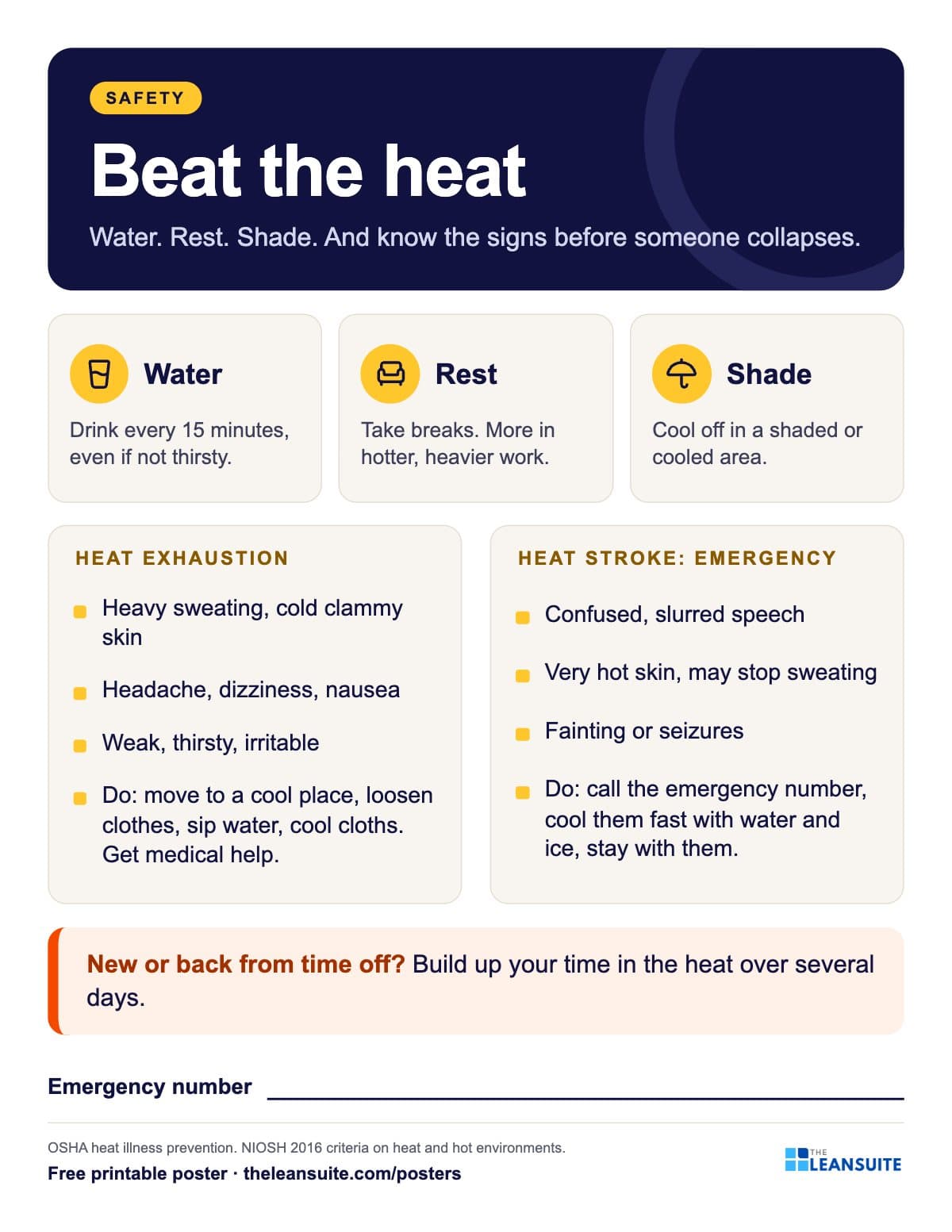
Water, rest, shade, and how to tell heat exhaustion from heat stroke and what to do.
Where to hang it
Post it in hot areas (furnaces, ovens, paint shops, docks in summer) and in break rooms.
Hazard labels, eyewash stations and fire extinguishers.
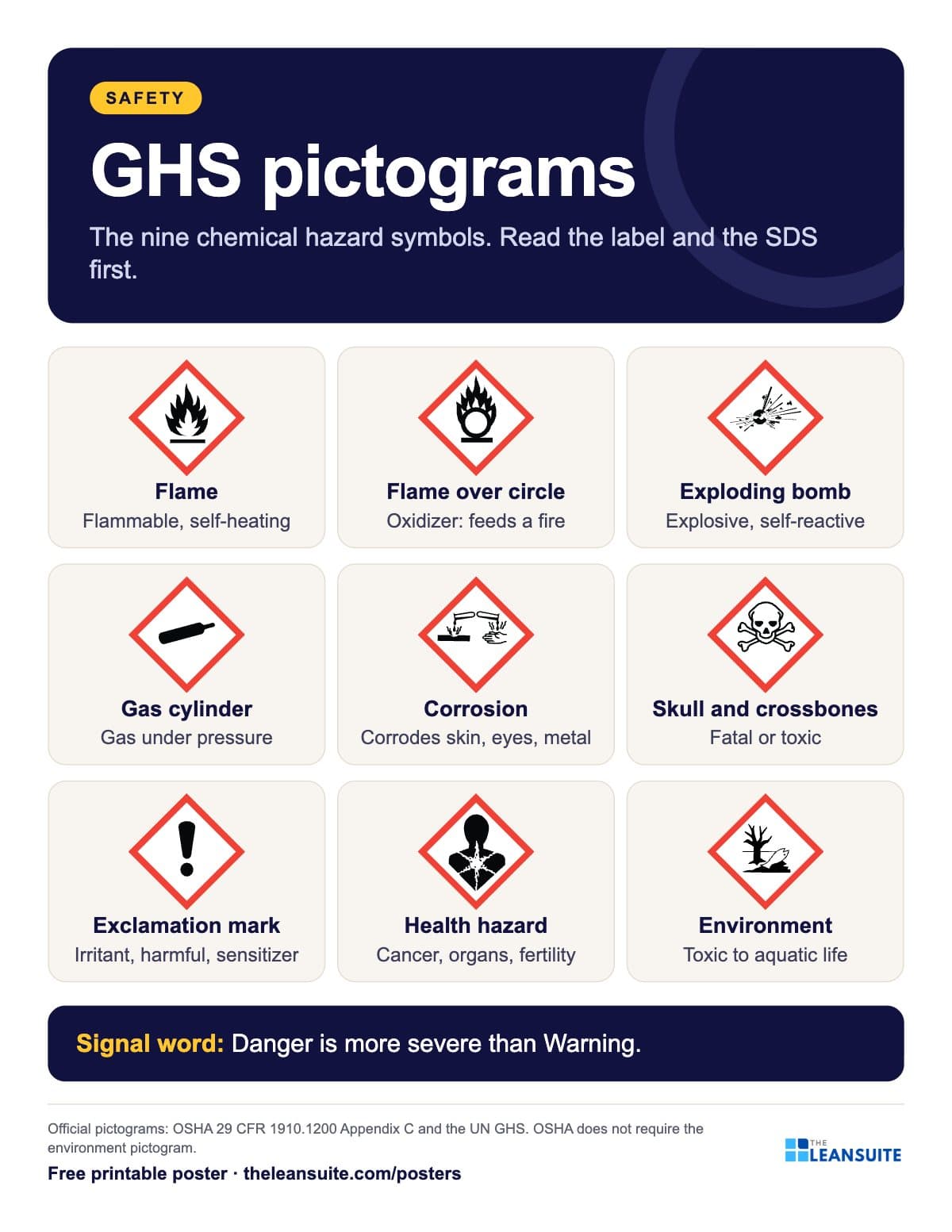
The nine GHS hazard pictograms, what each one warns of, and how to read the label.
Where to hang it
Post it in chemical stores, at dispensing points, in labs and maintenance shops.
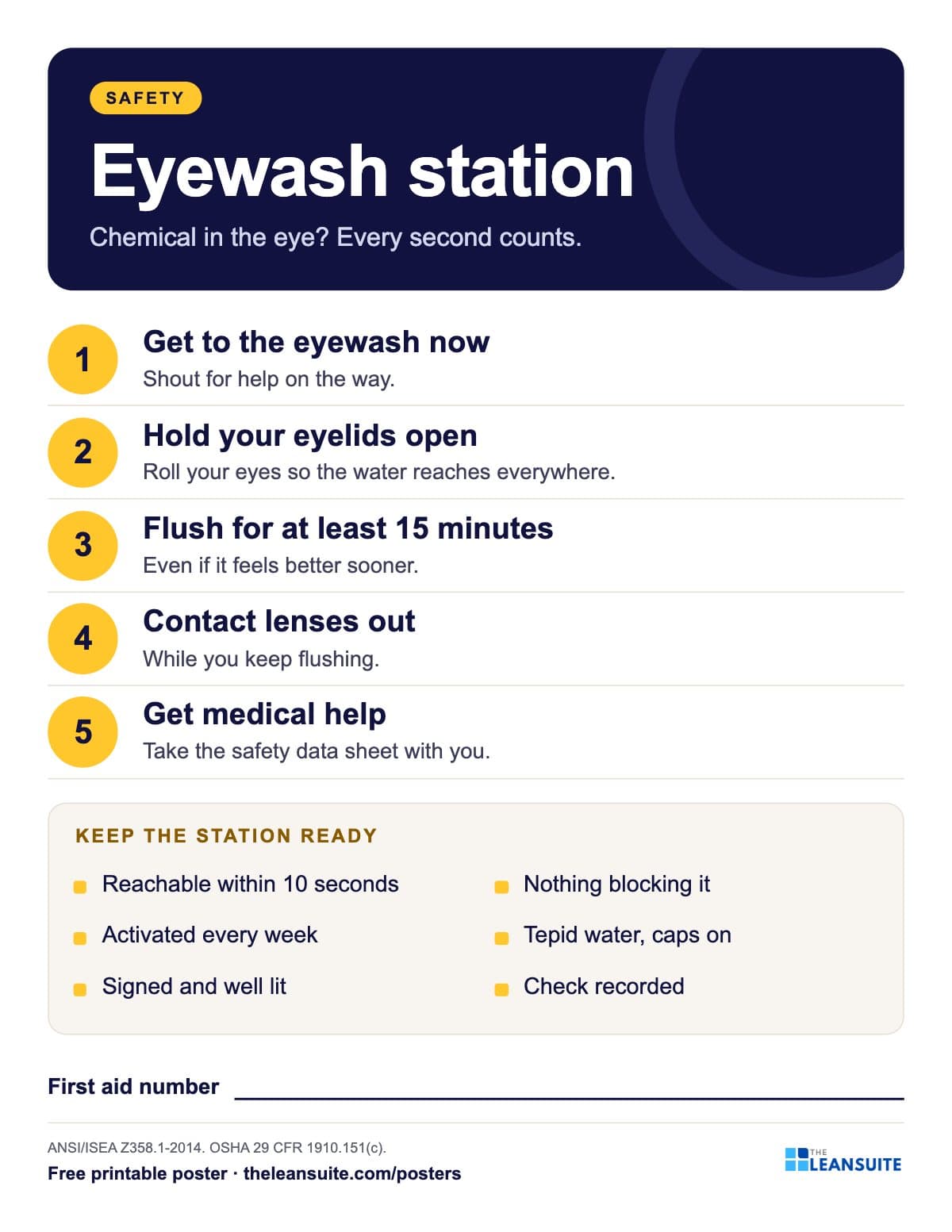
How to use an eyewash after a splash, and the checks that keep the station ready.
Where to hang it
Post it right next to every eyewash station and safety shower.
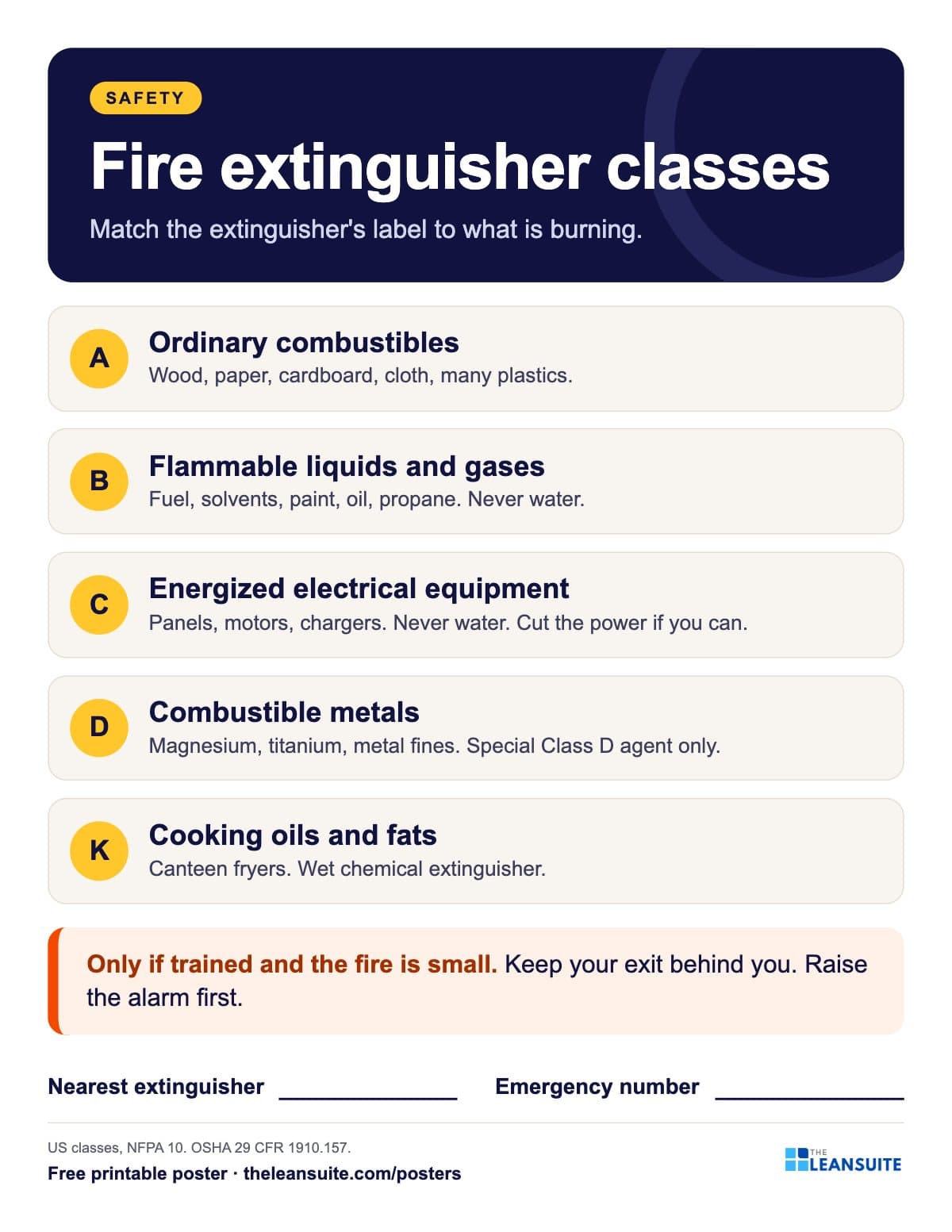
The five US fire classes, what burns in each, and which extinguisher label to look for.
Where to hang it
Post it next to extinguisher points and in welding, paint and battery charging areas.
Near misses, safety conversations, investigations and the daily record.
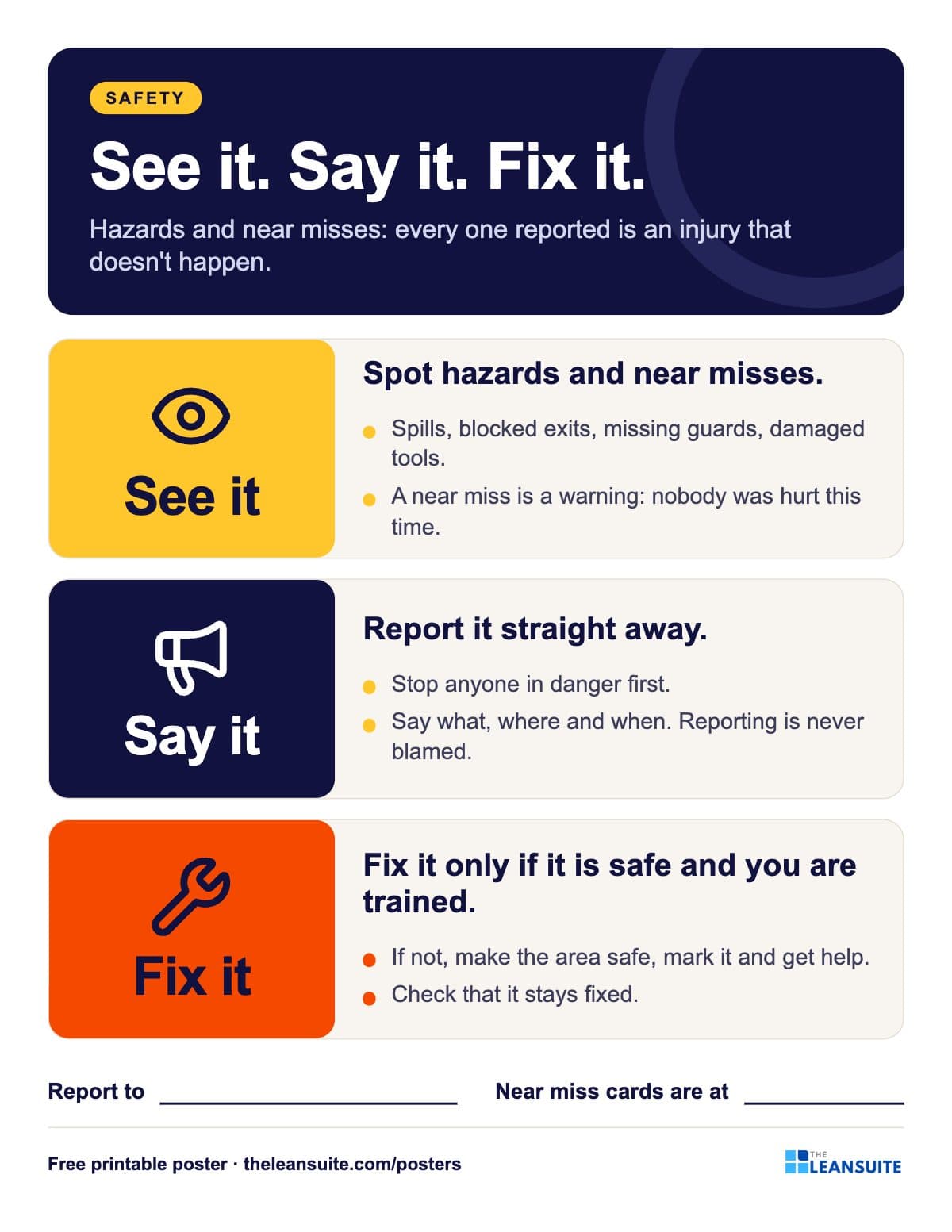
Hazard and near miss reporting in three words, with what each step means on the floor.
Where to hang it
Put it next to the near miss card box or the QR code people scan to report.
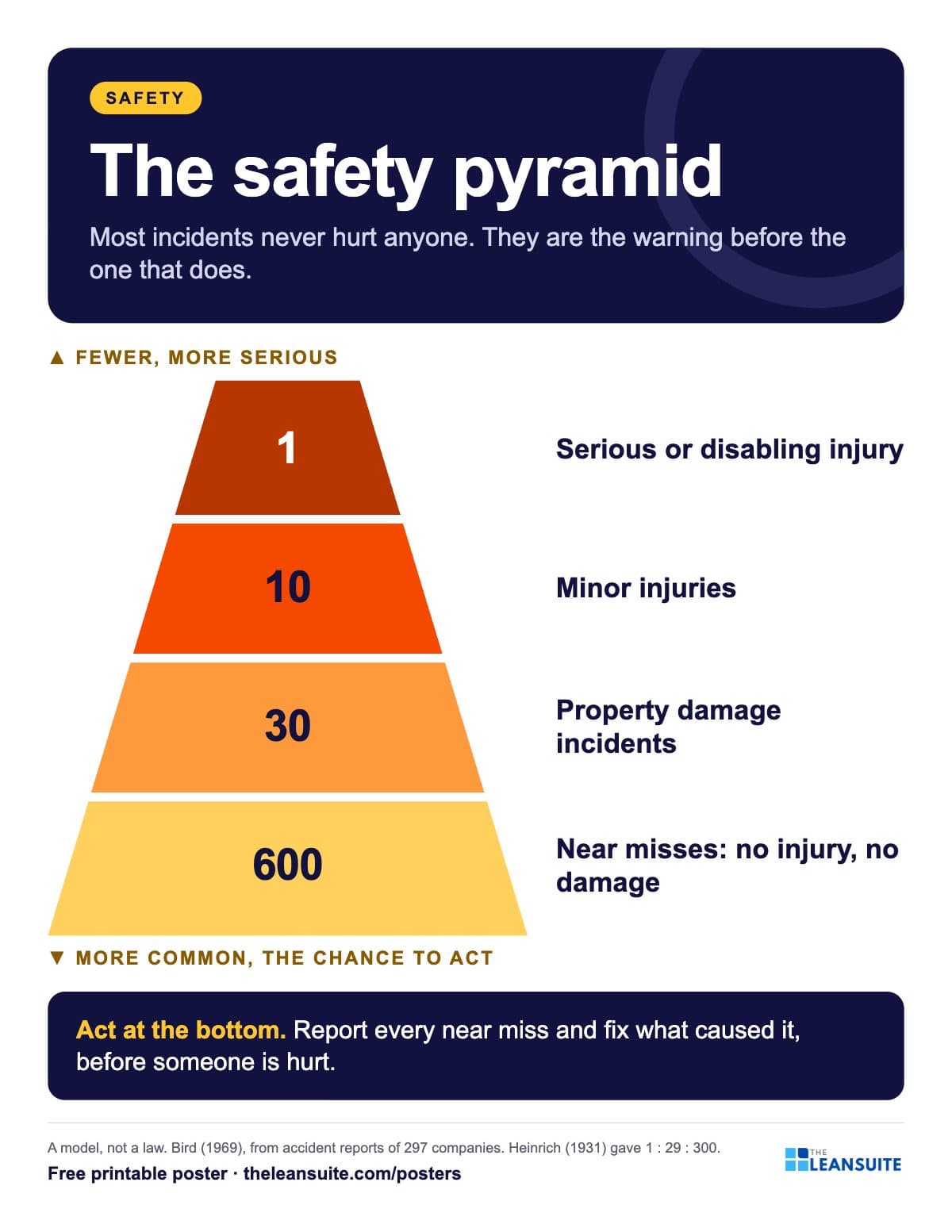
Bird's accident ratio as a pyramid, labelled as a model with its source, and why near misses matter.
Where to hang it
By the safety board, next to your own near miss count for the month.
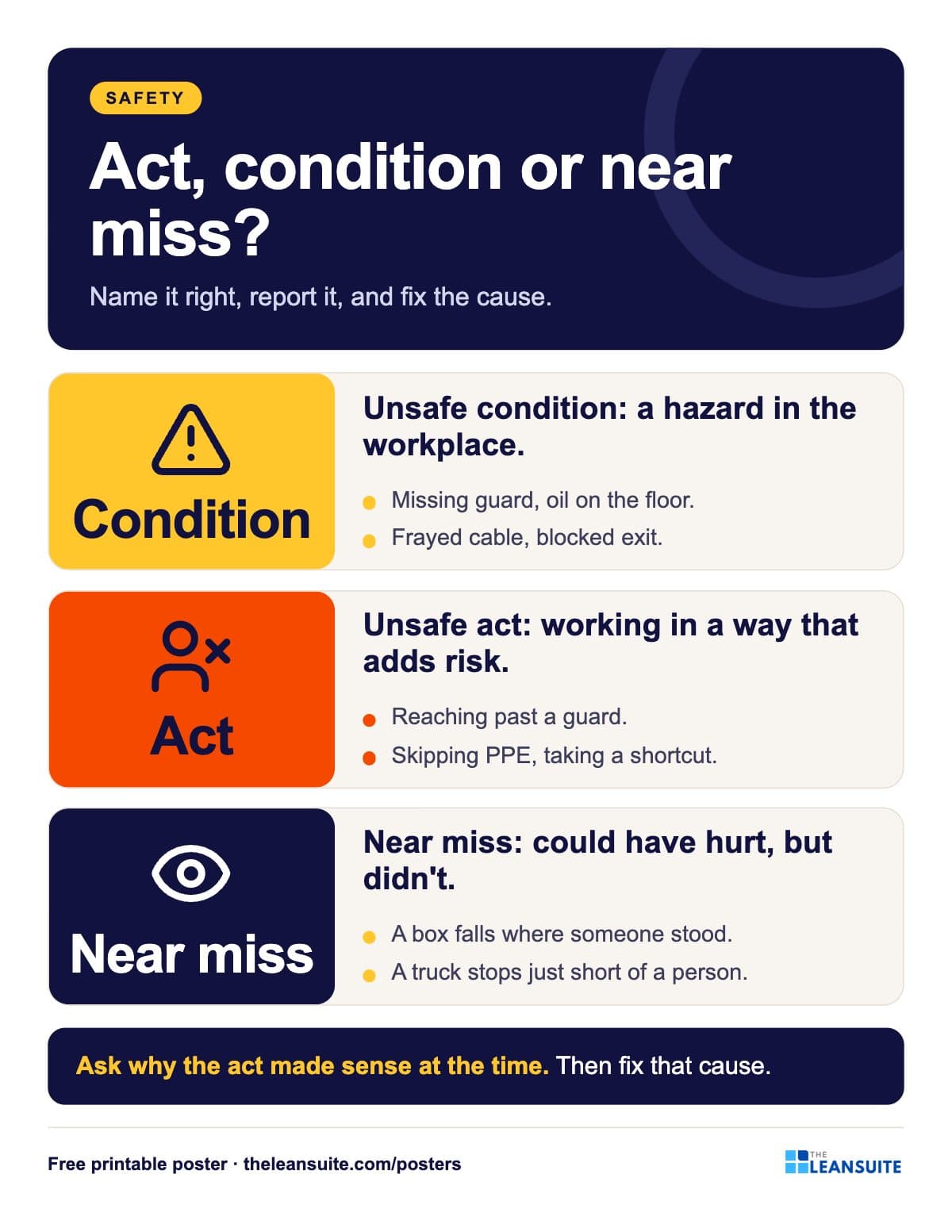
Unsafe condition, unsafe act and near miss, defined with shop floor examples.
Where to hang it
Post it next to the hazard report box or QR code, so people know which box to tick.
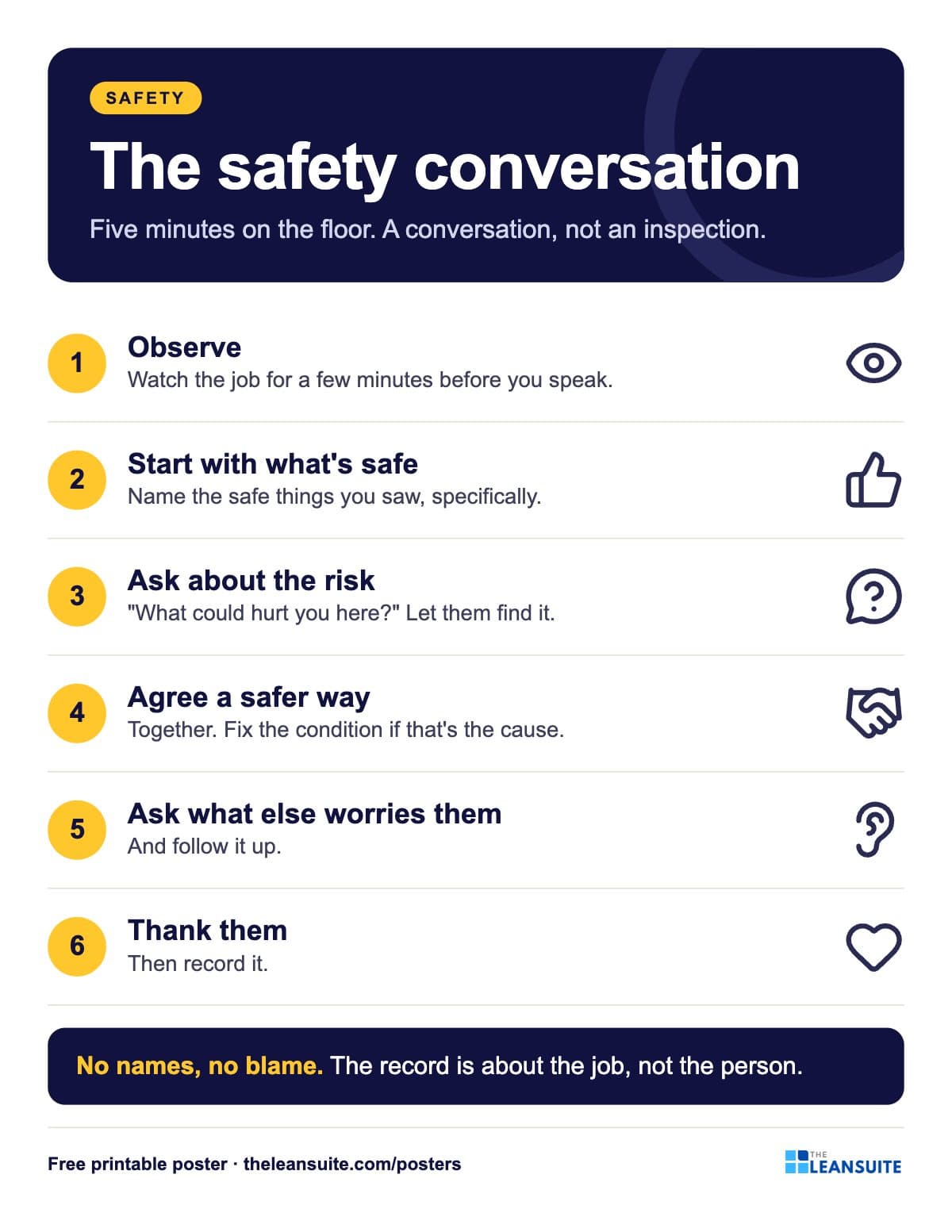
Six steps for a safety conversation on the floor: observe, praise, ask, agree, listen, thank.
Where to hang it
In the team area, with a copy for everyone who does safety walks or behaviour observations.
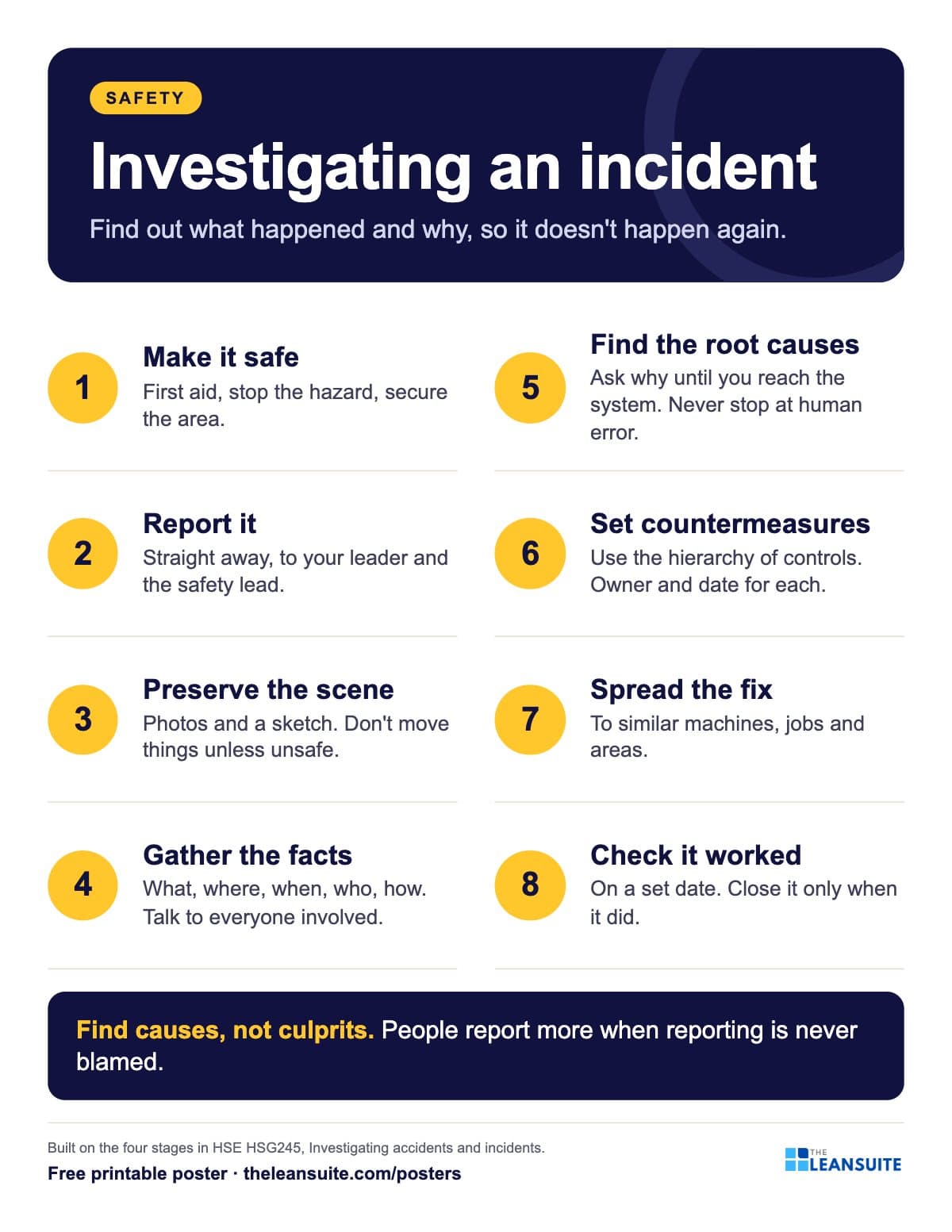
Eight steps from making the scene safe to checking that the fix worked and spreading it.
Where to hang it
Post it in the safety office and on the team board where incidents are reviewed.
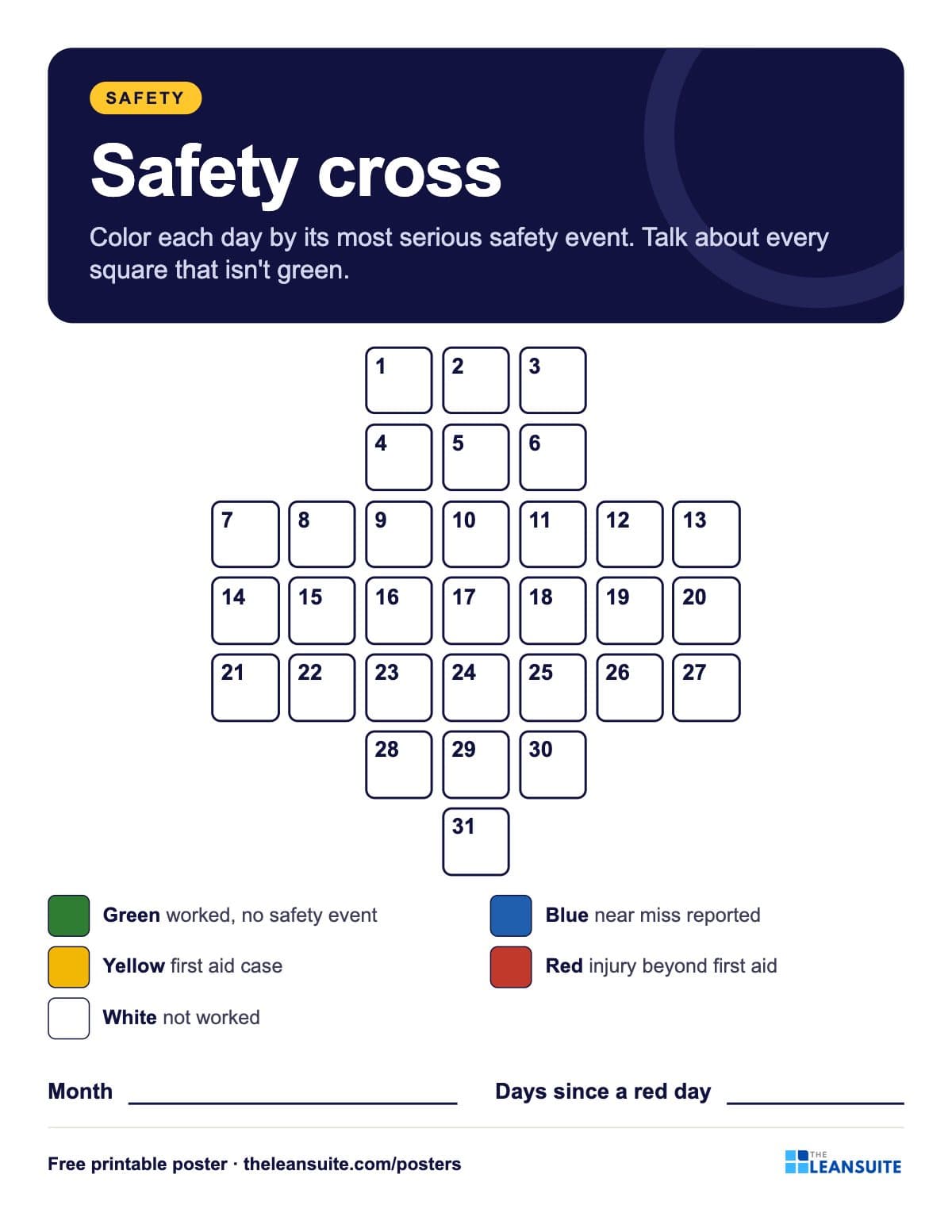
A wall-size safety cross for the month, to color in each day at the huddle.
Where to hang it
Print one per month at 18 x 24 in or larger and put it on the board where the team huddles.
On the floor
Walk the floor with the list. For each area, note the hazards people really meet there: trucks, stored energy, chemicals, noise, lifting.
Pick the posters that match those hazards, starting with the ones your own near miss and incident records point to.
Hang each one where its card says. A poster works at the place and moment the hazard shows up, not in the break room.
Check each poster against your own site rules, risk assessments and written procedures. Fill in the blanks (emergency numbers, who issues permits) before you put it up.
Use one poster as the topic of a short talk at the start of shift, then ask the crew what they see on the walk.
One vector PDF per size, one poster per page, 6.0 MB at A3. Opens after a short form, once.
Free to use: print it, copy it and edit it for your team. Enter your name and work email once to download.
The posters are general guidance and a reminder, not a replacement for your risk assessments, written procedures or local regulations. Check each one against your own rules before you put it up.
FAQs
Yes. Print them and pin them up as often as you like. The print PDFs open after you enter your name and work email once, with no account and nothing to pay. Every poster also has a 300 dpi PNG on its own page that downloads straight away with no form.
No. They are reminders of good general practice. Your risk assessments, written procedures (for example each machine's lockout procedure) and local regulations come first, and where a rule calls for a specific sign or label, use that one. Check each poster against your own rules before it goes up.
The pack has A3, Letter and A4. A3 suits a notice board or a station and also prints on 11 x 17 in paper with fit to page; Letter and A4 suit a binder, a clipboard or a handout. For a main wall or a team board, each poster's own page also has A2, 18 x 24 in and 24 x 36 in.
Start with the hazards your own records show. If forklifts and people share aisles, start with the forklift poster at the crossings. If your near miss log is thin, start with the reporting posters next to wherever people report. The shop floor safety rules poster is made for the main entrance.
Print the poster, then write them on by hand. Where a poster needs your site's details, such as who to call or who issues permits, it leaves a blank to write in. The PPE chart is a general guide: cross out or add what differs on your site.
See how plants run their audits, improvements and follow-ups in LeanSuite, on a call built around your own problem.
Book a 45-minute demo