

Quality poster
Updated · Free to print and share
5 whys poster
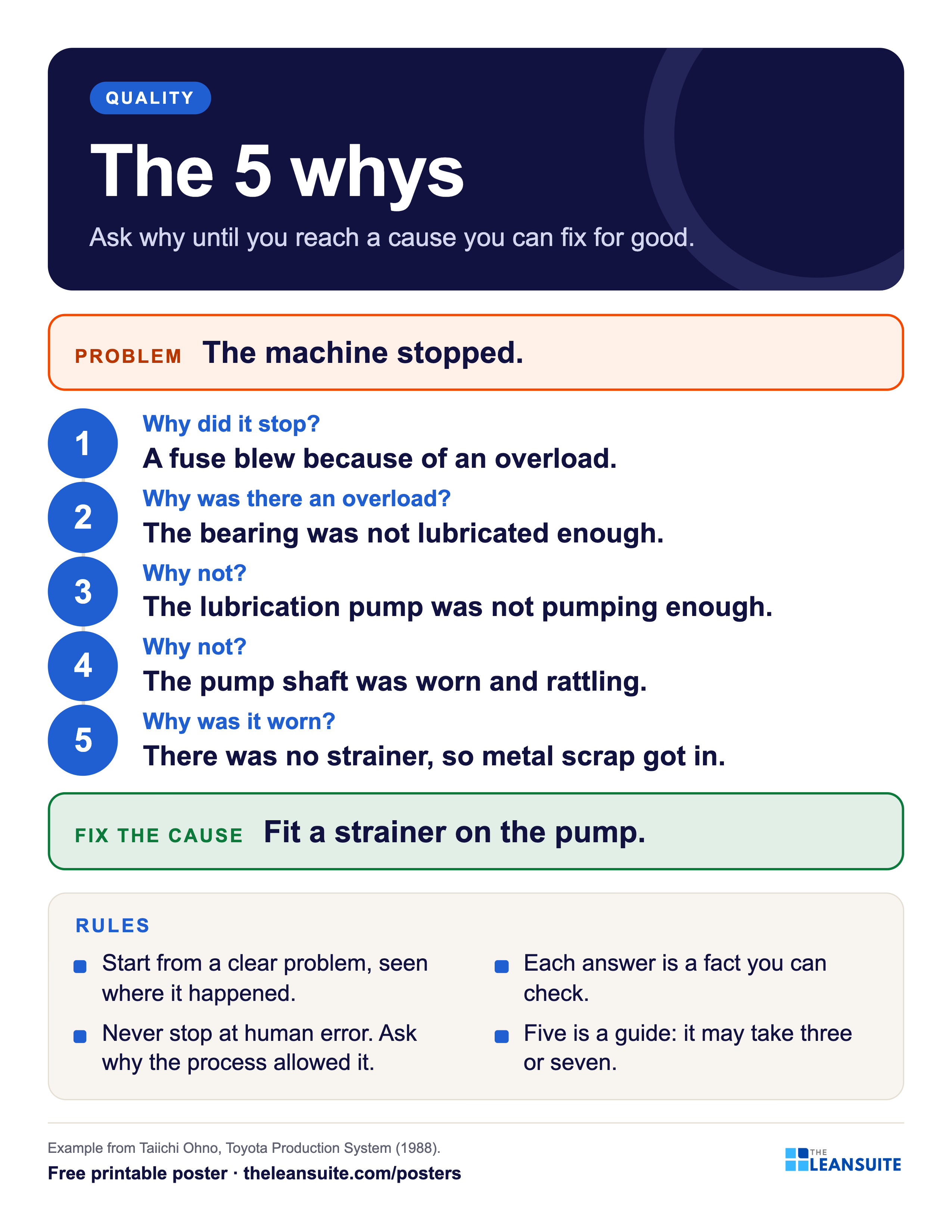
The 5 whys is a root cause method: ask why a problem happened, then why that happened, until you reach a cause that, once fixed, stops the problem coming back. This poster walks through the example Taiichi Ohno used in Toyota Production System, where a stopped machine leads to a pump with no strainer, and lists the rules that keep a 5 whys honest: facts, not guesses, and never stopping at human error.
Download the poster
The PNG is free to download now. The print-ready vector PDFs open after a short form, once.
Free to print and share with your team. Enter your name and work email once to download.
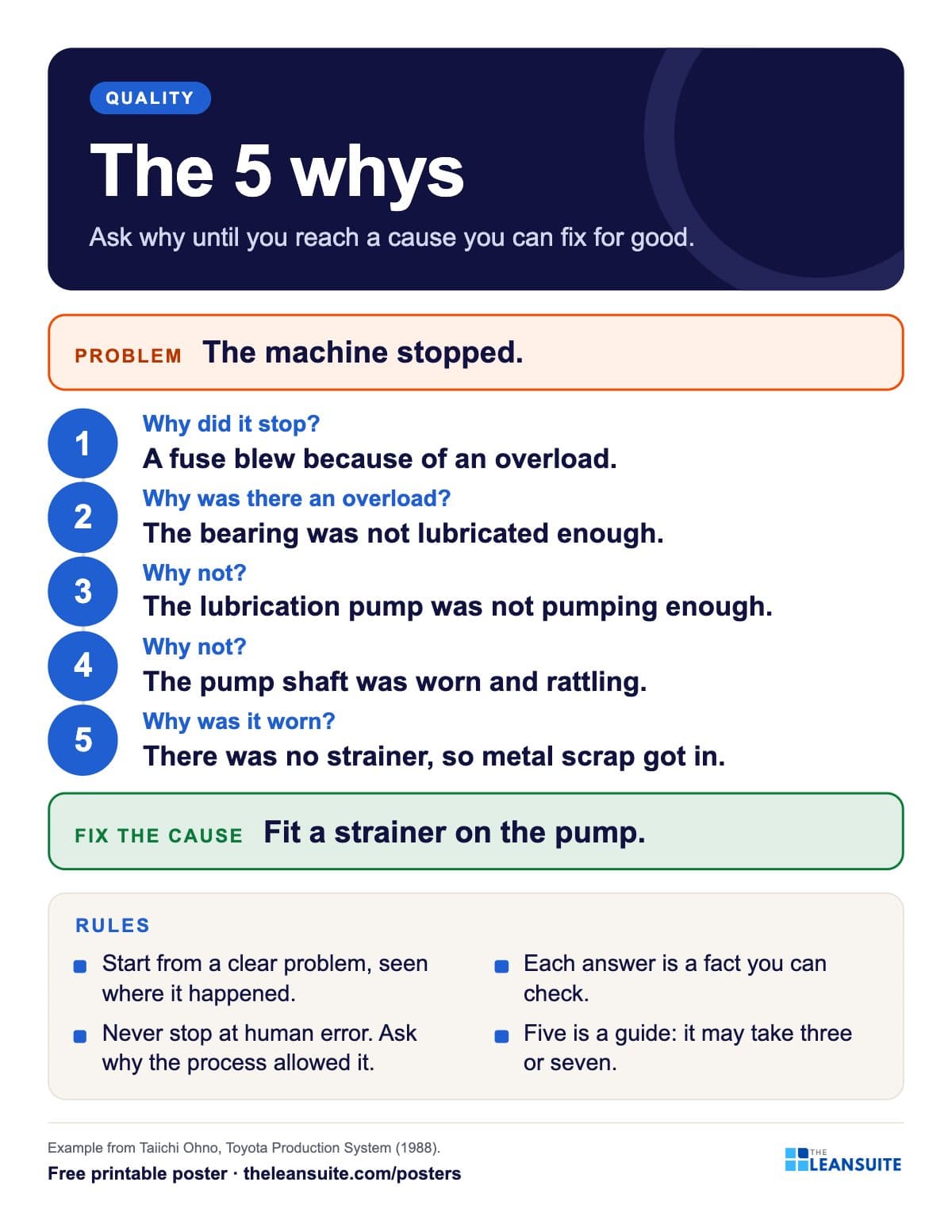
The words on the poster
The 5 whys
Ask why until you reach a cause you can fix for good.
Problem: The machine stopped.
- Why did it stop? A fuse blew because of an overload.
- Why was there an overload? The bearing was not lubricated enough.
- Why not? The lubrication pump was not pumping enough.
- Why not? The pump shaft was worn and rattling.
- Why was it worn? There was no strainer, so metal scrap got in.
- Fix Fit a strainer on the pump.
Rules
- Start from a clear problem, seen where it happened.
- Each answer is a fact you can check.
- Never stop at human error. Ask why the process allowed it.
- Five is a guide: it may take three or seven.
Example from Taiichi Ohno, Toyota Production System (1988).
On the floor
How to use it
- 1
Hang it where problems are discussed: the huddle board, the quality board, the A3 wall.
- 2
Use the example to teach the method in five minutes before a real 5 whys.
- 3
Check each finished 5 whys against the rules at the bottom of the poster.
- 4
Pair it with the free 5 whys template to record the chain.
Which size to print
- 24 x 36 in or A2: a main wall or team board, read from a few metres away.
- 18 x 24 in or A3: a station or notice board. The A3 file also fits 11 x 17 in paper.
- Letter or A4: a clipboard, binder or handout, on any office printer.
Every PDF is vector, so it stays sharp at full size. Nothing runs to the edge of the page, so no bleed is needed.
Sources and notes
- Example from Taiichi Ohno, Toyota Production System: Beyond Large-Scale Production (English edition, Productivity Press, 1988).
Templates, decks and guides to go with it
- Root cause analysis training presentation: 5 whys and fishboneFree training deck: Define, contain, the 5 whys, the fishbone diagram and verifying the cause, in 18 slides with a team activity.
- 5 Whys templateA problem statement, five why rows with evidence, the root cause and the countermeasure.
- Root cause analysis templateOne report from problem statement to proof: containment, evidence, analysis, verified causes, actions and the effectiveness check.
- A3 problem solving templateThe standard seven-box A3 from background to follow-up, with a filled-in worked example. PDF and Excel.
- Is / is not analysis templateWhat, where, when and extent with is, is not, distinctions and changes, then each possible cause tested against every pair and ranked.
- Topic: Root cause analysis and problem solvingEvery guide we have on the subject, sorted.
A poster reminds. A routine makes it stick.
See how plants run their audits, improvements and follow-ups in LeanSuite, on a call built around your own problem.
Schedule Demo