
Lean and CI poster
Updated · Free to print and share
TPM 8 pillars poster
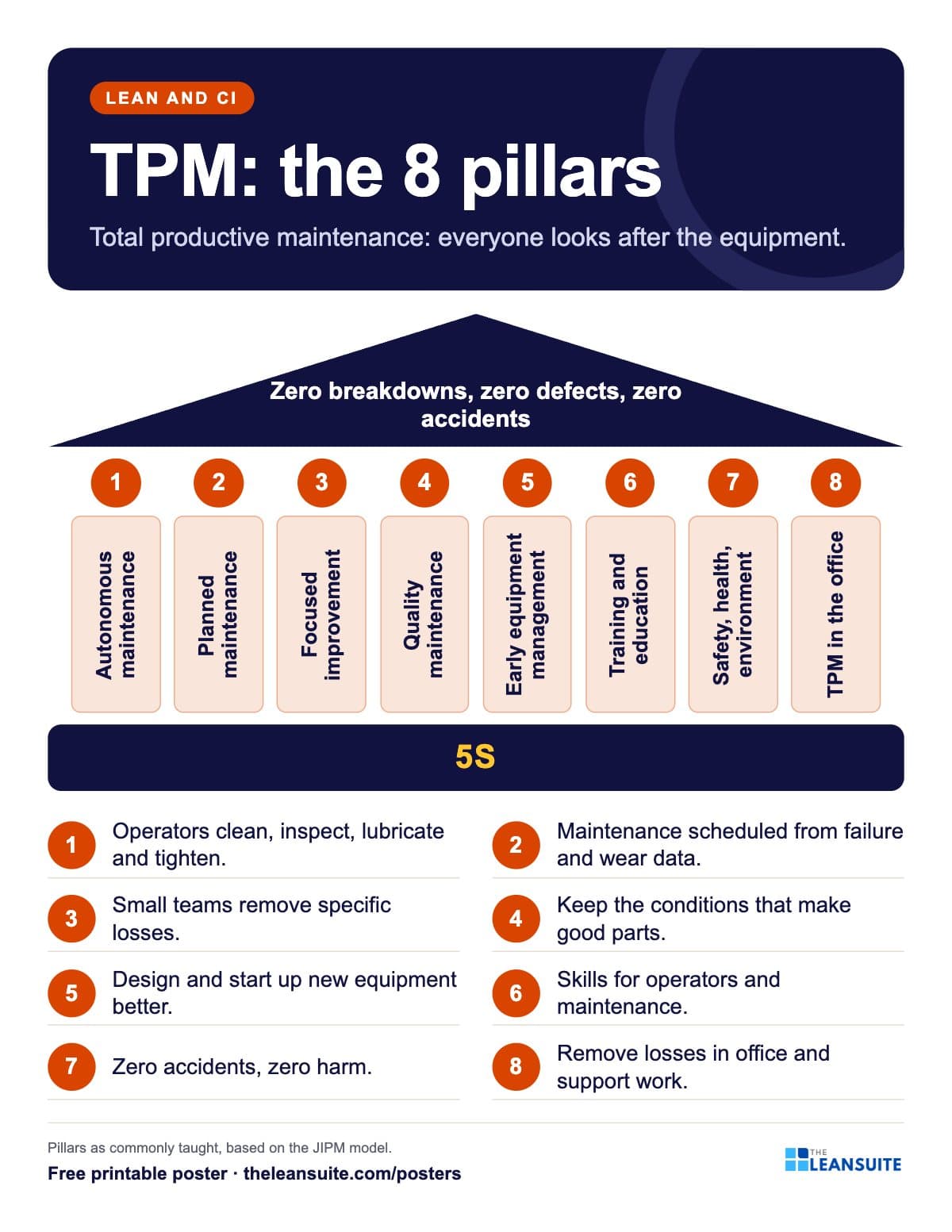
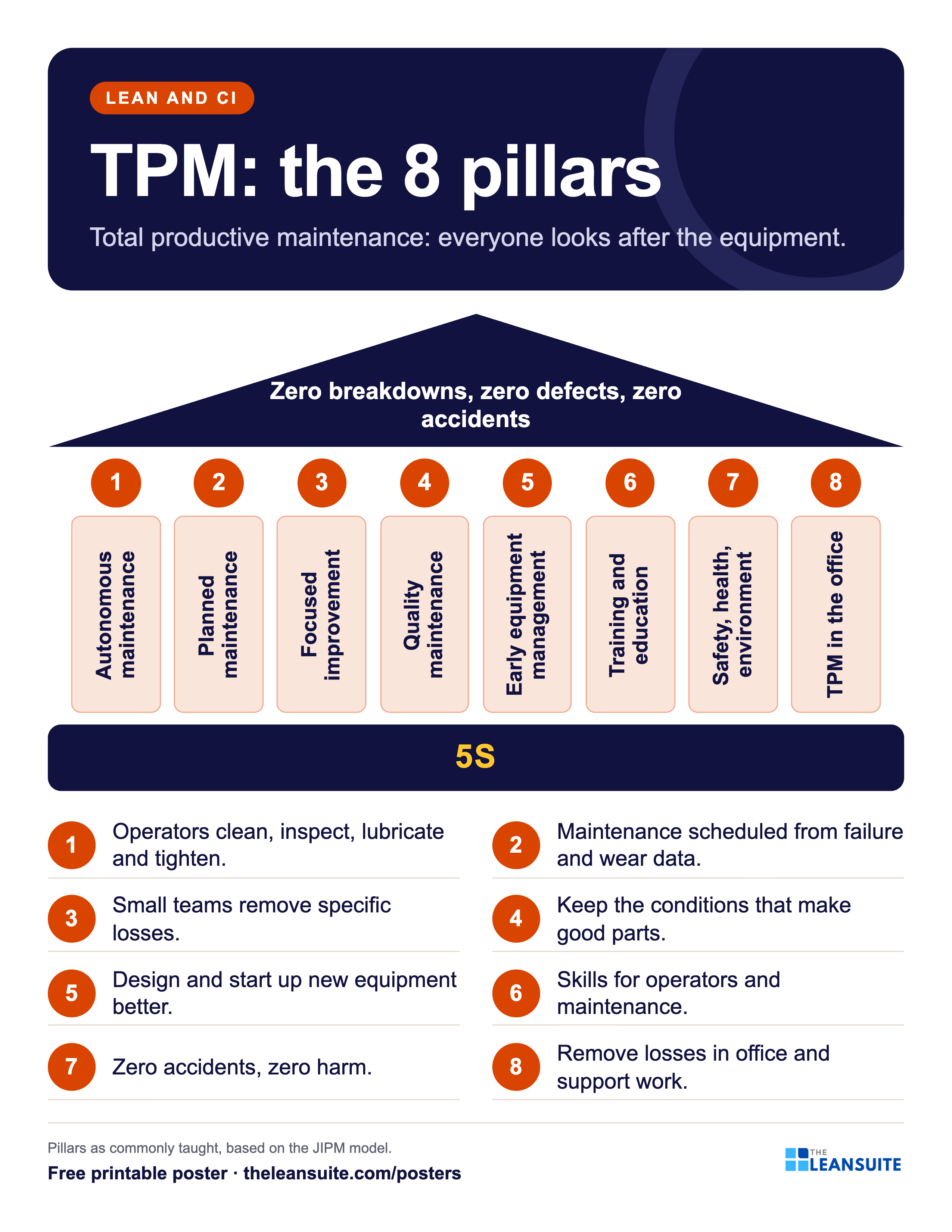
Total productive maintenance (TPM) is a plant-wide approach to equipment care aimed at zero breakdowns, zero defects and zero accidents. It is usually drawn as a house with eight pillars on a 5S foundation: autonomous maintenance, planned maintenance, focused improvement, quality maintenance, early equipment management, training and education, safety, health and environment, and TPM in the office. This poster draws the house and says what each pillar does.
Download the poster
The PNG is free to download now. The print-ready vector PDFs open after a short form, once.
Free to print and share with your team. Enter your name and work email once to download.
The words on the poster
TPM: the 8 pillars
Total productive maintenance: everyone looks after the equipment.
Zero breakdowns, zero defects, zero accidents
- Autonomous maintenance
- Planned maintenance
- Focused improvement
- Quality maintenance
- Early equipment management
- Training and education
- Safety, health, environment
- TPM in the office
- Foundation: 5S
- 1. Operators clean, inspect, lubricate and tighten.
- 2. Maintenance scheduled from failure and wear data.
- 3. Small teams remove specific losses.
- 4. Keep the conditions that make good parts.
- 5. Design and start up new equipment better.
- 6. Skills for operators and maintenance.
- 7. Zero accidents, zero harm.
- 8. Remove losses in office and support work.
Pillars as commonly taught, based on the JIPM model.
On the floor
How to use it
- 1
Put it in the maintenance office and the TPM or CI room.
- 2
Use it to show which pillars your plant has started and which come next.
- 3
Teach autonomous maintenance with the free 7-step training deck.
- 4
Pair it with the free TPM tag log and autonomous maintenance checklist.
Which size to print
- 24 x 36 in or A2: a main wall or team board, read from a few metres away.
- 18 x 24 in or A3: a station or notice board. The A3 file also fits 11 x 17 in paper.
- Letter or A4: a clipboard, binder or handout, on any office printer.
Every PDF is vector, so it stays sharp at full size. Nothing runs to the edge of the page, so no bleed is needed.
Sources and notes
- The eight pillars as commonly taught, based on the Japan Institute of Plant Maintenance (JIPM) model. TPM grew out of Nippondenso in Japan around 1971.
Templates, decks and guides to go with it
- Autonomous maintenance training presentation: the 7 stepsFree training deck: The 7 steps of jishu hozen, who does what and how step audits work, in 19 slides with notes and a quiz.
- TPM training presentation: the 8 pillarsFree training deck: What TPM is, the six big losses, OEE and the 8 pillars, in 19 slides with a loss-spotting activity.
- TPM tag logEvery abnormality tag with type, who fixes it, priority and dates, with days open and counts by type and week.
- Autonomous maintenance (CILR) checklist20 clean, inspect, lubricate and retighten checks with a box per day, an abnormality log and sign-off.
- Autonomous maintenance step auditCriteria for each of the seven autonomous maintenance steps, scored 0 to 2, with the step result and the decision to move on.
- Six big losses worksheetWhere a machine's planned time goes: the six big losses in minutes, ranked, with A, P, Q and OEE worked out.
- OEE tracking sheetOne row per shift for a week. The Excel version works out availability, performance, quality and OEE and charts the week.
- Topic: TPM and maintenanceEvery guide we have on the subject, sorted.
A poster reminds. A routine makes it stick.
See how plants run their audits, improvements and follow-ups in LeanSuite, on a call built around your own problem.
Schedule Demo