

Quality poster
Updated · Free to print and share
Strong and weak countermeasures poster
Not every countermeasure is equally likely to stop a problem coming back. Stronger actions change the design or the process so the error cannot happen. Middle actions make an error easy to catch. Weaker actions rely on people remembering: a sign, a memo, a new rule, retraining. This poster ranks the three with shop floor examples, after the action hierarchy used for root cause analysis in patient safety, so a team can see at a glance how strong its fix is.
Download the poster
The PNG is free to download now. The print-ready vector PDFs open after a short form, once.
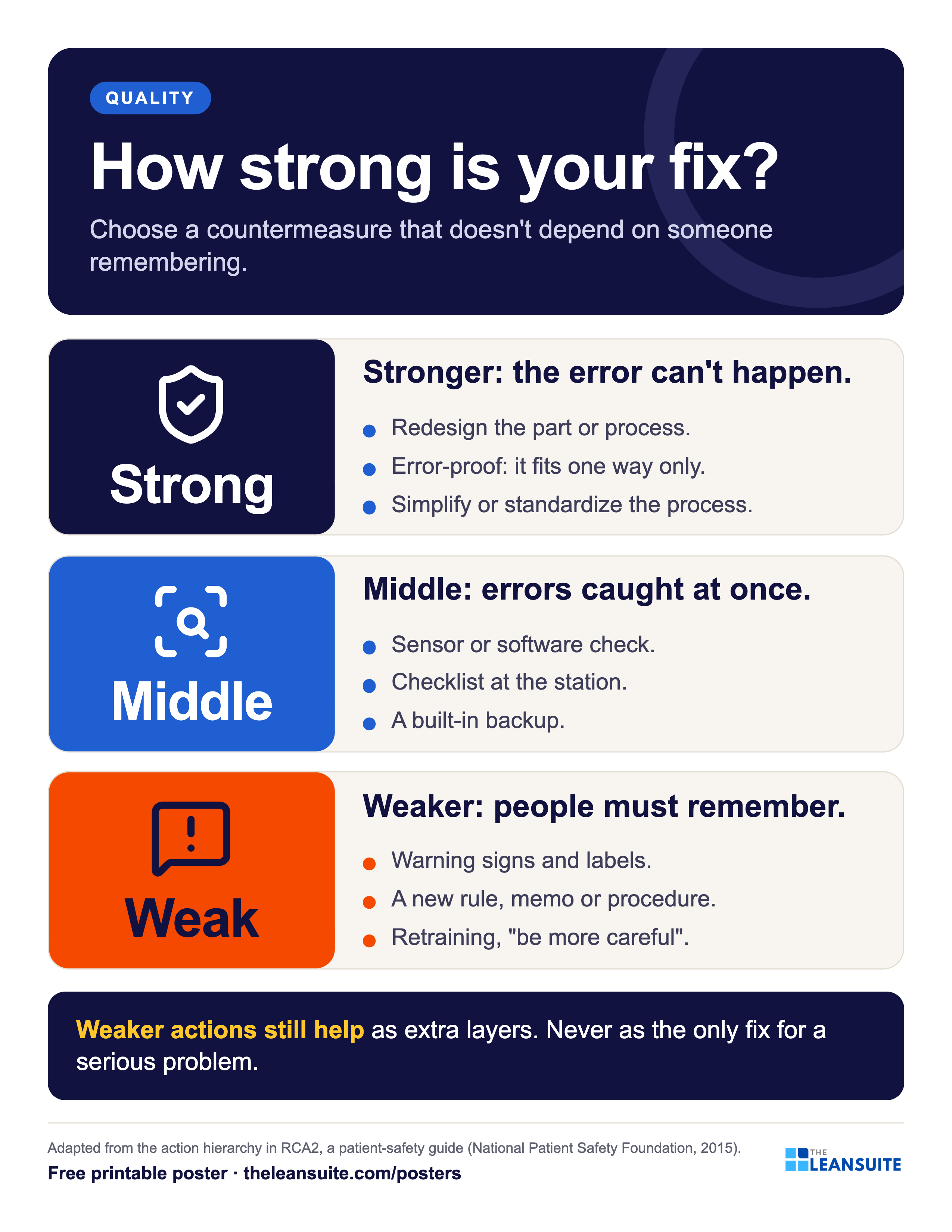
Free to print and share with your team. Enter your name and work email once to download.
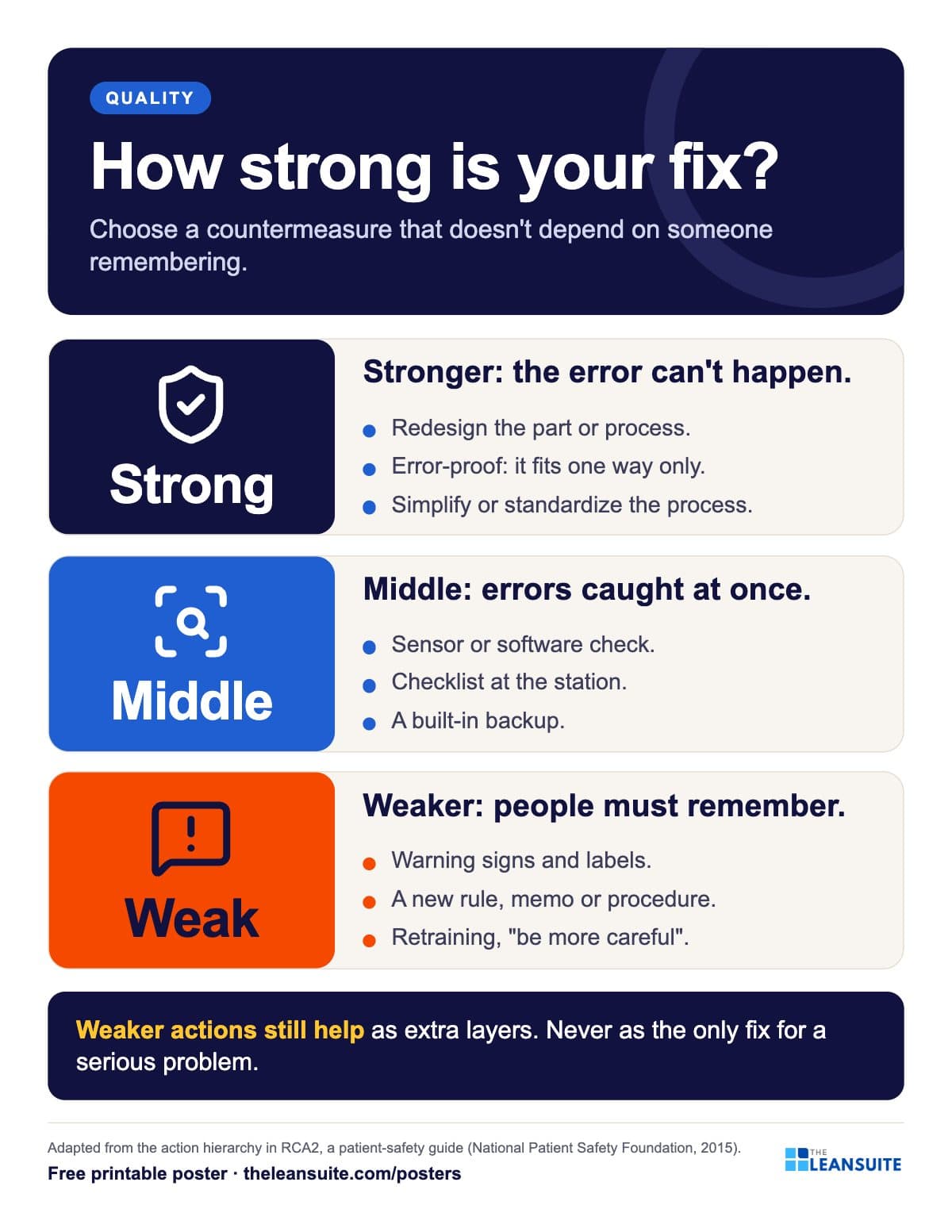 Three panels for stronger, middle and weaker actions with examples, and a band on using weaker actions as extra layers.
The words on the poster
How strong is your fix?
Choose a countermeasure that doesn't depend on someone remembering.
- Strong Stronger: the error can't happen. Redesign the part or process. Error-proof: it fits one way only. Simplify or standardize the process.
- Middle Middle: errors caught at once. Sensor or software check. Checklist at the station. A built-in backup.
- Weak Weaker: people must remember. Warning signs and labels. A new rule, memo or procedure. Retraining, "be more careful".
- Weaker actions still help as extra layers. Never as the only fix for a serious problem.
Adapted from the action hierarchy in RCA2, a patient-safety guide (National Patient Safety Foundation, 2015).
On the floor
How to use it
Putting the Strong and weak countermeasures poster to work
- 1
Check every corrective action against it before it is approved.
- 2
Ask: is there a stronger action we could take? If not, why not?
- 3
Use weaker actions as extra layers or stopgaps, never as the only fix for a serious problem.
- 4
Pair it with the free poka-yoke worksheet and corrective action form.
Which size to print
- 24 x 36 in or A2: a main wall or team board, read from a few metres away.
- 18 x 24 in or A3: a station or notice board. The A3 file also fits 11 x 17 in paper.
- Letter or A4: a clipboard, binder or handout, on any office printer.
Every PDF is vector, so it stays sharp at full size. Nothing runs to the edge of the page, so no bleed is needed.
Templates, decks and guides to go with it
- Root cause analysis training presentation: 5 whys and fishboneFree training deck: Define, contain, the 5 whys, the fishbone diagram and verifying the cause, in 18 slides with a team activity.
- Poka-yoke worksheetEach step's errors and what they cost, the device (approach, function, method), payback, and a log that proves each device works.
- Error-proofing verification log (daily master-sample check)Each poka-yoke device proved every day or week with a known-bad sample, with missed checks counted and the hours and parts at risk worked out when one fails.
- Corrective action request (CAPA) formOne problem from containment to proof the fix worked, with occurrence and escape causes and a closure check that tells you when it can close.
- Topic: Root cause analysis and problem solvingEvery guide we have on the subject, sorted.
- Topic: Quality managementEvery guide we have on the subject, sorted.
More quality posters
All posters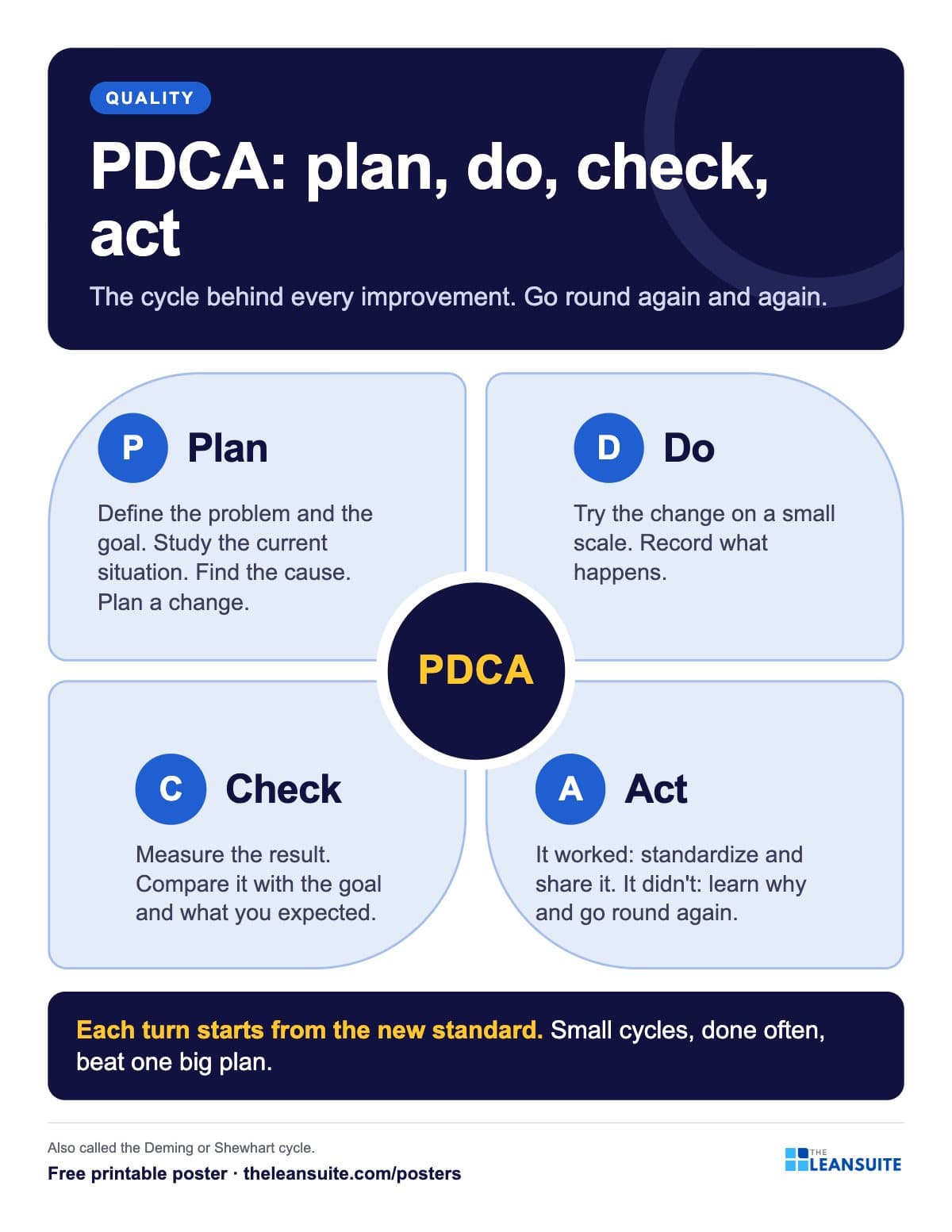 PDCA cycle poster
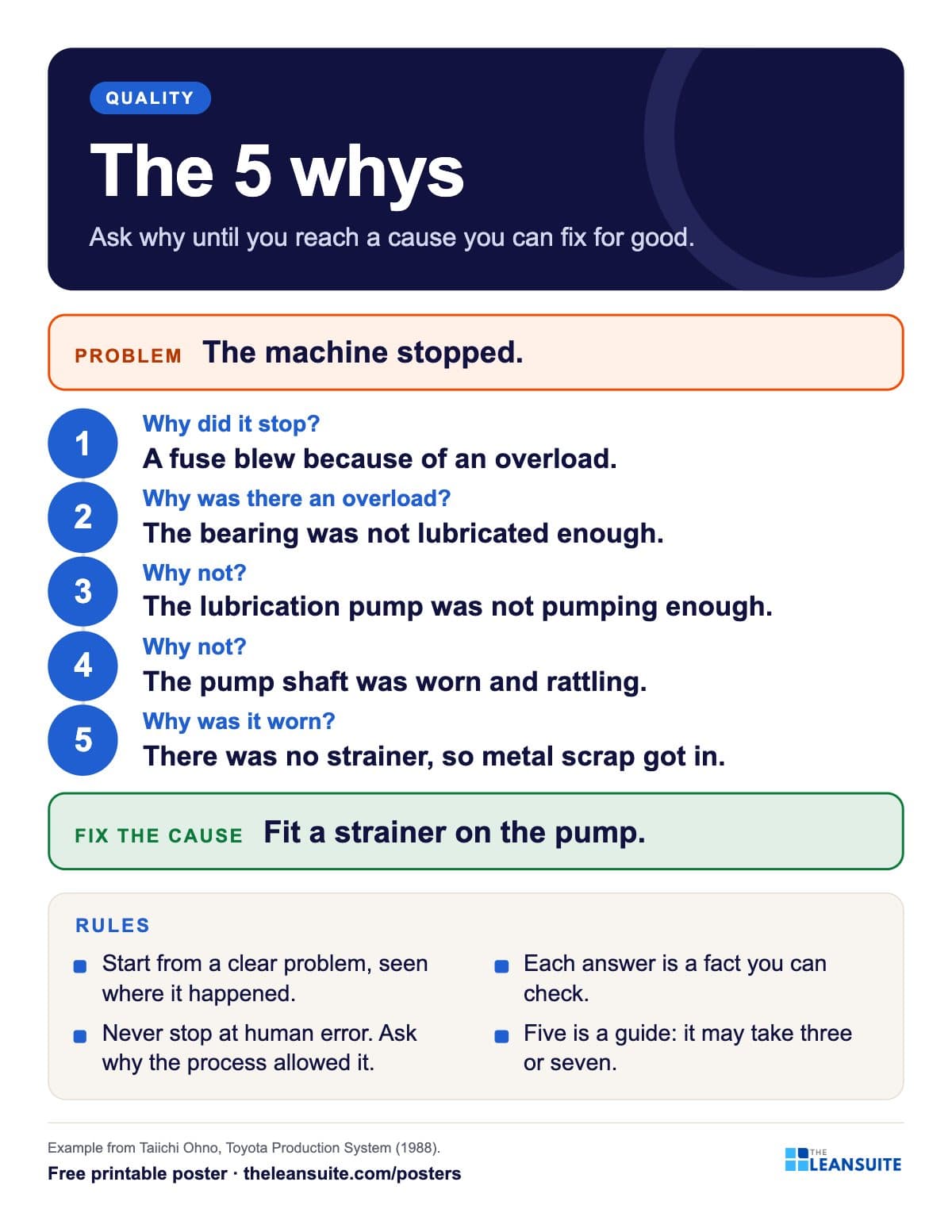 5 whys poster
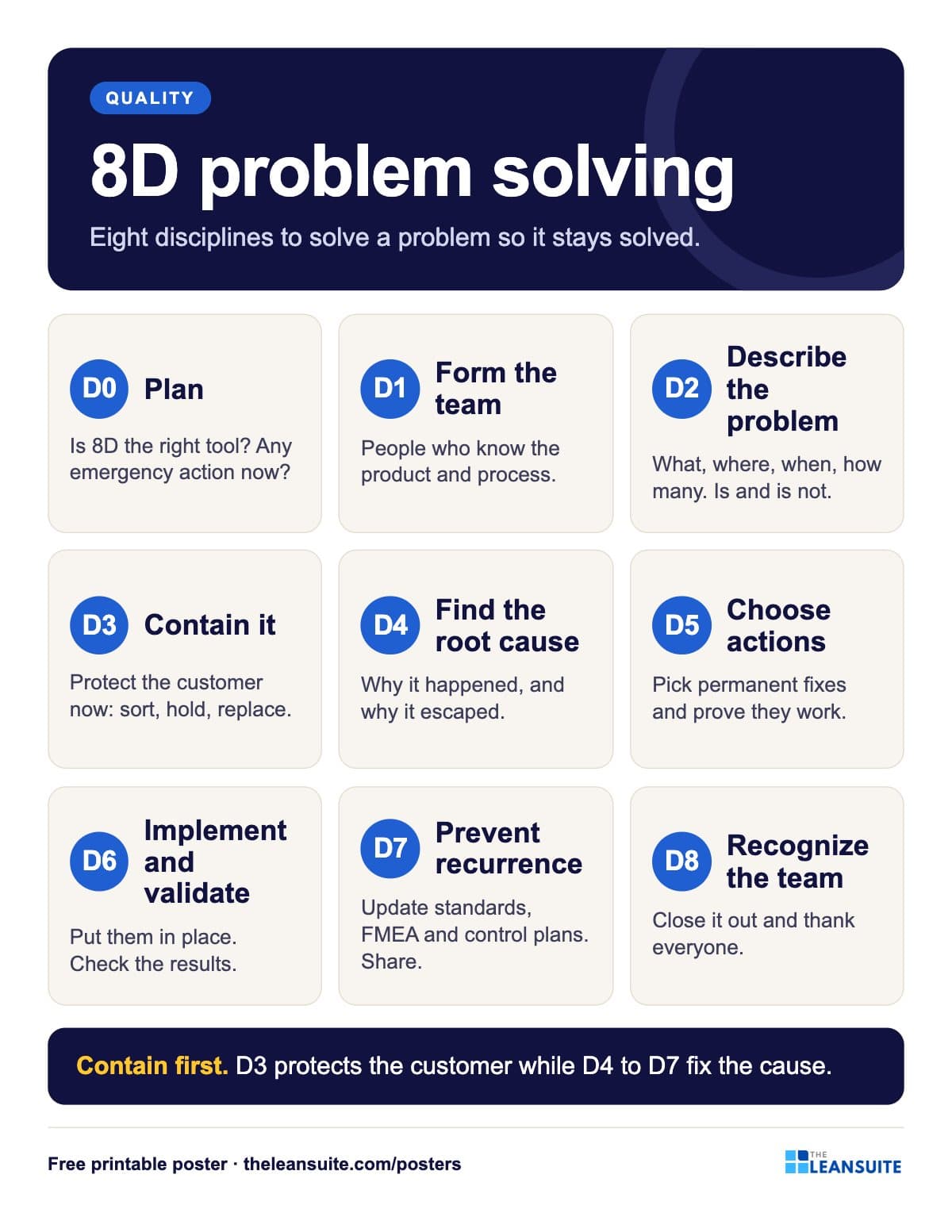 8D problem solving poster
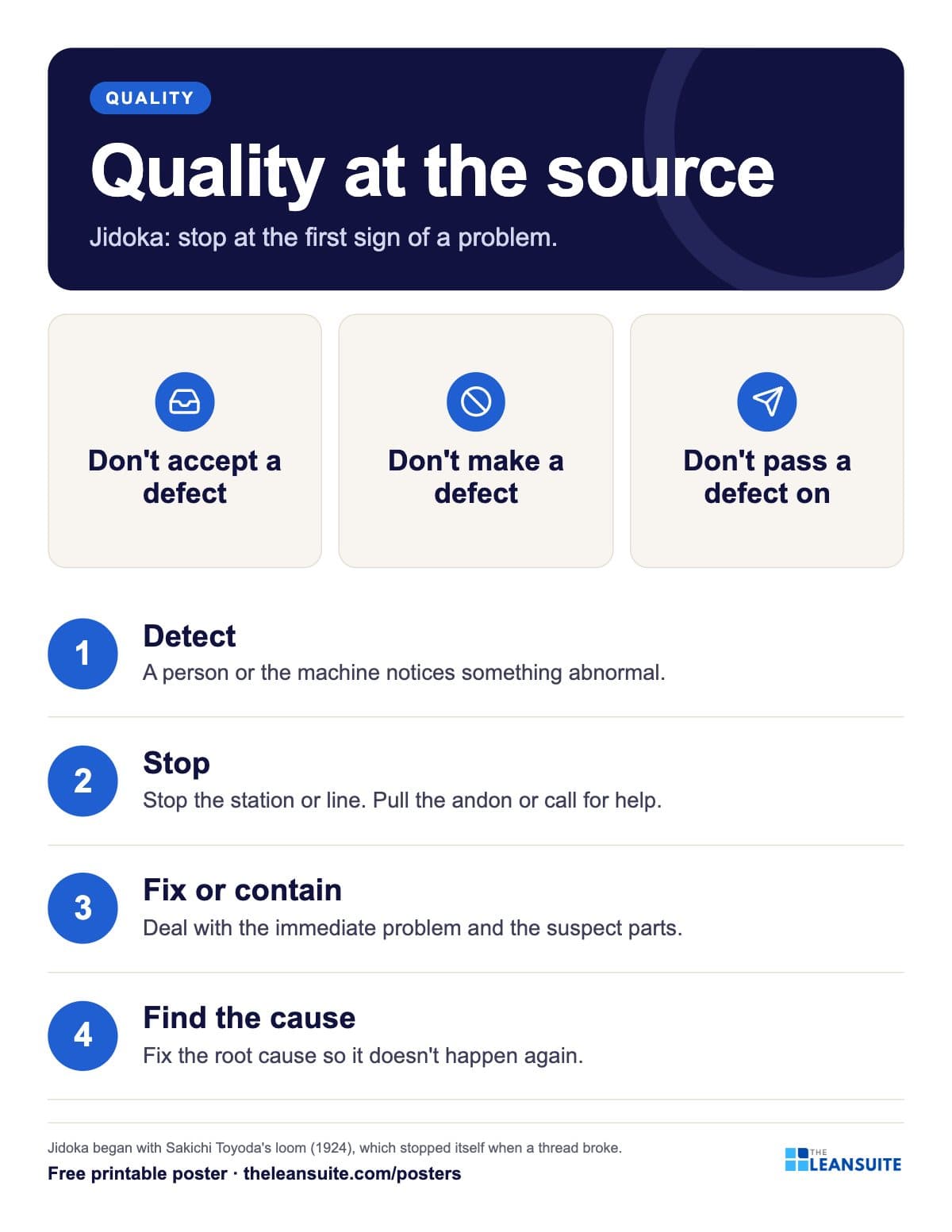 Jidoka and quality at the source poster
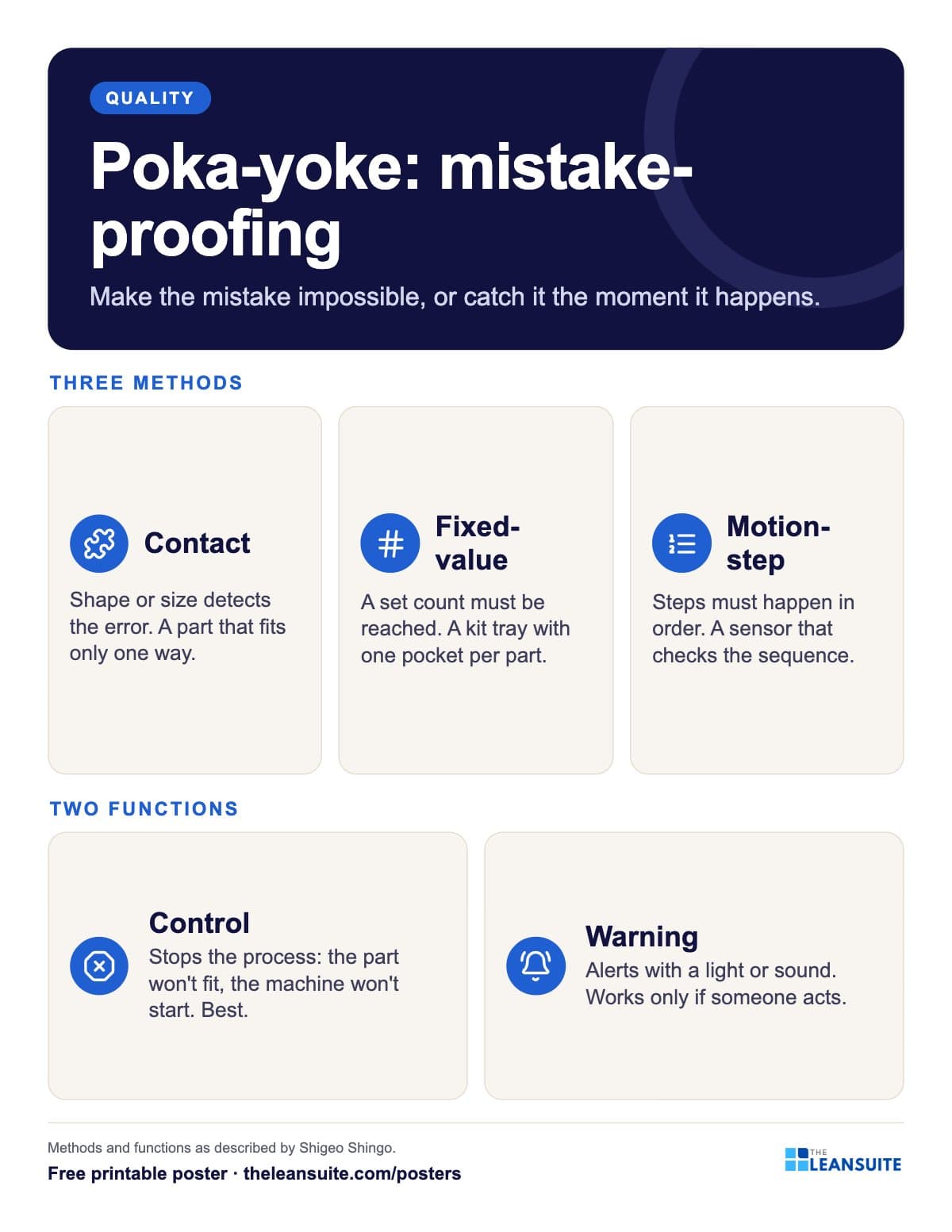 Poka-yoke types poster
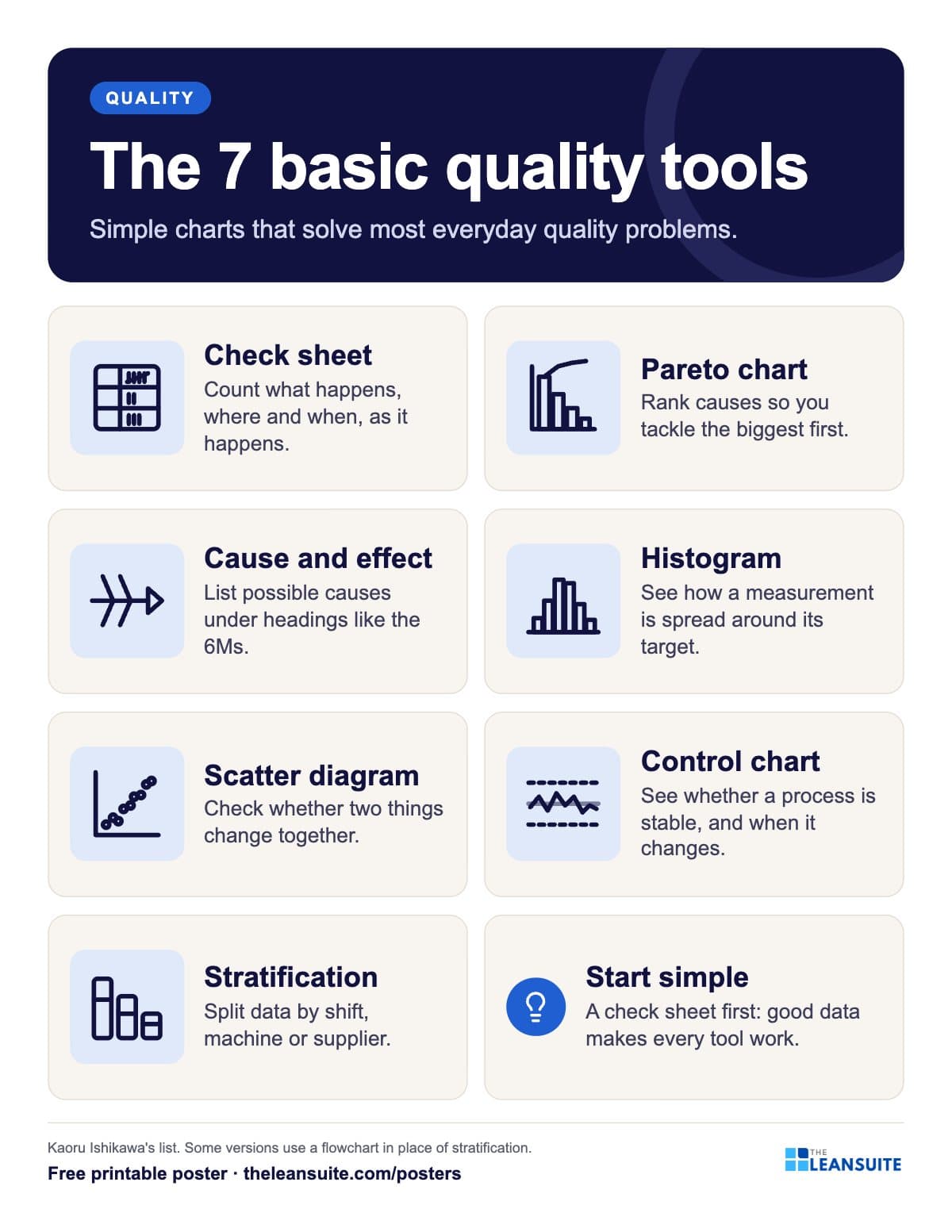 7 basic quality tools poster
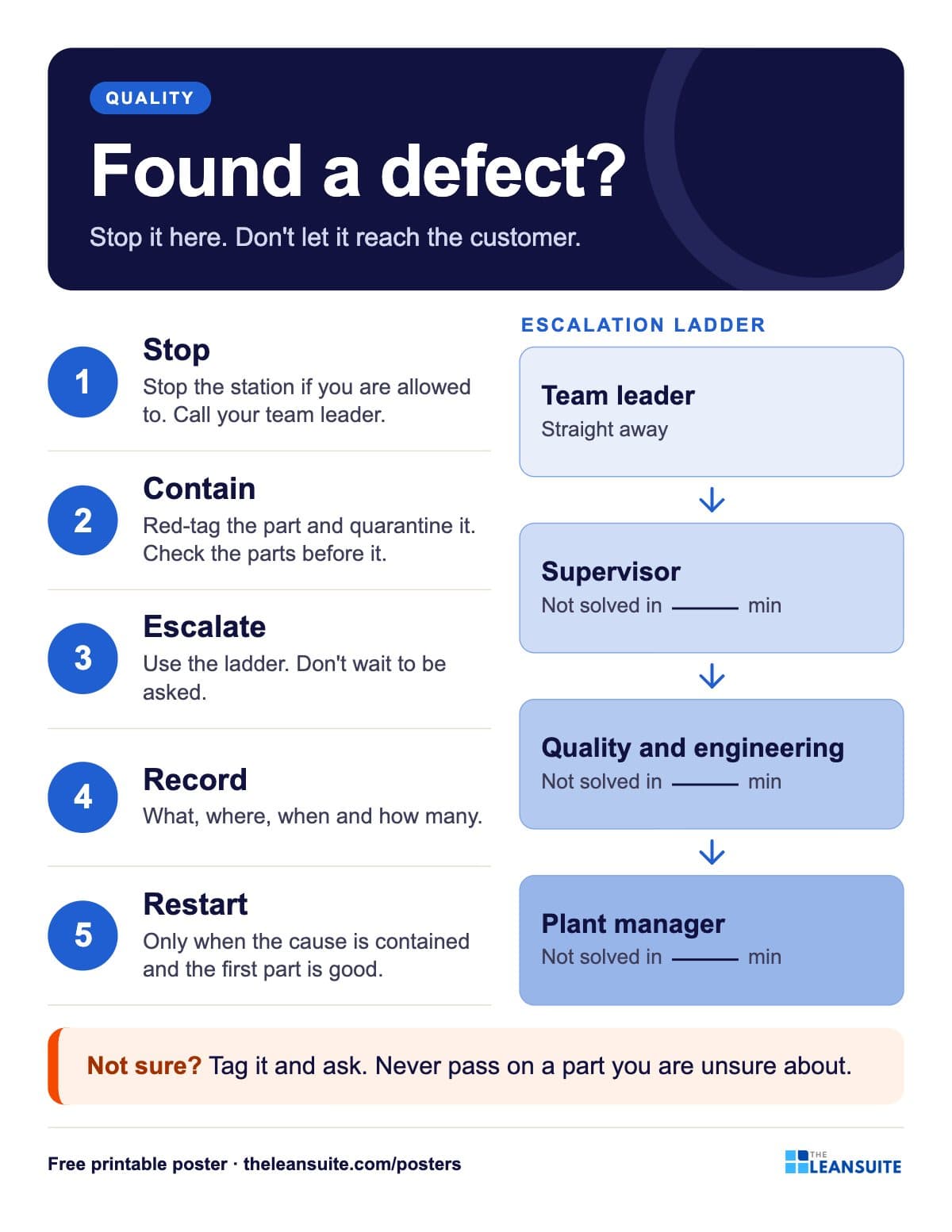 Defect escalation poster (red tag and stop the line)
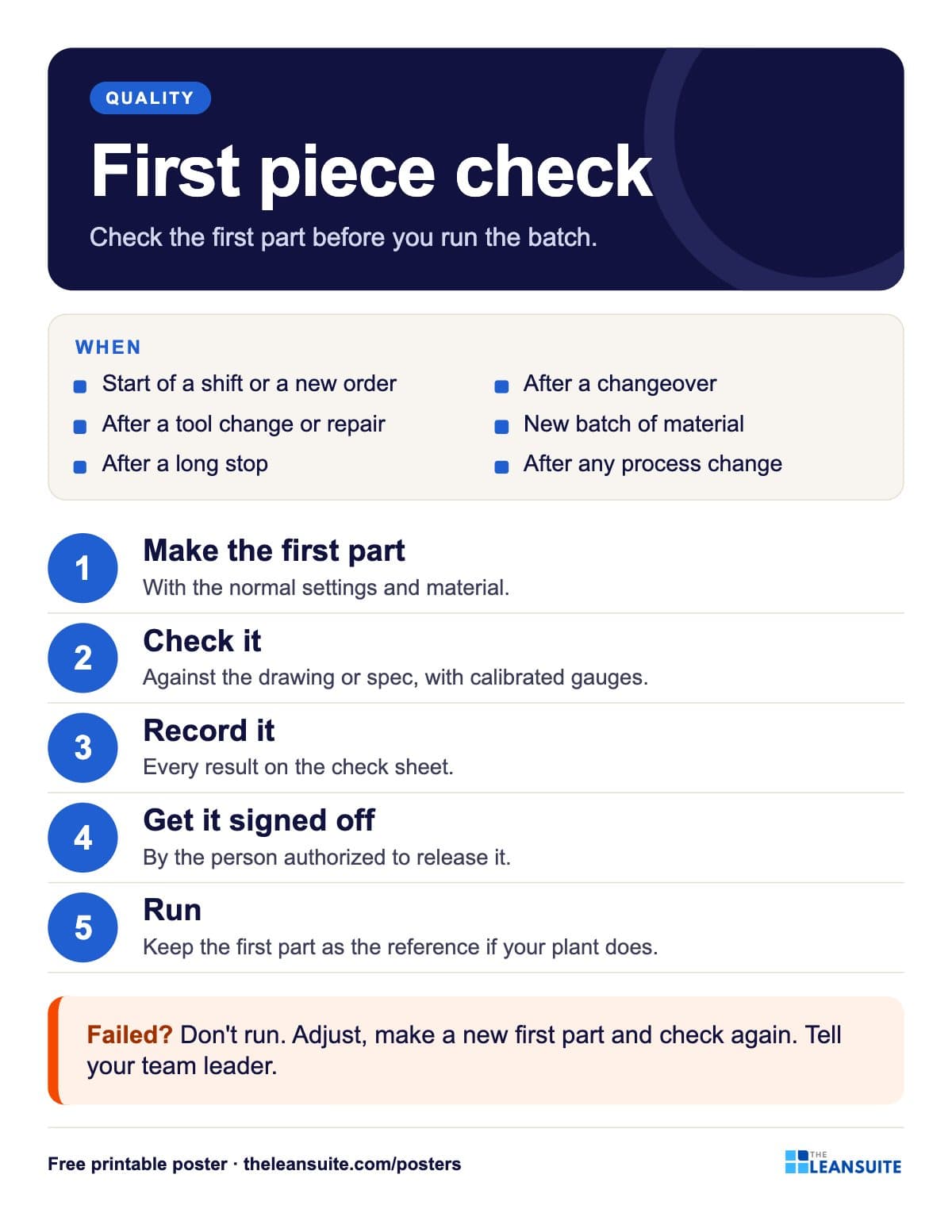 First piece (first article) check poster
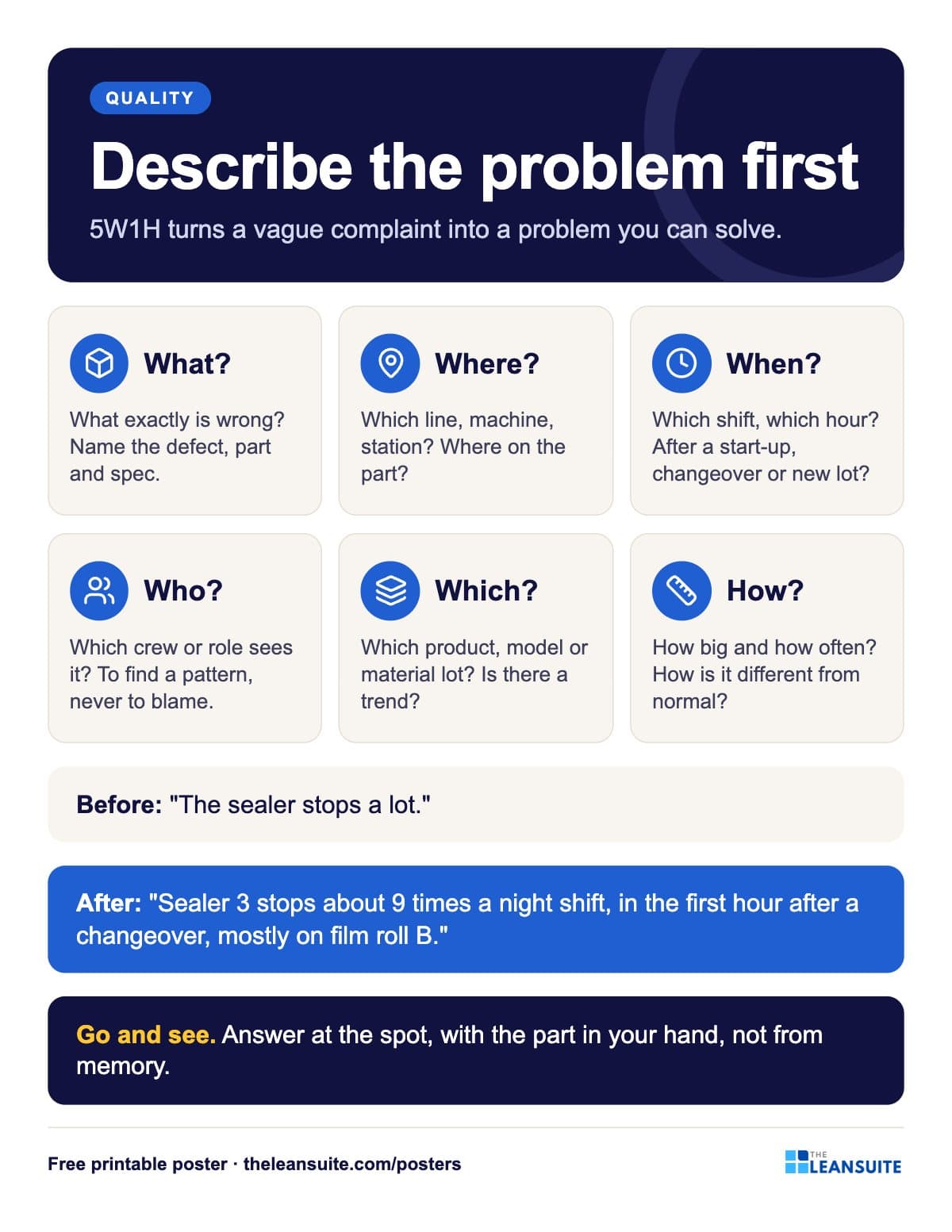 5W1H problem description poster
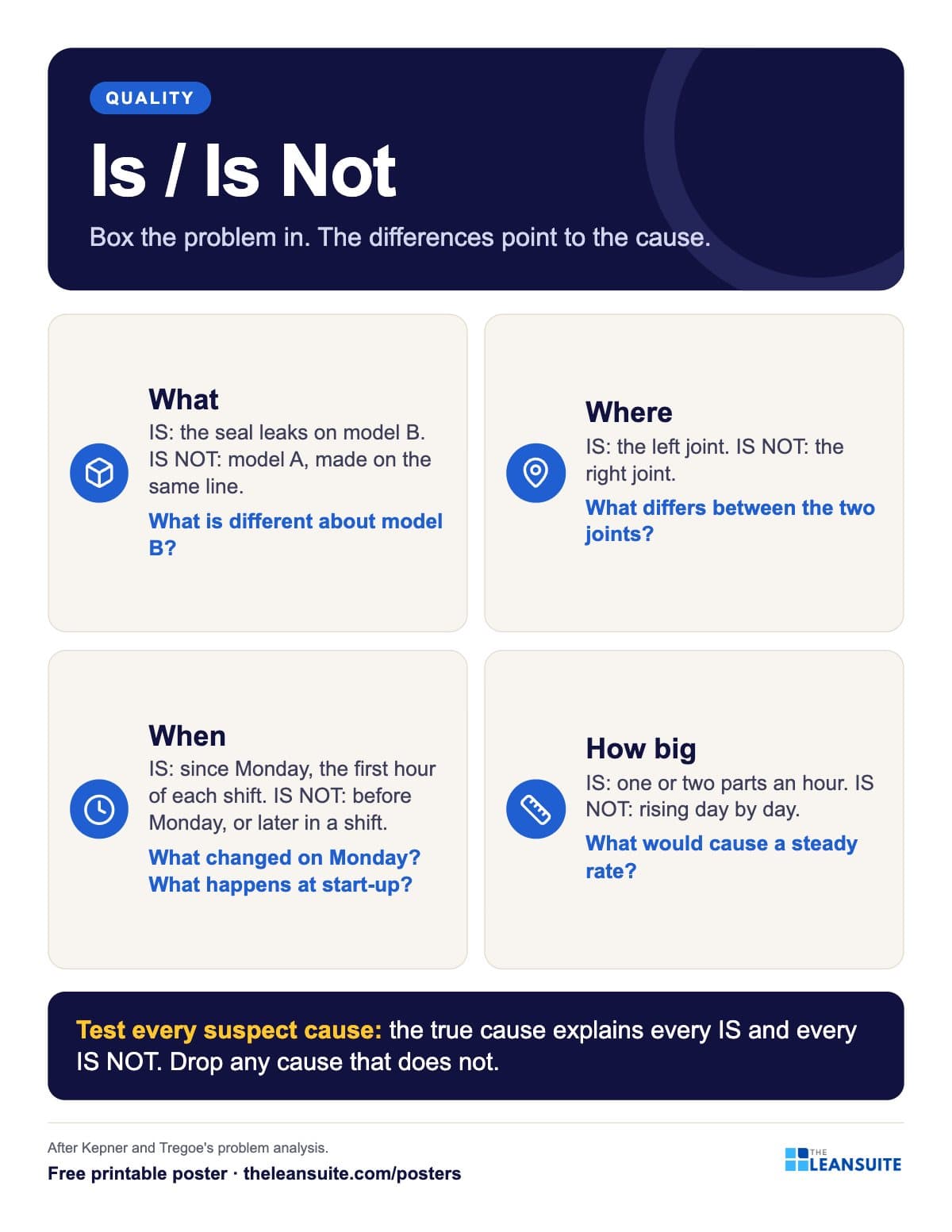 Is / Is Not analysis poster
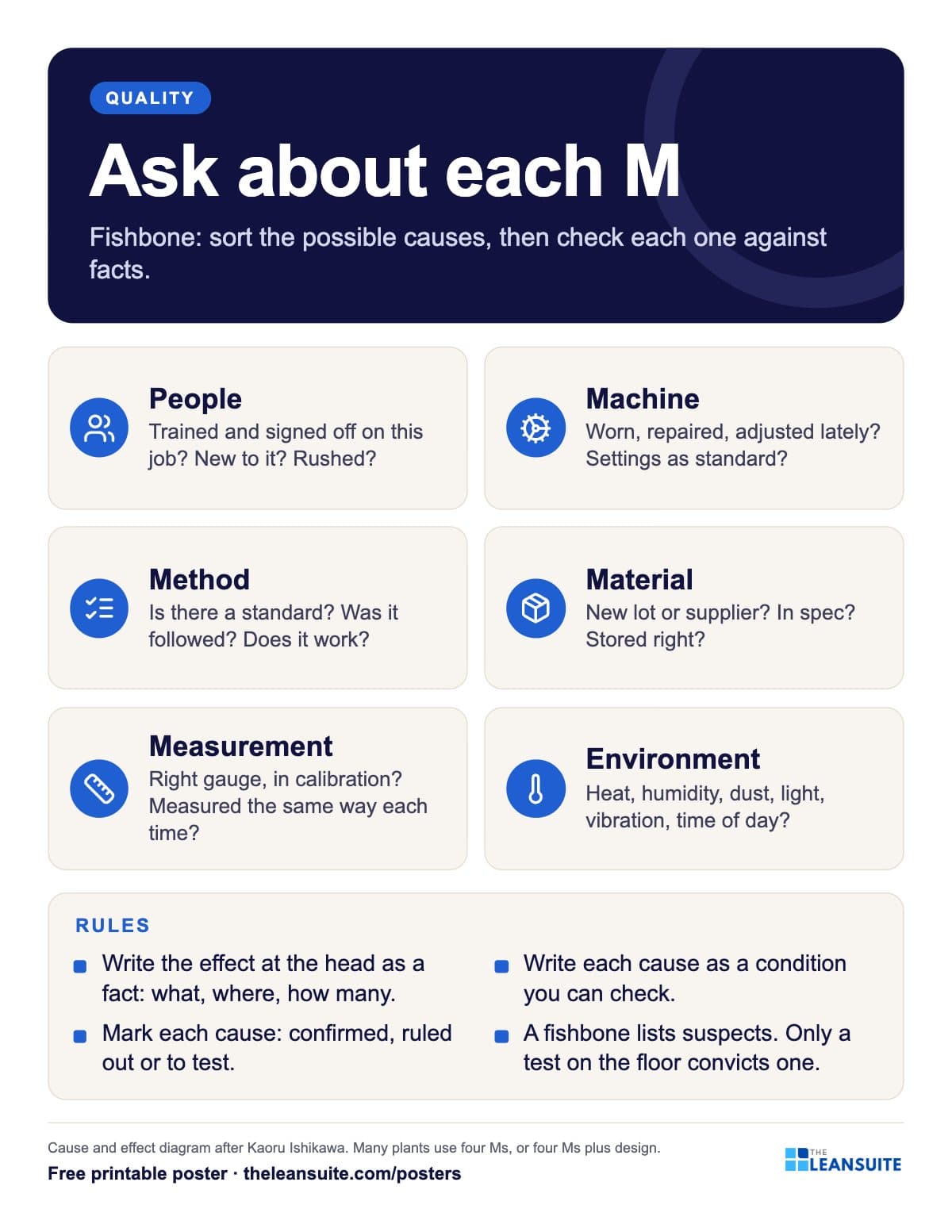 Fishbone 6M questions poster
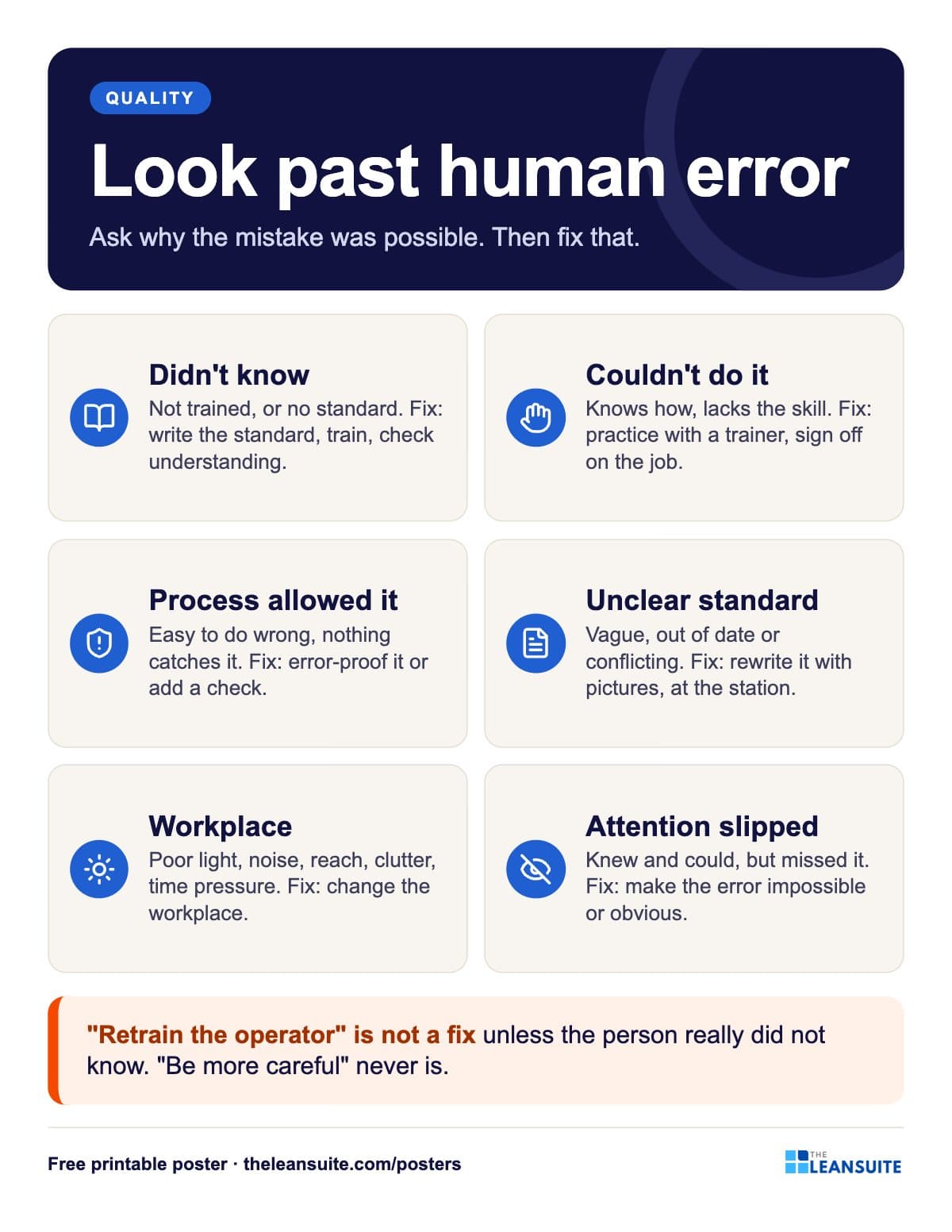 Human error root causes poster
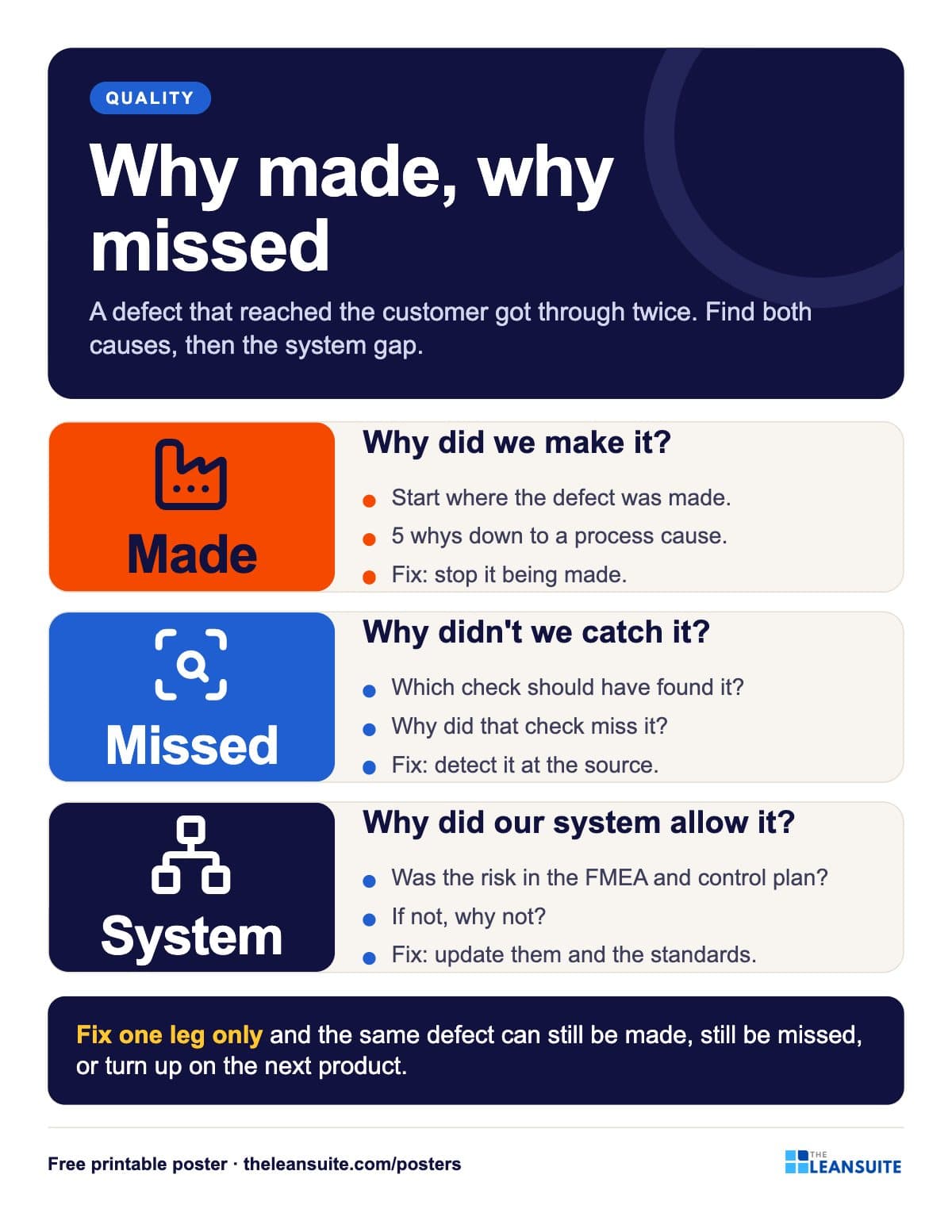 Why made, why missed poster
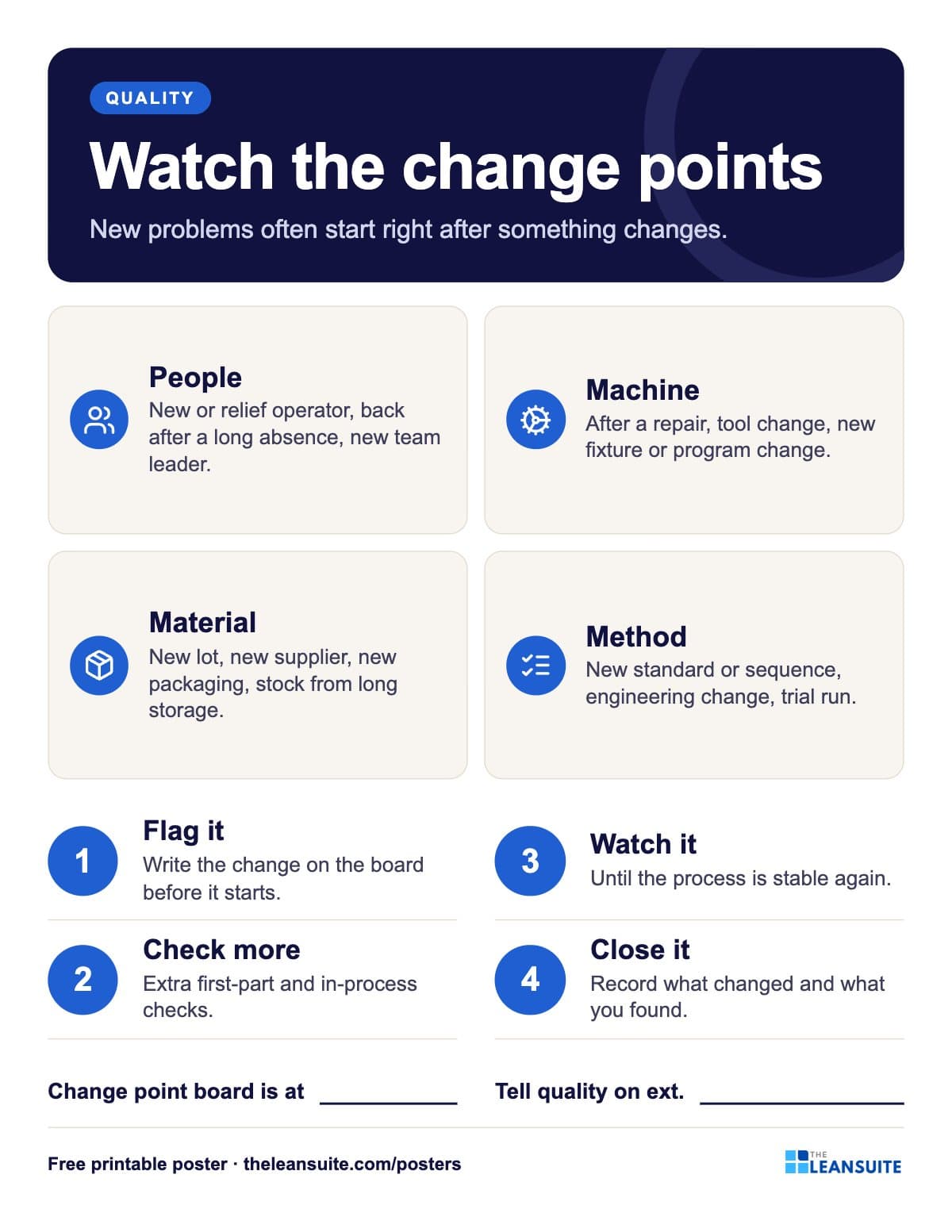 4M change points poster
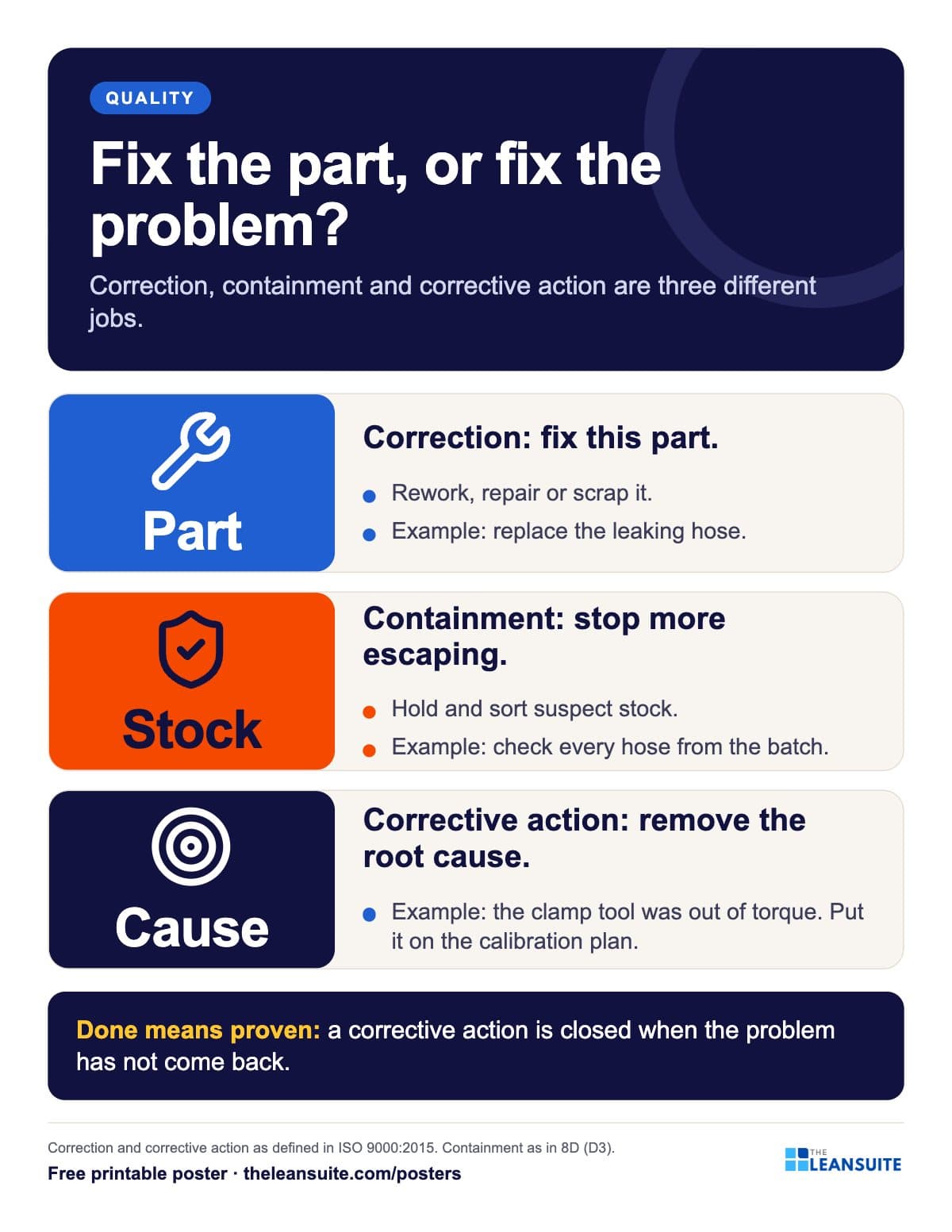 Correction vs corrective action poster
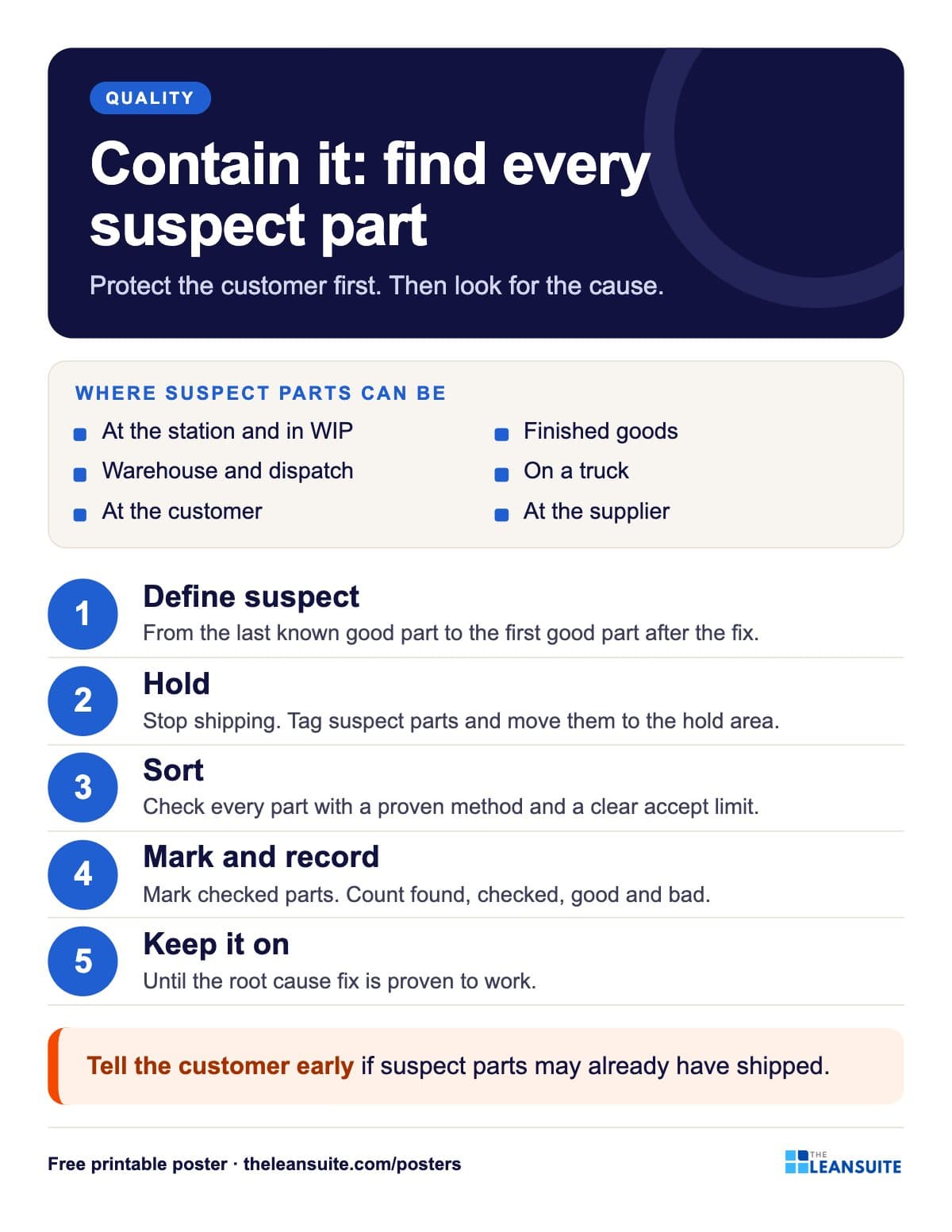 Containment actions poster
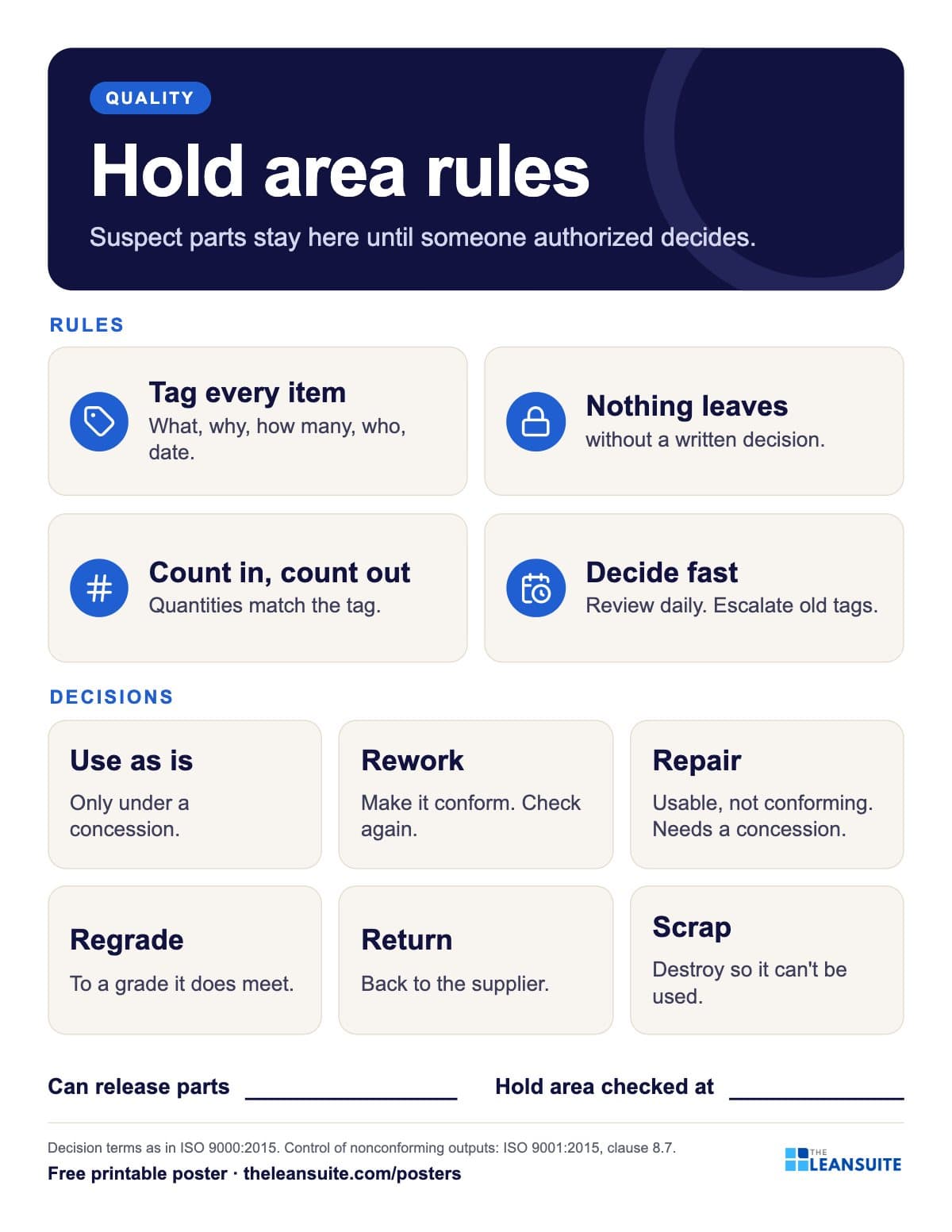 Hold area (quarantine) rules poster
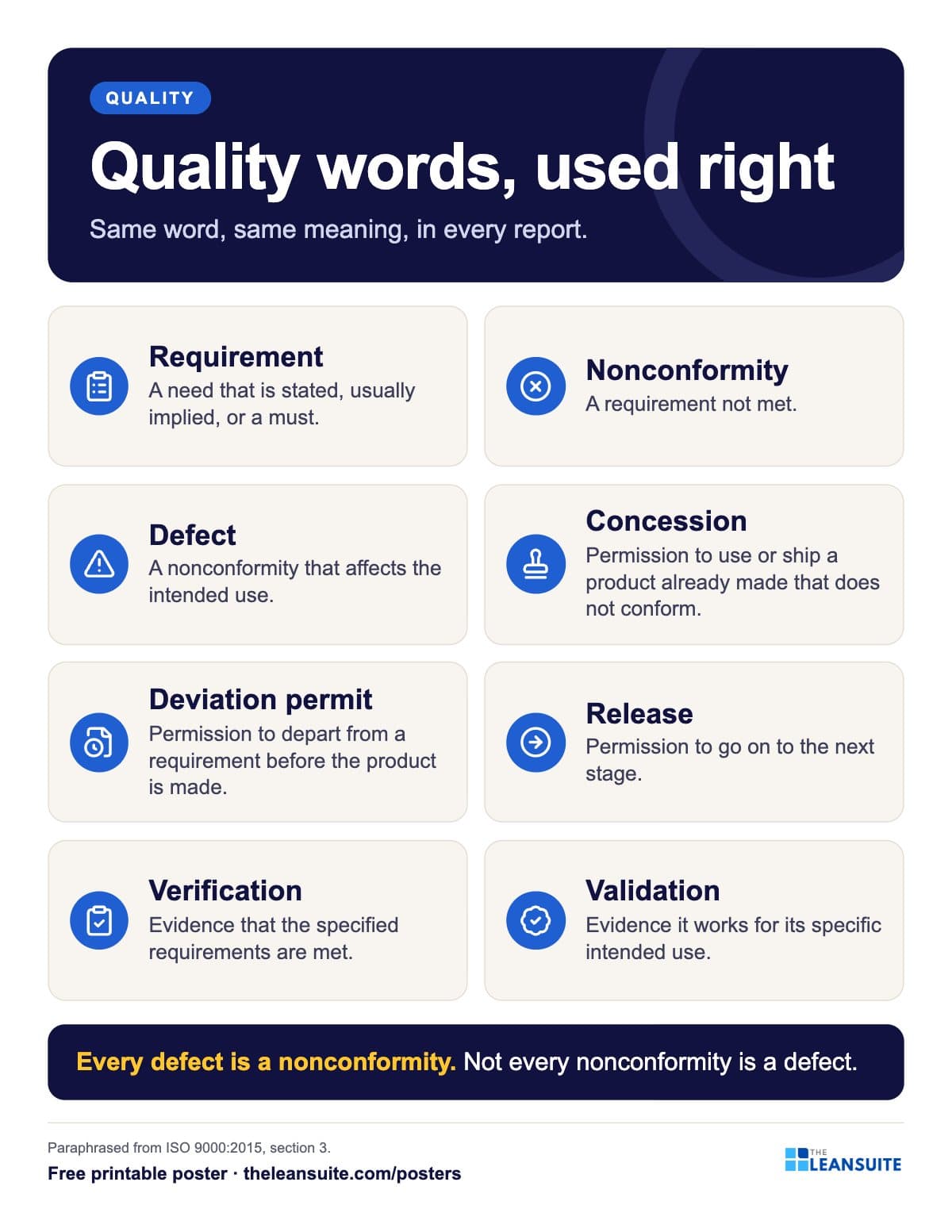 Quality terms poster (nonconformity, defect, concession)
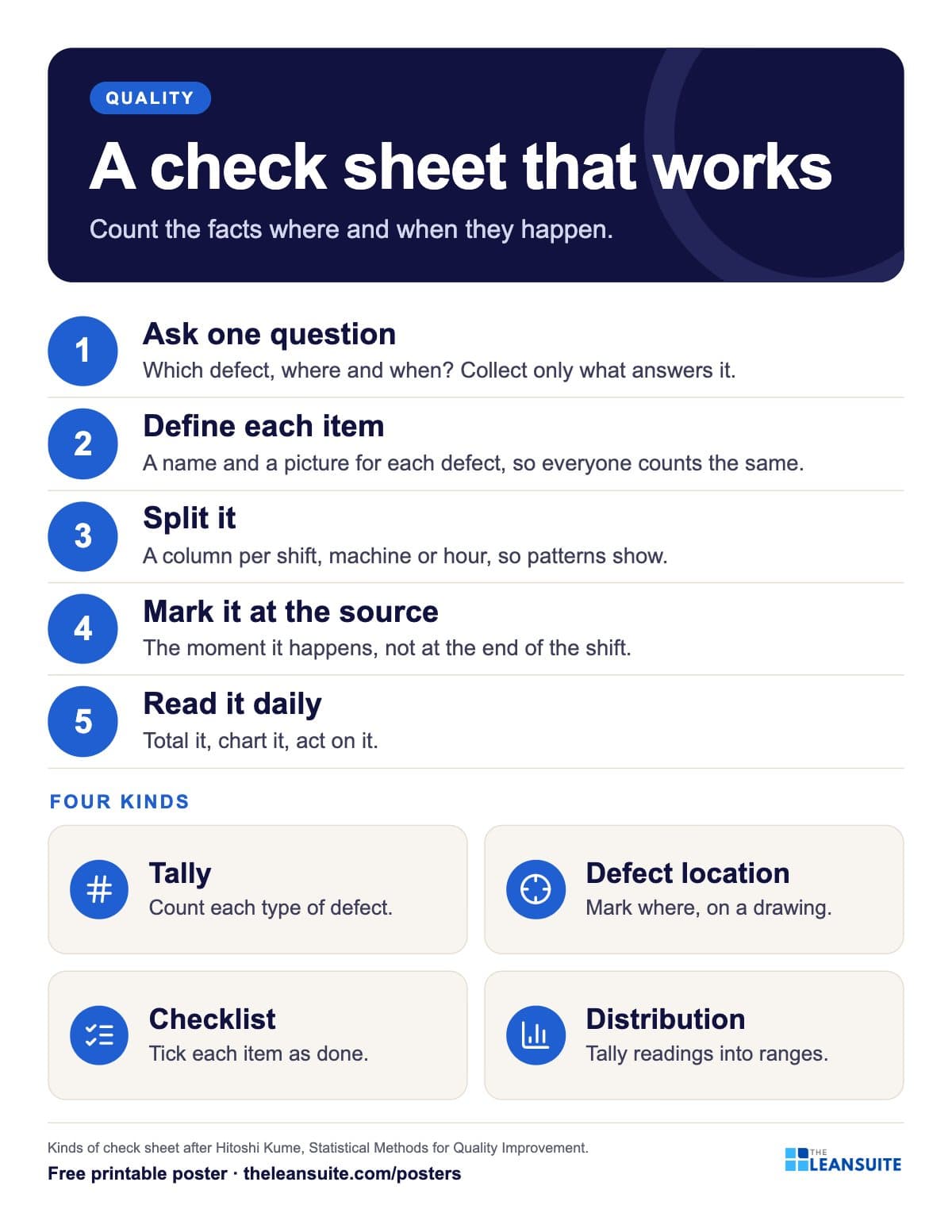 Check sheet poster
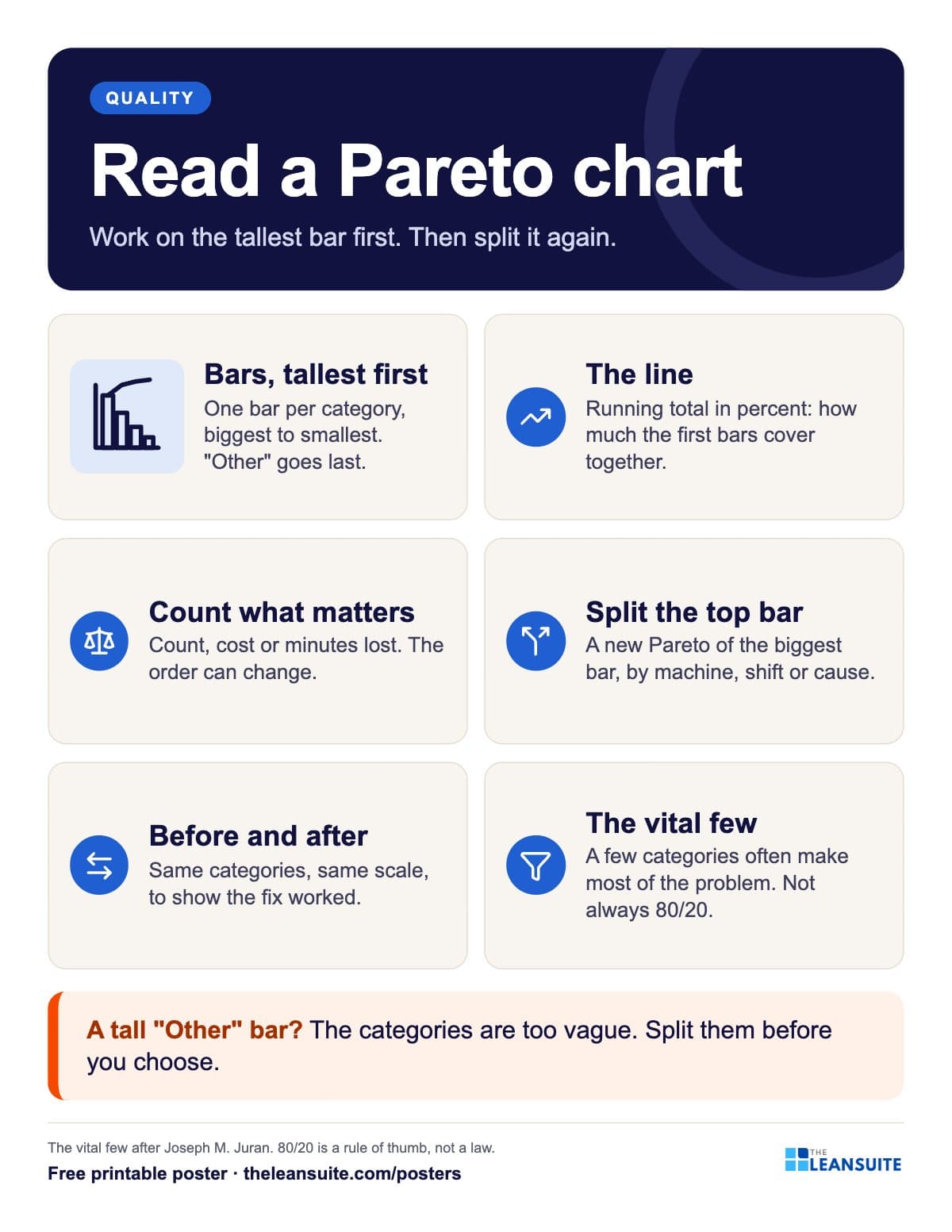 How to read a Pareto chart poster
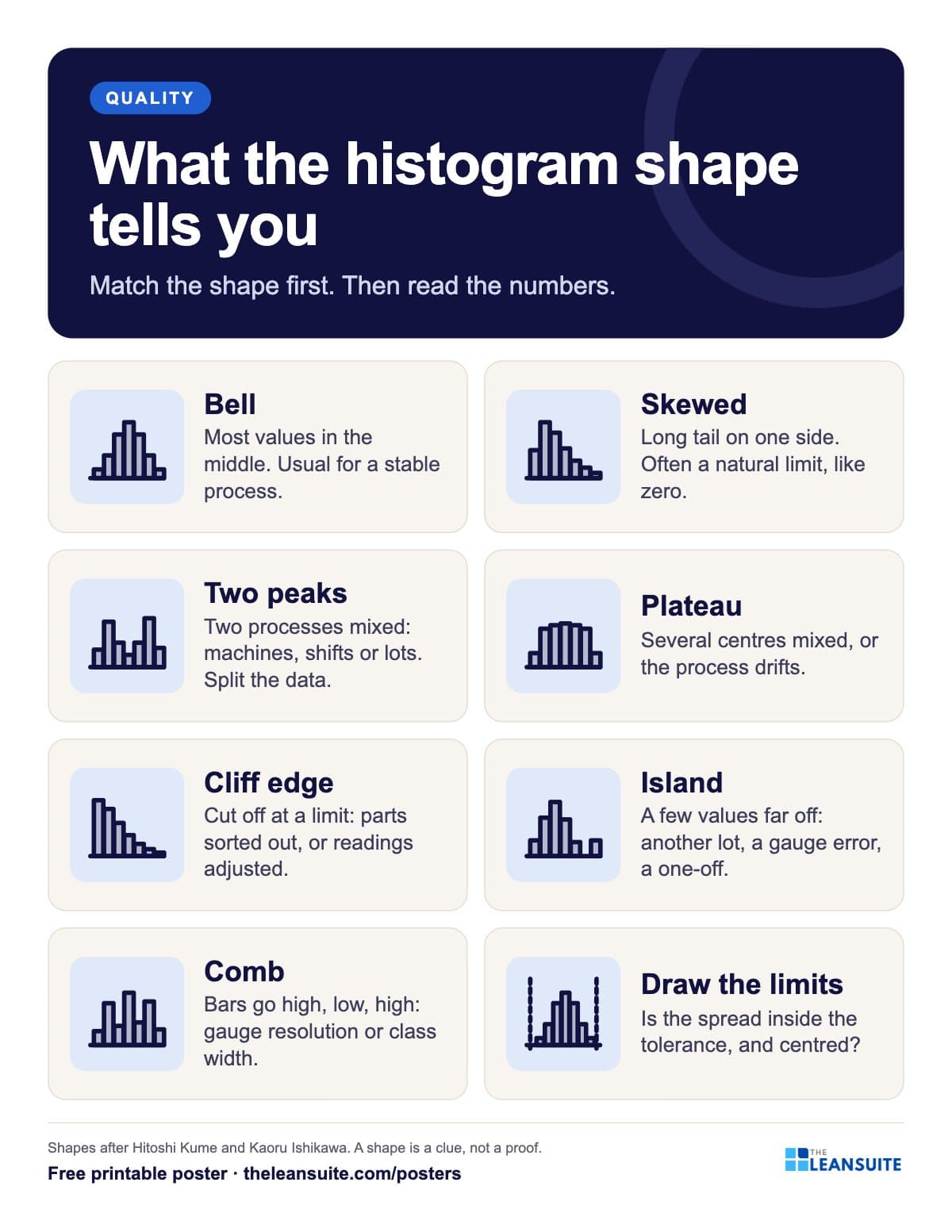 Histogram shapes poster
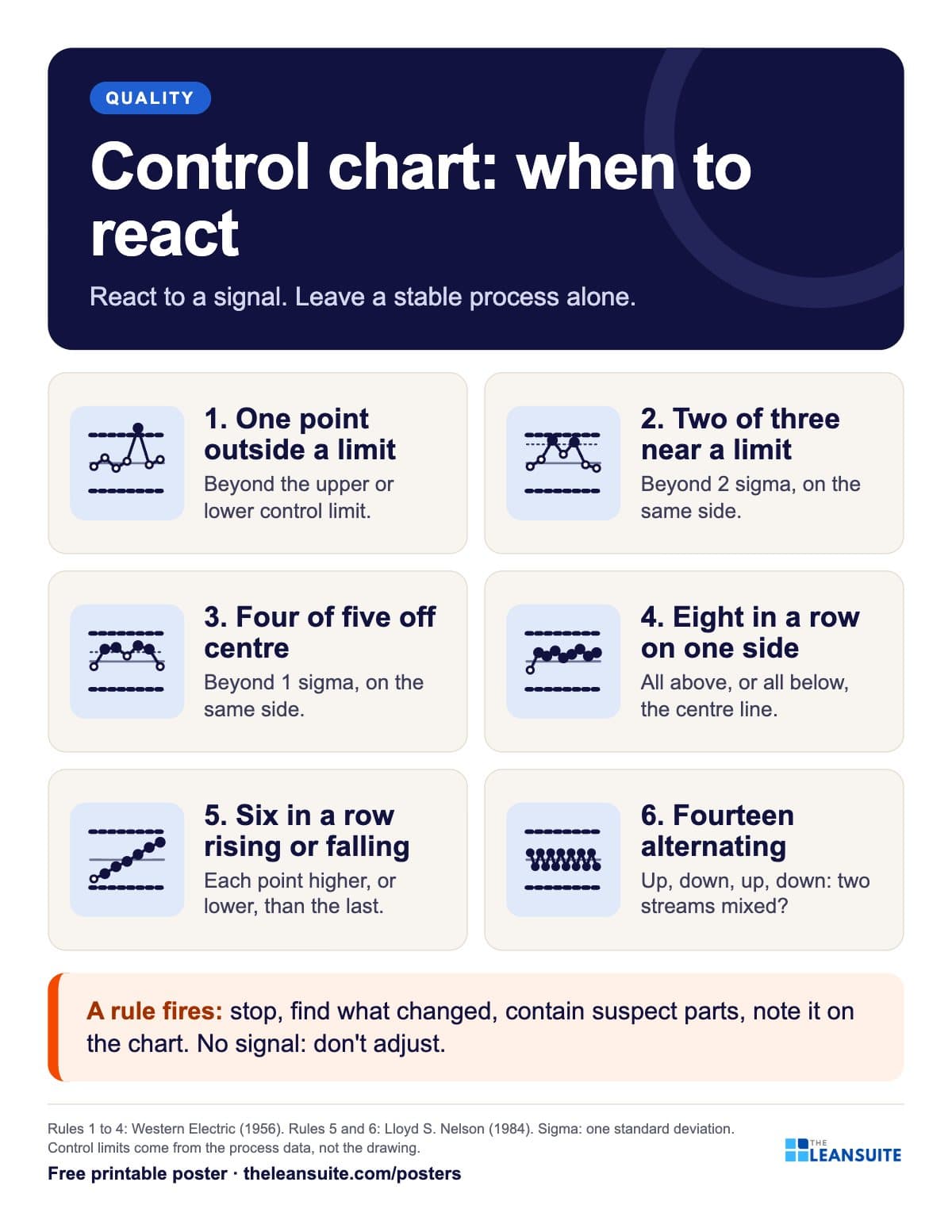 Control chart rules poster (when to react)
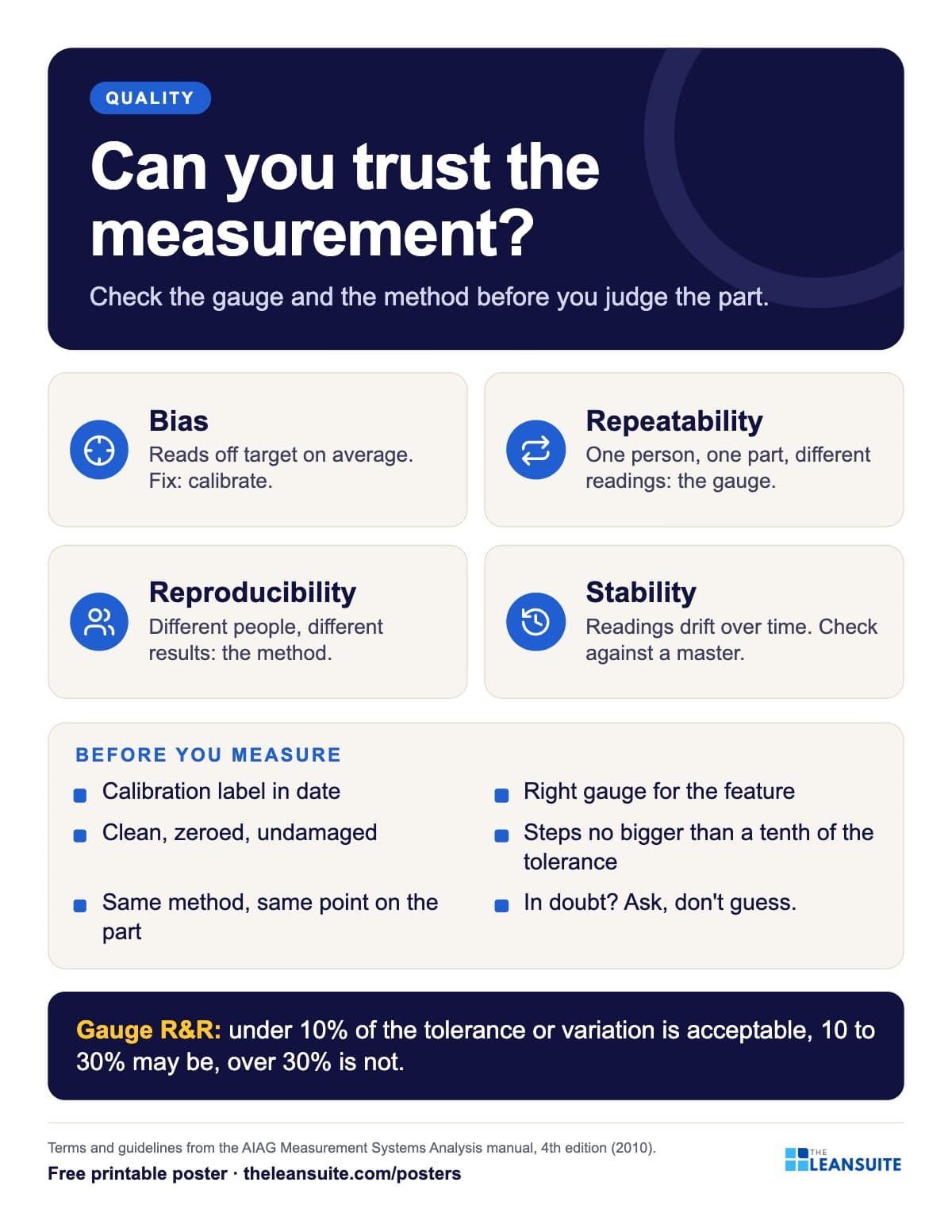 Measurement system basics poster
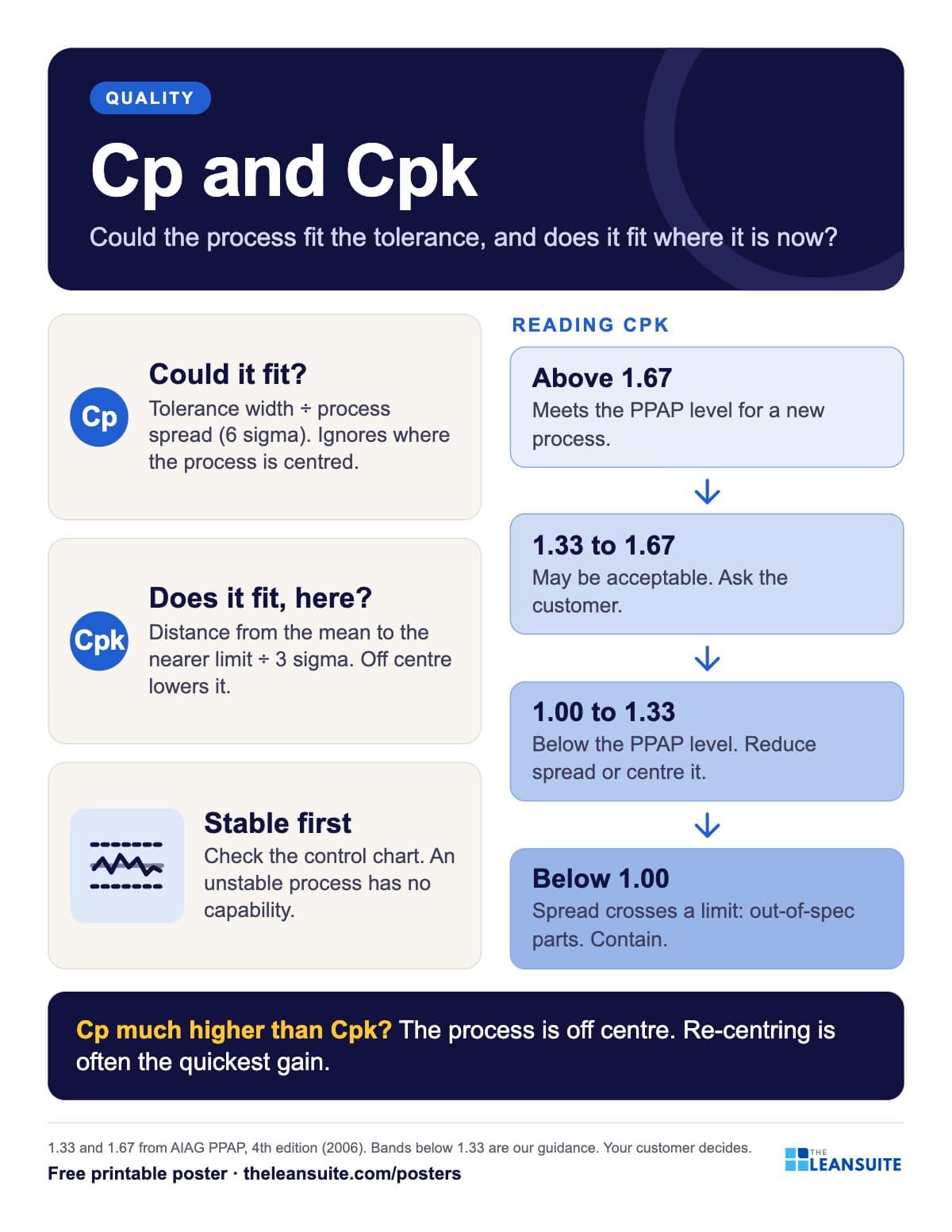 Cp and Cpk process capability poster
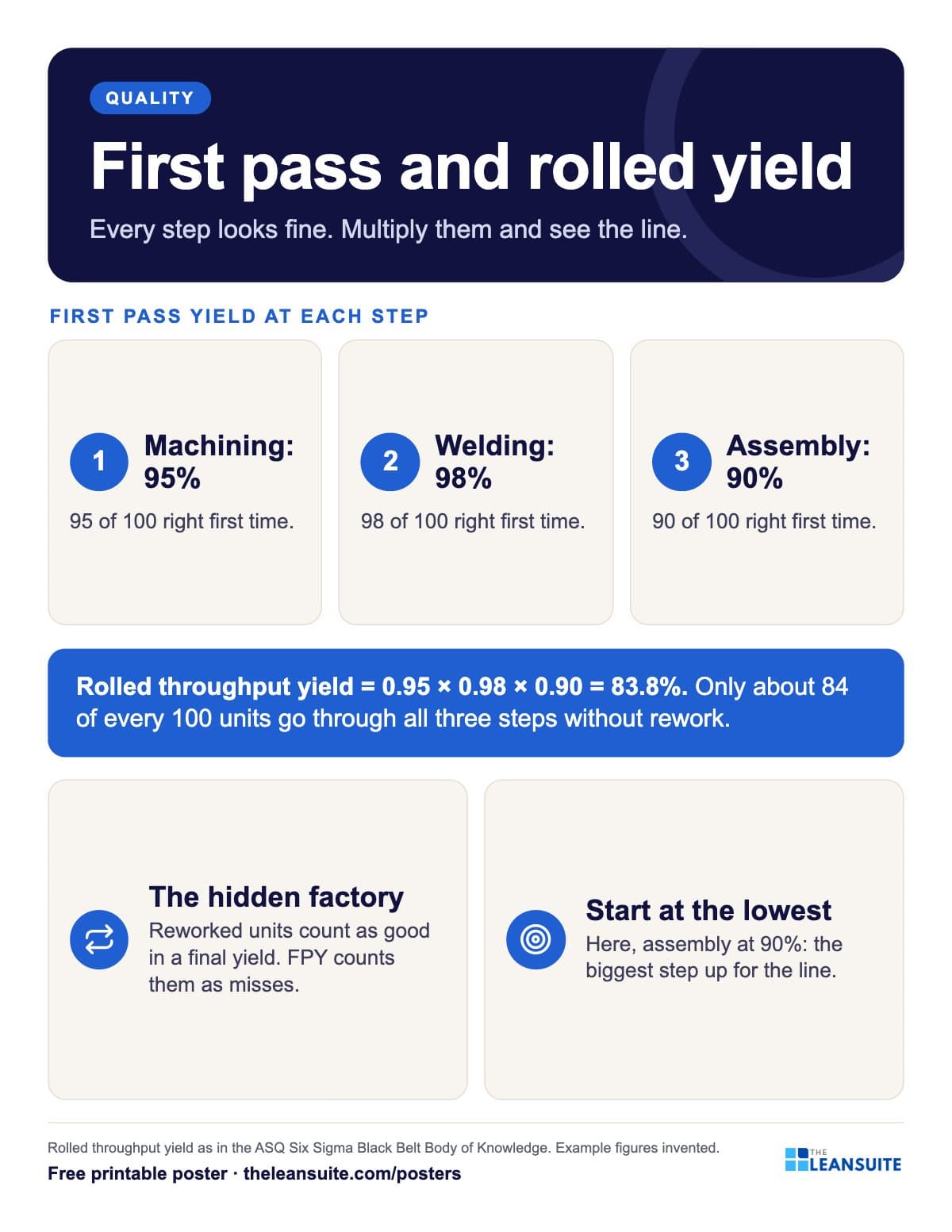 First pass yield and rolled throughput yield poster
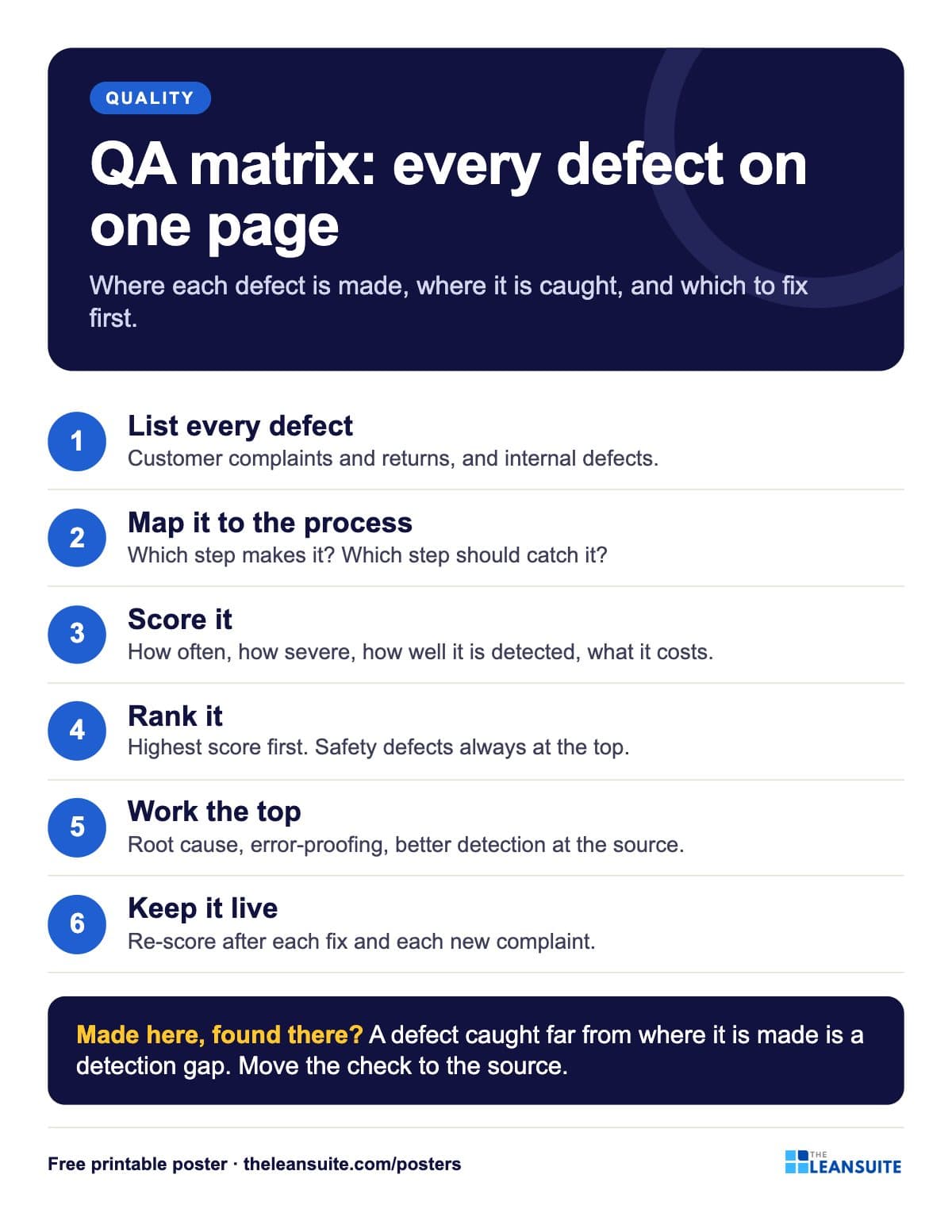 QA matrix poster
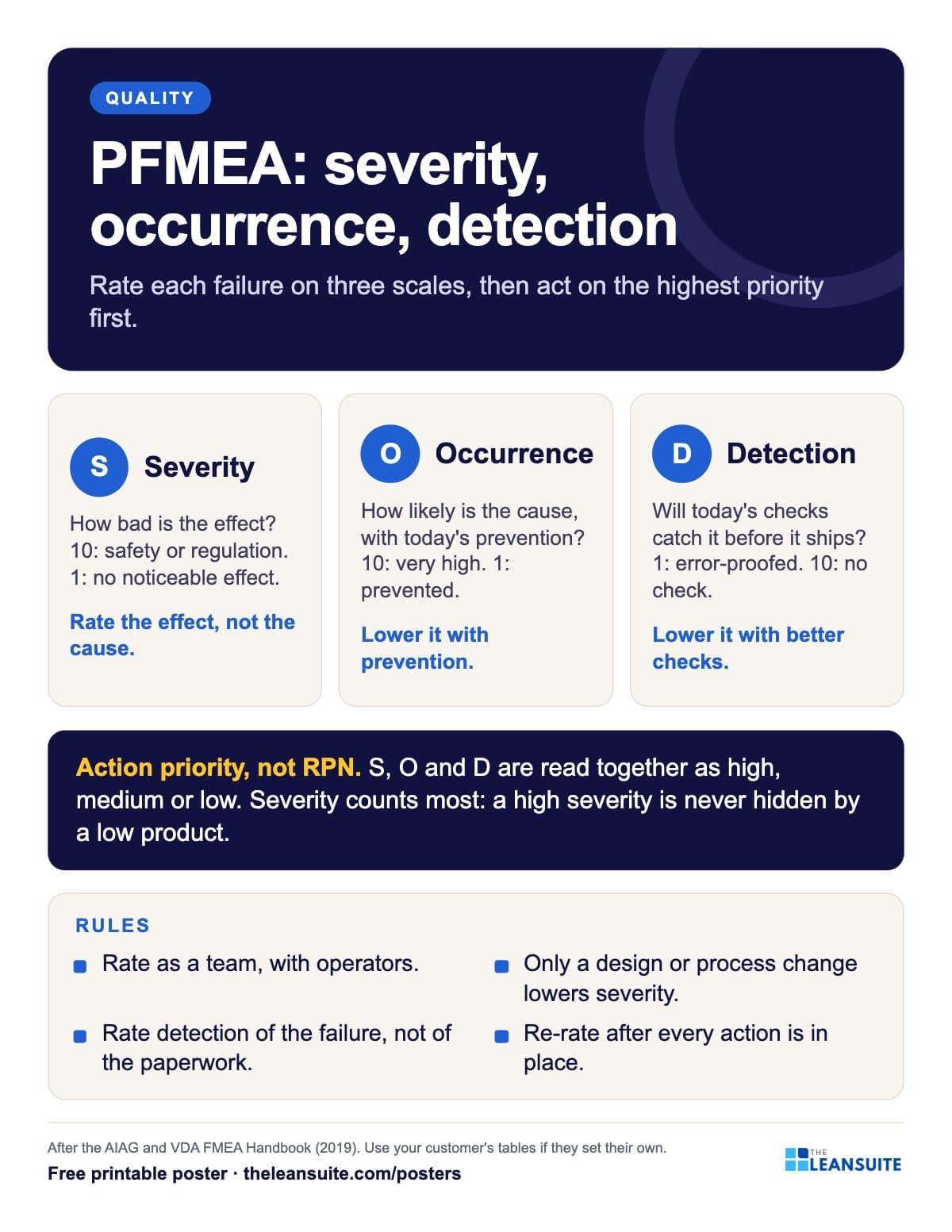 PFMEA severity, occurrence and detection poster
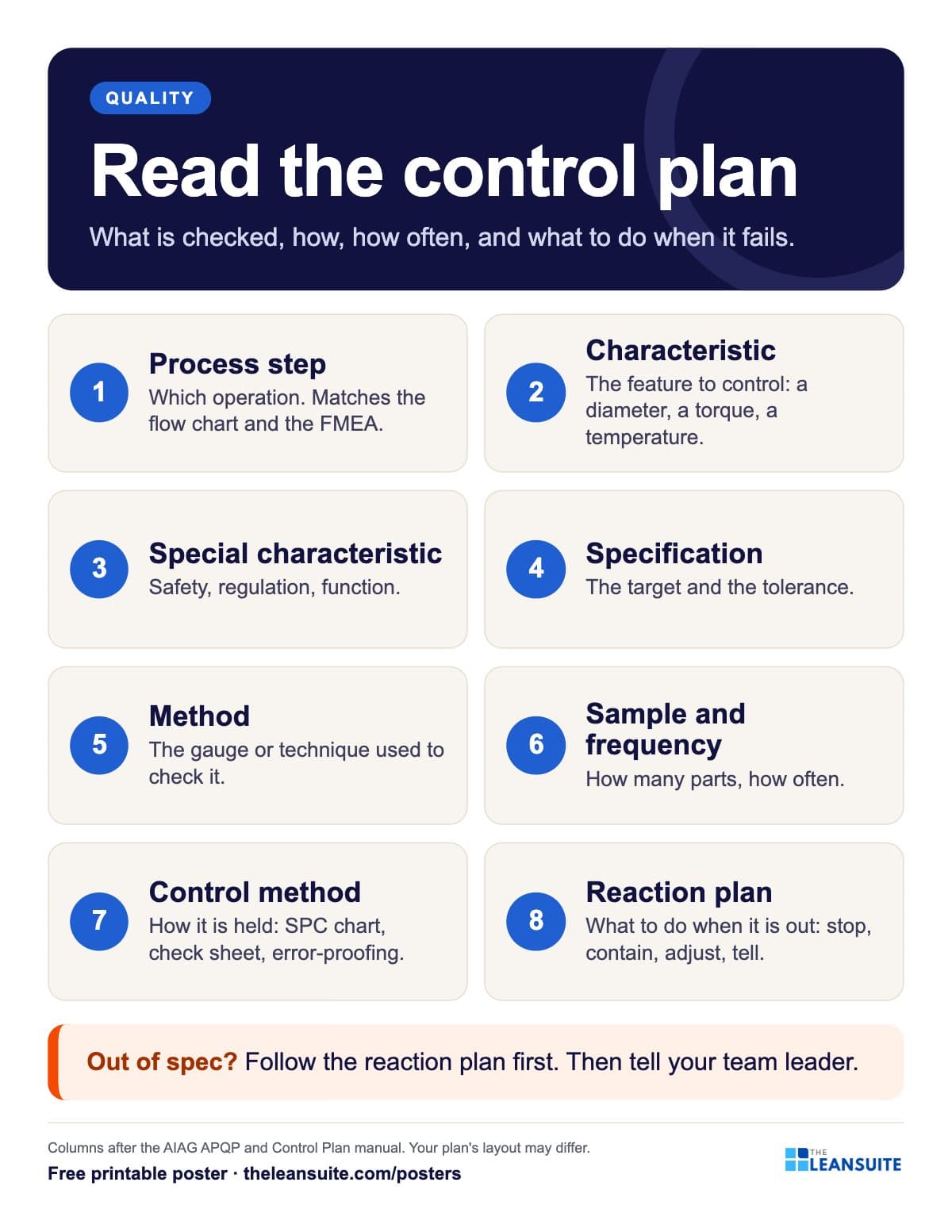 How to read a control plan poster
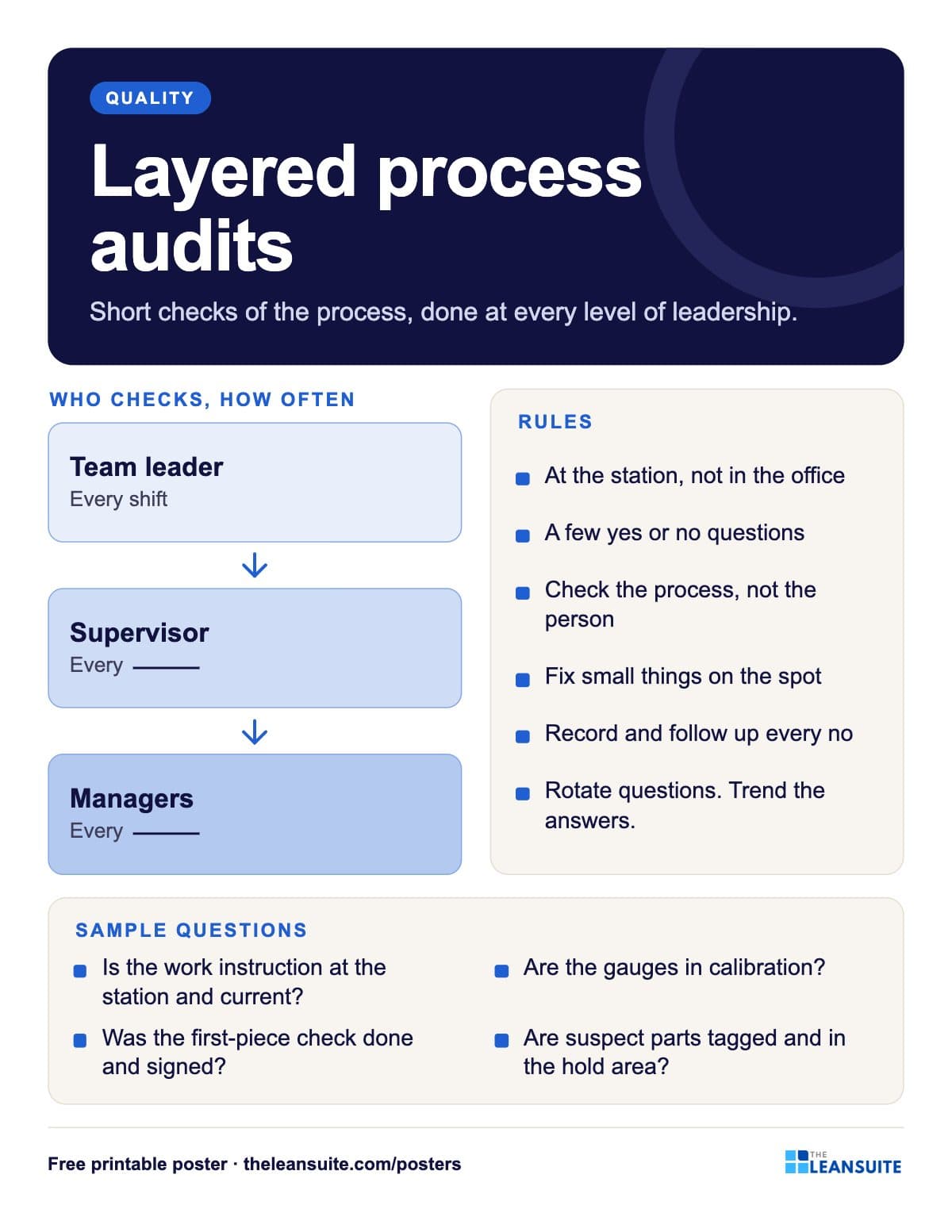 Layered process audit poster
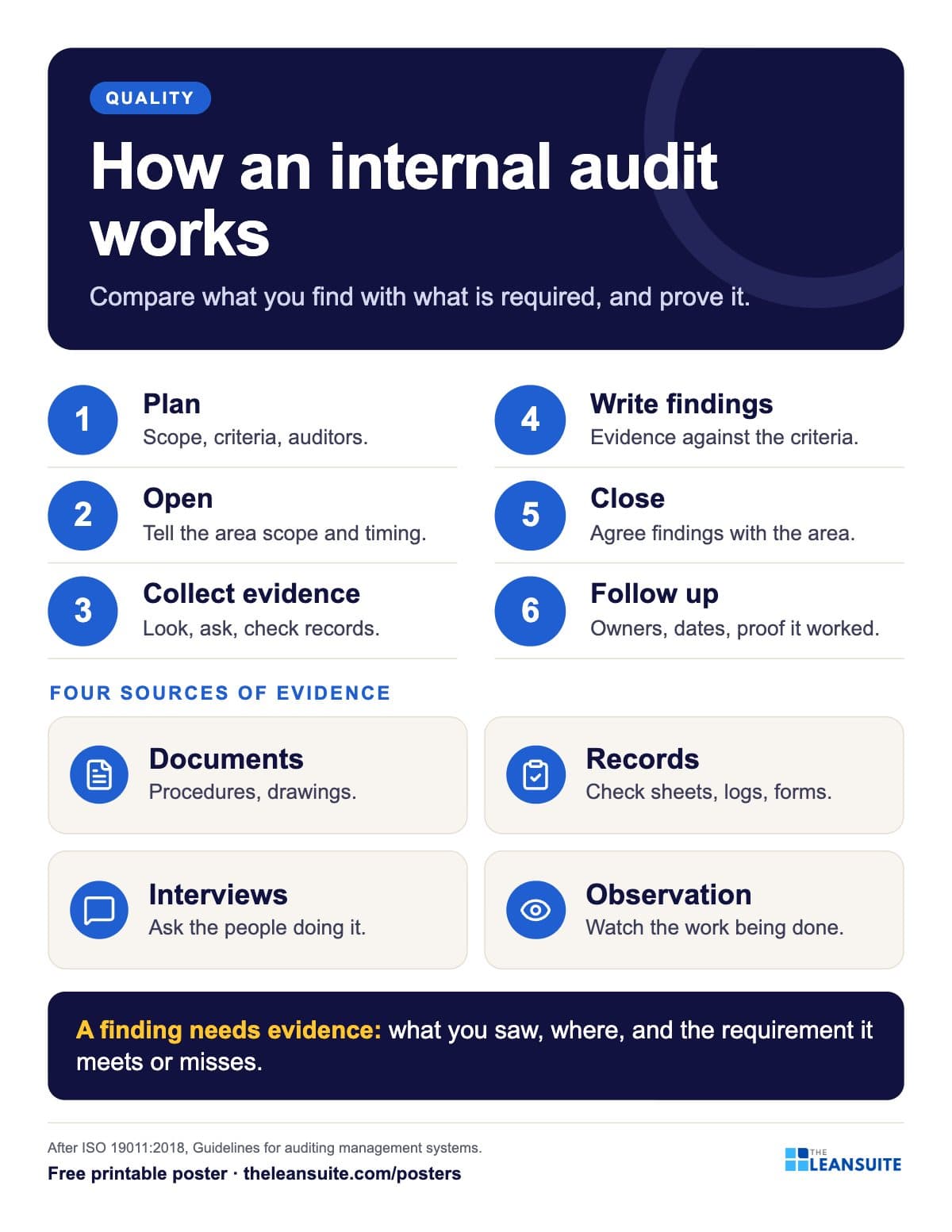 Internal audit steps poster
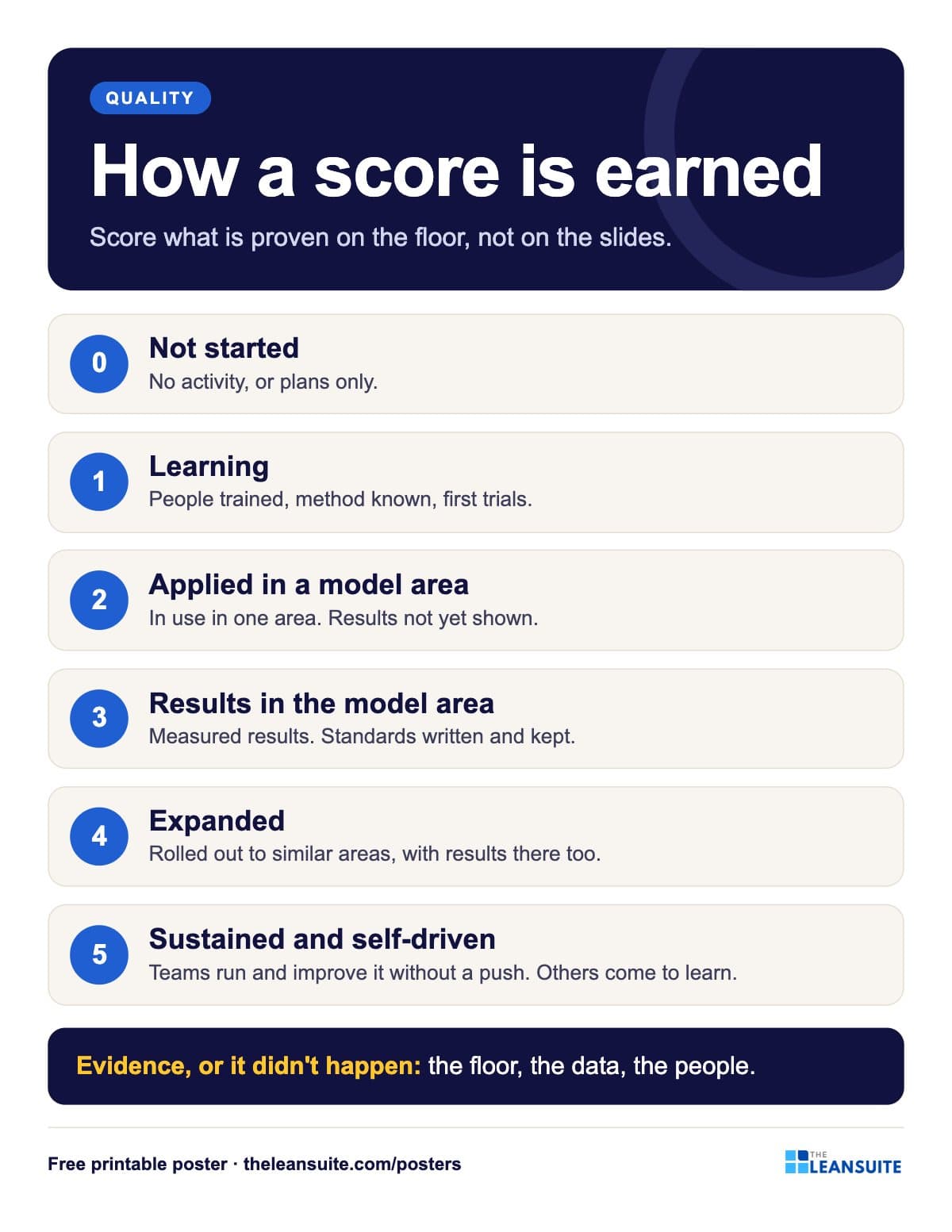 Audit score 0 to 5 poster
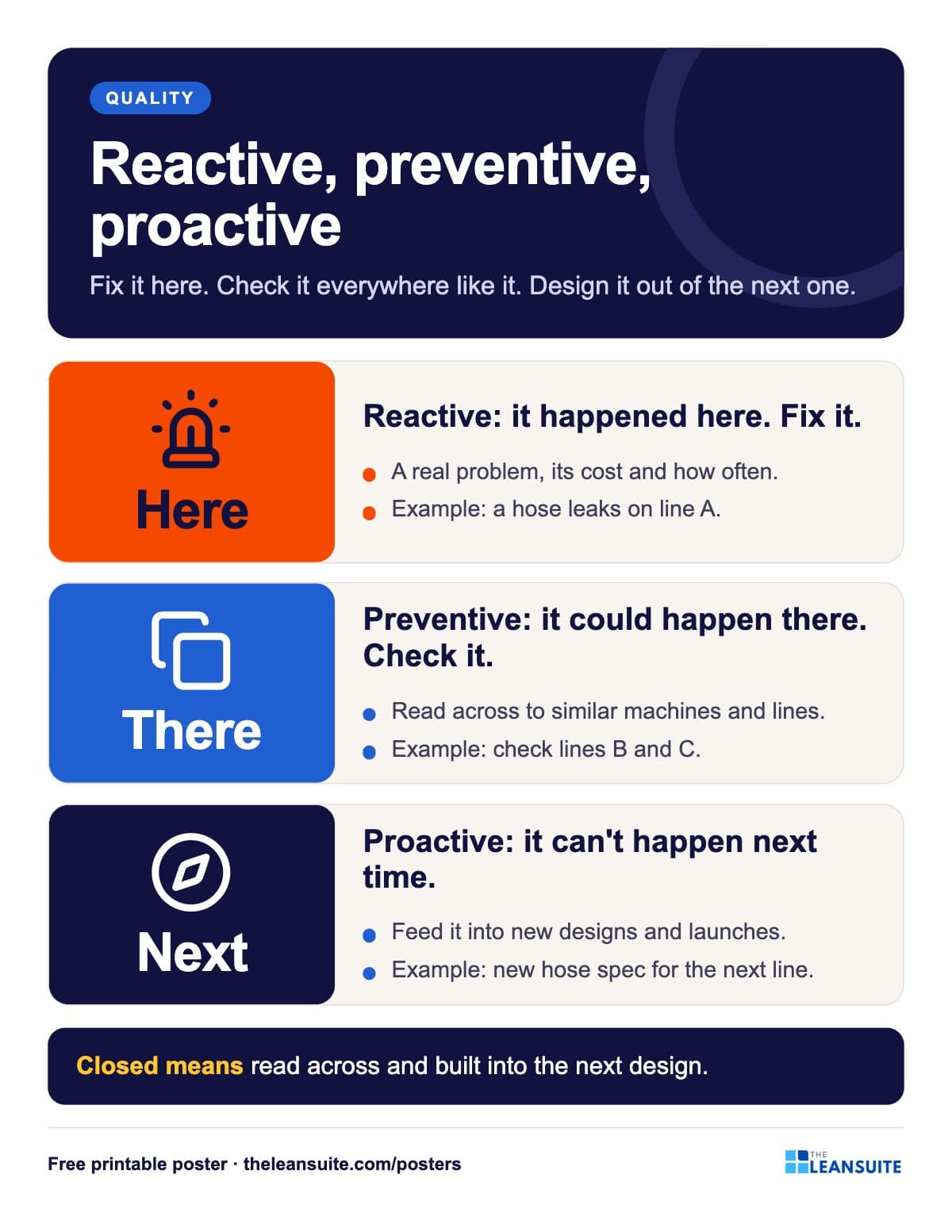 Reactive, preventive, proactive poster
A poster reminds. A routine makes it stick.
See how plants run their audits, improvements and follow-ups in LeanSuite, on a call built around your own problem.
Book a 45-minute demo