

Quality poster
Updated · Free to print and share
Why made, why missed poster
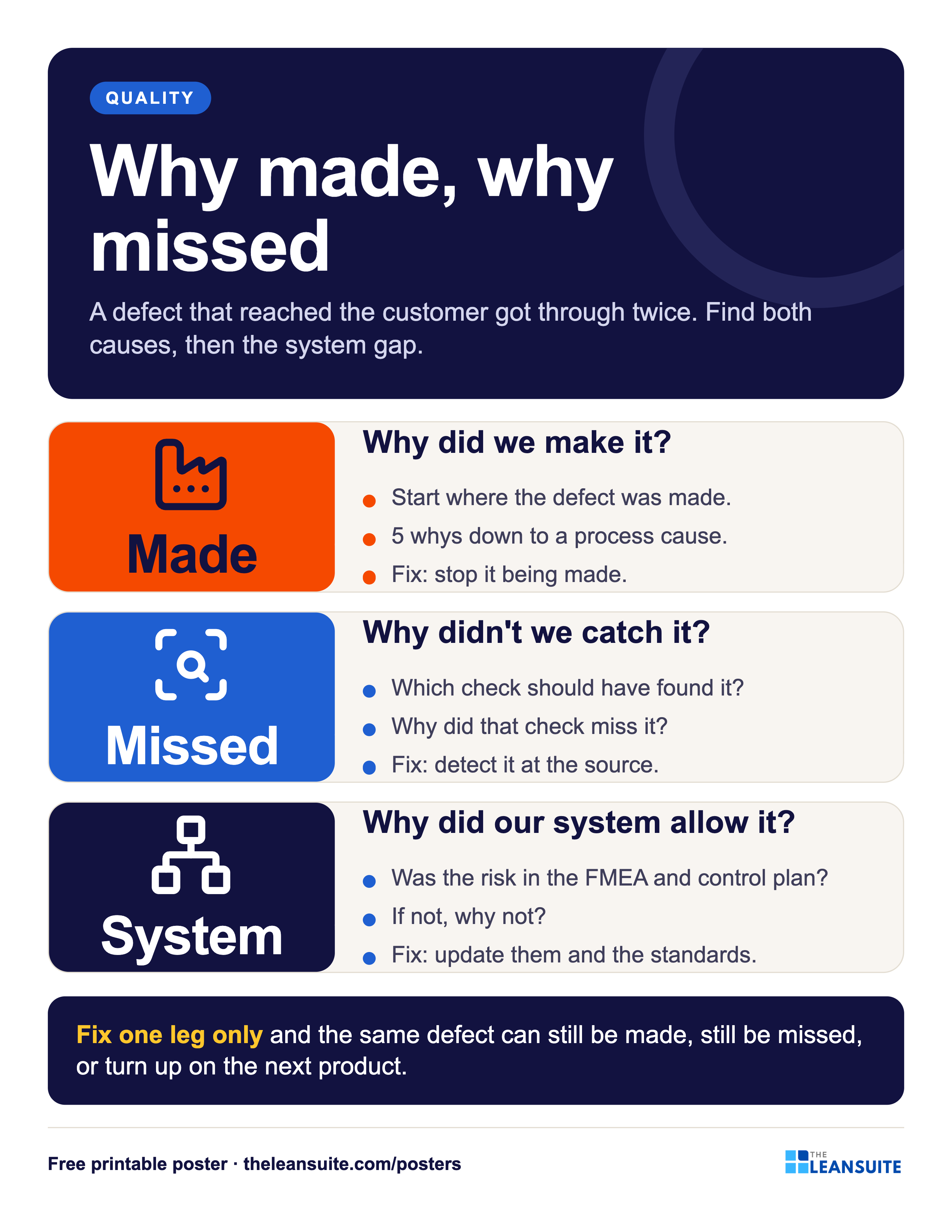
A defect that reaches a customer got through twice: once when it was made, and again when the checks that should have caught it did not. Many teams fix only the first. This poster splits the analysis into three legs: why we made it (the occurrence cause), why we missed it (the escape, or non-detection, cause) and why our system allowed it (the planning cause in the FMEA, control plan or standards). Each leg gets its own 5 whys and its own fix.
Download the poster
The PNG is free to download now. The print-ready vector PDFs open after a short form, once.
Free to print and share with your team. Enter your name and work email once to download.
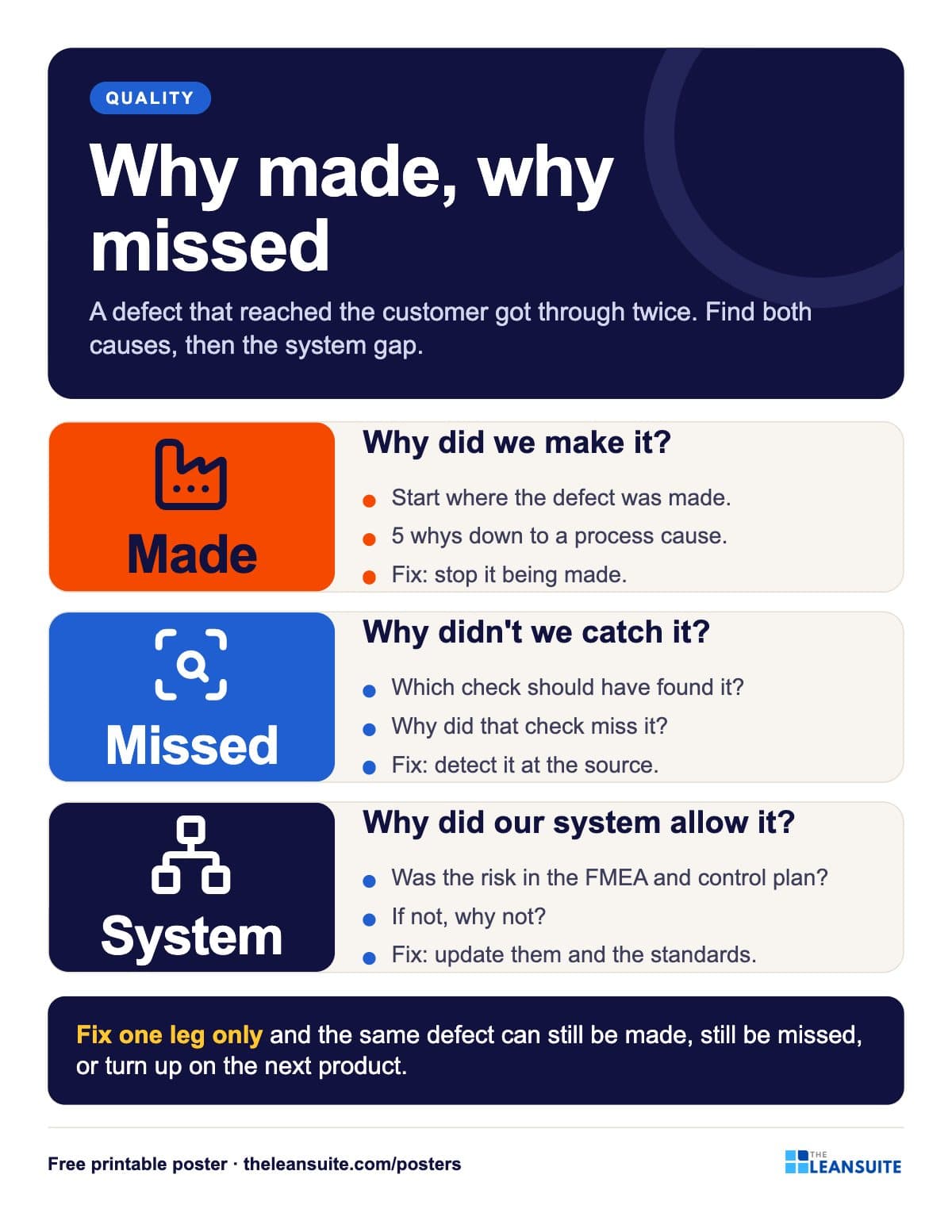 Three panels for why we made it, why we missed it and why the system allowed it, each with its questions and fix.
The words on the poster
Why made, why missed
A defect that reached the customer got through twice. Find both causes, then the system gap.
- Made Why did we make it? Start where the defect was made. 5 whys down to a process cause. Fix: stop it being made.
- Missed Why didn't we catch it? Which check should have found it? Why did that check miss it? Fix: detect it at the source.
- System Why did our system allow it? Was the risk in the FMEA and control plan? If not, why not? Fix: update them and the standards.
- Fix one leg only and the same defect can still be made, still be missed, or turn up on the next product.
On the floor
How to use it
Putting the Why made, why missed poster to work
- 1
Use it on every customer complaint and every defect found after final inspection.
- 2
Run a separate 5 whys for each leg and write all three on the 8D or A3.
- 3
Check the escape leg names the check that should have caught the defect.
- 4
Pair it with the free 8D report template and PFMEA template.
Which size to print
- 24 x 36 in or A2: a main wall or team board, read from a few metres away.
- 18 x 24 in or A3: a station or notice board. The A3 file also fits 11 x 17 in paper.
- Letter or A4: a clipboard, binder or handout, on any office printer.
Every PDF is vector, so it stays sharp at full size. Nothing runs to the edge of the page, so no bleed is needed.
Sources and notes
- Ford's 8D (team oriented problem solving) separates the root cause from the escape point, the earliest place in the process where the problem should have been detected.
Templates, decks and guides to go with it
- Root cause analysis training presentation: 5 whys and fishboneFree training deck: Define, contain, the 5 whys, the fishbone diagram and verifying the cause, in 18 slides with a team activity.
- 8D report templateD0 to D8 with targets, containment counts, occurrence, escape and systemic causes, verified actions and a worked example.
- PFMEA template (process FMEA)Failure modes, effects and causes rated for severity, occurrence and detection, with RPN before and after action.
- Control plan templateWhat is checked at each step, against which limits, how, how often, and what to do when a result is out.
- 5 Whys templateA problem statement, a why chain that can branch, evidence for every answer, root causes and countermeasures that are checked.
- Topic: Root cause analysis and problem solvingEvery guide we have on the subject, sorted.
- Topic: Quality managementEvery guide we have on the subject, sorted.
More quality posters
All posters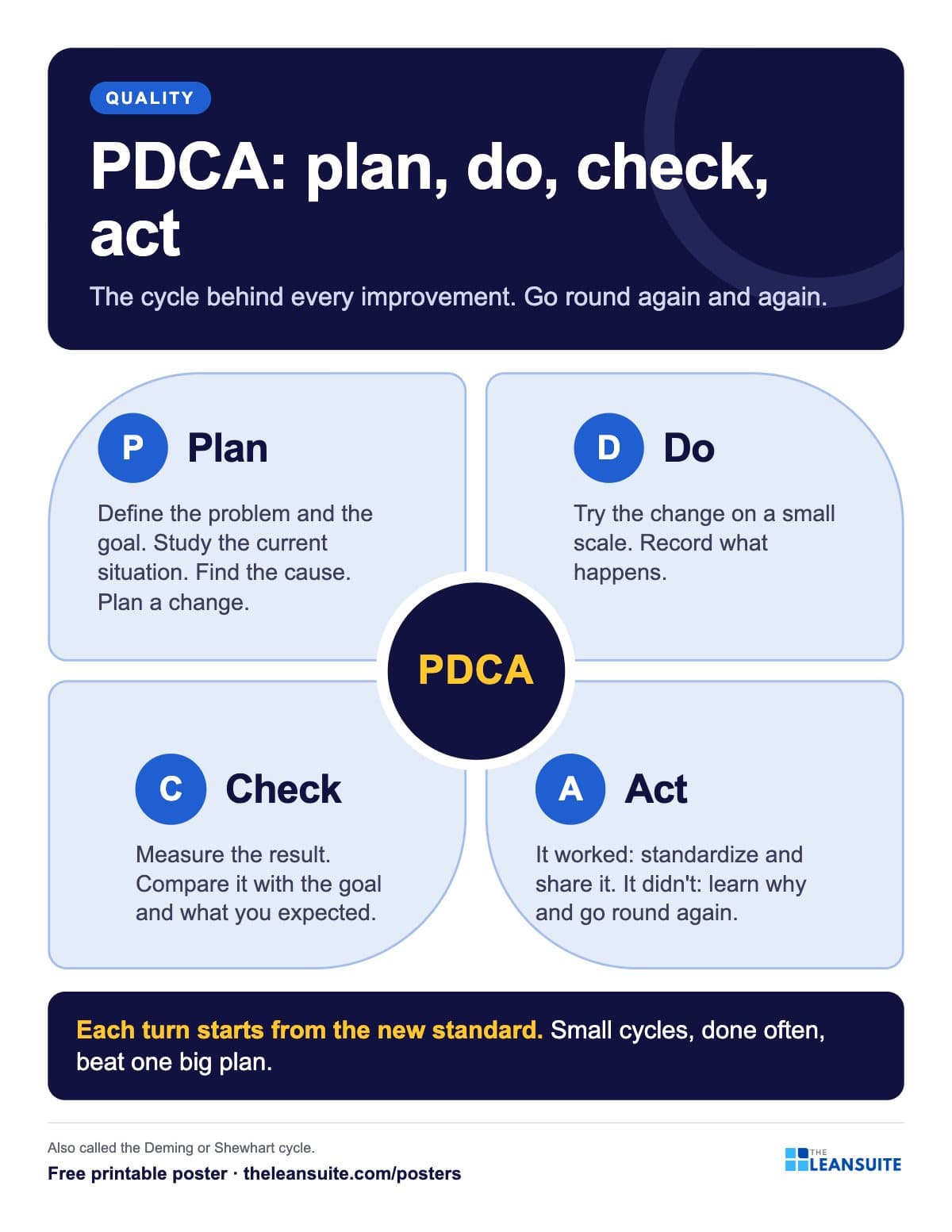 PDCA cycle poster
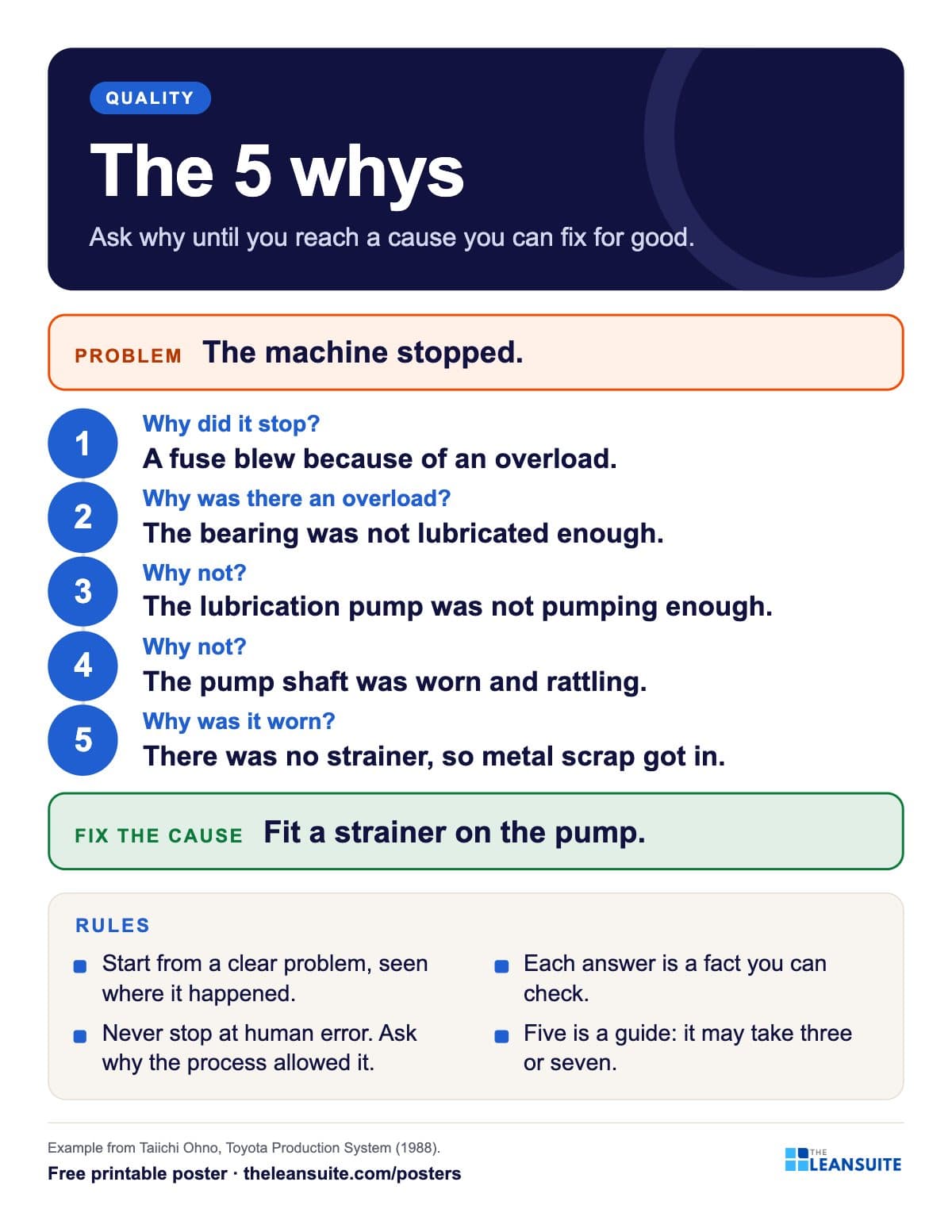 5 whys poster
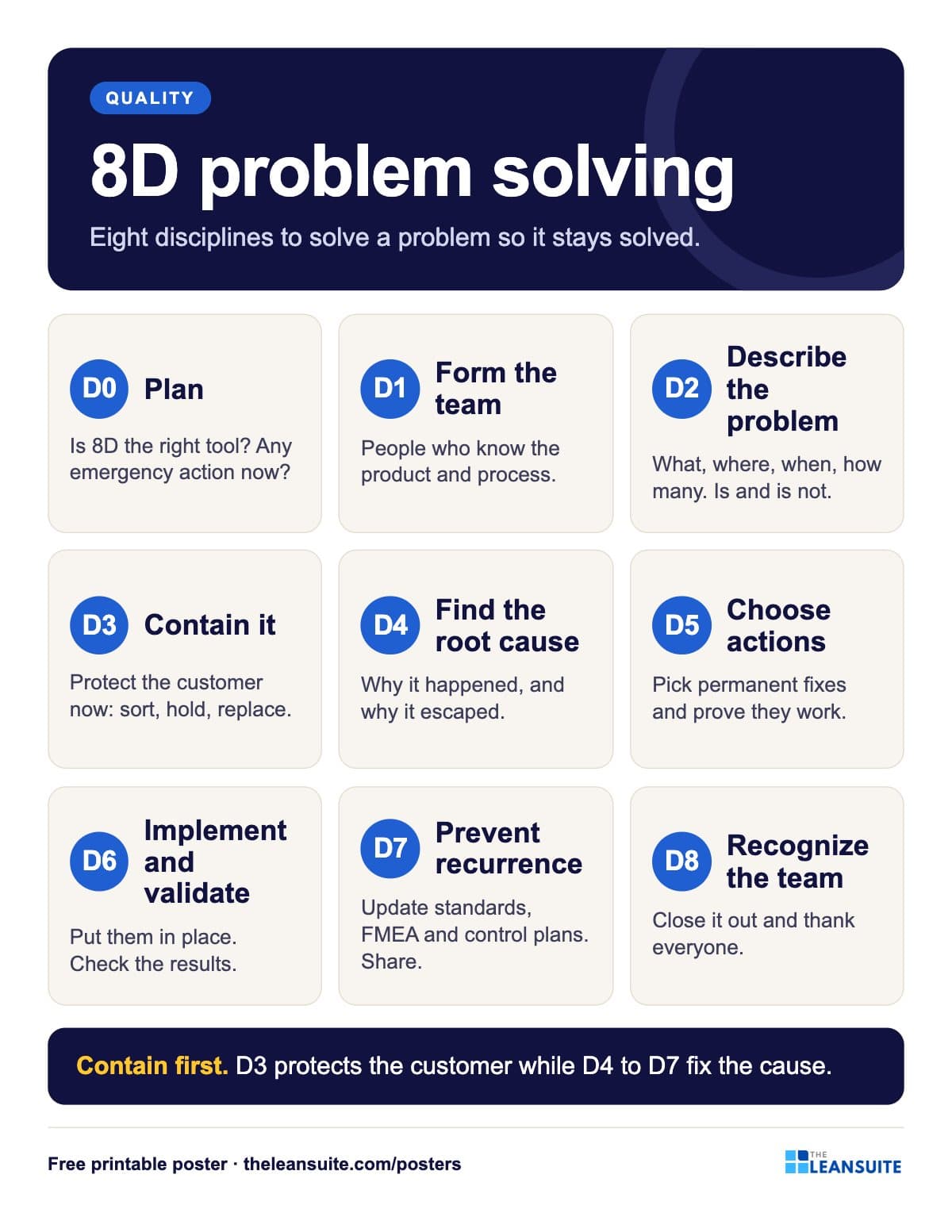 8D problem solving poster
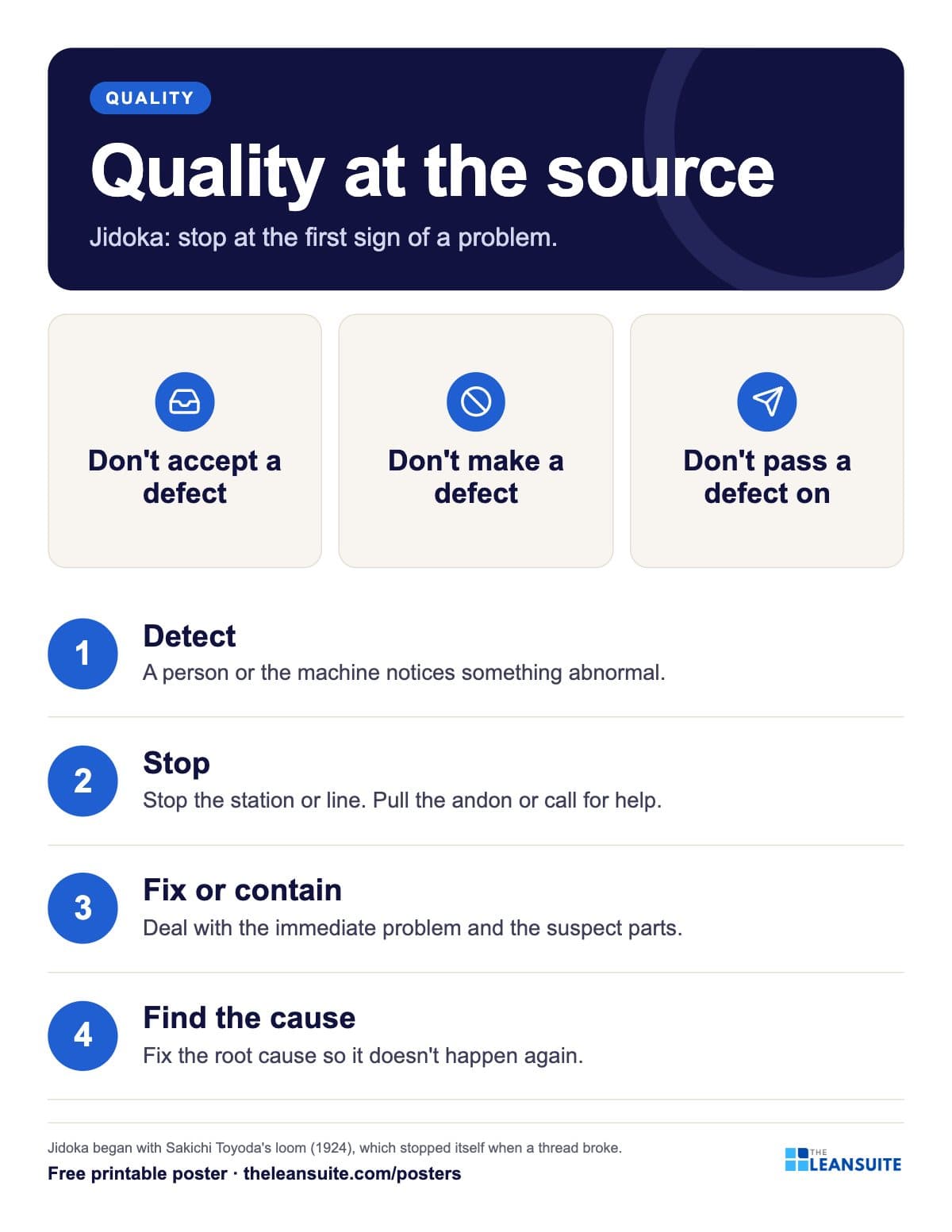 Jidoka and quality at the source poster
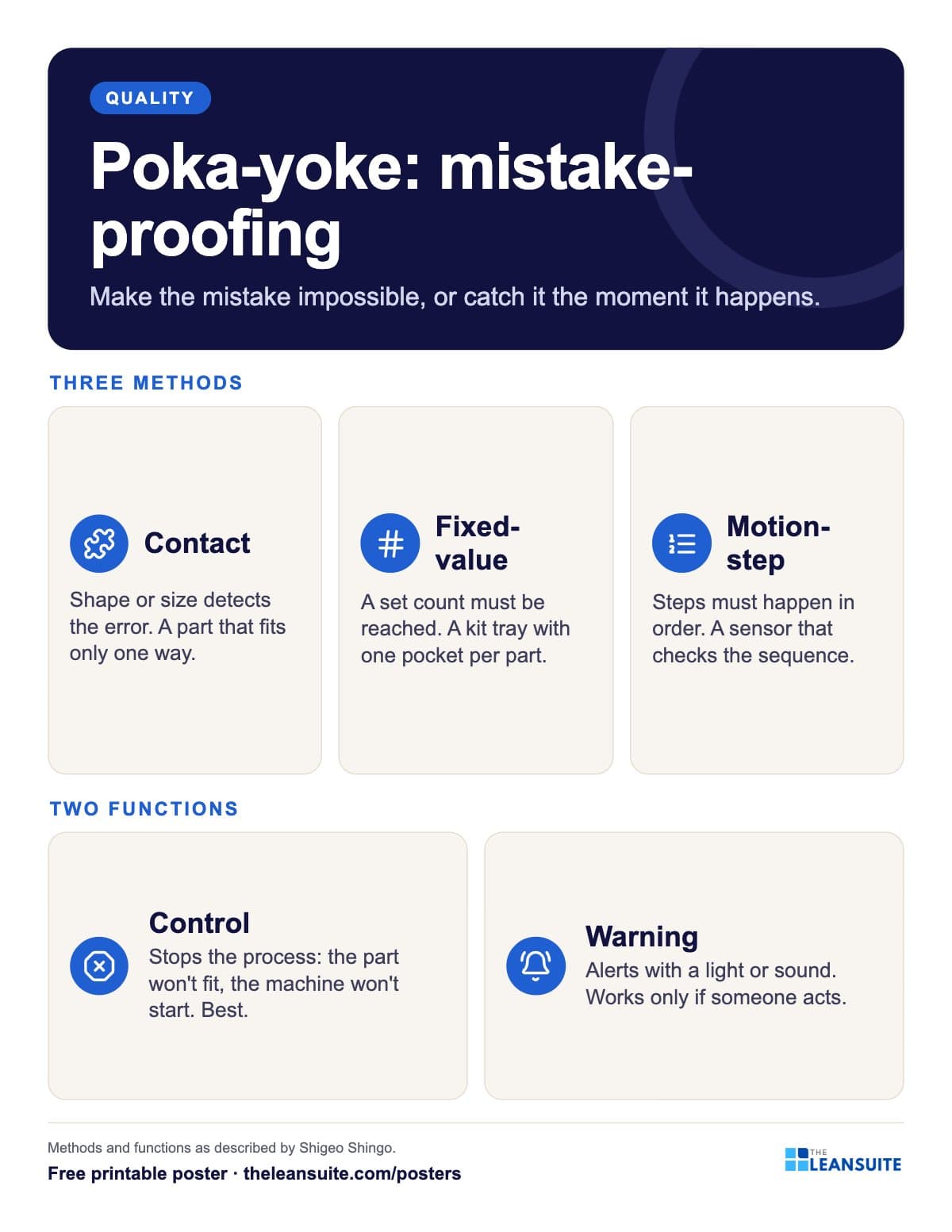 Poka-yoke types poster
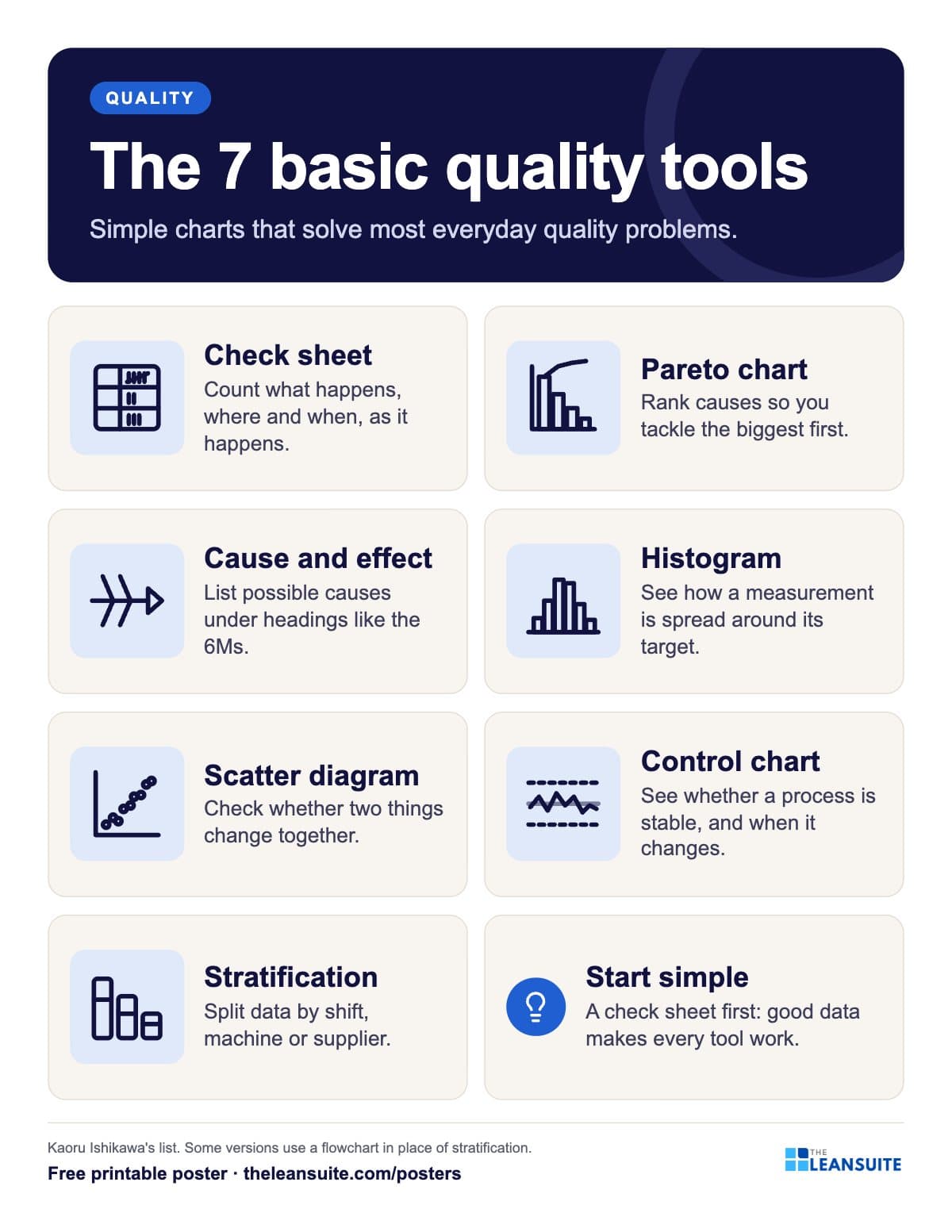 7 basic quality tools poster
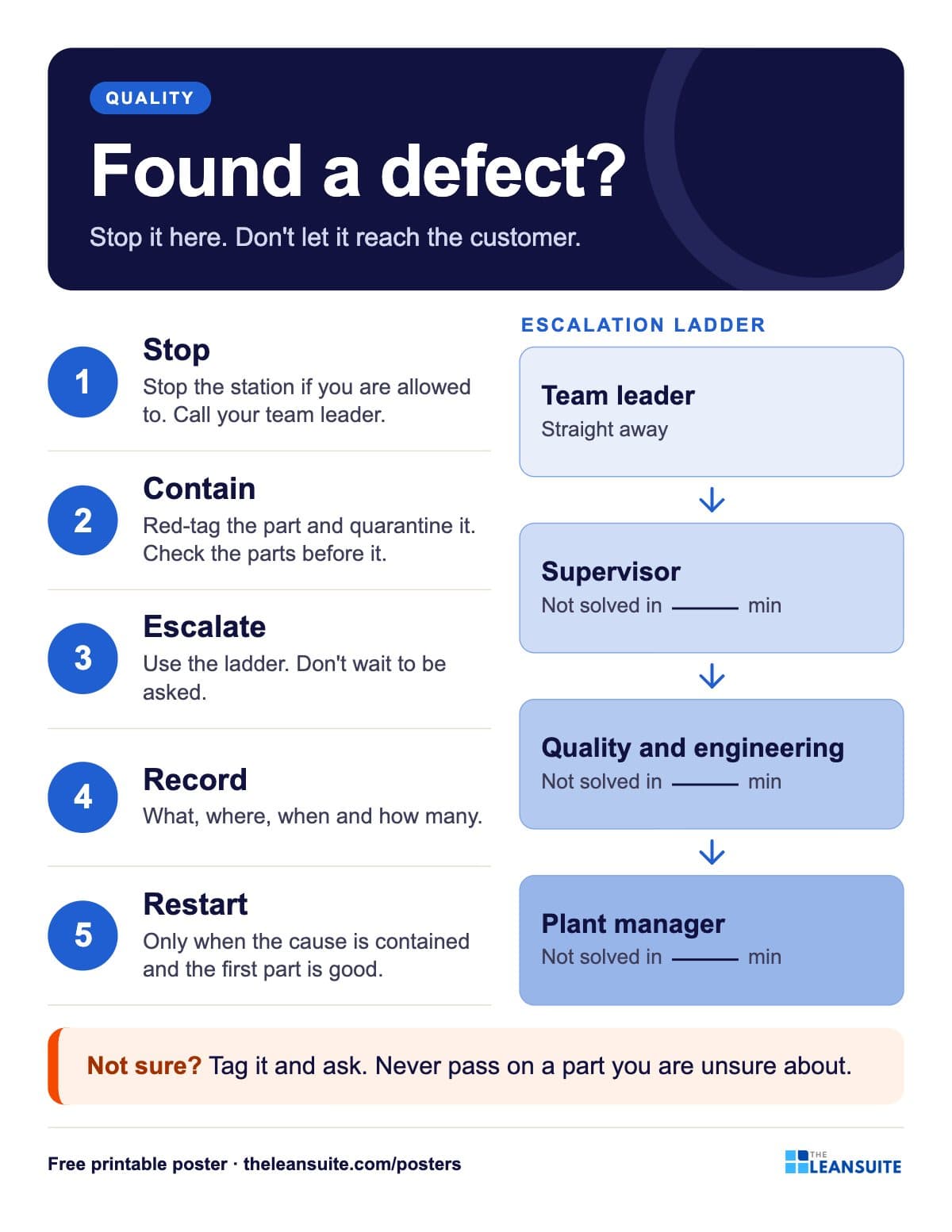 Defect escalation poster (red tag and stop the line)
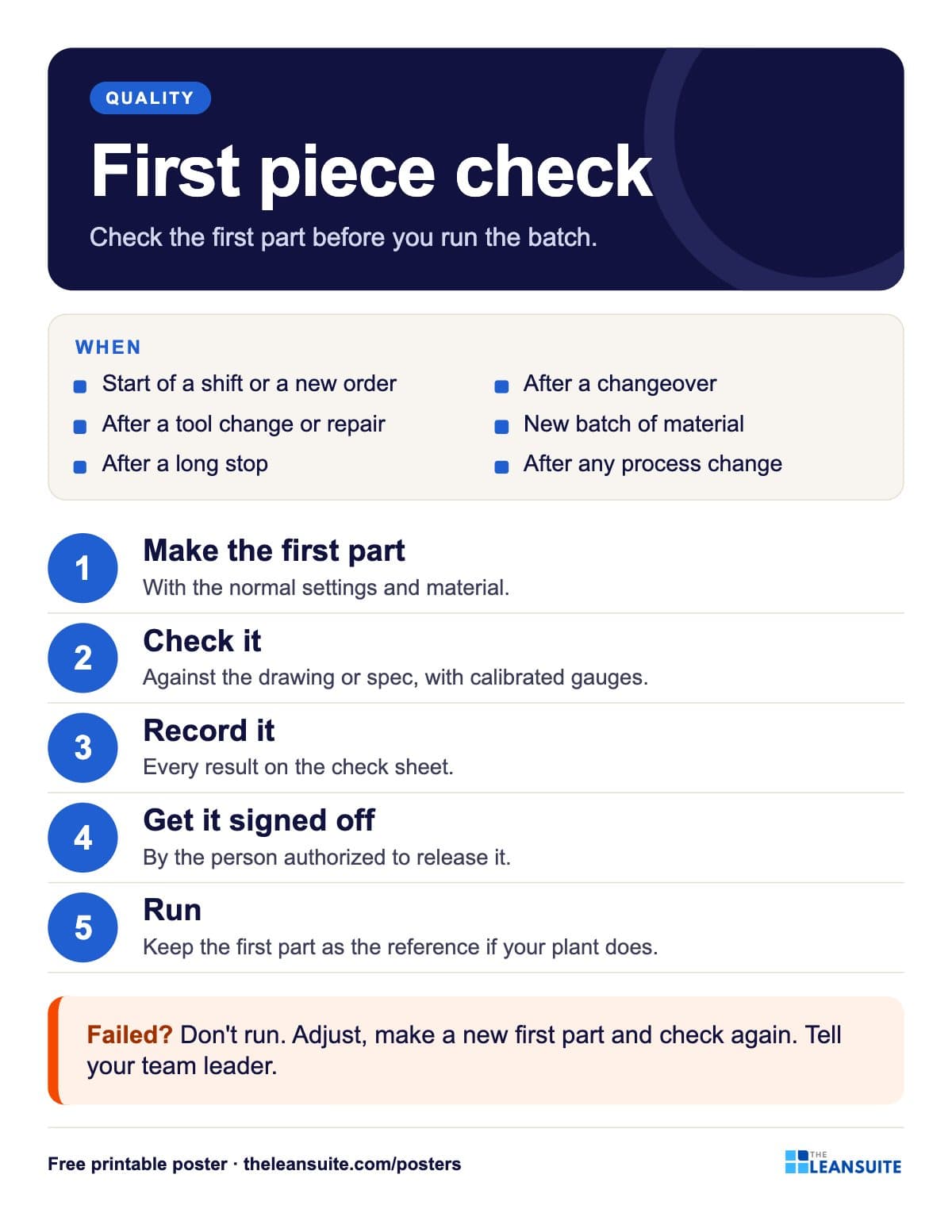 First piece (first article) check poster
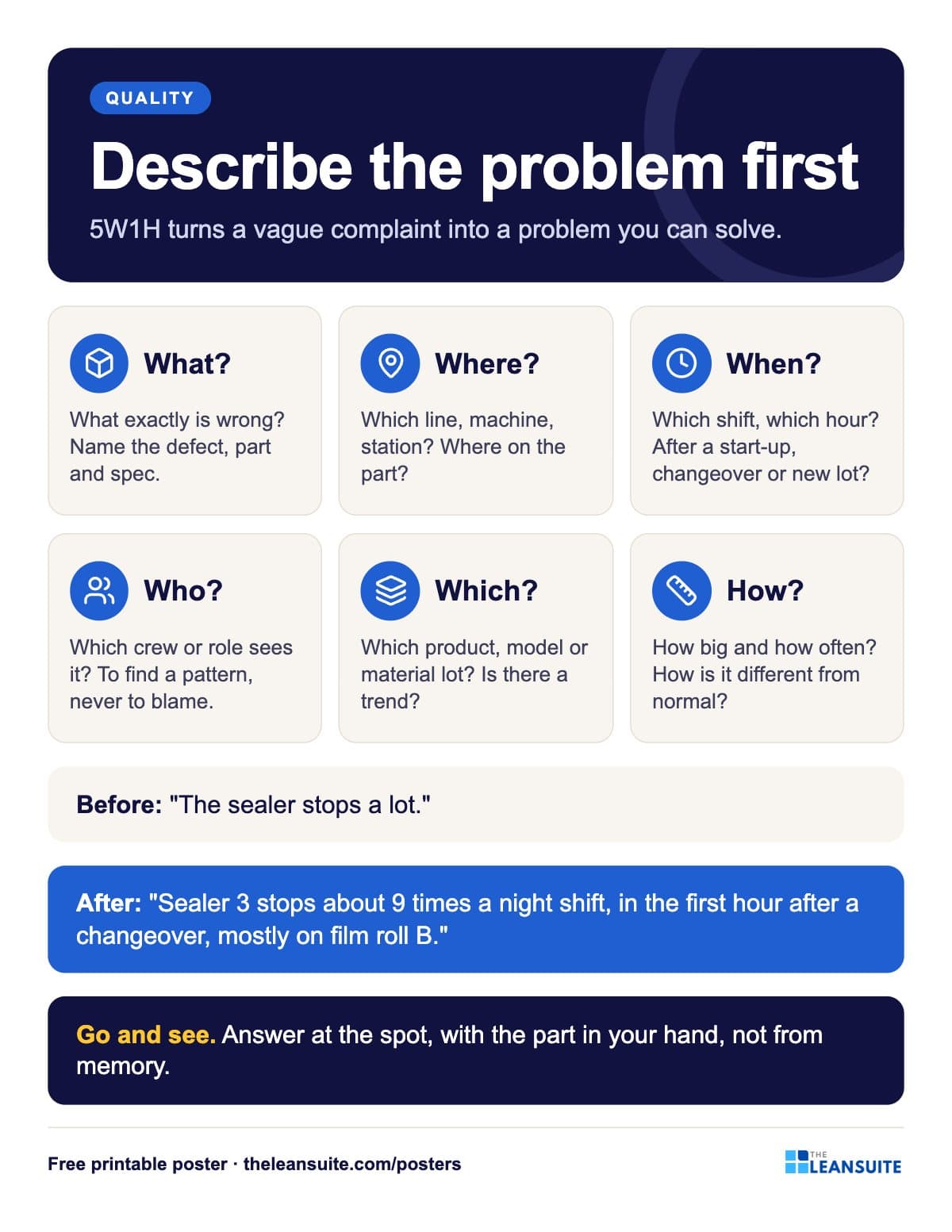 5W1H problem description poster
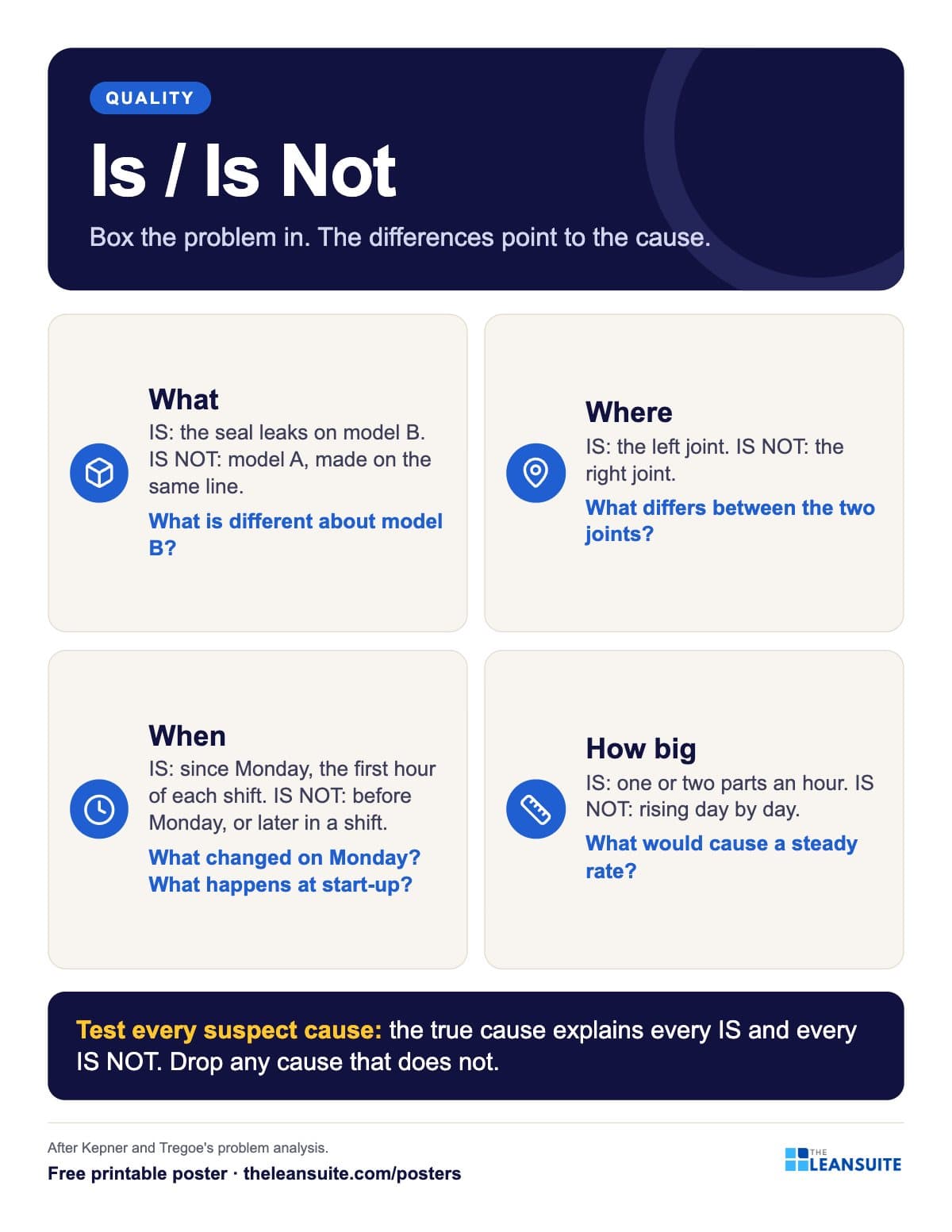 Is / Is Not analysis poster
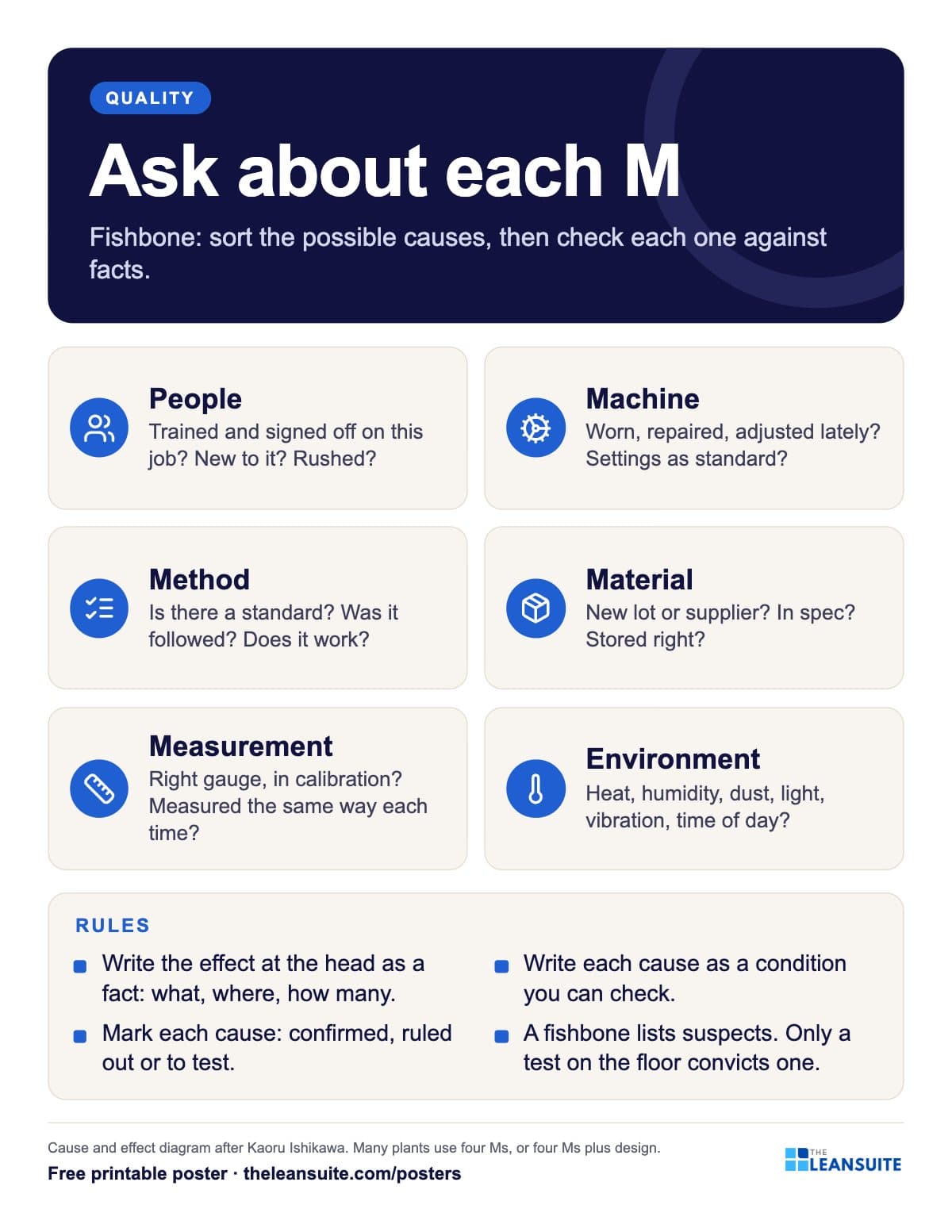 Fishbone 6M questions poster
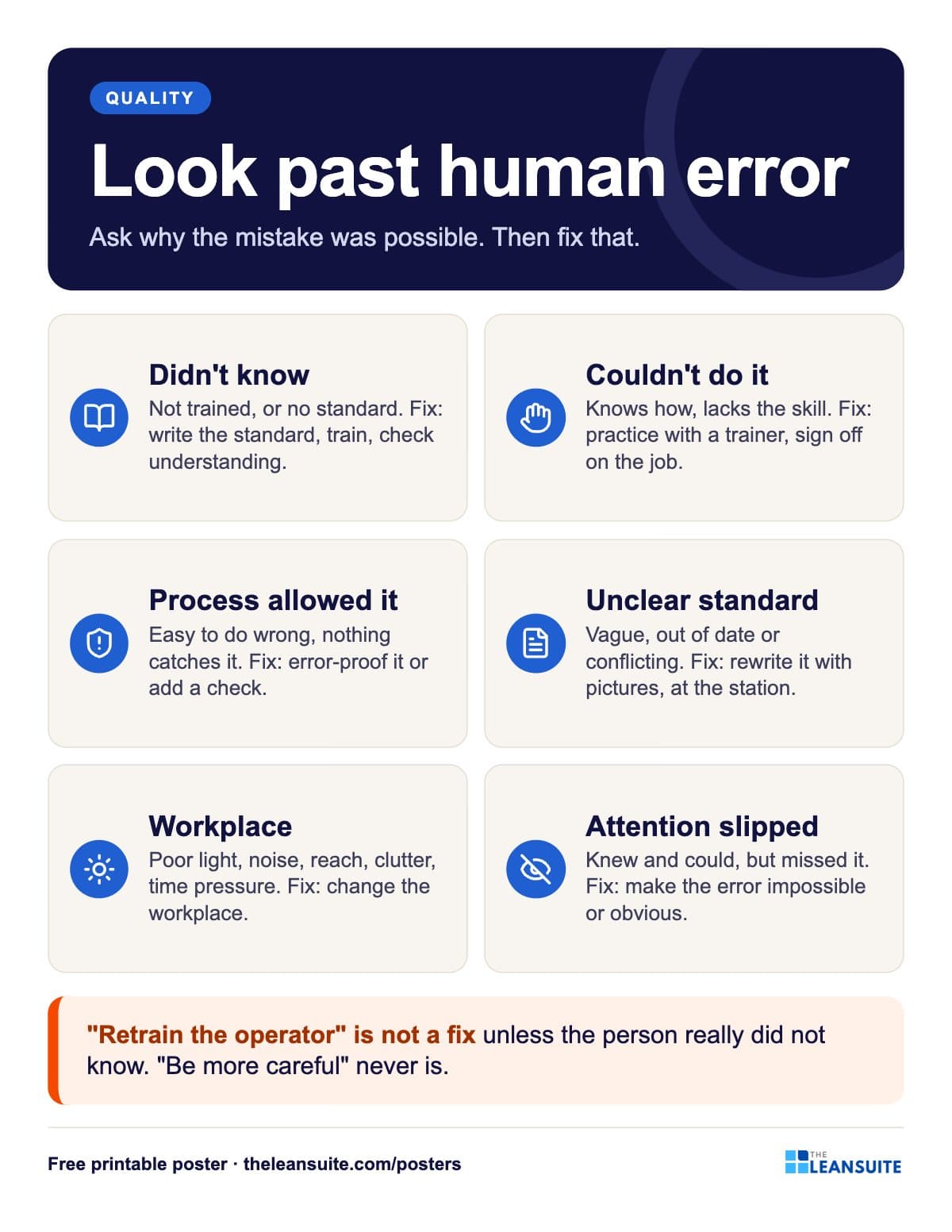 Human error root causes poster
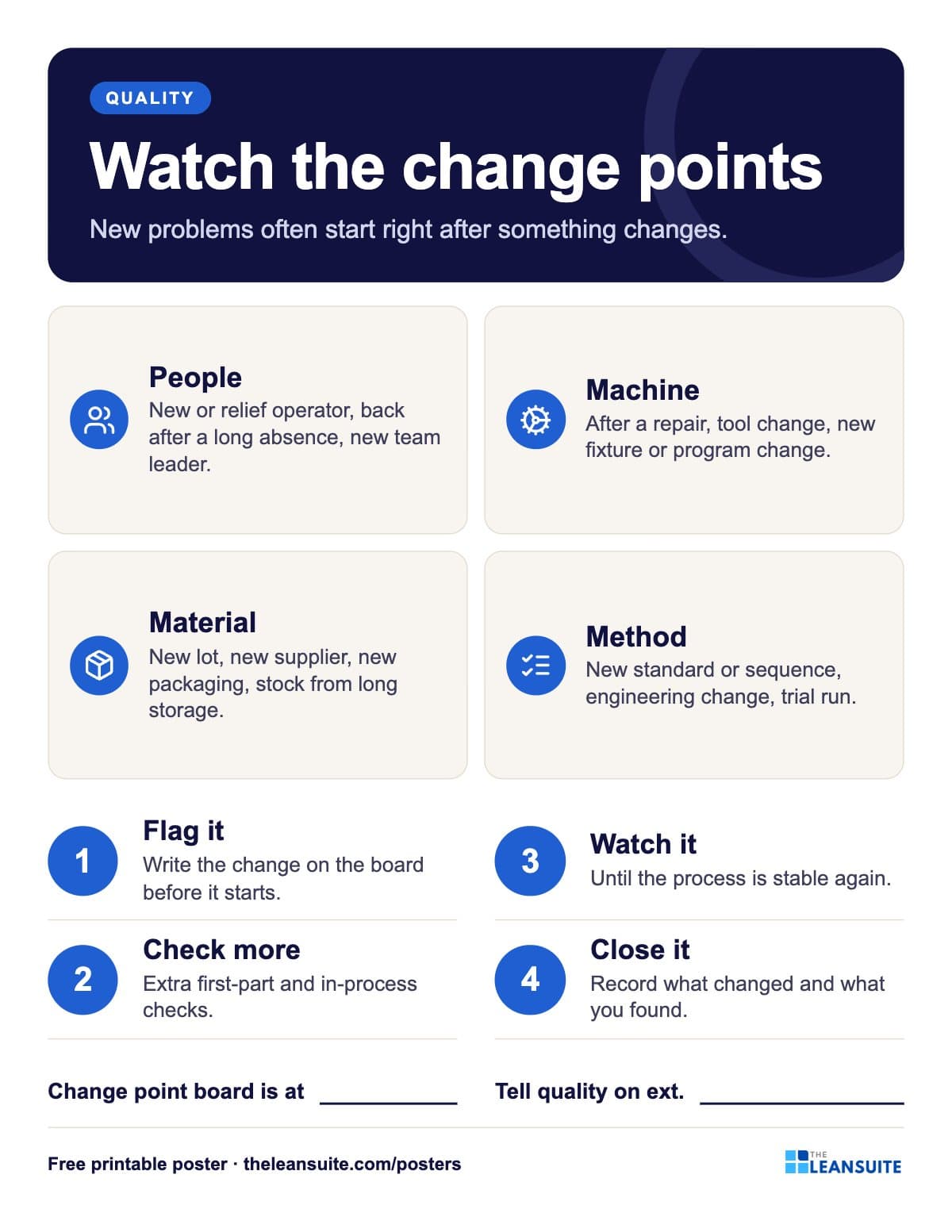 4M change points poster
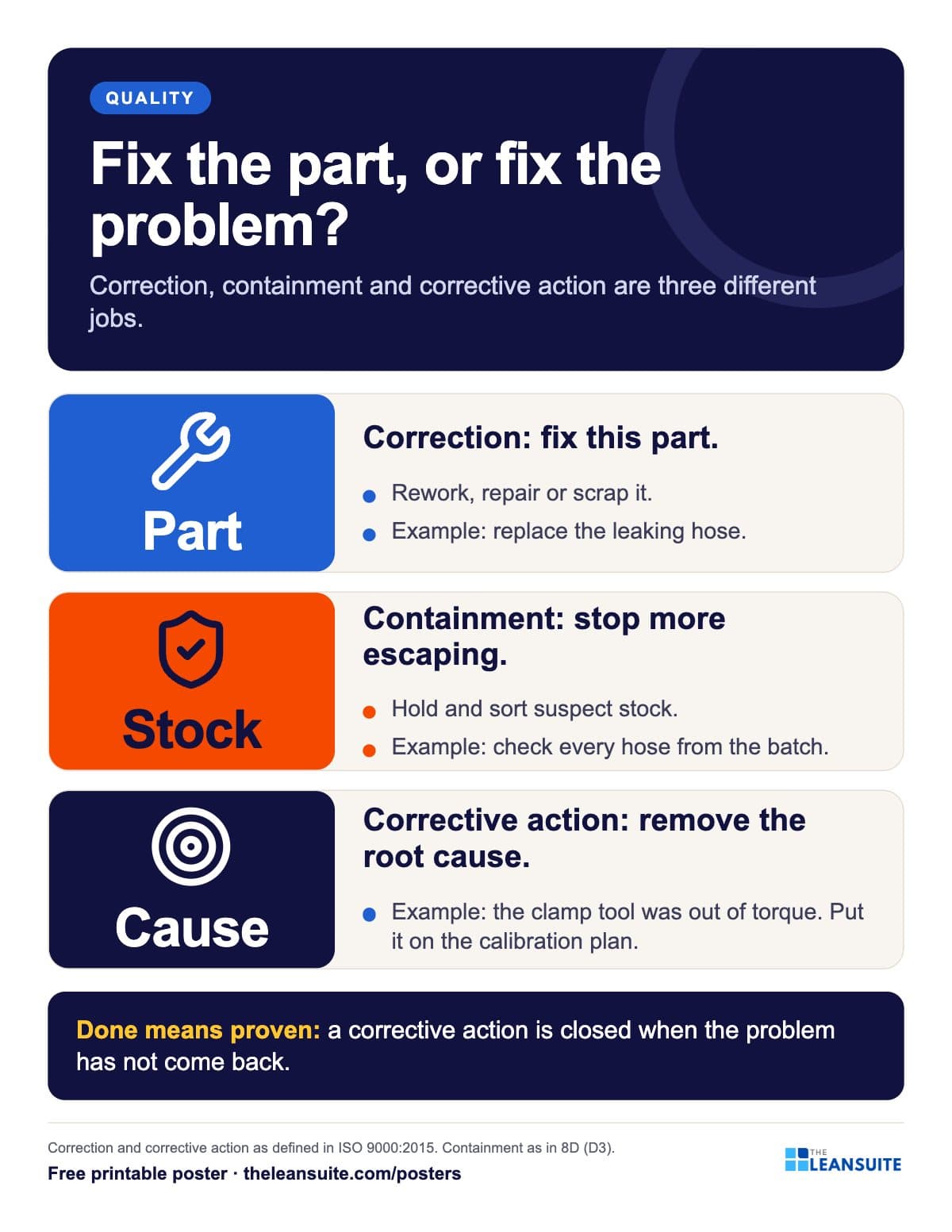 Correction vs corrective action poster
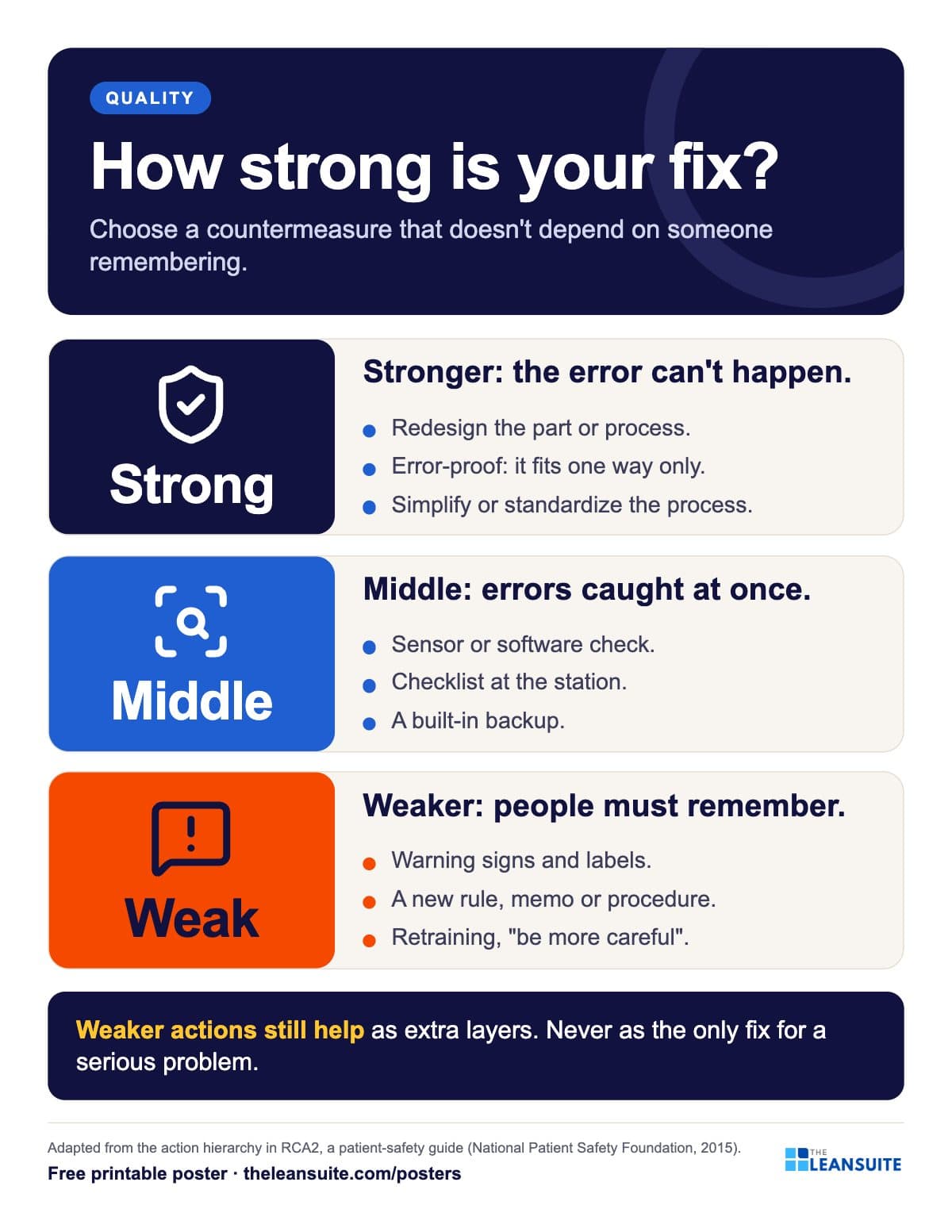 Strong and weak countermeasures poster
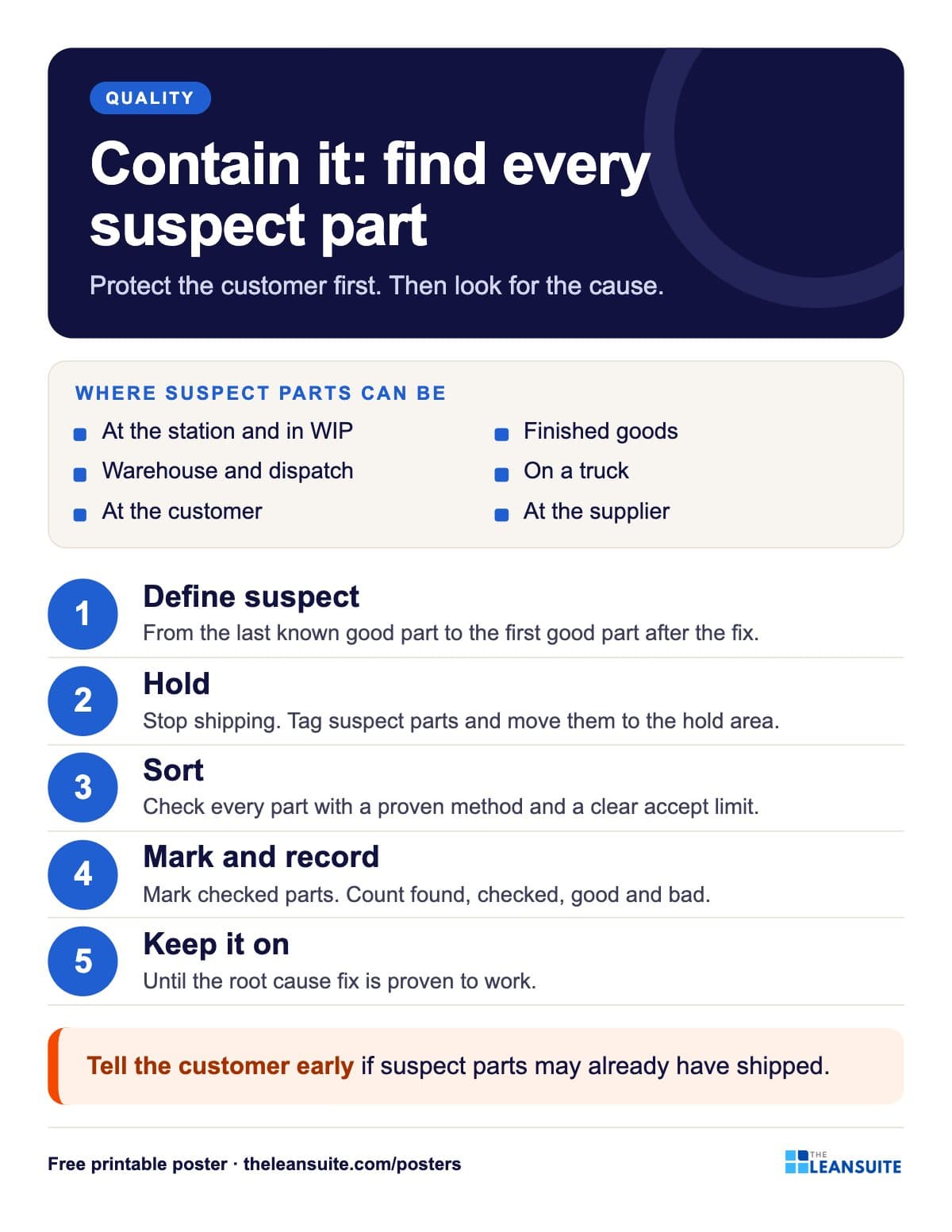 Containment actions poster
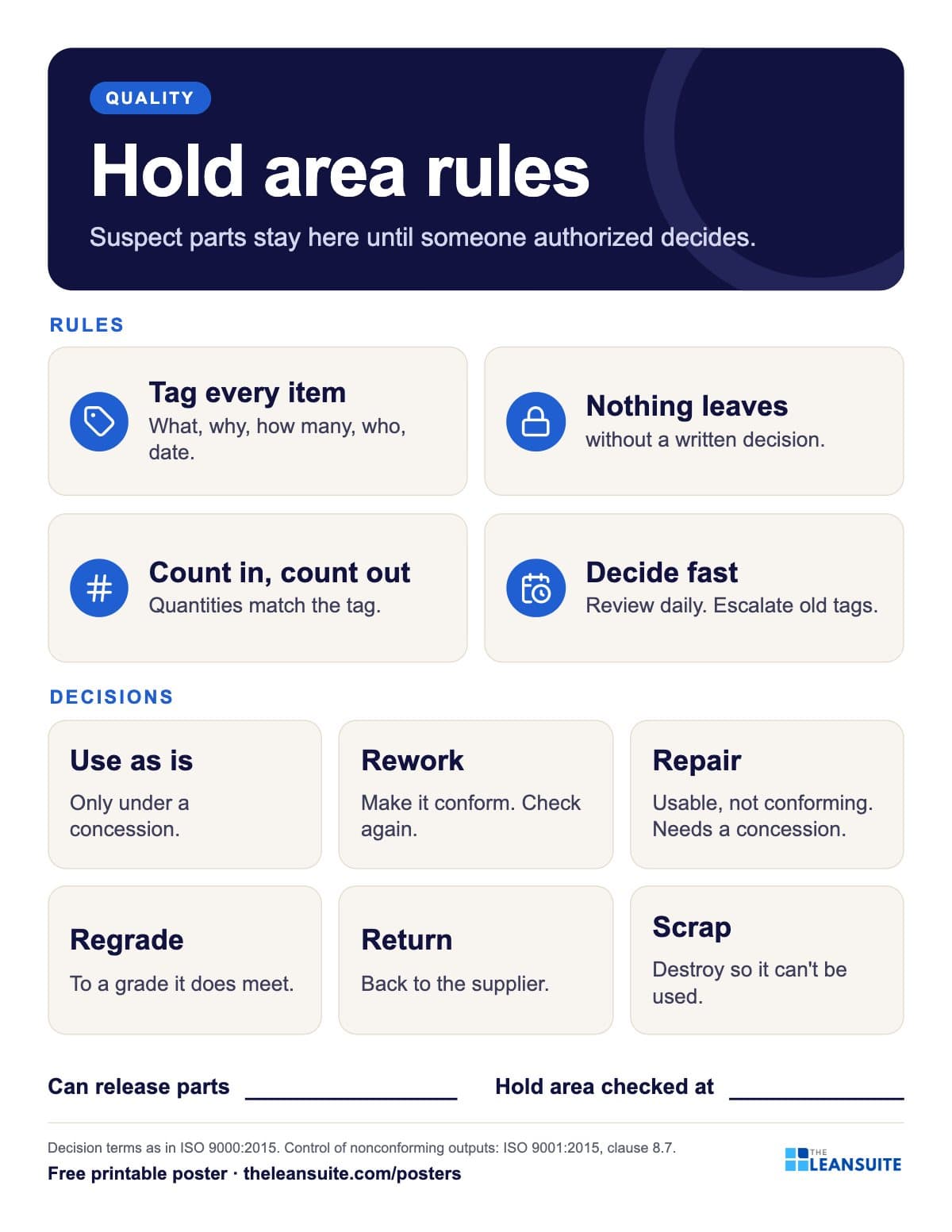 Hold area (quarantine) rules poster
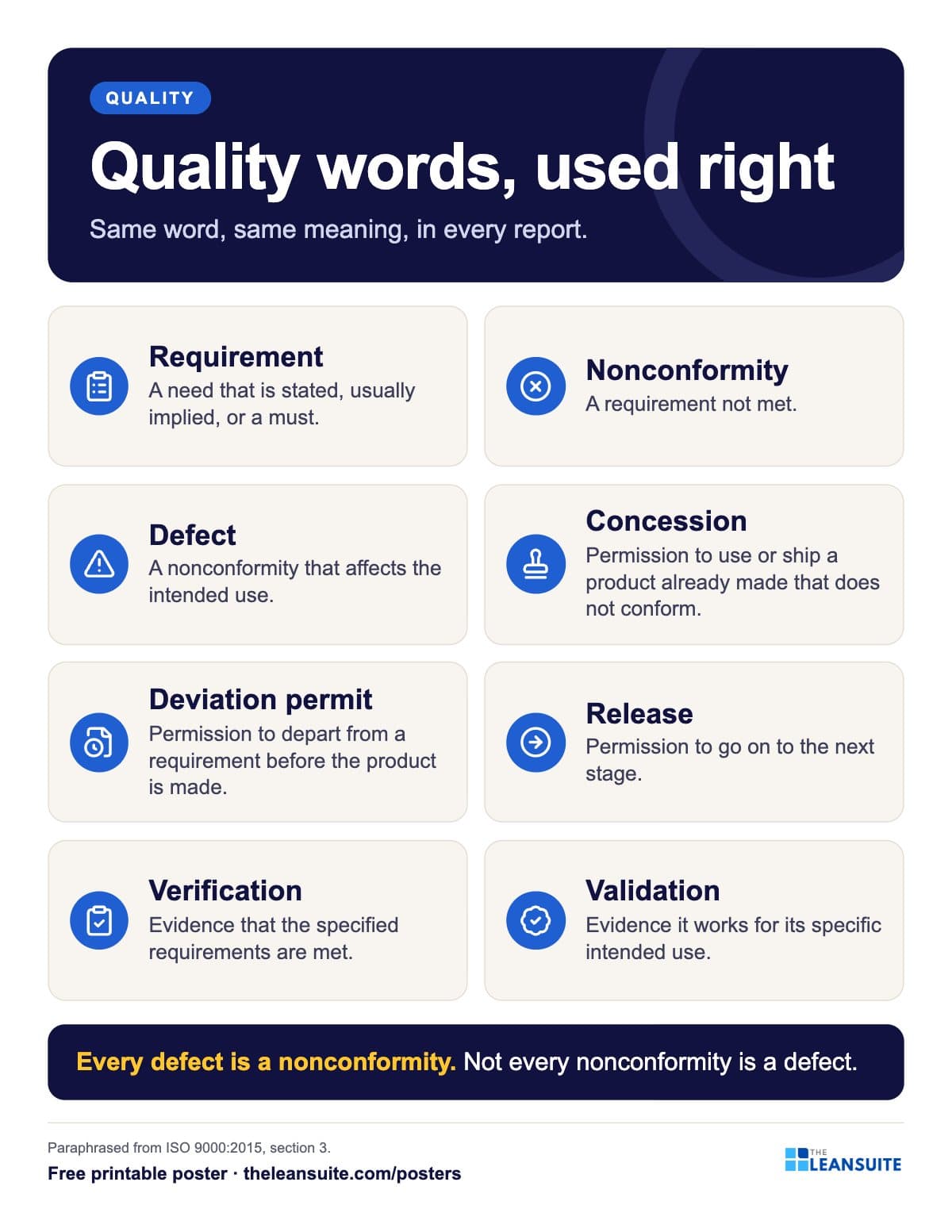 Quality terms poster (nonconformity, defect, concession)
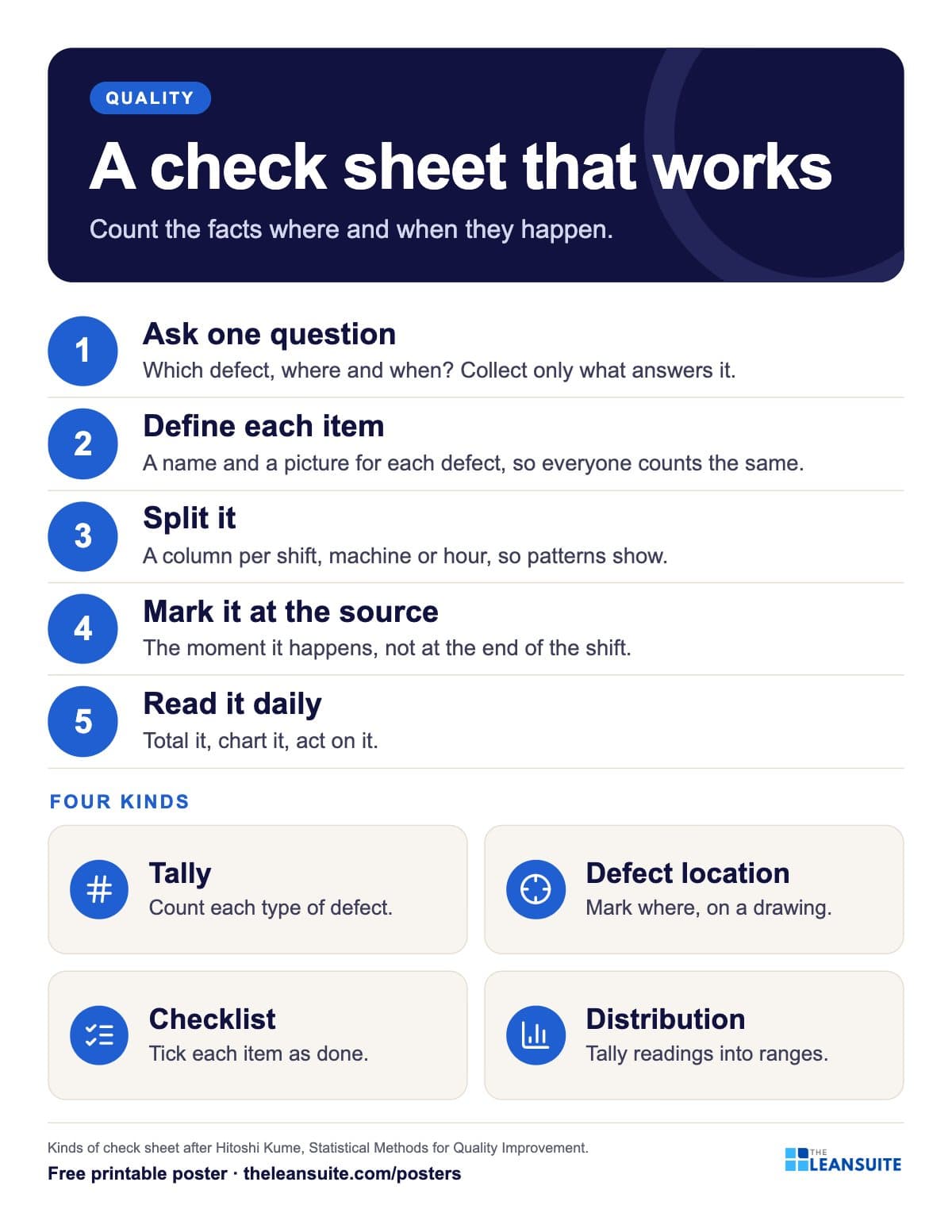 Check sheet poster
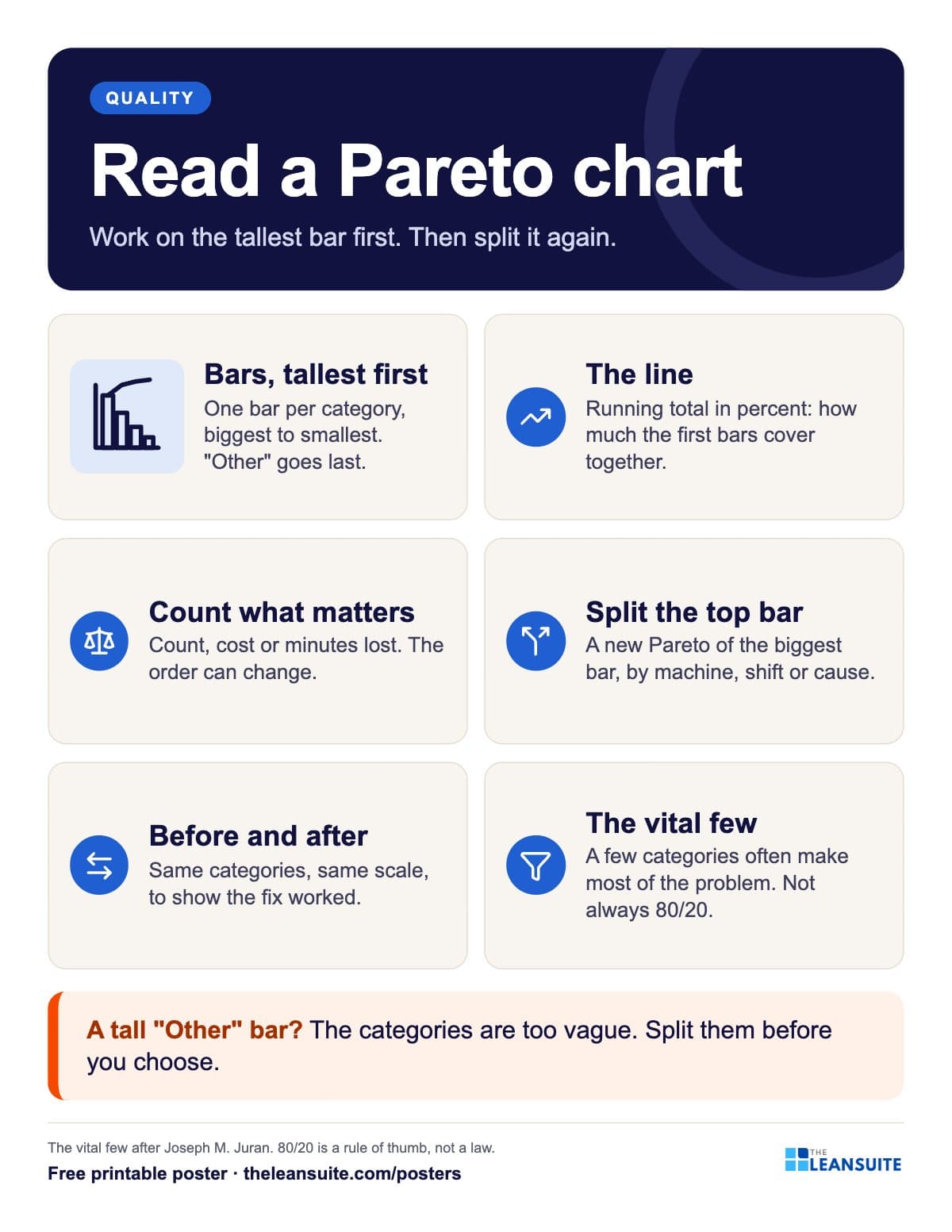 How to read a Pareto chart poster
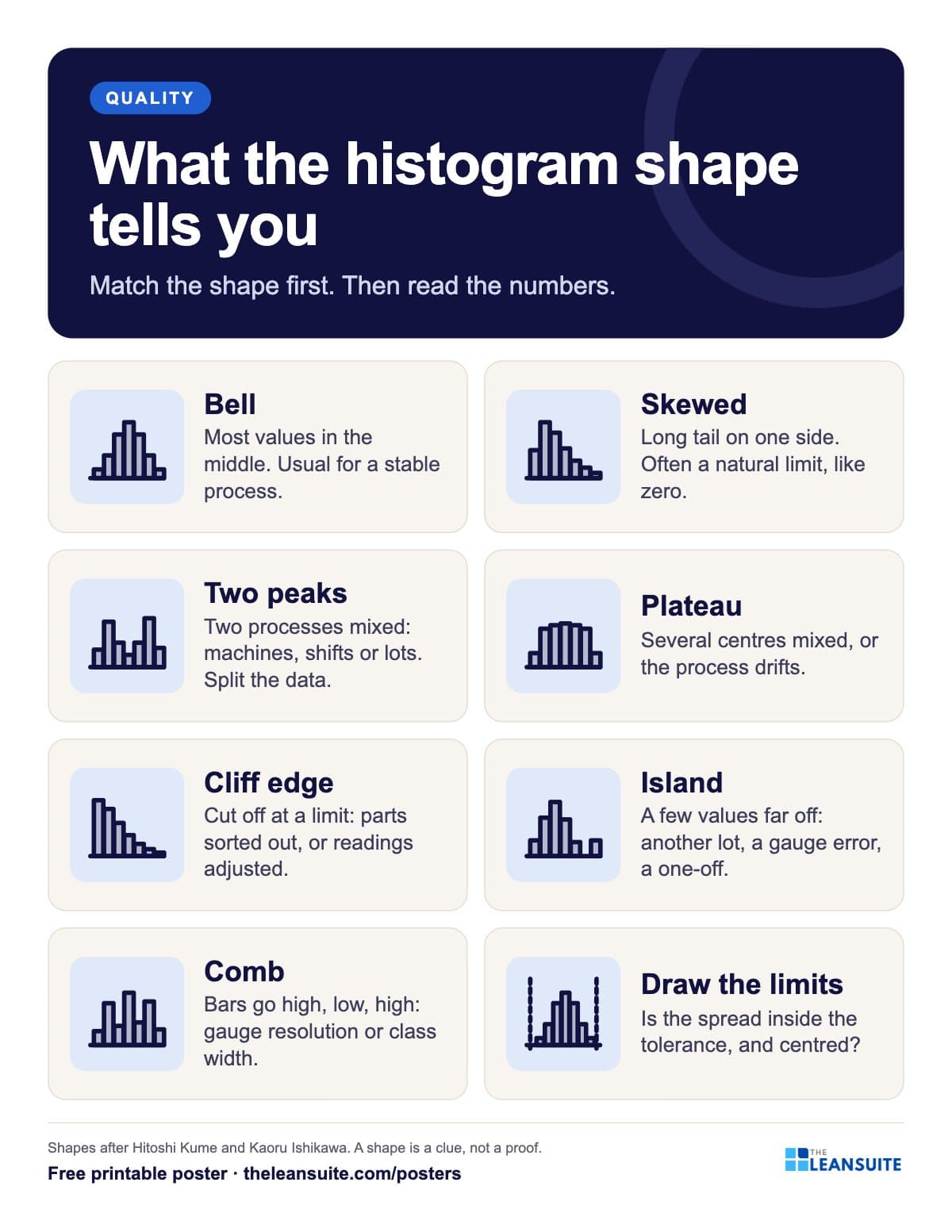 Histogram shapes poster
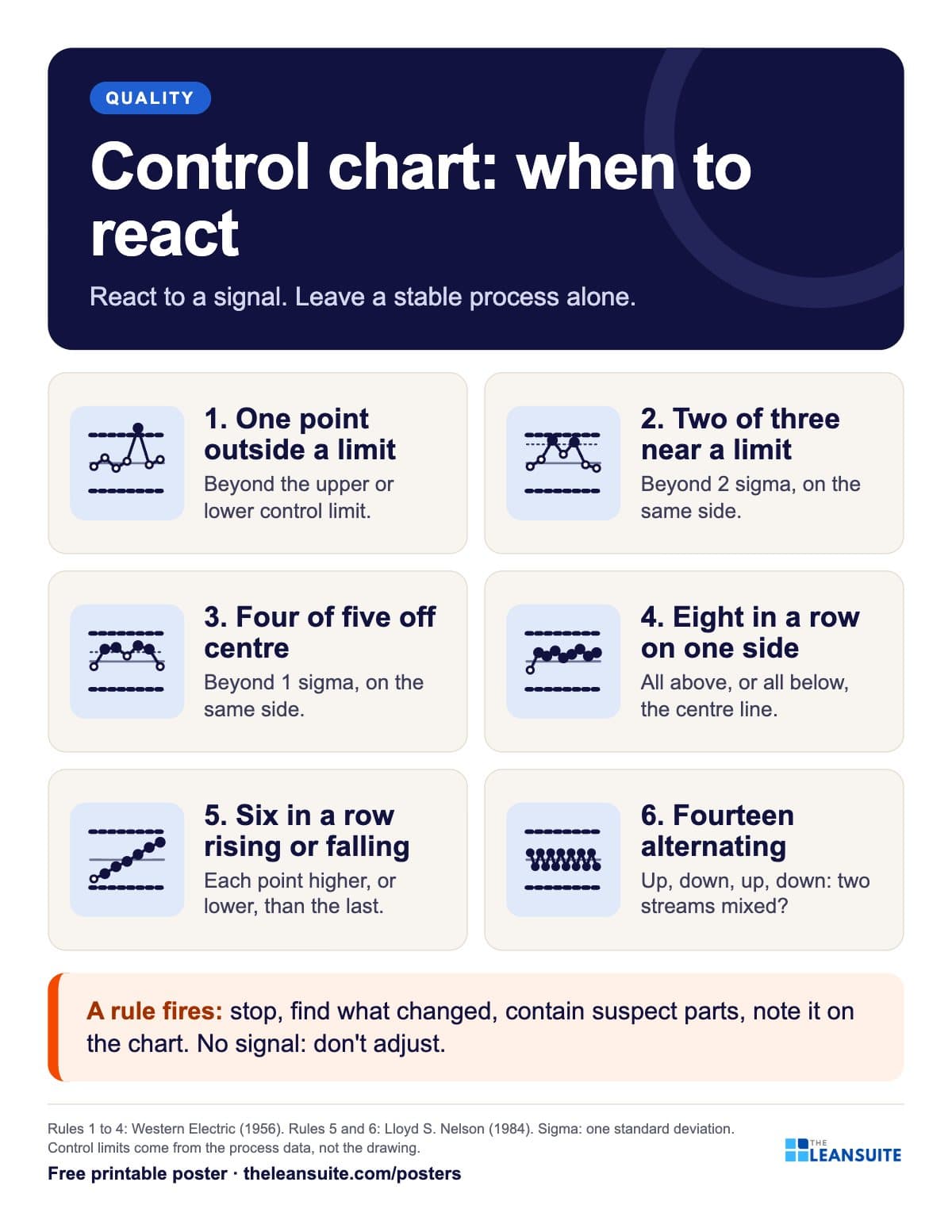 Control chart rules poster (when to react)
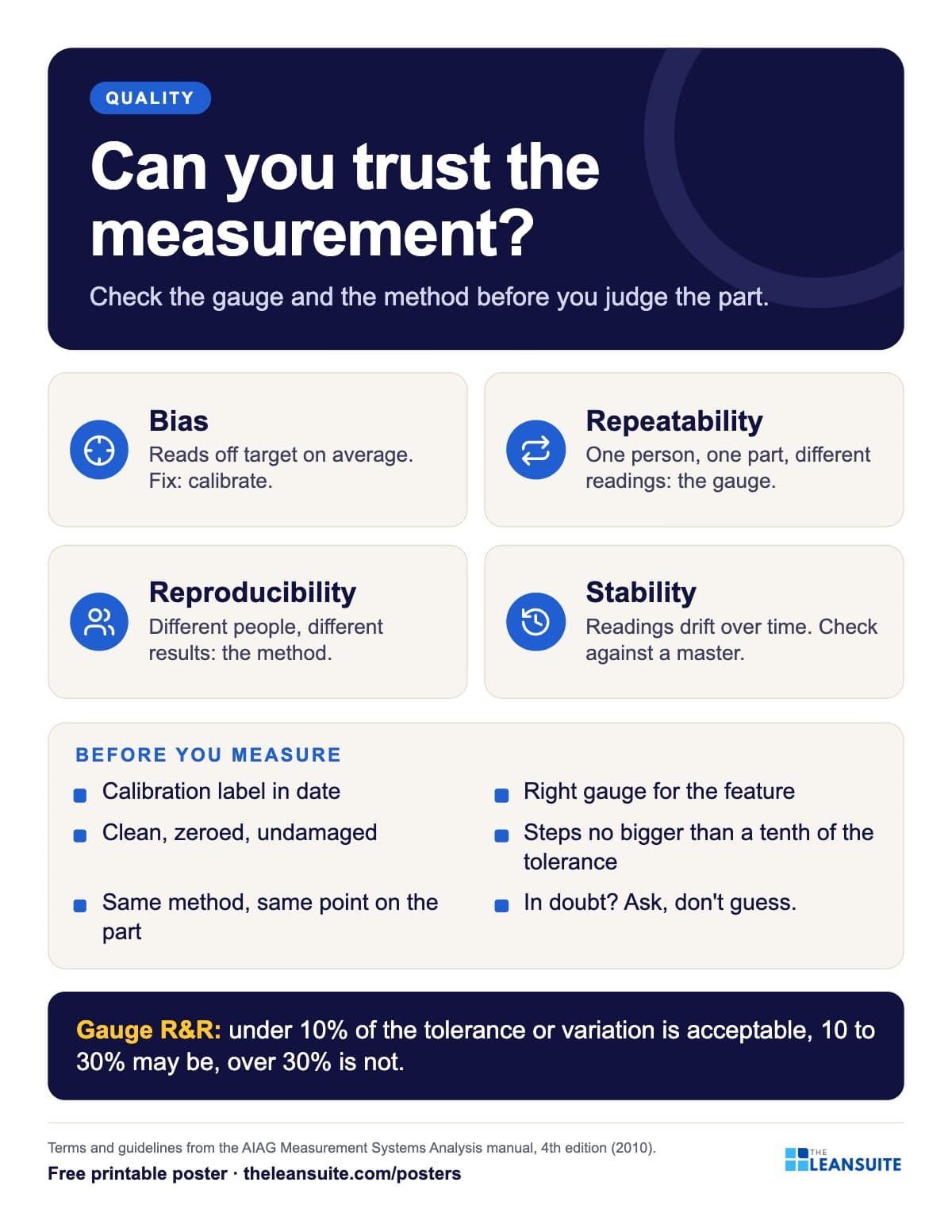 Measurement system basics poster
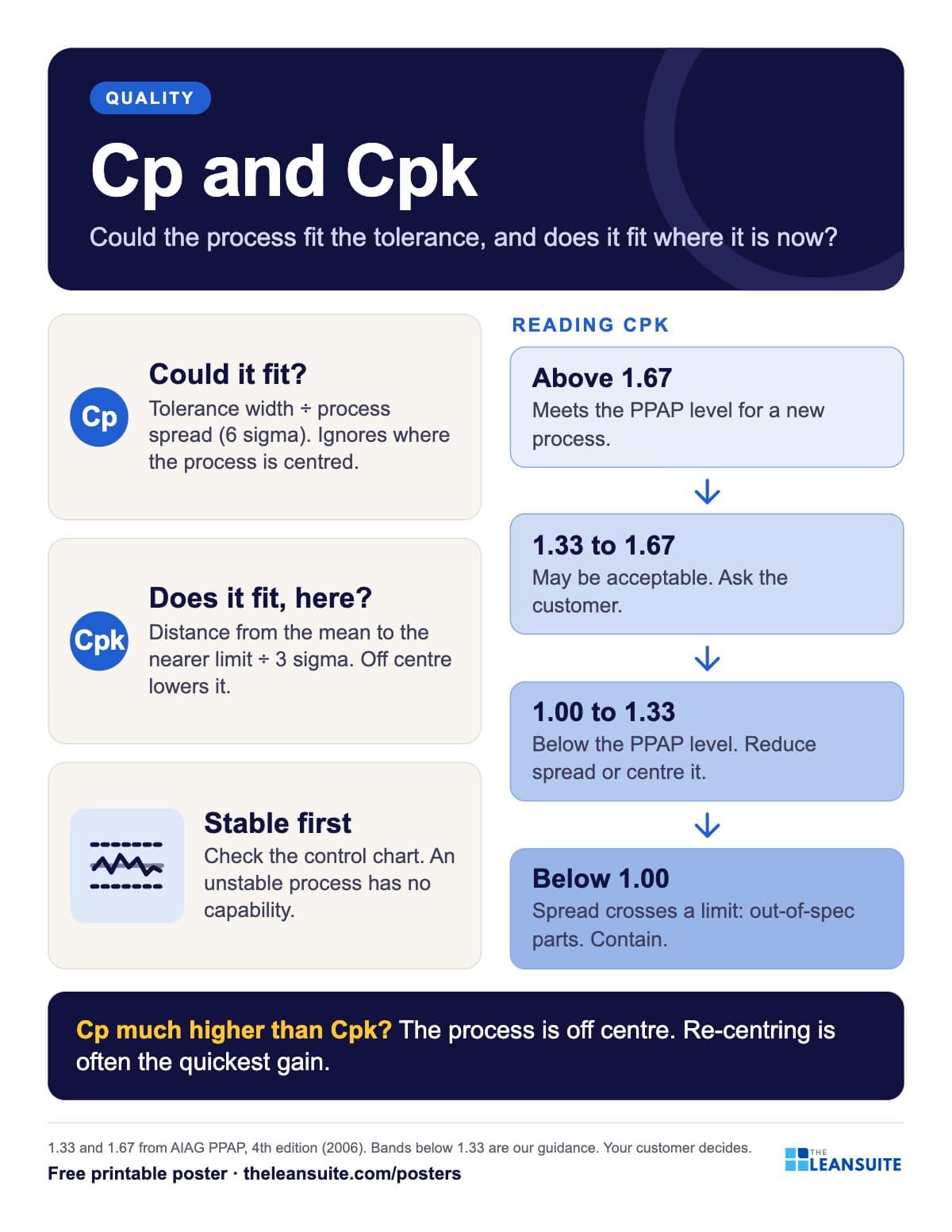 Cp and Cpk process capability poster
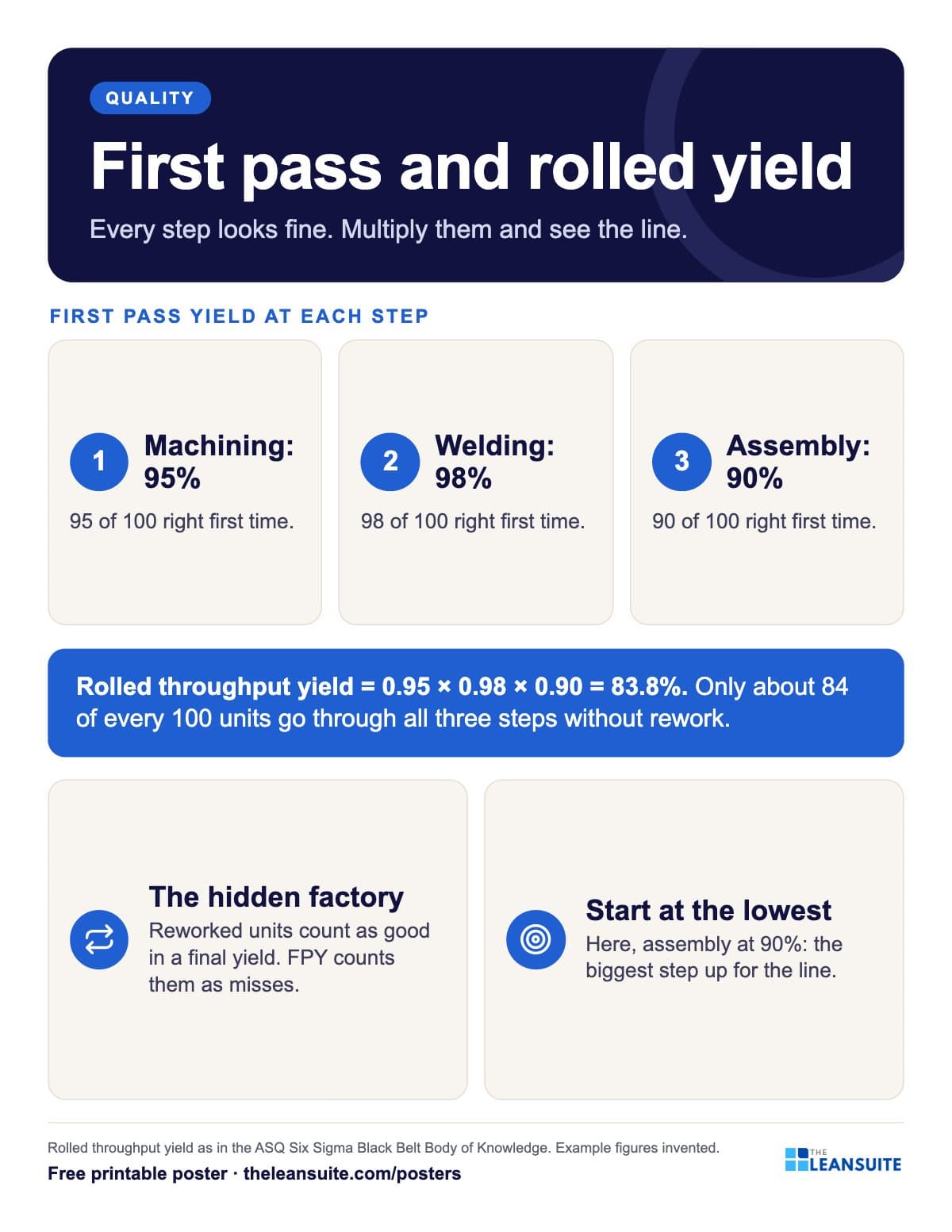 First pass yield and rolled throughput yield poster
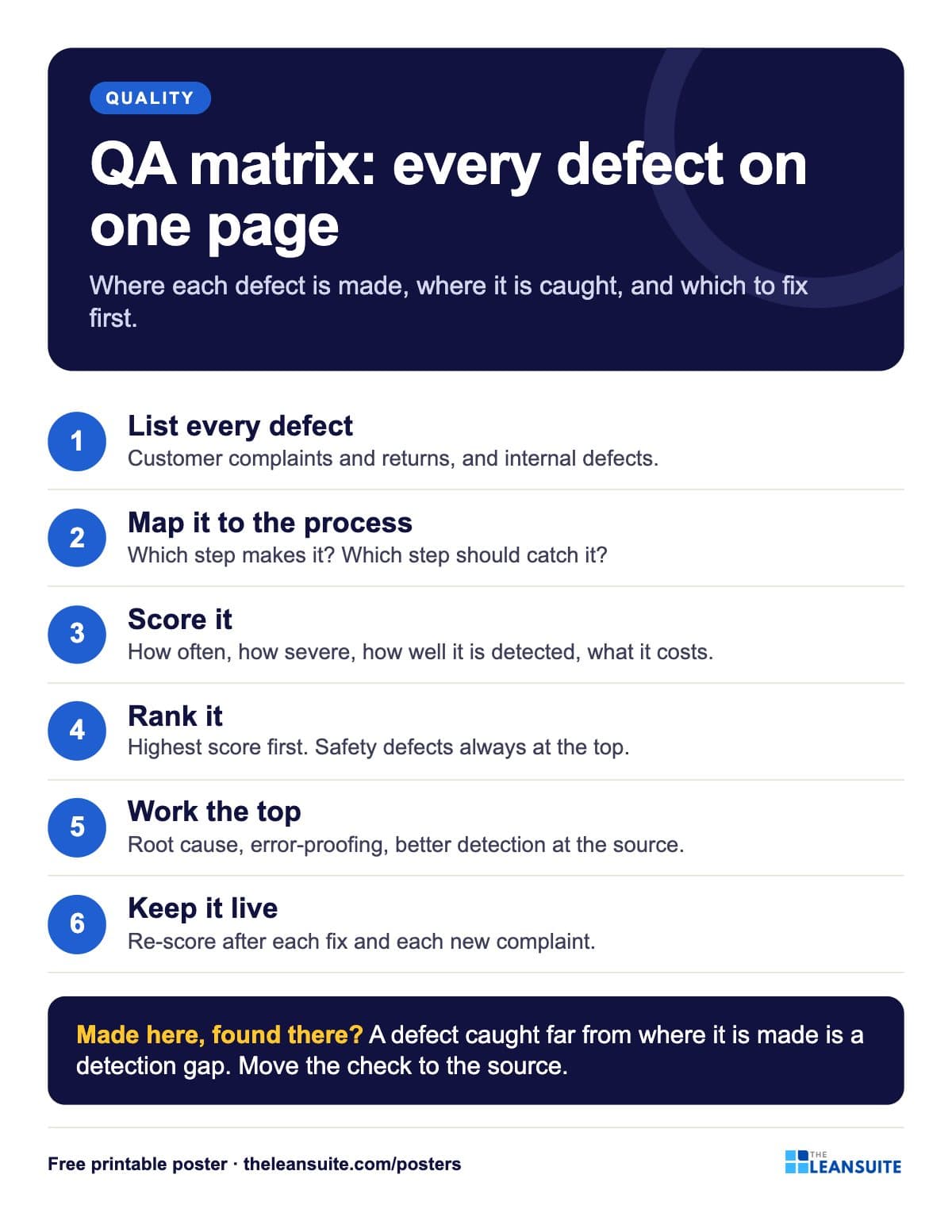 QA matrix poster
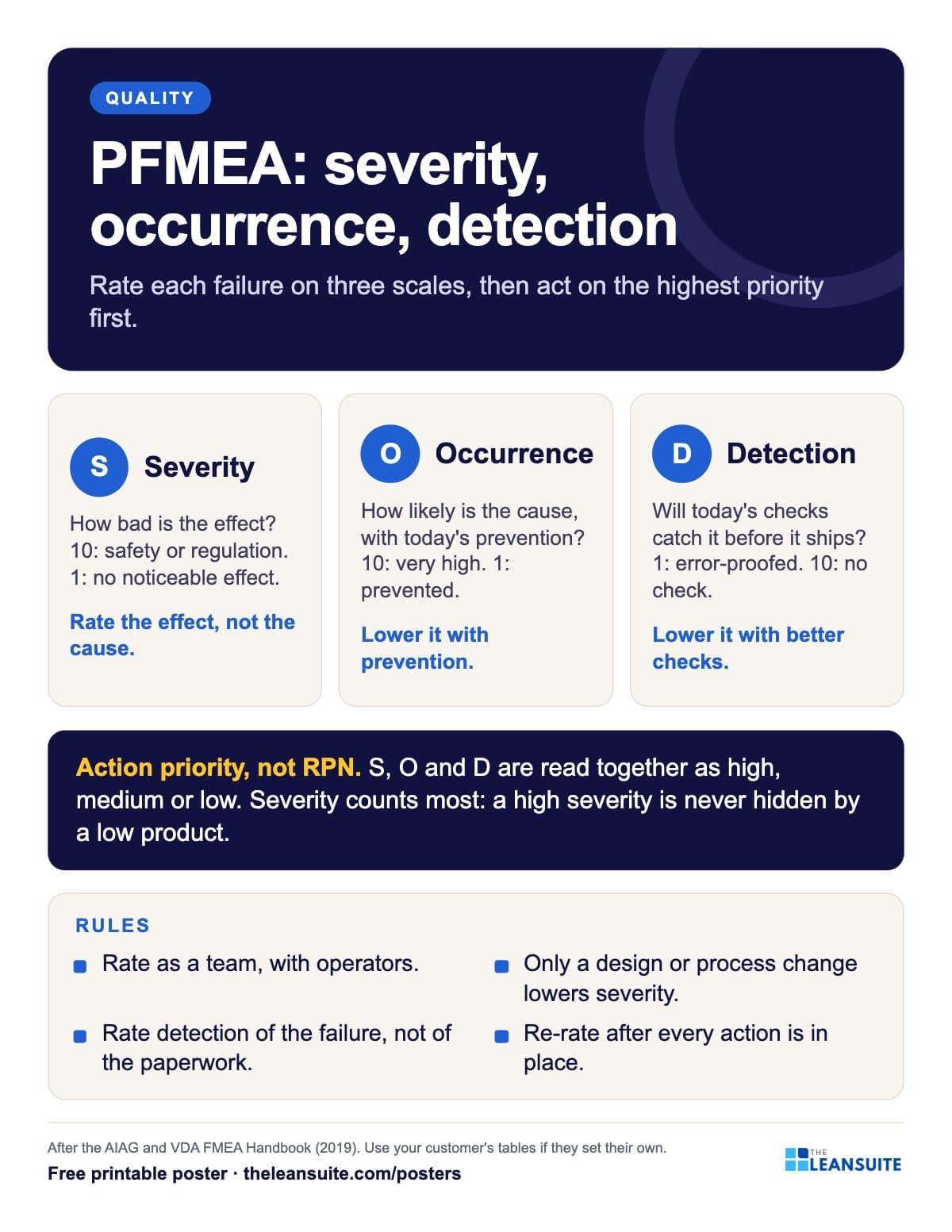 PFMEA severity, occurrence and detection poster
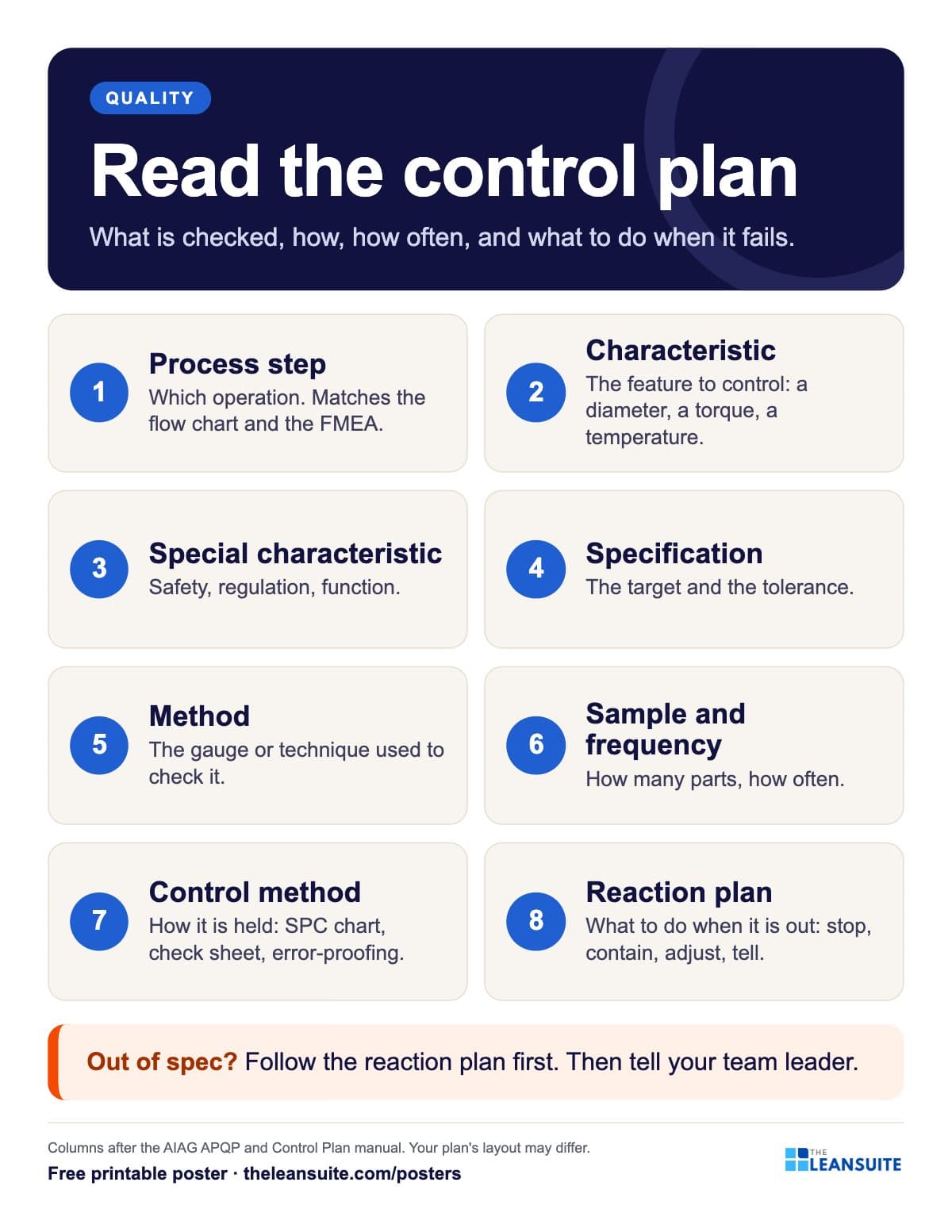 How to read a control plan poster
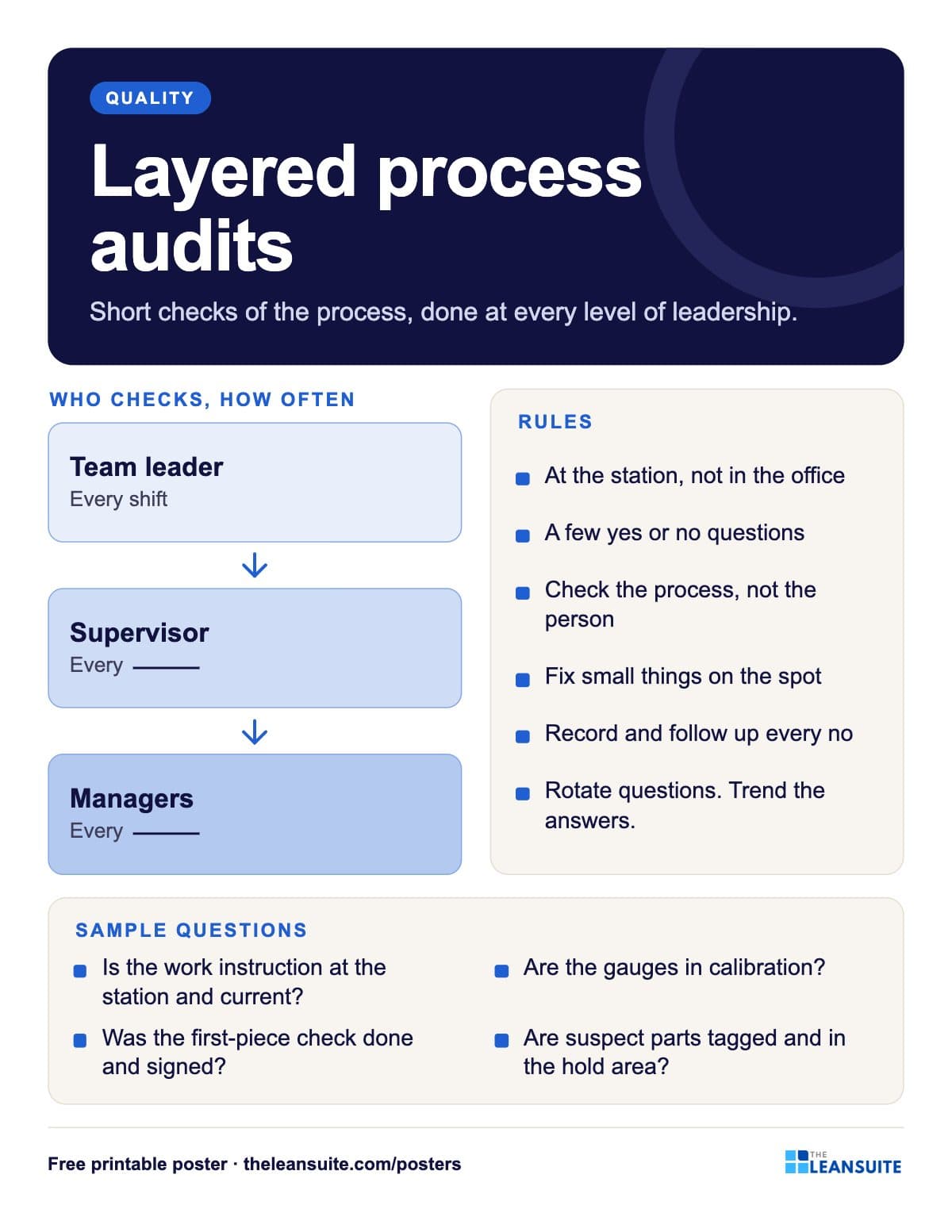 Layered process audit poster
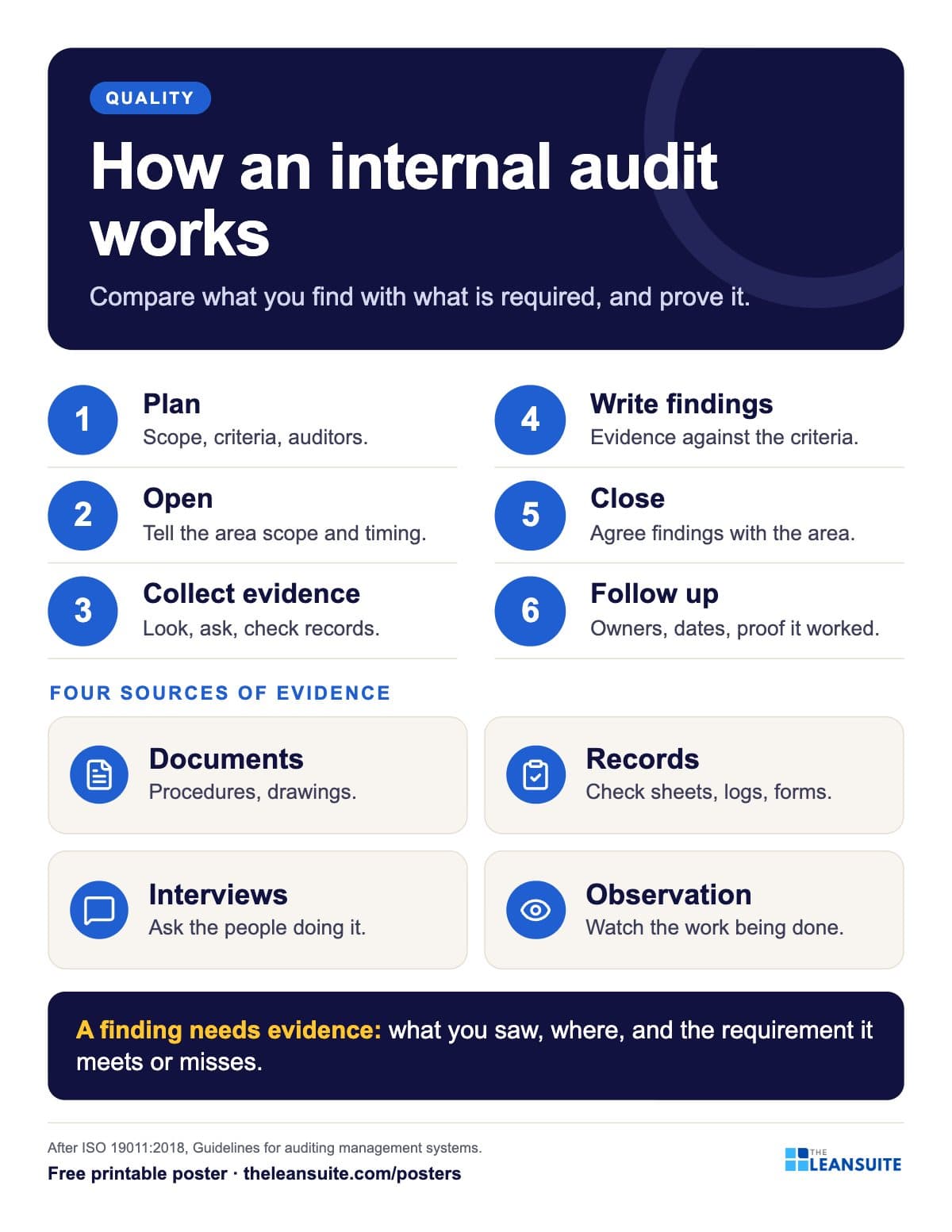 Internal audit steps poster
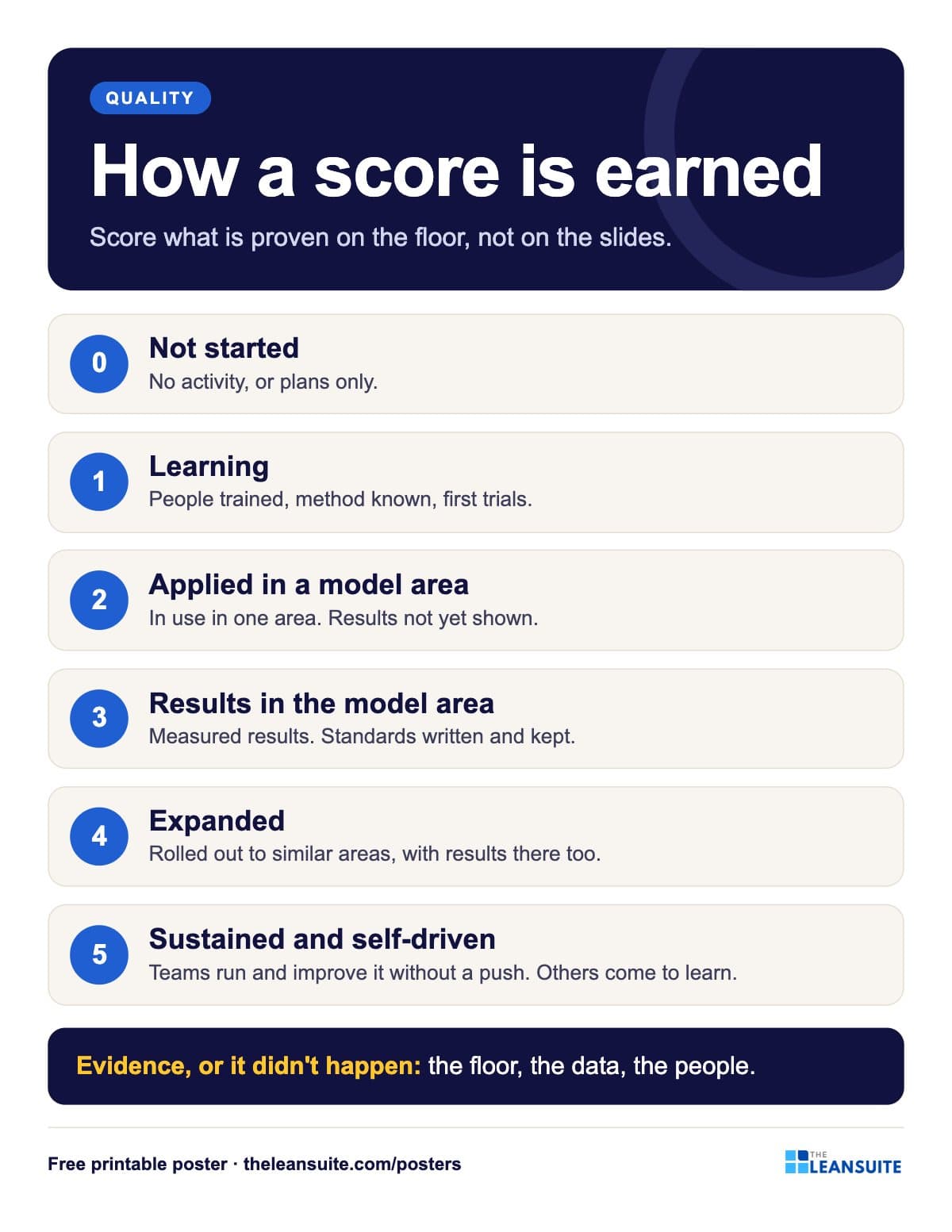 Audit score 0 to 5 poster
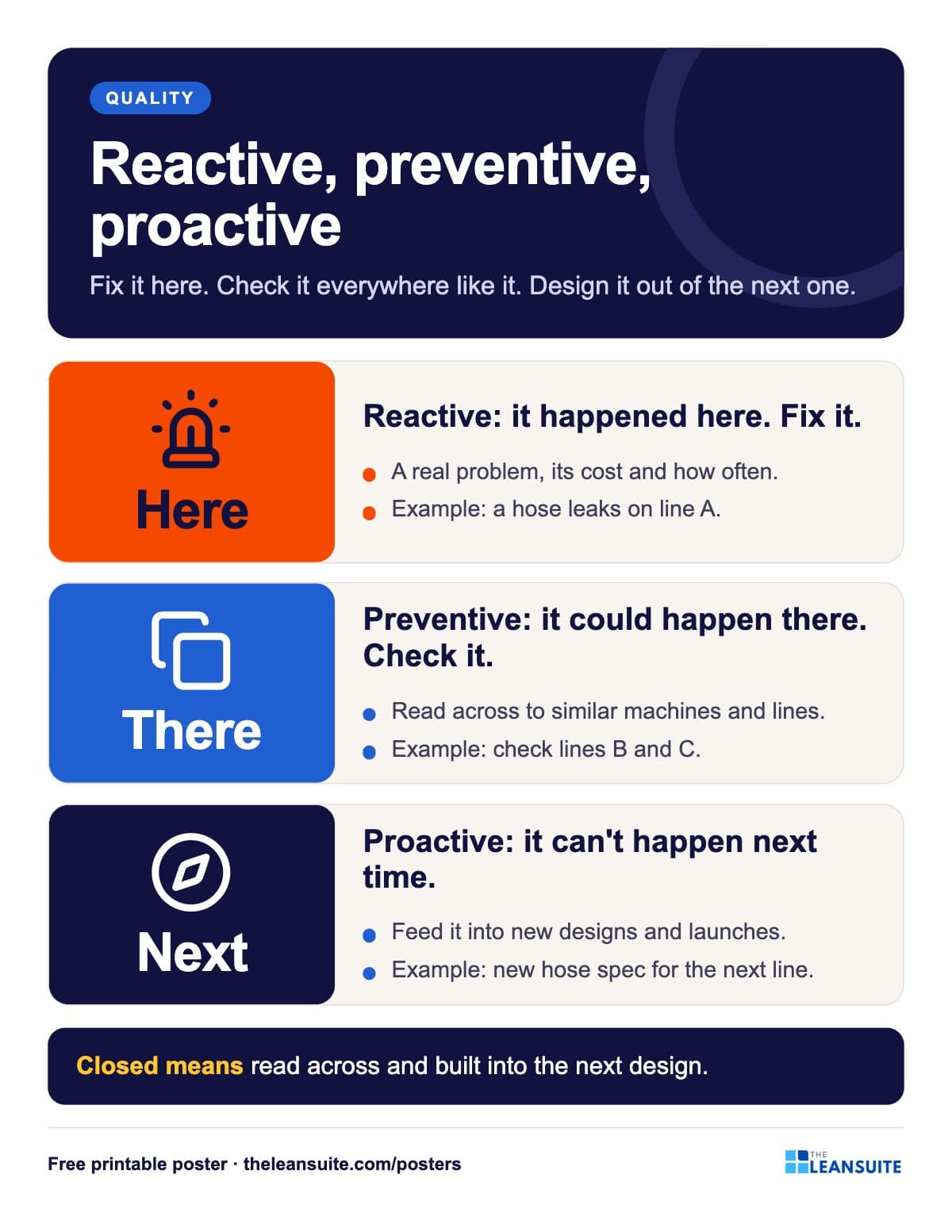 Reactive, preventive, proactive poster
A poster reminds. A routine makes it stick.
See how plants run their audits, improvements and follow-ups in LeanSuite, on a call built around your own problem.
Book a 45-minute demo