

Lean playbook · Pharmaceuticals
Lean playbook for pharmaceutical plants
Short answer
Lean in a pharmaceutical plant works on the time around the validated process, not the process itself. Start with changeovers and line clearance on the packaging line, where most capacity goes. Pareto batch record corrections and fix the top error types, so lots are released sooner. Triage deviations on the day they are raised and review open ones at a short daily meeting. Any change to a validated process still goes through your change control.
Last updated:
7 problems on the floor, and the lean methods for each
Each problem says what it looks like, which methods address it, the first moves to make and the number to watch. Pick the one or two that cost your plant most; you do not need all of them at once.
Where a solid-dose pharmaceutical line loses time and quality
Granulation and blending
Compression, encapsulation or filling
Coating and inspection
Primary and secondary packaging
Across the whole line
Long changeovers and cleaning between products
Dispensing booths, granulators, presses and packaging lines all need cleaning and set-up between products. Steps run in a different order on each shift, parts are fetched after the line stops, and cleaning waits for a swab result.
In LeanSuite
Run each changeover as a visual checklist in Lean Creator and require a photo on the steps that matter most.
First moves
- Film or time one changeover and split it into steps done while the line runs and steps that need it stopped.
- Prepare parts, tooling and documents before the stop, and use spare change parts cleaned off the line.
- Group products in a changeover matrix so more changes need a minor clean, within what your cleaning validation allows.
Number to watch: Changeover time, from last good unit of one lot to first good unit of the next.
Line clearance findings
A leaflet in a chute, a carton from the last lot on the floor, a label roll left on a spindle. Each finding delays the next lot, and the same hiding places turn up again and again.
Lean methods
In LeanSuite
Run each changeover as a visual checklist in Lean Creator and require a photo on the steps that matter most.
First moves
- Write the clearance as a station-by-station walk, with photos of each place leftovers hide.
- Log every finding with its location, and fix the hiding places that recur: covers, chute designs, bins.
- Remove what is not needed from the line, so there is less to clear.
Number to watch: Line clearance findings per clearance, by location.
Slow deviation investigations
A spike in inspection rejects or a coating defect raises a deviation, and the lot waits. Investigations sit with one person, start from a blank page and run for weeks, and the same root causes come back.
In LeanSuite
Quality tags in LeanSuite give operators one simple way to flag defects, non-conformances and quality deviations the moment they see them, and track each to a corrective action.
First moves
- Triage each deviation the day it is raised, so minor ones are not run like major ones.
- Review every open deviation with its owner and due date at a weekly meeting.
- Trend deviations by root cause each month and run an improvement project on the top cause.
Number to watch: Deviation cycle time, and the share closed within target.
Batch record errors that delay release
Missed entries, wrong calculations and late signatures send batch records back for correction. Each correction adds days before QA can release the lot, and the same few fields cause most of them.
Lean methods
In LeanSuite
Kaizen & Projects runs every improvement with A3, DMAIC and PDCA templates, Kanban and Gantt views, and projected and actual savings.
First moves
- Count batch record corrections for a month by error type and by form field.
- Fix the top causes at the source: clearer forms, calculations done once, signatures at the step.
- Review a sample of records at the line before they go to QA.
Number to watch: Right-first-time batch records, and batch release lead time.
Micro-stops on presses and packaging lines
Tablet presses stop for weight checks and sticking punches; blister and cartoning lines stop for misfed cartons, film breaks and rejected codes. Each stop is short and never written down.
In LeanSuite
Operators log each minor stop as it happens, with category, duration and contributing factor.
First moves
- Log every stop over a set threshold for two weeks, with the station and a reason code.
- Pareto the stops and fix the top one with operators and engineering.
- Add the cleaning and checks that prevent it to the operators' daily routine.
Number to watch: Packaging-line OEE, with micro-stops counted as their own loss.
GMP training that keeps up with procedure changes
Every procedure change means retraining before the next run, and supervisors find out at shift start that someone is not yet trained. Training by reading a procedure rarely shows whether people can do the job.
In LeanSuite
A learning plan gives every new hire the same courses and on-the-job sign-offs, and the skills matrix updates on completion, so supervisors see who is cleared to run each line.
First moves
- Build a skills matrix by line and procedure, showing who is trained and who is due.
- Train critical tasks with job breakdowns and an observed run, not only a signature on a read-through.
- Check the matrix before scheduling each shift, and plan retraining before a procedure change goes live.
Number to watch: Required trainings completed on time.
Problems found a month late
Right-first-time, deviations and schedule misses are reviewed at a monthly meeting, long after the shift that caused them. By then the people involved cannot remember what happened.
In LeanSuite
Lean Studio runs tiered meetings on live, cascaded SQDCM boards, and red metrics become tracked actions.
First moves
- Start a 15-minute daily meeting at the line with production, quality and engineering.
- Show yesterday's numbers: right-first-time, deviations raised, changeover times, schedule.
- Give every red number an owner and a date, and escalate what the line cannot fix.
Number to watch: Actions from the daily meeting closed on time.
More small fixes in the production, quality and maintenance sections of the kaizen idea bank.
A 90-day starting plan
One line or product family, two problems, measured before and after. The point of the first 90 days is a result the plant believes and a method it can repeat, not a plant-wide program.
The 90 days, with the gate that ends each stage
- Days 1 to 30Pick one packaging line and measure itDone when: You have baseline numbers, two problems with owners and an agreed route through change control.
- Days 31 to 60Cut changeover time and correctionsDone when: Each change has a before-and-after number and an approved standard.
- Days 61 to 90Hold the gains and spread themDone when: The gains have held for a month and the next line has its baseline.
Days 1 to 30
Pick one packaging line and measure it
See where one line loses time, and agree with QA what will change and how.
- Choose the packaging line with the most changeovers or the lowest OEE, and name an owner.
- Agree with QA which changes need change control, so improvements do not stall later.
- Time three changeovers, log stops for two weeks and count batch record corrections.
- Start a short daily meeting at the line with production, quality and engineering.
- Choose the two biggest losses to work on first.
Days 31 to 60
Cut changeover time and corrections
Attack the two problems and prove the change with numbers.
- Run a SMED workshop on the most frequent changeover and write the new standard.
- Fix the top two batch record error types at the source.
- Rewrite the line clearance walk and fix the hiding places that recur.
- Raise change control for anything that touches a validated step.
Days 61 to 90
Hold the gains and spread them
Keep the new standards in place and start the next line.
- Train every operator on the new standards and update the skills matrix.
- Audit the changeover and clearance standards on every shift.
- Start trending deviations by root cause at the monthly review.
- Share the results and pick the next line.
The KPIs to track
Track them per line and shift, on a board the team sees every day. Set targets from your own baseline, not from someone else's plant.
| KPI | What it tells you | How to measure it | Free help |
|---|---|---|---|
| Right-first-time | How often a lot and its batch record pass every check with no correction. | Lots with no deviation or correction divided by lots made, per line and month. | First pass yield (FPY) calculator |
| Changeover time | How much line time goes to cleaning, clearance and set-up between lots. | Last good unit of one lot to first good unit of the next, with cleaning, clearance and set-up timed separately. | SMED changeover calculatorSMED changeover worksheet |
| Packaging-line OEE | How much planned time the line spends packing good units at full speed. | Availability × performance × quality, per line and shift. | OEE calculatorOEE tracking sheet |
| Deviation cycle time | How long deviations stay open, and so how long lots wait. | Average days from deviation raised to closed, and the share closed within your procedure's target. | CAPA log template |
| Batch release lead time | How long finished lots wait before QA releases them. | Days from end of packaging to QA release, averaged over the month's lots. | - |
| Training on time | Whether people are trained before they run a new or changed procedure. | Required trainings completed by their due date divided by trainings due. | Training matrix template with expiry dates |
By the numbers
Public figures for this industry or for the wider sector it belongs to, each linked to the report or government table it comes from and checked against it on September 26, 2026. More in our lean manufacturing statistics and benchmark charts.
31%
Only 31% of respondents feel they fully understand how quality costs affect their organization's financial performance.
From ASQE's 2025 Insights on Excellence Cost of Quality Report, as published by ASQ. Across industries, not pharma alone.
Source: ASQ, What is Cost of Quality (COQ)? (citing the 2025 ASQE Insights on Excellence Cost of Quality Report) (2025)
32%
Work units in the top quarter for employee engagement have 32% fewer quality defects than bottom-quarter units.
Median difference across Gallup's meta-analysis of 183,806 business and work units in 53 industries, not pharma alone.
Source: Gallup, The Relationship Between Engagement at Work and Organizational Outcomes: Q12 Meta-Analysis, 11th edition (2024)
1.9 million
Up to 1.9 million U.S. manufacturing jobs could go unfilled between 2024 and 2033 if manufacturers cannot close the skills and applicant gaps.
Deloitte and The Manufacturing Institute projection for all U.S. manufacturing, which includes pharmaceutical plants.
Source: The Manufacturing Institute and Deloitte, Manufacturers Need as Many as 3.8 Million New Employees by 2033 (2024-04-03)
Injury and illness rate by industry, 2024
- Motor vehicles5.6
- Beverage and tobacco3.7
- Furniture3.5
- Food3.3
- Primary metals3.3
- Nonmetallic mineral products, incl. glass3.3
- Fabricated metal products3.2
- Transportation equipment3.2
- Motor vehicle parts2.9
- Plastics and rubber products2.8
- HVAC and refrigeration2.4
- Paper2.4
- Machinery2.3
- All private industry2.3
- Electrical equipment and appliances2.0
- Printing1.6
- Chemicals1.6
Total recordable cases per 100 full-time workers, 2024: Motor vehicles 5.6, Beverage and tobacco 3.7, Furniture 3.5, Food 3.3, Primary metals 3.3, Nonmetallic mineral products, incl. glass 3.3, Fabricated metal products 3.2, Transportation equipment 3.2, Motor vehicle parts 2.9, Plastics and rubber products 2.8, All manufacturing 2.7, HVAC and refrigeration 2.4, Paper 2.4, Machinery 2.3, All private industry 2.3, Electrical equipment and appliances 2, Printing 1.6, Chemicals 1.6.
Free templates, calculators and buyer's guides
Templates (18)
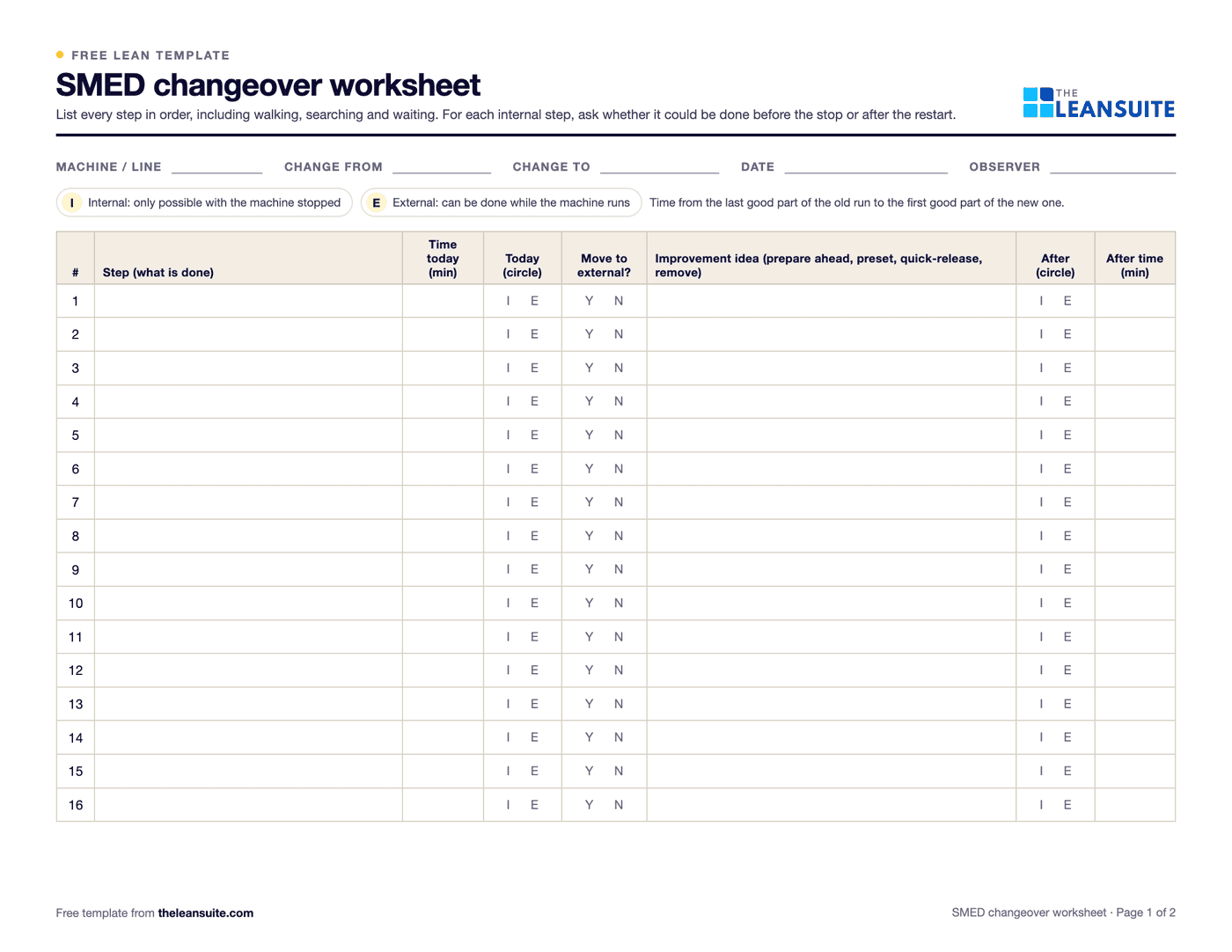 PDF and ExcelSMED changeover worksheetChangeover steps with times, internal or external, what can move, ideas and before/after totals.
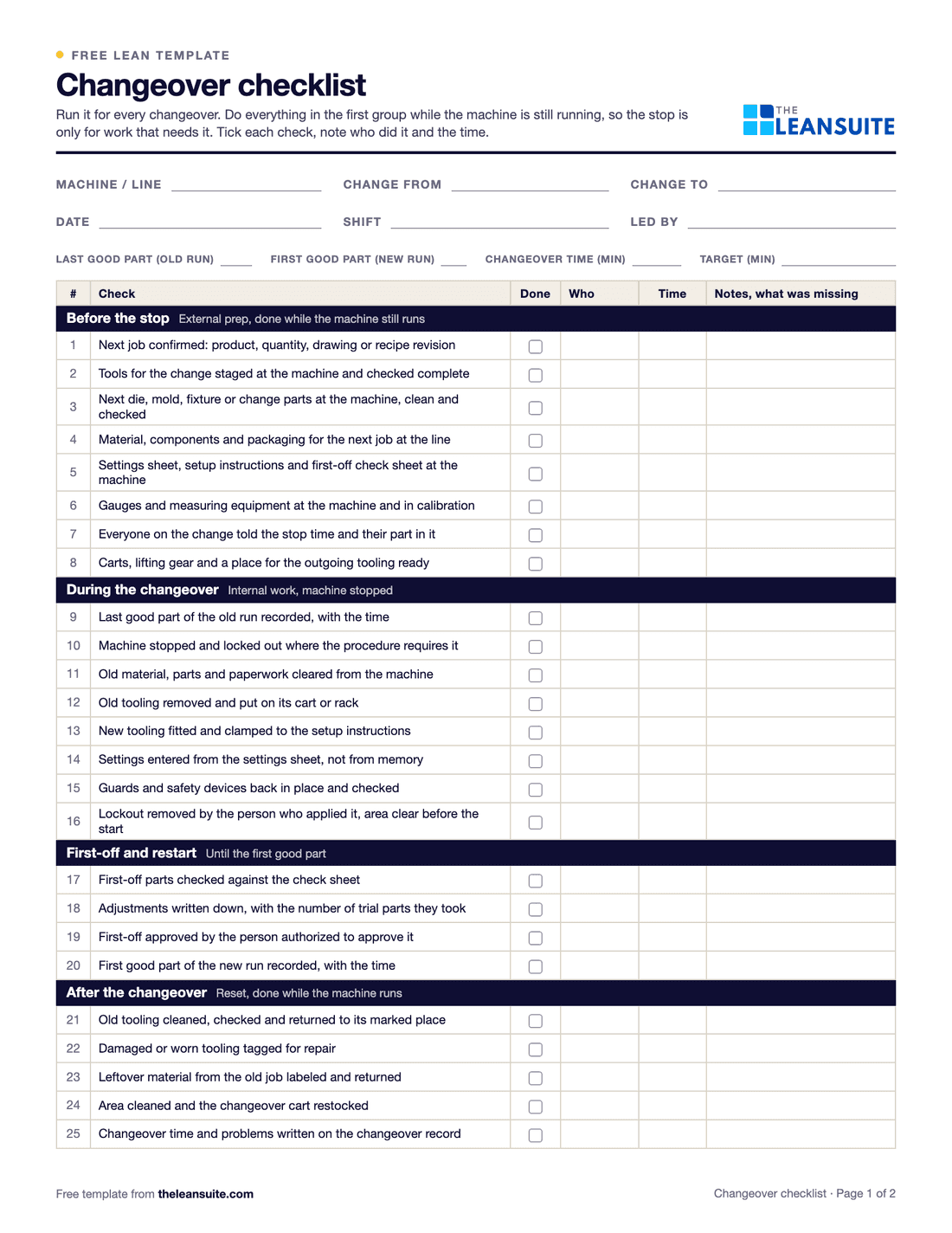 PDF and ExcelChangeover checklist25 checks for every changeover, a record of planned and actual times, and a log of changeover time against target.
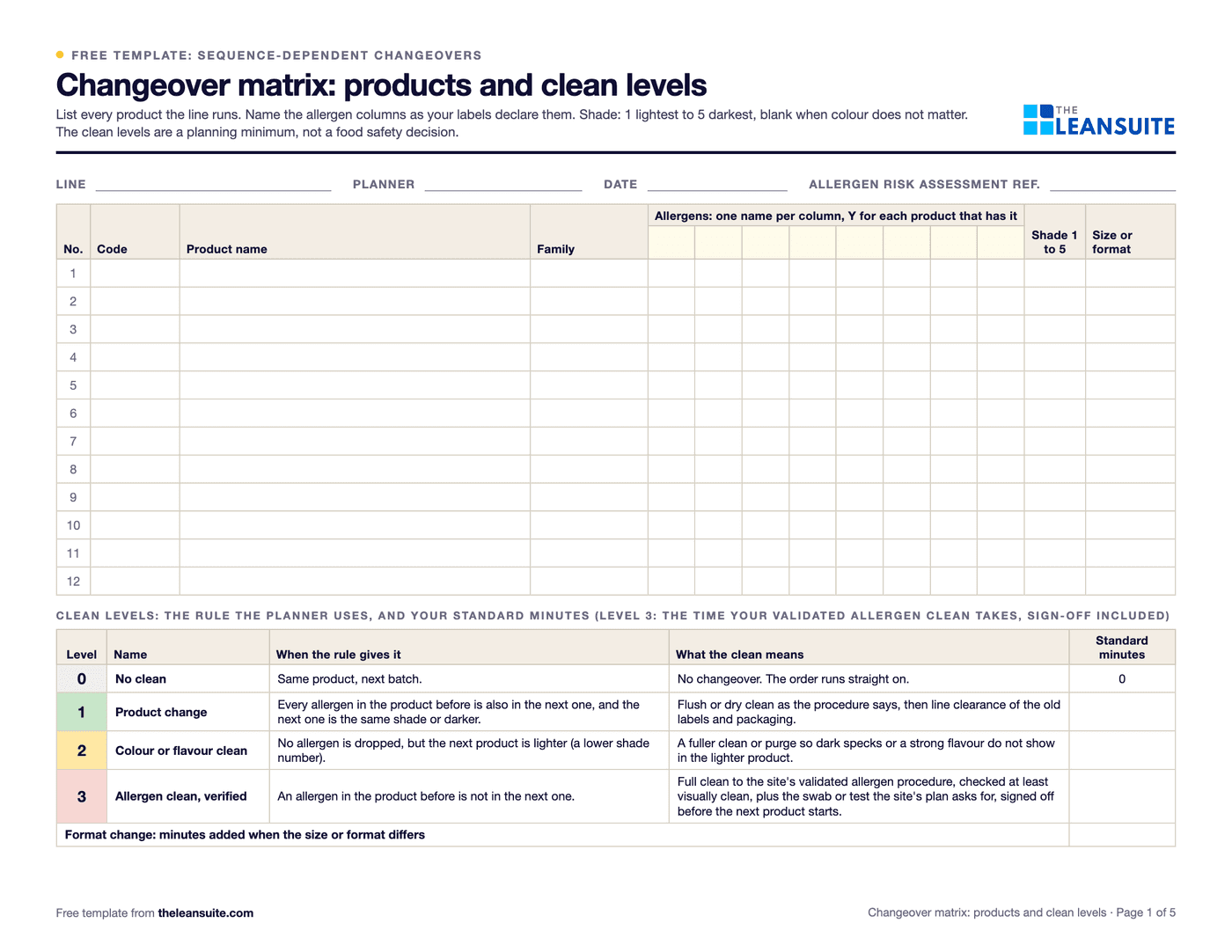 PDF and ExcelChangeover matrix templateA from-to matrix of changeover minutes with the clean each transition needs (allergen, colour, format), and a weekly planner that totals the order and suggests a shorter one.
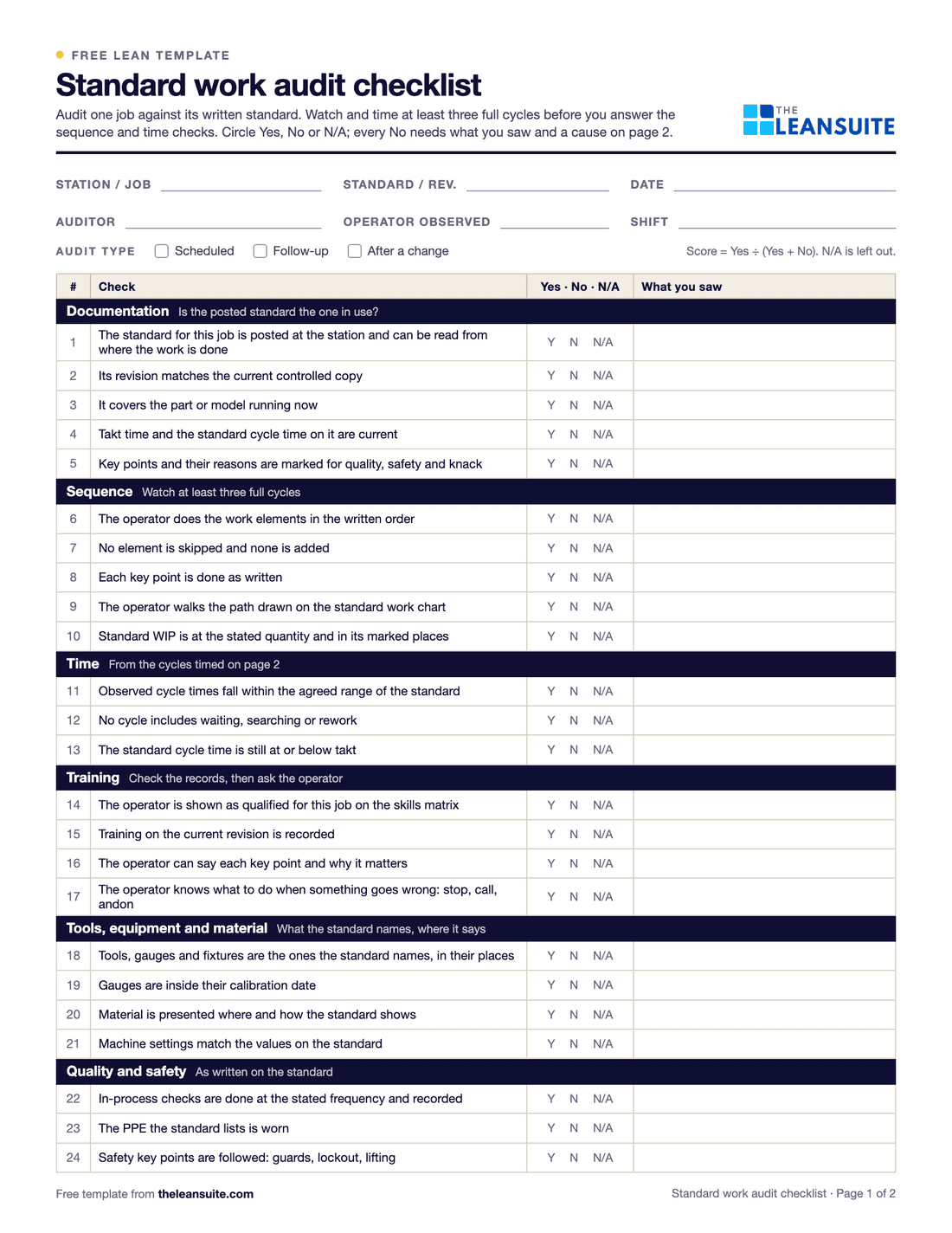 PDF and ExcelStandard work audit checklist24 checks of a job against its written standard, ten timed cycles, and each gap sorted by cause before anyone acts.
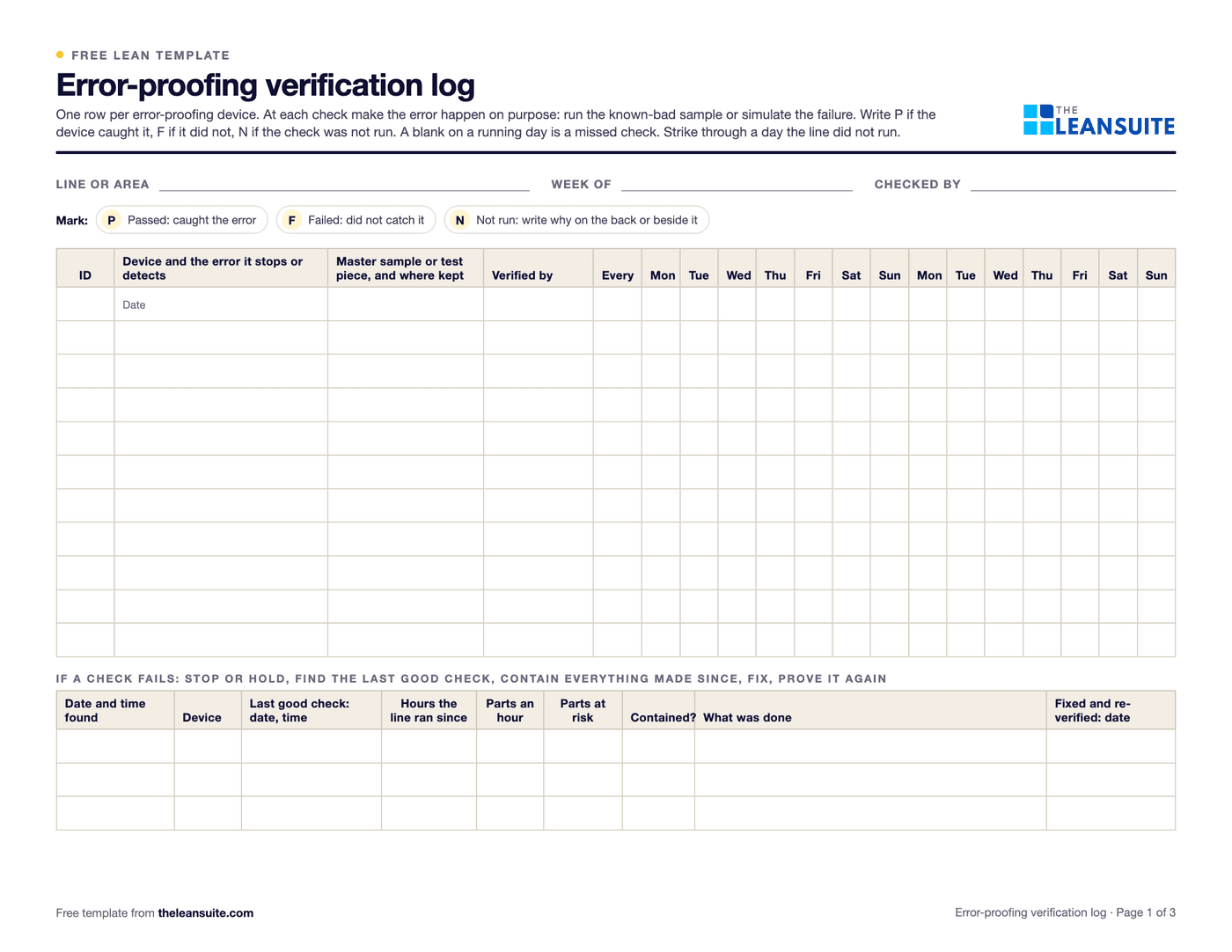 PDF and ExcelError-proofing verification log (daily master-sample check)Each poka-yoke device proved every day or week with a known-bad sample, with missed checks counted and the hours and parts at risk worked out when one fails.
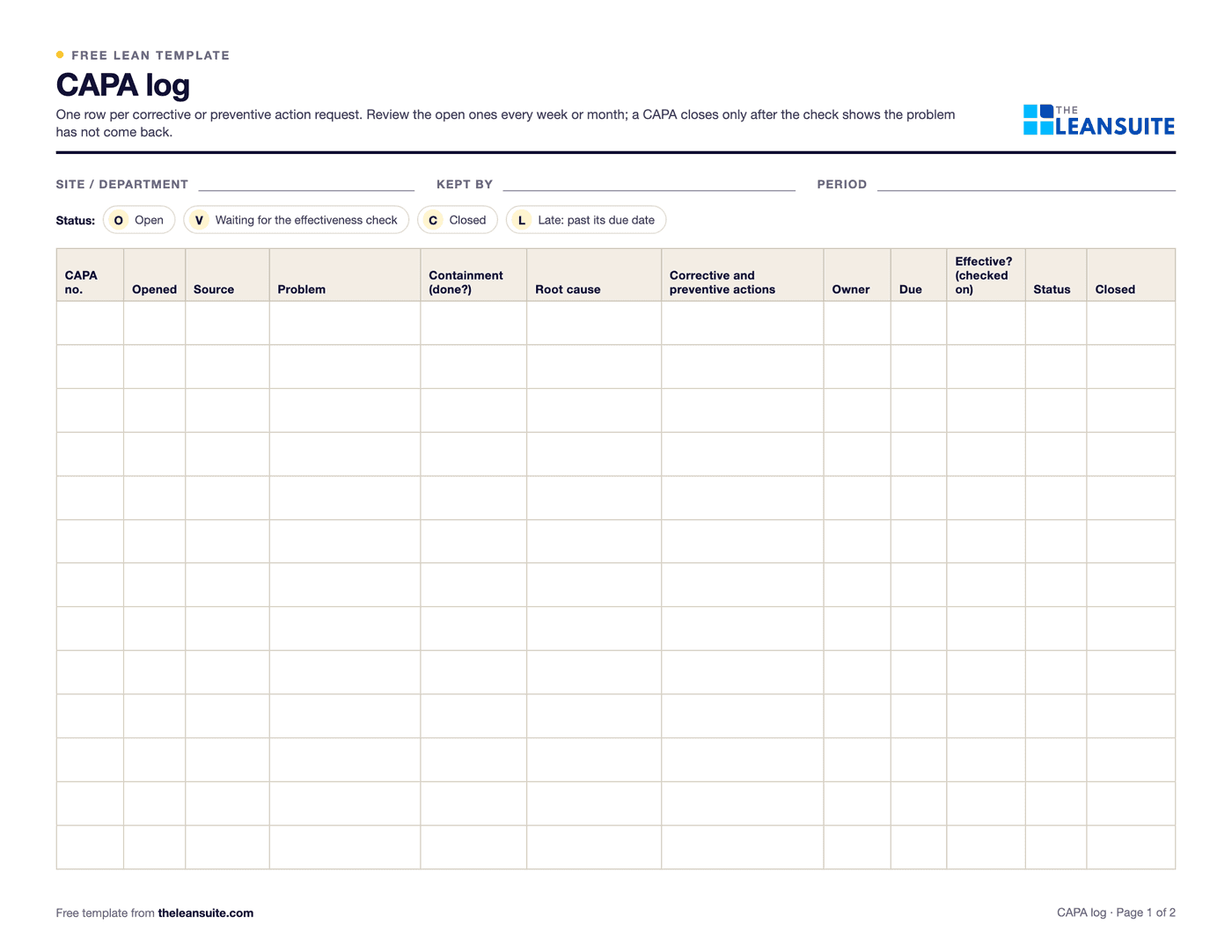 PDF and Excel and WordCAPA log templateAn Excel CAPA tracker with status, days open, late flags and counts by source, plus a printable log and monthly review.
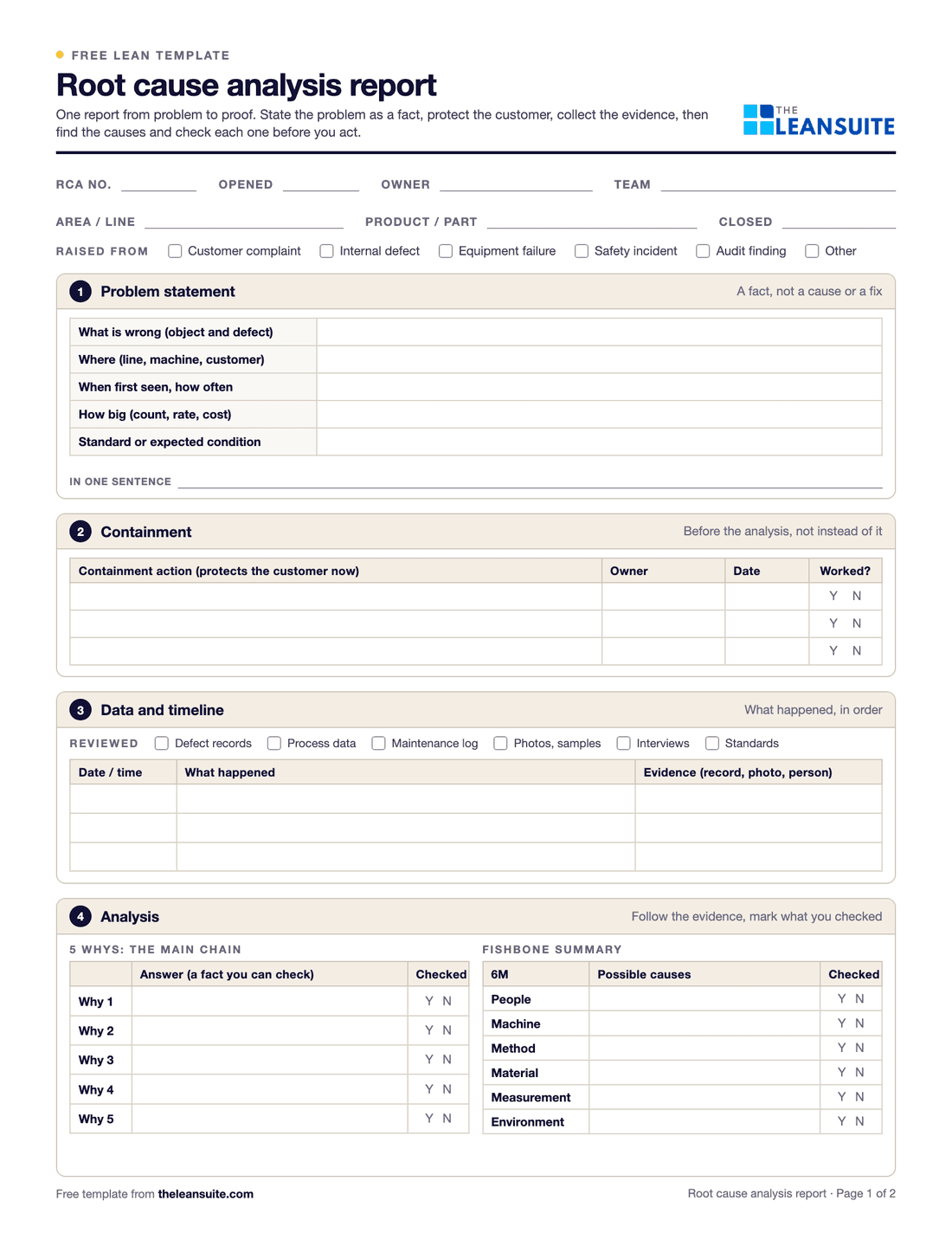 PDF and ExcelRoot cause analysis templateOne report from problem statement to proof: containment, evidence, analysis, verified causes, actions and the effectiveness check.
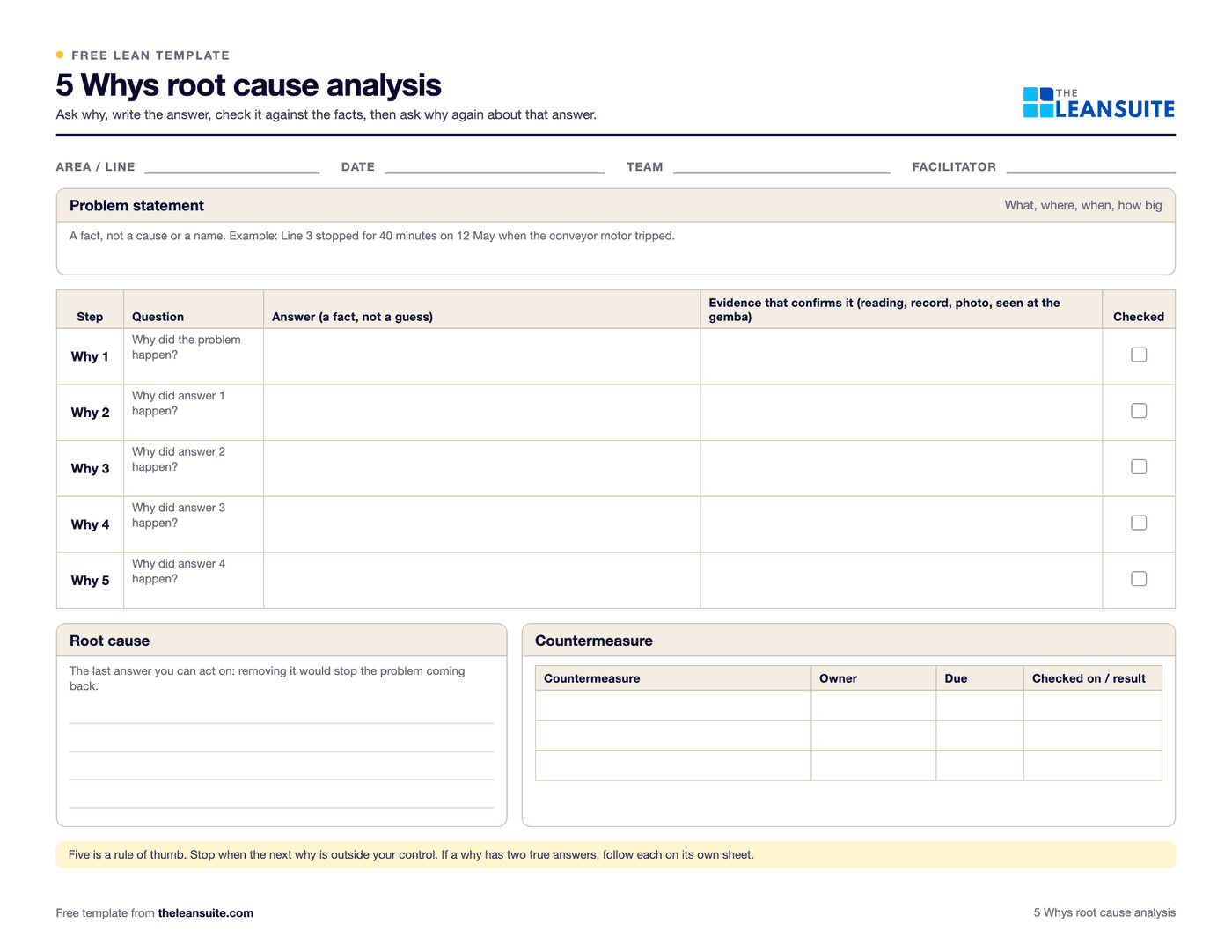 PDF and Excel and Word5 Whys templateA problem statement, a why chain that can branch, evidence for every answer, root causes and countermeasures that are checked.
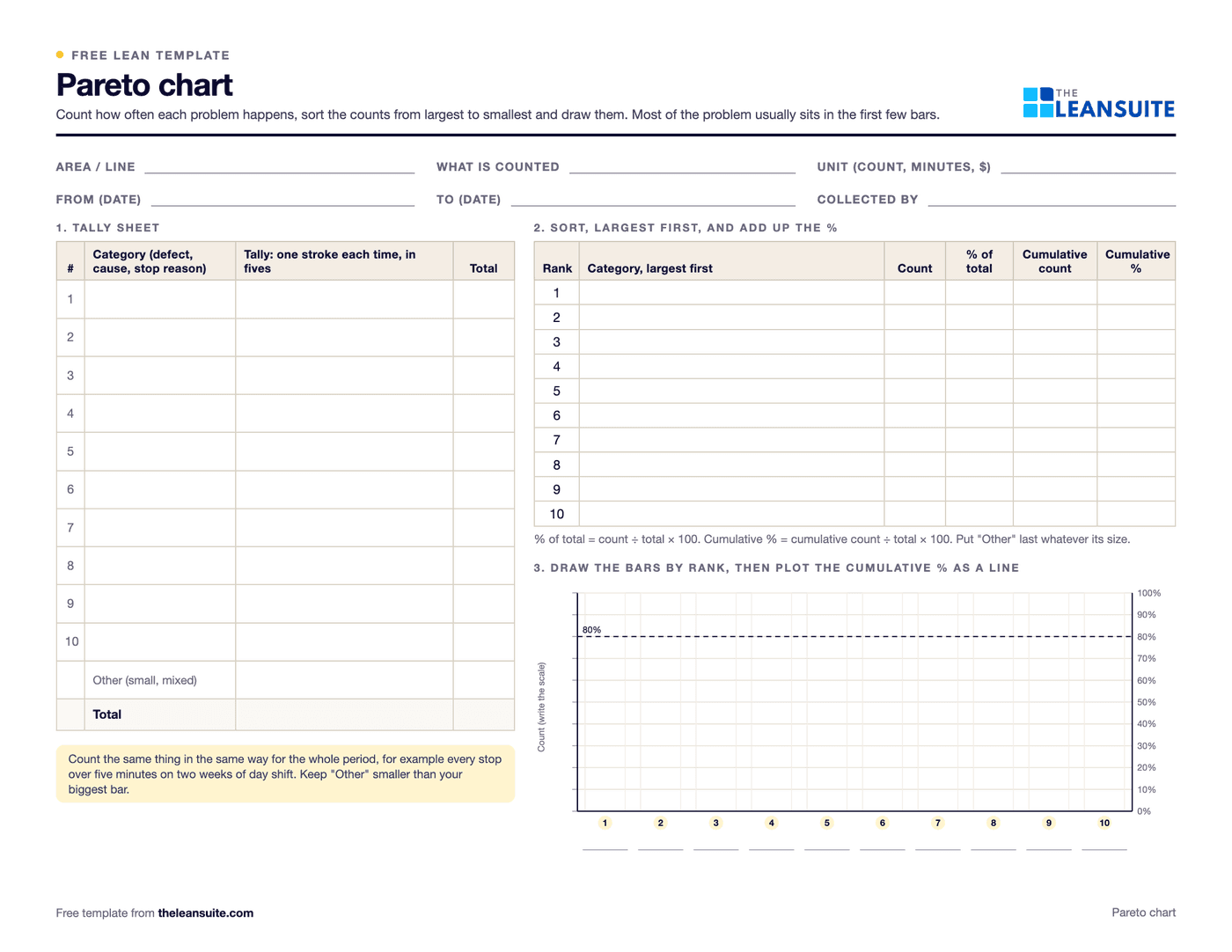 PDF and ExcelPareto chart templateA tally sheet, the Pareto by count and by cost with the cumulative line and the 80% cut, and a before and after comparison. Excel sorts and draws it.
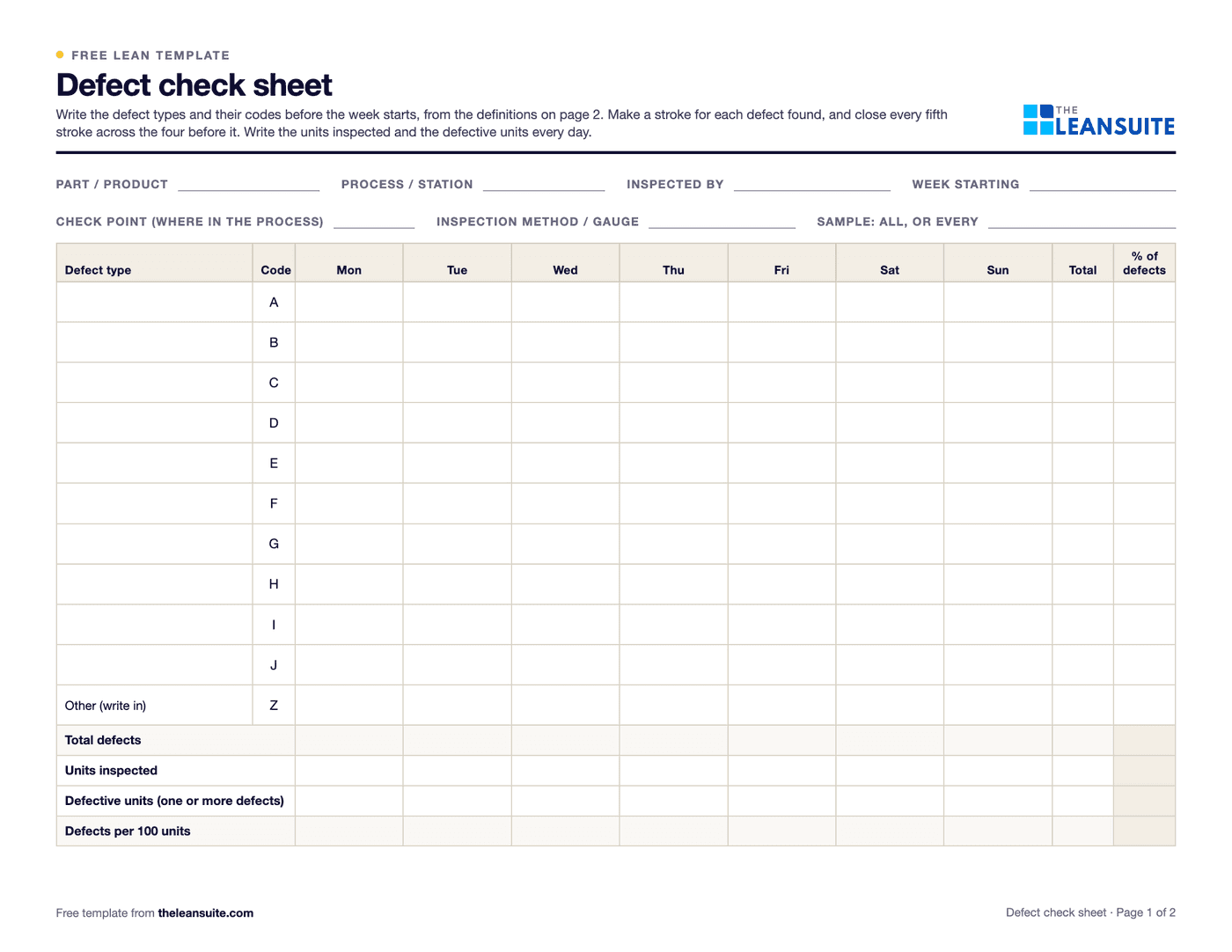 PDF and ExcelDefect check sheetTally defects by type and day, with units inspected, defect rates, a location sheet and the week's Pareto.
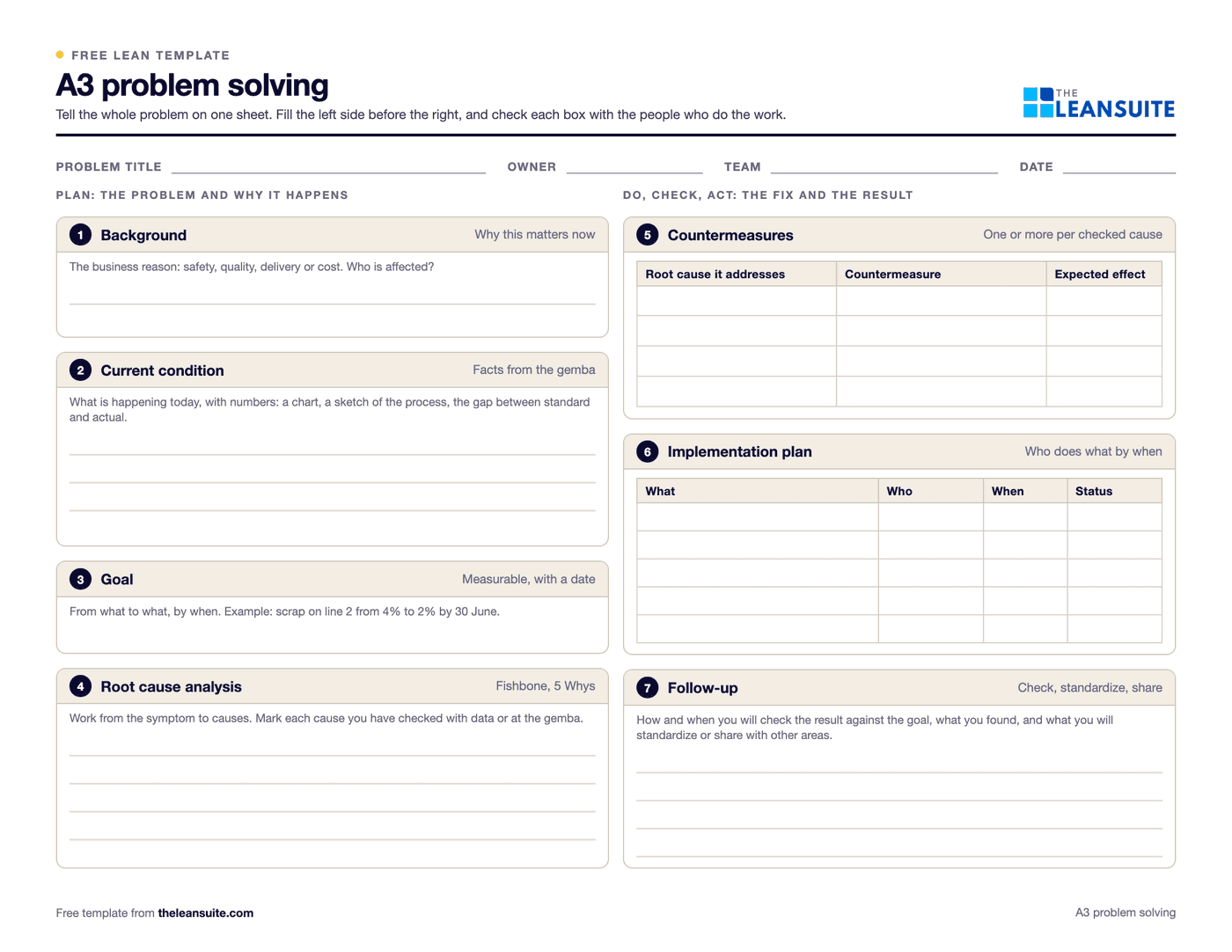 PDF and Excel and WordA3 problem solving templateThe standard seven-box A3 from background to follow-up, with a filled-in worked example. PDF and Excel.
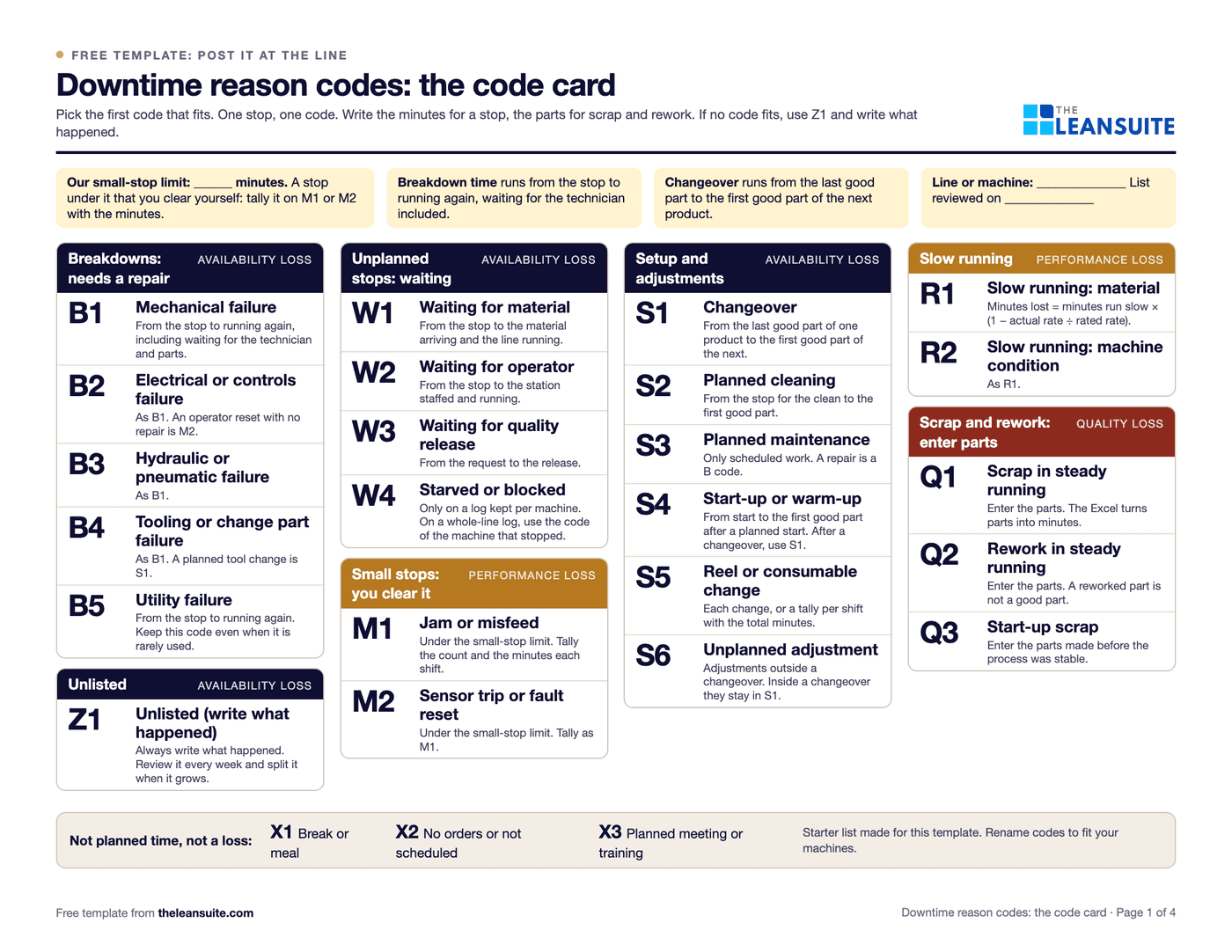 PDF and ExcelDowntime reason codes template26 starter codes mapped to the six big losses, a log with drop-downs, a Pareto by code and by loss, and a code card for the line.
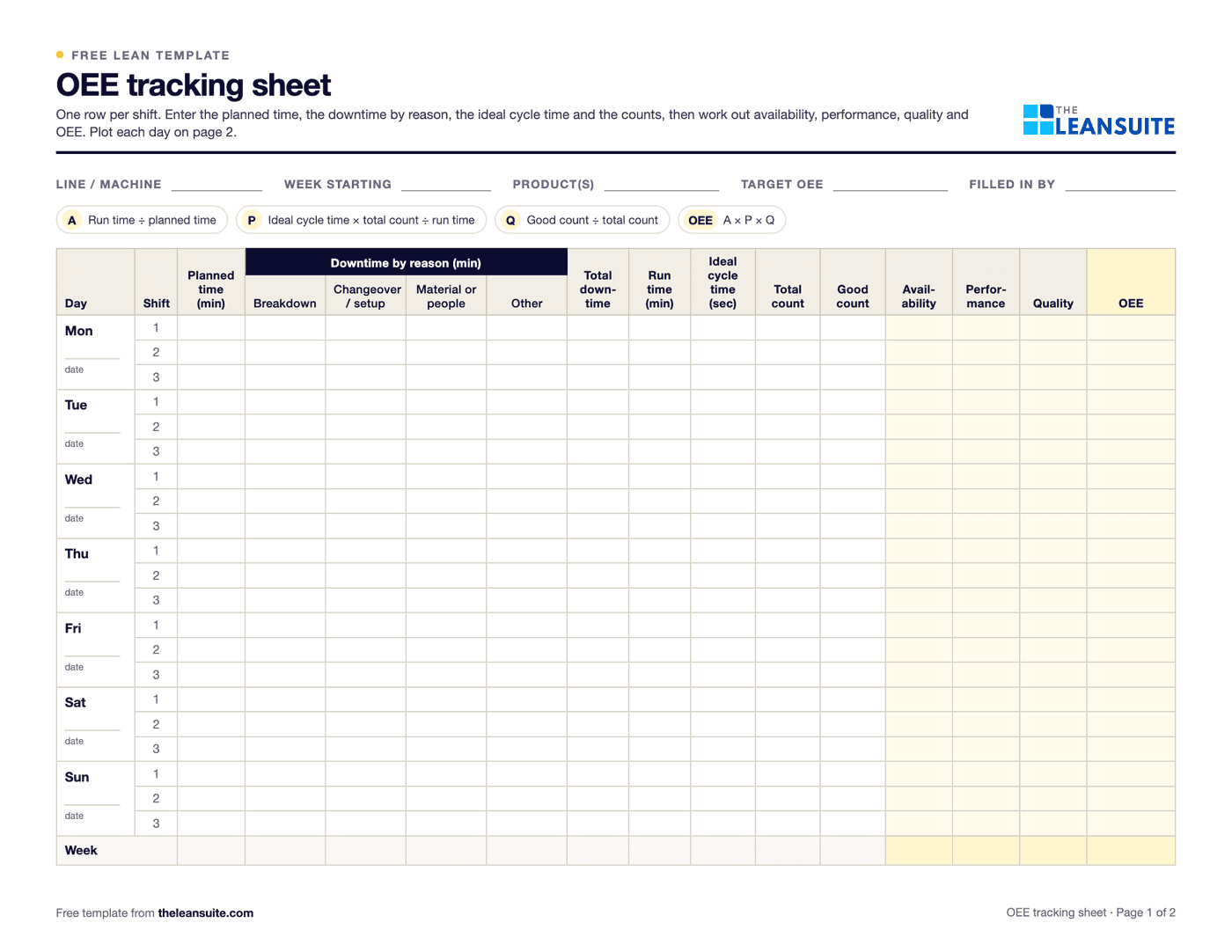 PDF and ExcelOEE tracking sheetOne row per shift for a week. The Excel version works out availability, performance, quality and OEE and charts the week.
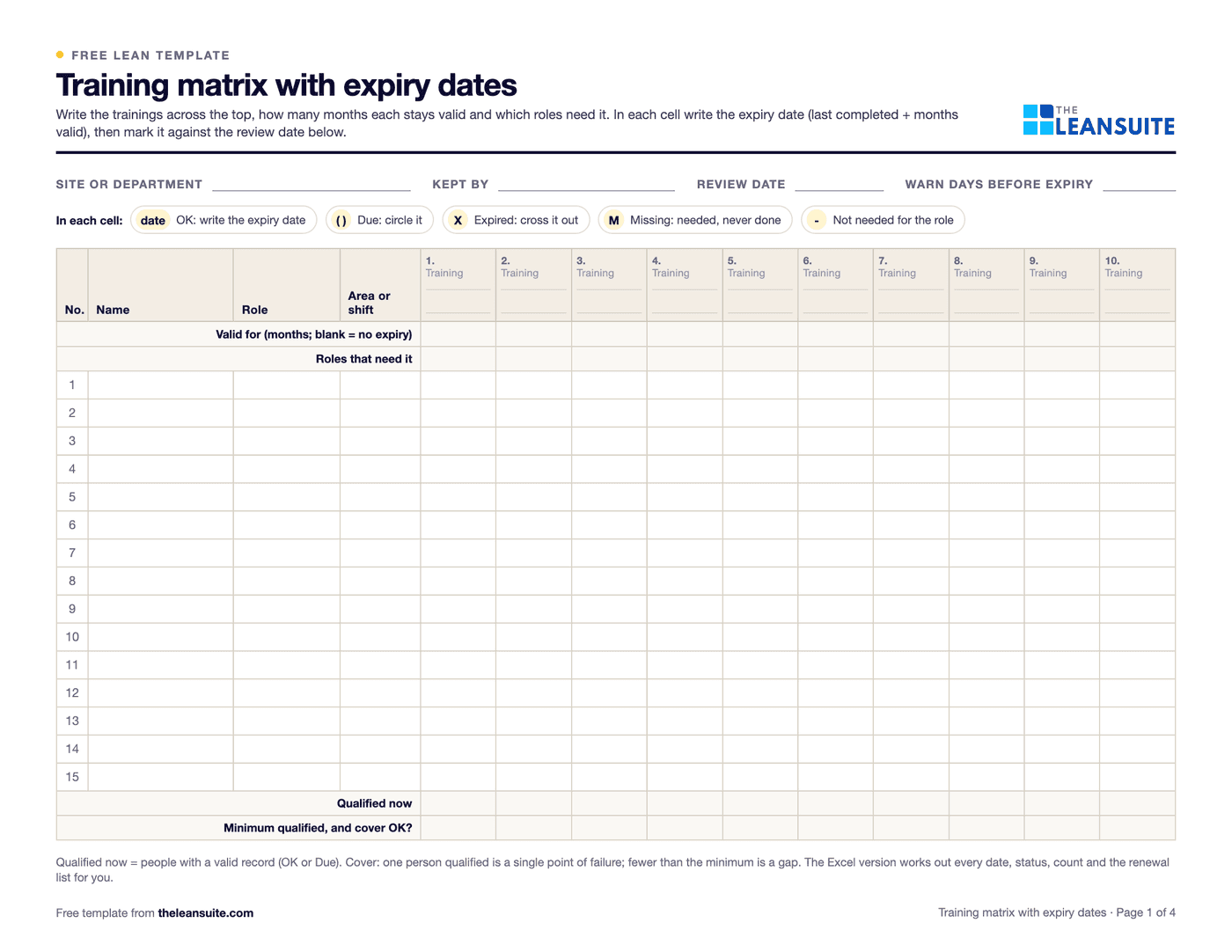 PDF and ExcelTraining matrix template with expiry datesPeople by required trainings with expiry dates, OK, due, expired and missing flags, compliance by person and area, cover per training and a renewal list.
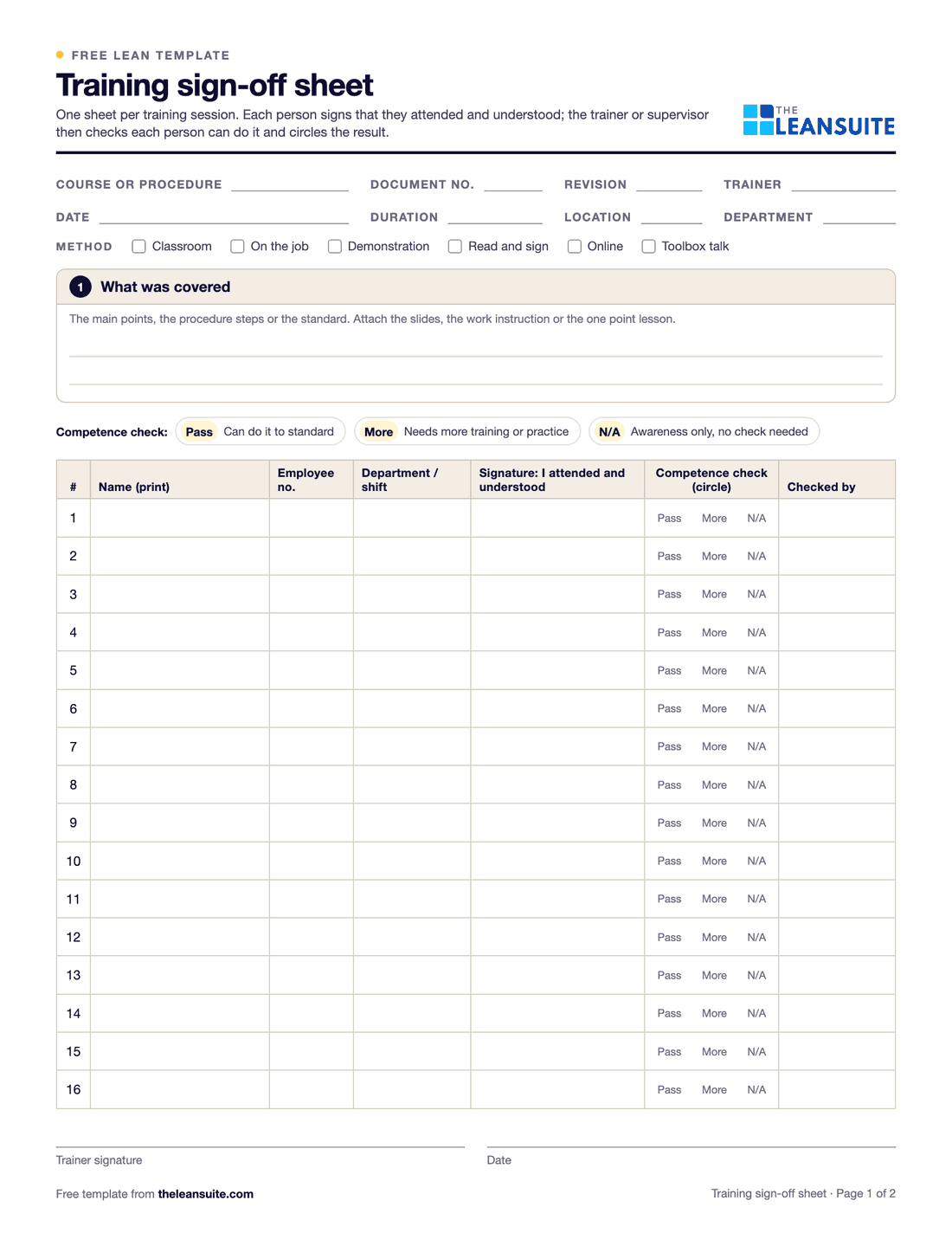 PDF and ExcelTraining sign-off sheetAn attendance and sign-off record where each person signs they understood, with a competence check and an Excel log.
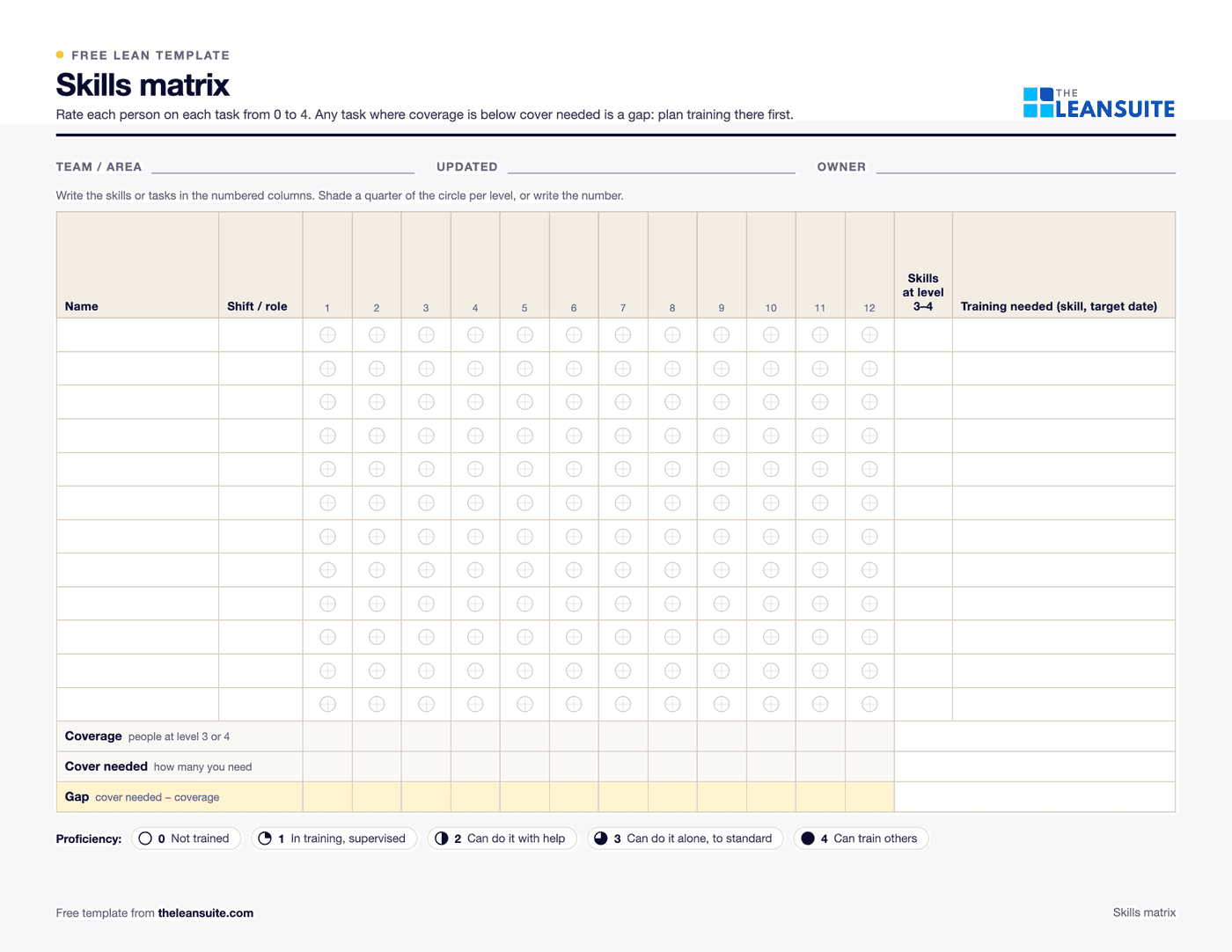 PDF and ExcelSkills matrix templatePeople by tasks on a 0 to 4 scale, coverage and gaps per task and shift, and a training plan that closes them.
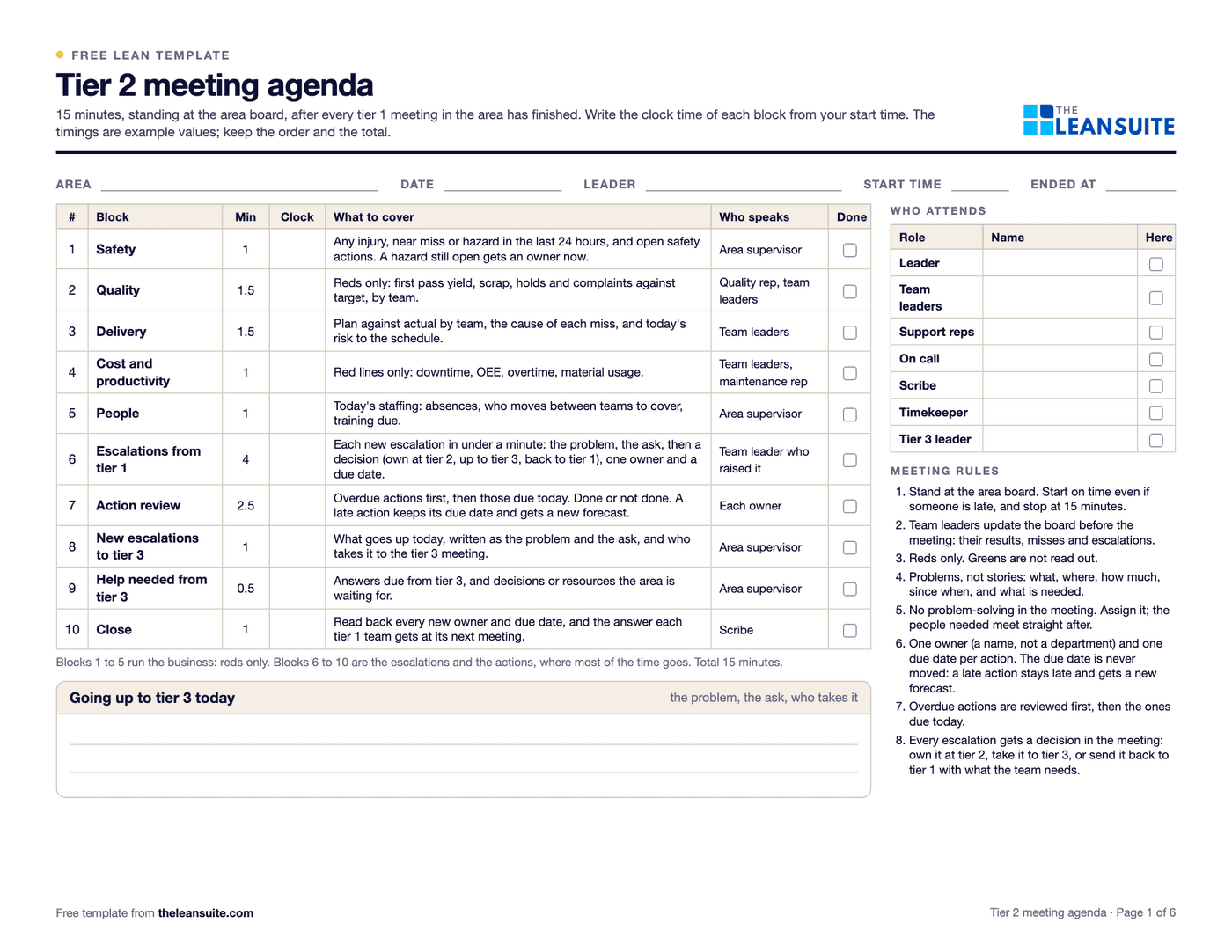 PDF and ExcelTier 2 meeting agenda and escalation sheetA 15-minute tier 2 agenda in ten timed blocks, fixed roles and rules, escalation triggers with time limits, and a log that ages every escalation and sends the answer back down.
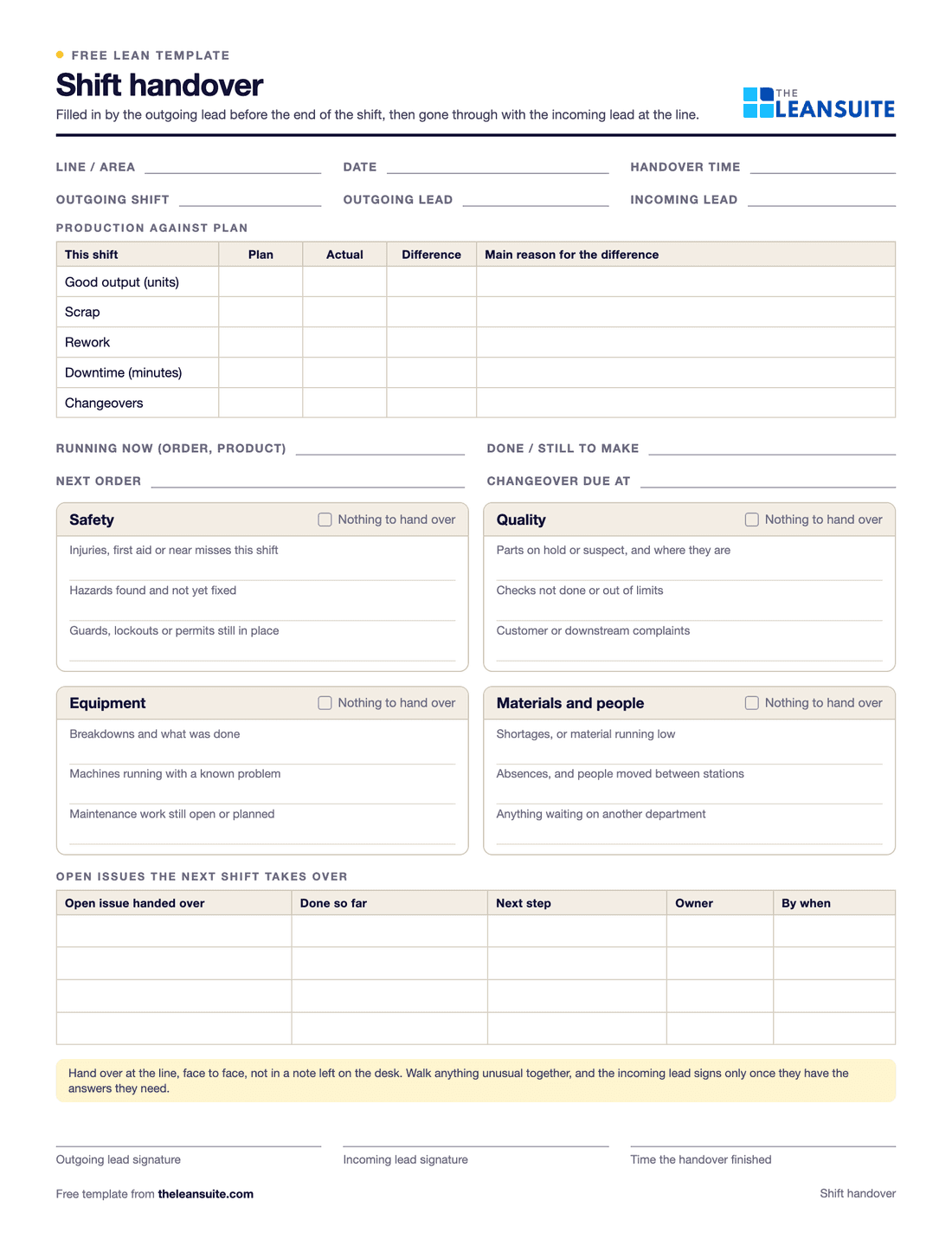 PDF and Excel and WordShift handover templateSafety, production against plan, holds, downtime events, materials and people, and the open actions the next shift takes over.
Calculators (4)
- Free calculatorSMED changeover calculatorTime saved by moving changeover steps from internal to external, capacity freed per week and the smaller batch it allows.
- Free online toolPareto chart makerPaste categories and counts: sorted bars, cumulative percentage line and the vital few at the 80% line, as a PNG or SVG.
- Free calculatorFirst pass yield (FPY) calculatorFirst pass yield at each step and rolled throughput yield (RTY) across the whole process.
- Free calculatorOEE calculatorOverall equipment effectiveness from shift time, downtime, ideal cycle time and part counts.
Buyer's guides
LeanSuite pages for these problems
- SMED
- AI SMED changeover analysis
- Quality tags
- Corrective Action Log
- Kaizen & Projects
- CI Portfolio
- Micro-stops
- Loss & Cost Management
- Trainings (LMS)
- Competency Management
- Tiered Meetings
- KPI Dashboards
How LeanSuite handles each of these is on the page for pharmaceutical plants.
Whirlpool tackled project visibility and continuous improvement across 14 manufacturing plants with LeanSuite. Read the Whirlpool case study.
FAQ
Lean in pharmaceutical plants: common questions
Yes. Most of the loss in a pharmaceutical plant sits around the validated process: changeovers, cleaning, line clearance, waiting for results and correcting paperwork. Lean shortens that time. Changes to a validated step still go through your change control, and QA should agree the route before you start.
On the packaging line with the most changeovers. Time three changeovers, log the stops and count batch record corrections for two weeks, then fix the two biggest losses. Packaging usually has more room to improve, with less validation work, than upstream steps.
Most of a changeover can be shortened without touching the validated cleaning: prepare parts and documents before the stop, use spare change parts cleaned off the line, standardize the order of steps and sequence products so more changes need a minor clean. Anything that alters the cleaning procedure itself goes through change control.
Right-first-time, changeover time, packaging-line OEE, deviation cycle time, batch release lead time and training on time. Review them at a short daily meeting at the line, not only at the monthly quality review.
See LeanSuite on your changeovers and daily meetings
Bring the routine you want to fix first. We will show you how LeanSuite handles it and what a 90-day pilot would cover.