

Lean playbook · Chemicals
Lean playbook for chemical plants
Short answer
Lean in a chemical plant starts at the bottleneck reactor and never bypasses process safety. Record every batch step by step and close the gap between the median batch and the best one, raise right-first-time so fewer batches are adjusted or reworked, shorten cleanouts between products, and keep pumps and seals from leaking with daily operator rounds. Near misses and small releases are reported and acted on every day, and any change to chemistry, equipment or procedures goes through the plant's management of change first.
Last updated:
7 problems on the floor, and the lean methods for each
Each problem says what it looks like, which methods address it, the first moves to make and the number to watch. Pick the one or two that cost your plant most; you do not need all of them at once.
Where a batch chemical plant loses time and quality
Raw material receipt and storage
Separation, filtration and drying
Blending and filling
Tank farm, loading and shipping
Across the whole line
Batch cycle time that varies at the bottleneck reactor
The same product takes hours longer one week than the next. Most of the gap is waiting: for a lab result, an operator, steam or cooling water, a free receiving tank, or a raw material that was not staged.
In LeanSuite
Import your loss data and LeanSuite builds a loss tree that puts a cost on each loss, then tracks the savings as you remove them, and a high-impact loss starts a Kaizen event in one click.
First moves
- Record every step of every batch on the bottleneck reactor for four weeks: charging, heating, reaction, cooling, sampling, waiting for results, transfer and cleaning.
- Compare the median batch with the best one, step by step, and list the waits.
- Write the best practice as the standard sequence, stage raw materials before the batch starts and agree a turnaround time for lab results.
Number to watch: Median batch cycle time on the bottleneck reactor, and the spread between batches.
Off-spec batches, additions and rework
A batch misses its viscosity, color, assay or particle size at the first test, so it waits while an addition is made, or it is blended off or reworked. The fix is recorded on the batch sheet, but the cause is rarely tracked across batches.
Lean methods
In LeanSuite
Each non-conformance is captured at the line and linked to a CAPA with root cause analysis.
First moves
- Log every batch that misses at the first test, with the property out of limit and the correction made.
- Pareto the misses by product and by cause: raw material lot, charge quantity, temperature profile or timing.
- Add a check at the step where the top cause starts, such as a verified weight at charging or a raw material lot check, and chart the key property for each product.
Number to watch: Right-first-time batches, and reactor hours spent on corrections.
Long cleanouts between products
Moving from one product to the next means draining, washing, flushing and checking vessels, lines and filters. Cleanouts run long when hoses, cleaning chemicals and people are found after the last batch ends, and a vessel judged clean by eye can contaminate the next one.
In LeanSuite
Run each cleaning and product changeover as a digital checklist in Lean Creator, and Issue Management flags missing items.
First moves
- Time each step of the cleanout on the bottleneck vessel and mark which steps could be prepared before the last batch ends.
- Plan product sequences with a changeover matrix, so compatible products follow each other and the full cleanouts are fewer.
- Write the cleanout as a checklist with a defined check that the vessel is clean before the next charge.
Number to watch: Cleanout time per changeover, and reactor hours lost to cleanouts each month.
Process-safety signals that go unreported
A small leak at a flange, an alarm left in bypass, a relief valve that lifted, a hose connected to the wrong line at unloading. Each is a warning before a serious event, but they go unreported when reporting is a hassle, and actions from incidents and audits sit open for months.
In LeanSuite
Anyone logs a near miss, unsafe act or unsafe condition on their phone in seconds by scanning a QR code, and each corrective action is tracked until it is closed.
First moves
- Make near-miss and small-release reporting quick, review new reports every day and tell people what changed.
- Walk each unit weekly with operators to find leaks, bypassed alarms, open drains and blocked access.
- Track every action from incidents, audits and hazard reviews to closure, and review the overdue ones at the daily meeting.
Number to watch: Near misses reported, process-safety events by tier, and overdue safety actions.
Pump, seal and valve leaks
Seals weep, valve packing and flanges seep, and a pump runs hot or loud for days before it fails. Rounds done from memory miss the early signs, and the same bad-actor pumps get repaired again and again.
Lean methods
In LeanSuite
Digital CILR checklists put each machine's clean, inspect, lubricate and retighten routine on the operator's Daily Standard Work, and operators flag an abnormality with a photo without leaving the checklist.
First moves
- Write an operator round for each area: seal leaks, pump noise, vibration and temperature, flange and valve leaks, levels and pressures against their limits.
- Tag every leak at the source and raise a work order, so nothing is reported only by radio.
- List the pumps with the most repairs and run a root-cause analysis on the worst three.
Number to watch: Mean time between failures for pumps, open leaks, and PM compliance.
Operating procedures that drift from practice
Procedures are revised when an auditor asks, while the way operators run a step changes shift by shift. New operators learn from whoever trains them, and the written version falls behind until someone follows it and it is wrong.
In LeanSuite
Film the task once and LeanSuite drafts an SOP with purpose, scope, PPE, warnings and a photo for each step, then versions it and collects each person's signature.
First moves
- Walk each critical procedure on the unit with the operators who run it, and mark where practice differs from the page.
- Decide which is right, update the procedure through the plant's change procedure, then retrain and sign people off.
- Audit a sample of procedures on the unit every month.
Number to watch: Procedures reviewed on schedule, and audit findings per procedure.
Filling-line losses on drums, totes and pails
The filling line stops for pallets, labels, caps, a scale out of calibration or a drum that will not seal. Each stop is short, so it never reaches a report, but together they decide whether the day's orders ship.
In LeanSuite
Operators log each minor stop in one tap with its category, duration and cause.
First moves
- Measure OEE on the filling line by shift, with a reason code for every stop.
- Count the short stops for a week and fix the top three causes.
- Stage pallets, labels and closures for the next order before the current one ends.
Number to watch: Filling-line OEE, and orders shipped on time.
More small fixes in the production, maintenance and safety sections of the kaizen idea bank.
The 14 elements of process safety management, and where daily routines fit
OSHA's process safety management standard applies to processes that hold listed highly hazardous chemicals, or flammable liquids or gases, above threshold quantities. It has 14 elements. A lean daily system replaces none of them, but several depend on routines done well on every shift.
Employee participation
- What it covers
- A written plan for consulting workers on PSM and giving them access to hazard analyses and other PSM information.
- Where daily routines help
- Daily meetings and quick near-miss reporting give operators a routine way to raise hazards and see what was done.
Process safety information
- What it covers
- Written information on the chemicals, the technology and the equipment in the process.
- Where daily routines help
- Operator rounds and walk-throughs catch places where the plant no longer matches its drawings.
Process hazard analysis
- What it covers
- A systematic study of what can go wrong, such as a HAZOP or what-if review, revalidated at least every five years.
- Where daily routines help
- Near misses and small releases logged every day are evidence for the next study, and its recommendations need tracking to closure.
Operating procedures
- What it covers
- Written procedures for each phase of operation, including startup, shutdown and emergencies, certified as current every year.
- Where daily routines help
- Walking procedures with the operators who run them, and auditing them on the unit, keeps them matched to practice.
Training
- What it covers
- Initial training on the operating procedures and refresher training at least every three years, with records.
- Where daily routines help
- A skills matrix shows who is trained on each procedure and when each refresher is due.
Contractors
- What it covers
- Choosing contractors on their safety record, telling them the hazards and checking they follow safe work practices.
- Where daily routines help
- Contractor near misses and observations go into the same daily review as everyone else's.
Pre-startup safety review
- What it covers
- A check before new or changed equipment starts that construction, procedures, training and hazard analysis are complete.
- Where daily routines help
- Running the review as a checklist, with each item signed, leaves a clear record before startup.
Mechanical integrity
- What it covers
- Inspection, testing and maintenance of vessels, tanks, piping, relief and vent systems, controls and pumps.
- Where daily routines help
- Operator rounds and autonomous maintenance find leaks, vibration and heat early, and planned maintenance keeps inspections on schedule.
Hot work permit
- What it covers
- A permit for welding, cutting and other hot work on or near covered processes.
- Where daily routines help
- Field audits of open permits check that fire watches and gas tests happen as written.
Management of change
- What it covers
- Written procedures to review changes to chemicals, technology, equipment and procedures before they are made.
- Where daily routines help
- Kaizen ideas that change the process go through the plant's change procedure before the new standard is issued.
Incident investigation
- What it covers
- Investigating every incident that caused, or could have caused, a catastrophic release, starting within 48 hours.
- Where daily routines help
- Root-cause methods and tracking each action to closure stop the same failure from coming back.
Emergency planning and response
- What it covers
- An emergency action plan for the whole plant, including procedures for small releases.
- Where daily routines help
- Drills and checks of emergency equipment run on a schedule, with records.
Compliance audits
- What it covers
- Certifying compliance with the standard at least every three years, and acting on the findings.
- Where daily routines help
- Findings tracked to closure with owners and due dates, and reviewed at the daily meeting.
Trade secrets
- What it covers
- Making trade-secret information available to the people who need it for PSM work.
- Where daily routines help
- No daily routine here; access rules belong to the PSM program.
Summarized in plain words, not quoted. Read 29 CFR 1910.119 itself, and EPA's risk management program rule (40 CFR 68) if your site is covered, for what each element requires. Your PSM program owns these elements; daily routines feed it.
A 90-day starting plan
One line or product family, two problems, measured before and after. The point of the first 90 days is a result the plant believes and a method it can repeat, not a plant-wide program.
The 90 days, with the gate that ends each stage
- Days 1 to 30Measure the bottleneckDone when: You have four weeks of batch data, a right-first-time baseline and two problems with owners.
- Days 31 to 60Close the gap to the best batchDone when: Batch cycle time and right-first-time each have a before-and-after number and a written standard.
- Days 61 to 90Hold the gains and spread themDone when: The gains have held for a month and the next unit has its baseline.
Days 1 to 30
Measure the bottleneck
See where the bottleneck reactor and the filling line lose time.
- Name an owner for the bottleneck reactor and for the filling line.
- Record every batch step by step, with waits and their reasons.
- Log every batch that misses at the first test, with the cause if known.
- Start a daily meeting at a board on the unit, with near misses as the first item.
- Choose the two biggest losses to work on first.
Days 31 to 60
Close the gap to the best batch
Attack the two losses and prove the change with numbers.
- Write the standard batch sequence from the best batches, and send it through the plant's change procedure.
- Stage raw materials and agree a turnaround time for lab results.
- Run the cleanout as a checklist, with preparation done before the last batch ends.
- Start operator rounds on pumps and seals, and tag every leak.
Days 61 to 90
Hold the gains and spread them
Keep the new standards, keep procedures matched to practice and start the next unit.
- Audit the new standards and procedures on the unit every month.
- Retrain and sign off operators on the updated procedures.
- Measure OEE on the filling line and fix its top stop cause.
- Share the results and measure the next reactor or unit.
The KPIs to track
Track them per line and shift, on a board the team sees every day. Set targets from your own baseline, not from someone else's plant.
| KPI | What it tells you | How to measure it | Free help |
|---|---|---|---|
| Batch cycle time | How long a batch occupies the bottleneck reactor, and how much that varies. | From the start of charging to the end of transfer, for every batch and step. Watch the median and the spread, not only the average. | Cycle time calculator |
| Right-first-time batches | The share of batches that meet specification without additions, blending or rework. | Batches that pass at the first test divided by all batches made, per product. | - |
| Yield | How much of the raw material charged ends up as on-spec product. | On-spec output divided by the theoretical output from the raw materials charged, per batch. | - |
| Filling-line OEE | How much of the planned time the filling line fills good containers at its standard rate. | Availability times performance times quality, by shift. | OEE calculatorOEE tracking sheet |
| Process-safety events | Whether losses of containment are becoming rarer, separately from personal injuries. | Tier 1 and Tier 2 events as API RP 754 defines them, counted each month, and as a rate per 200,000 hours worked. | - |
| Recordable injury rate (TRIR) | How often people are hurt badly enough to record. | Recordable cases times 200,000 divided by hours worked. | TRIR and DART rate calculator |
| PM compliance | Whether planned maintenance on pumps, vessels and instruments happens on time. | Planned maintenance work orders completed on time divided by those due, each month. | Preventive maintenance checklist template |
Worked example: batch cycle time and right-first-time on one reactor
One bottleneck reactor over four weeks: 44 batches, a median cycle of 14.0 hours and a best batch of 11.5 hours. The numbers are illustrative, chosen to show the method; use your own batch records.
The calculation, step by step
Example numbersHours a week for batches
168 hours, less two cleanouts between products of 4 hours each.
160 h
Batches a week at today's median
160 ÷ 14.0
11.4
Batches a week if the median falls to 12.5 hours
160 ÷ 12.5
12.8
Extra capacity from the same reactor
12.8 batches against 11.4, about 1.4 more a week: 1.37 ÷ 11.43.
+12%
Right-first-time
37 of 44 batches met specification at the first test; 6 needed an addition and 1 was reworked: 37 ÷ 44.
84.1%
Yield on one batch
9,350 kg of on-spec product against 10,000 kg in theory from the charge: 9,350 ÷ 10,000.
93.5%
Standards and regulations plants work to
Chemical plants answer to process safety, environmental and worker safety law, and often to an industry program. These are the ones most plants meet, named so you know what applies; each standard's own text sets its requirements.
OSHA process safety management (29 CFR 1910.119)
Prevents catastrophic releases of highly hazardous chemicals through 14 elements, from process hazard analysis to management of change.
EPA risk management program (40 CFR 68)
Covers sites holding listed toxic or flammable substances above threshold quantities, with hazard assessment, prevention, emergency response and a plan filed with EPA.
OSHA hazard communication (29 CFR 1910.1200) and GHS
Labels, safety data sheets and training on chemical hazards, aligned with the UN's Globally Harmonized System.
Responsible Care and RC14001
The American Chemistry Council's program for member companies, with a management system certified as RCMS or as RC14001, which combines it with ISO 14001.
API RP 754
A recommended practice for process-safety performance indicators that sorts losses of containment into tiers by severity; many chemical companies report Tier 1 and Tier 2 events.
ISO 9001, ISO 14001 and ISO 45001
The quality, environmental and occupational health and safety management standards many chemical plants are certified to.
Software does not make a plant compliant with any of these, and no lean routine replaces a PSM or RMP program. The routines in this playbook produce records the program can use: rounds done, near misses reported, findings closed and people trained.
By the numbers
Public figures for this industry or for the wider sector it belongs to, each linked to the report or government table it comes from and checked against it on October 9, 2026. More in our lean manufacturing statistics and benchmark charts.
1.6
Chemical manufacturing recorded 1.6 injury and illness cases per 100 full-time workers in 2024, against 2.7 for all manufacturing.
Total recordable cases per 100 full-time workers, U.S. private industry, 2024 data from the Survey of Occupational Injuries and Illnesses (NAICS 325). A low injury rate does not measure process-safety risk, which is why plants track process-safety events separately.
Source: U.S. Bureau of Labor Statistics, Table 1. Incidence rates of nonfatal occupational injuries and illnesses by industry and case types, 2024 (2024 data, table updated January 22, 2026)
1.0
In chemical manufacturing, 1.0 case per 100 full-time workers in 2024 was serious enough to mean days away from work, job restriction or transfer.
Same survey and industry group, cases with days away from work, job restriction or transfer (DART).
Source: U.S. Bureau of Labor Statistics, Table 1. Incidence rates of nonfatal occupational injuries and illnesses by industry and case types, 2024 (2024 data, table updated January 22, 2026)
Injury and illness rate by industry, 2024
- Motor vehicles5.6
- Beverage and tobacco3.7
- Furniture3.5
- Food3.3
- Primary metals3.3
- Nonmetallic mineral products, incl. glass3.3
- Fabricated metal products3.2
- Transportation equipment3.2
- Motor vehicle parts2.9
- Plastics and rubber products2.8
- HVAC and refrigeration2.4
- Paper2.4
- Machinery2.3
- All private industry2.3
- Electrical equipment and appliances2.0
- Printing1.6
- Chemicals1.6This industry
Total recordable cases per 100 full-time workers, 2024: Motor vehicles 5.6, Beverage and tobacco 3.7, Furniture 3.5, Food 3.3, Primary metals 3.3, Nonmetallic mineral products, incl. glass 3.3, Fabricated metal products 3.2, Transportation equipment 3.2, Motor vehicle parts 2.9, Plastics and rubber products 2.8, All manufacturing 2.7, HVAC and refrigeration 2.4, Paper 2.4, Machinery 2.3, All private industry 2.3, Electrical equipment and appliances 2, Printing 1.6, Chemicals 1.6.
Free templates, calculators and buyer's guides
Templates (22)
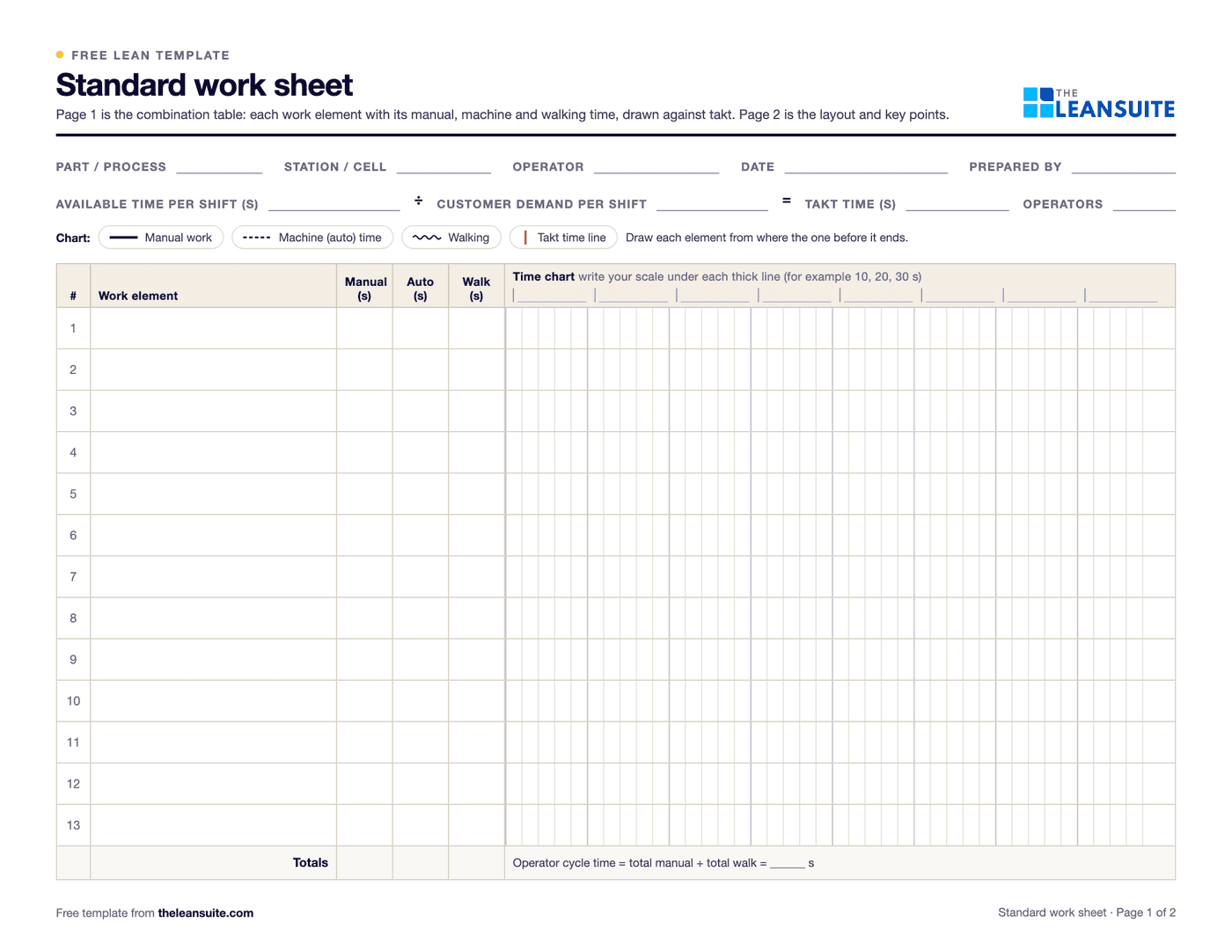 PDF and Excel and WordStandard work sheet templateTakt time, each element's manual, machine and walk time on a time chart, key points and standard WIP.
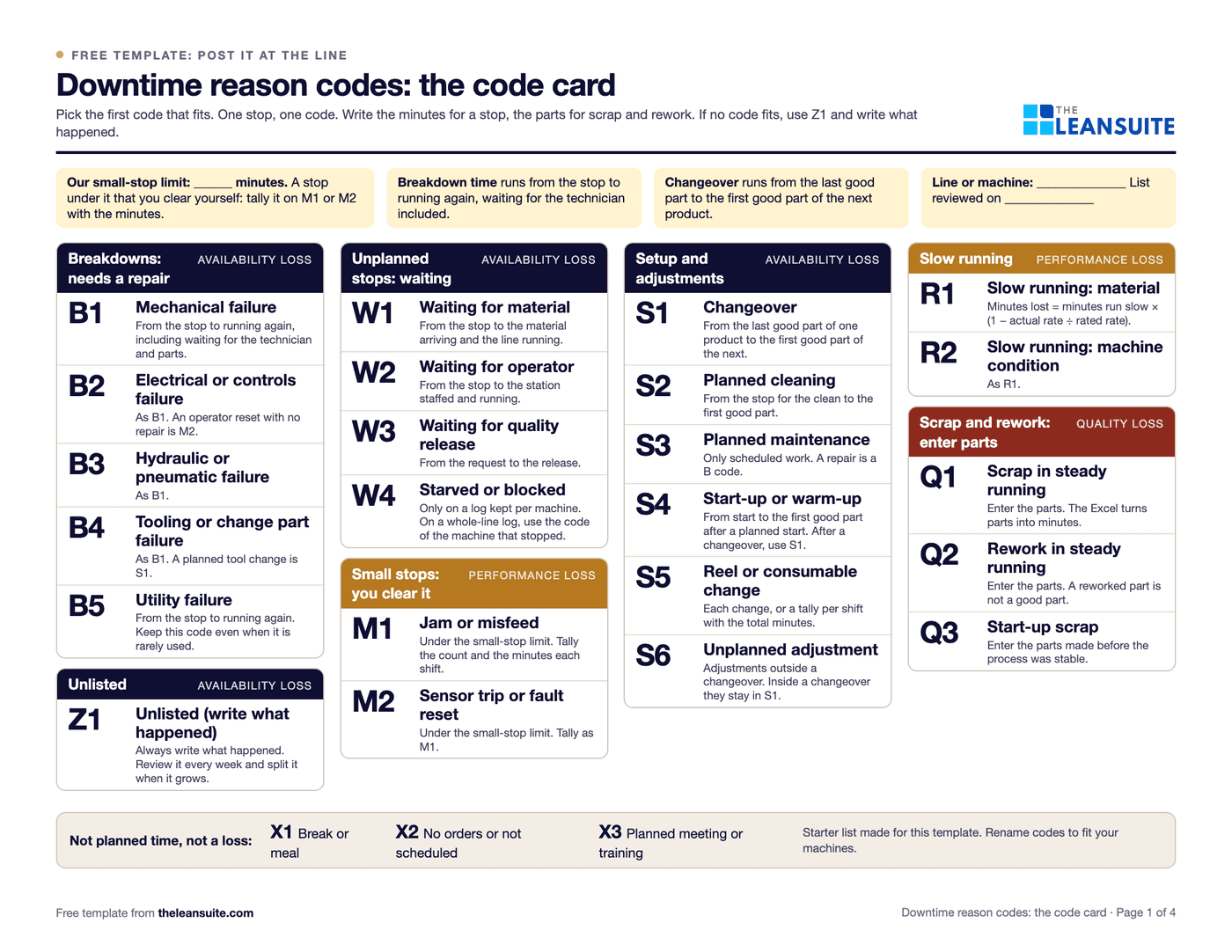 PDF and ExcelDowntime reason codes template26 starter codes mapped to the six big losses, a log with drop-downs, a Pareto by code and by loss, and a code card for the line.
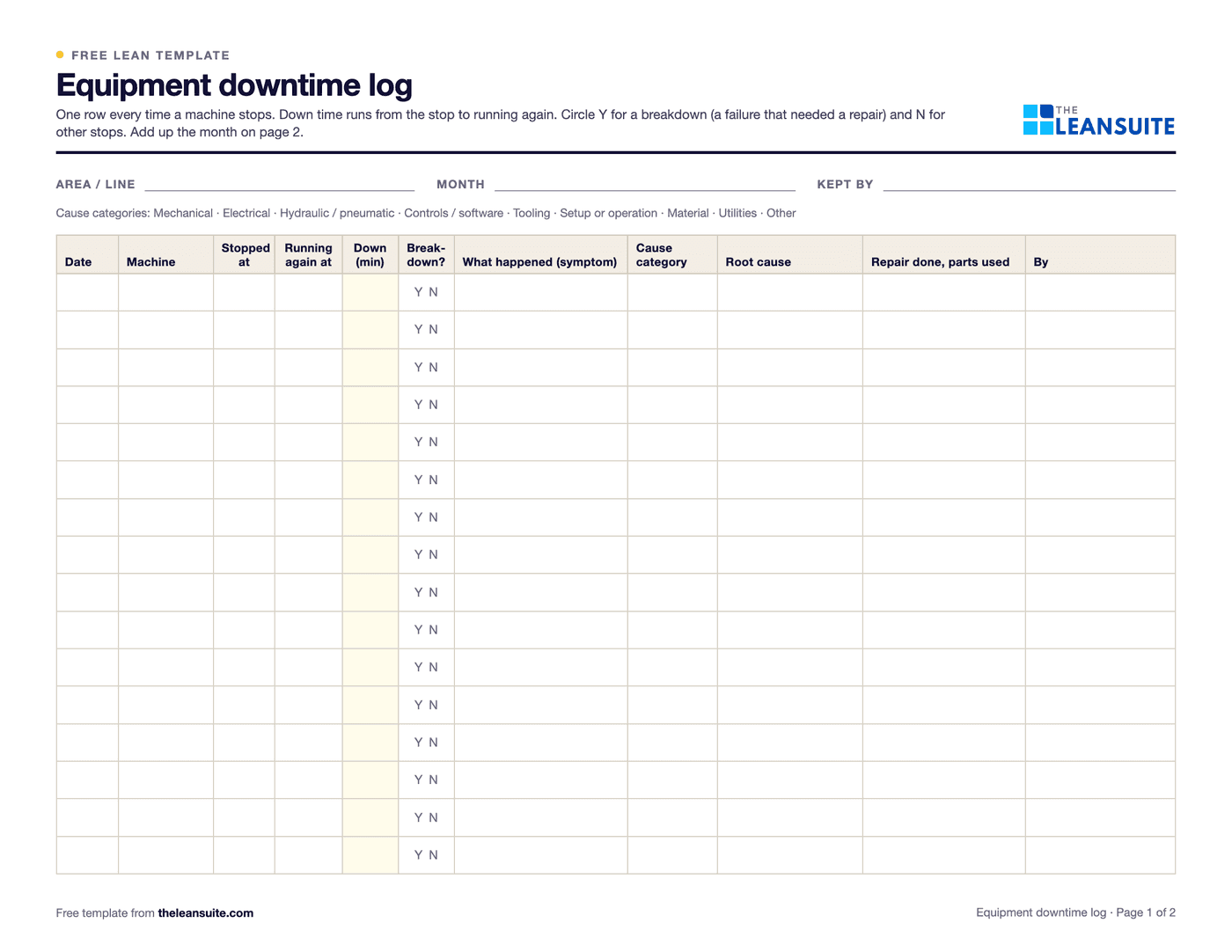 PDF and ExcelEquipment downtime log (MTTR and MTBF)A breakdown and downtime log, with MTTR, MTBF and downtime by machine and cause worked out in Excel.
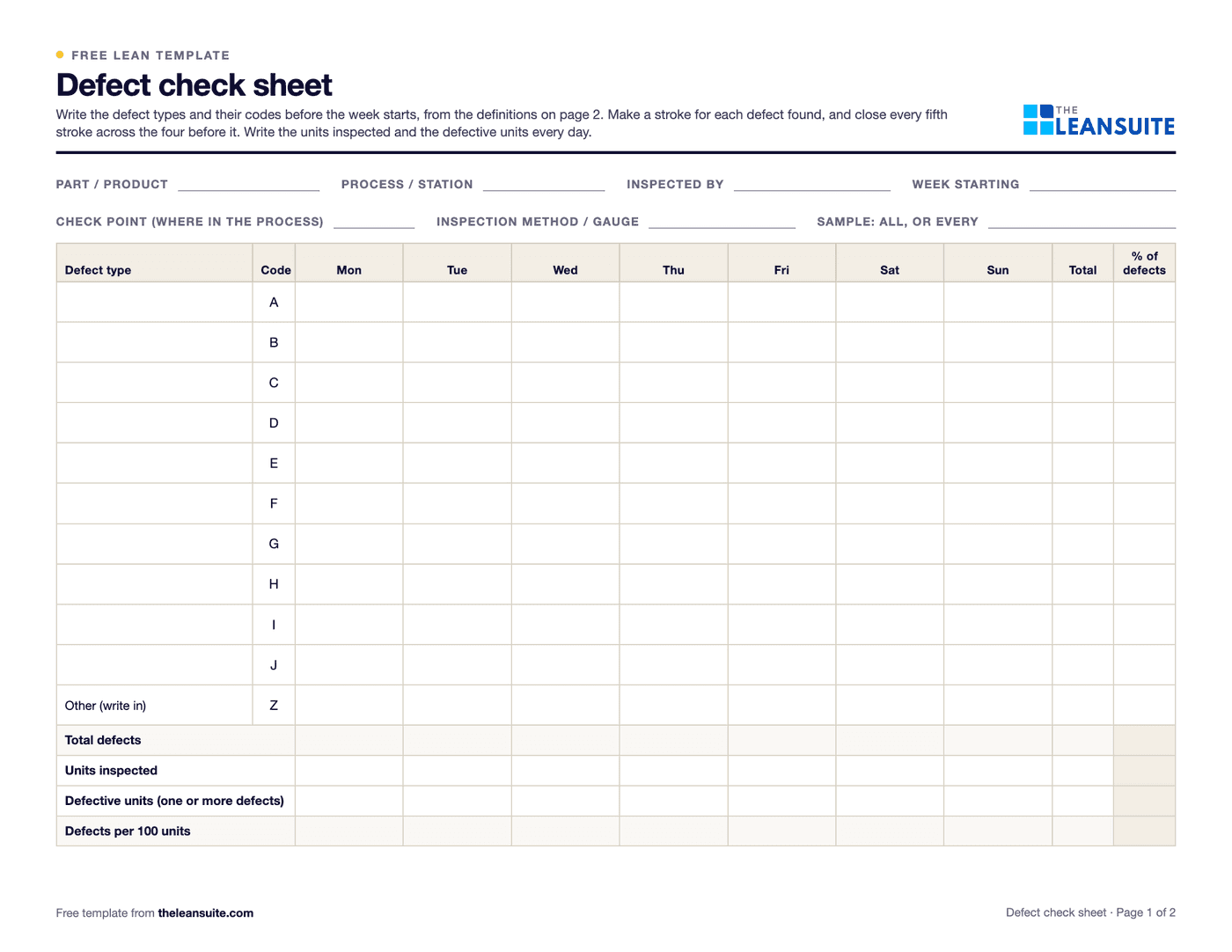 PDF and ExcelDefect check sheetTally defects by type and day, with units inspected, defect rates, a location sheet and the week's Pareto.
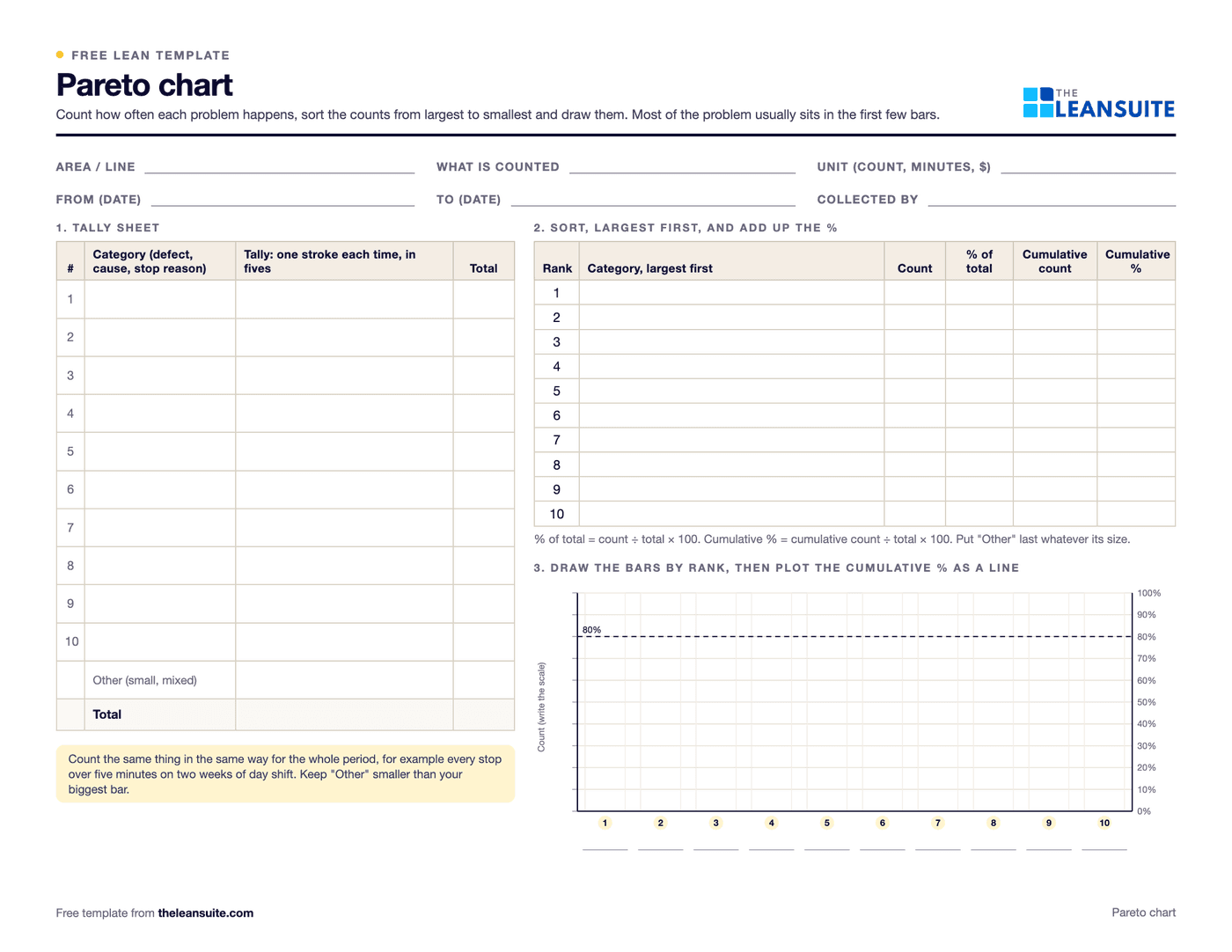 PDF and ExcelPareto chart templateA tally sheet, the Pareto by count and by cost with the cumulative line and the 80% cut, and a before and after comparison. Excel sorts and draws it.
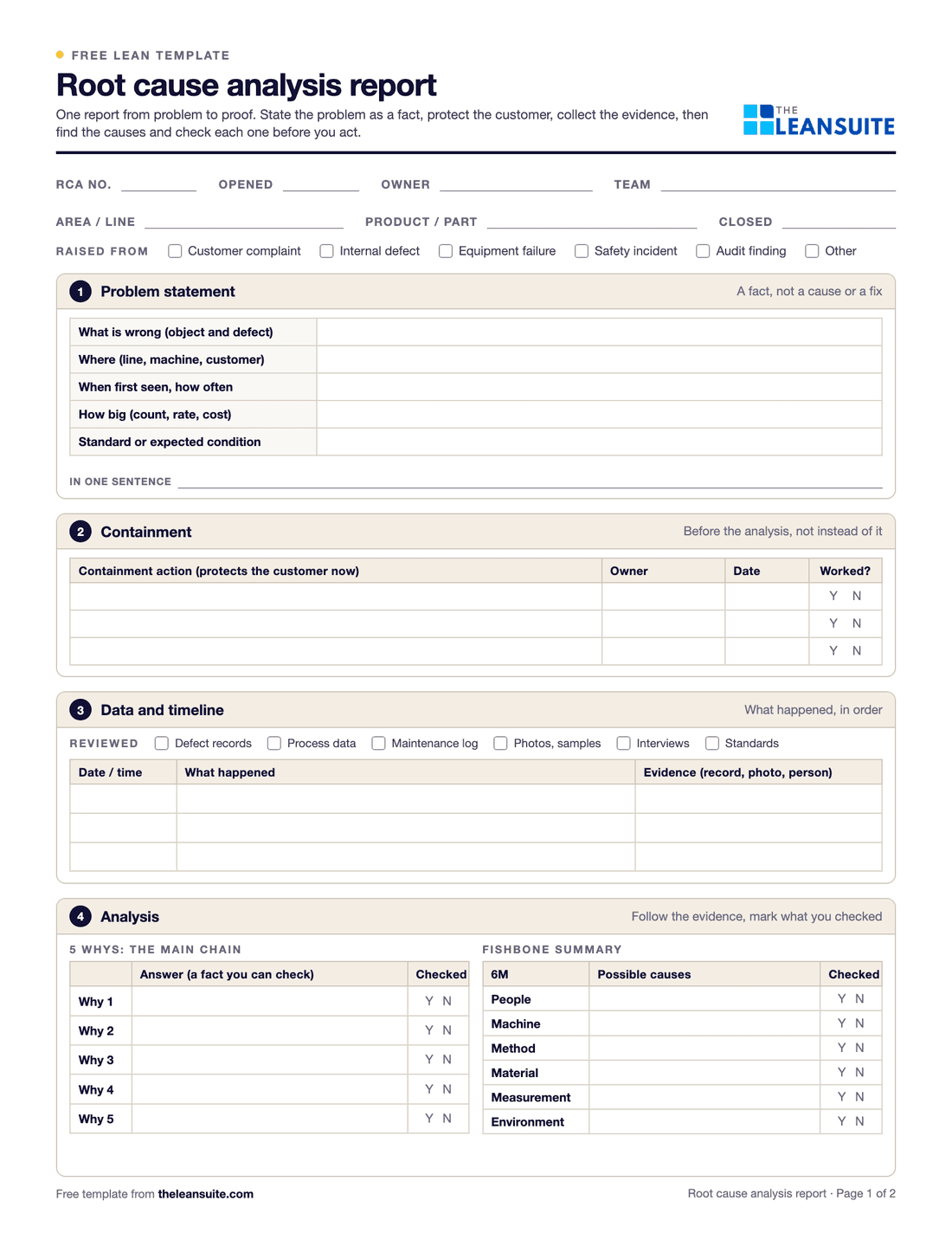 PDF and ExcelRoot cause analysis templateOne report from problem statement to proof: containment, evidence, analysis, verified causes, actions and the effectiveness check.
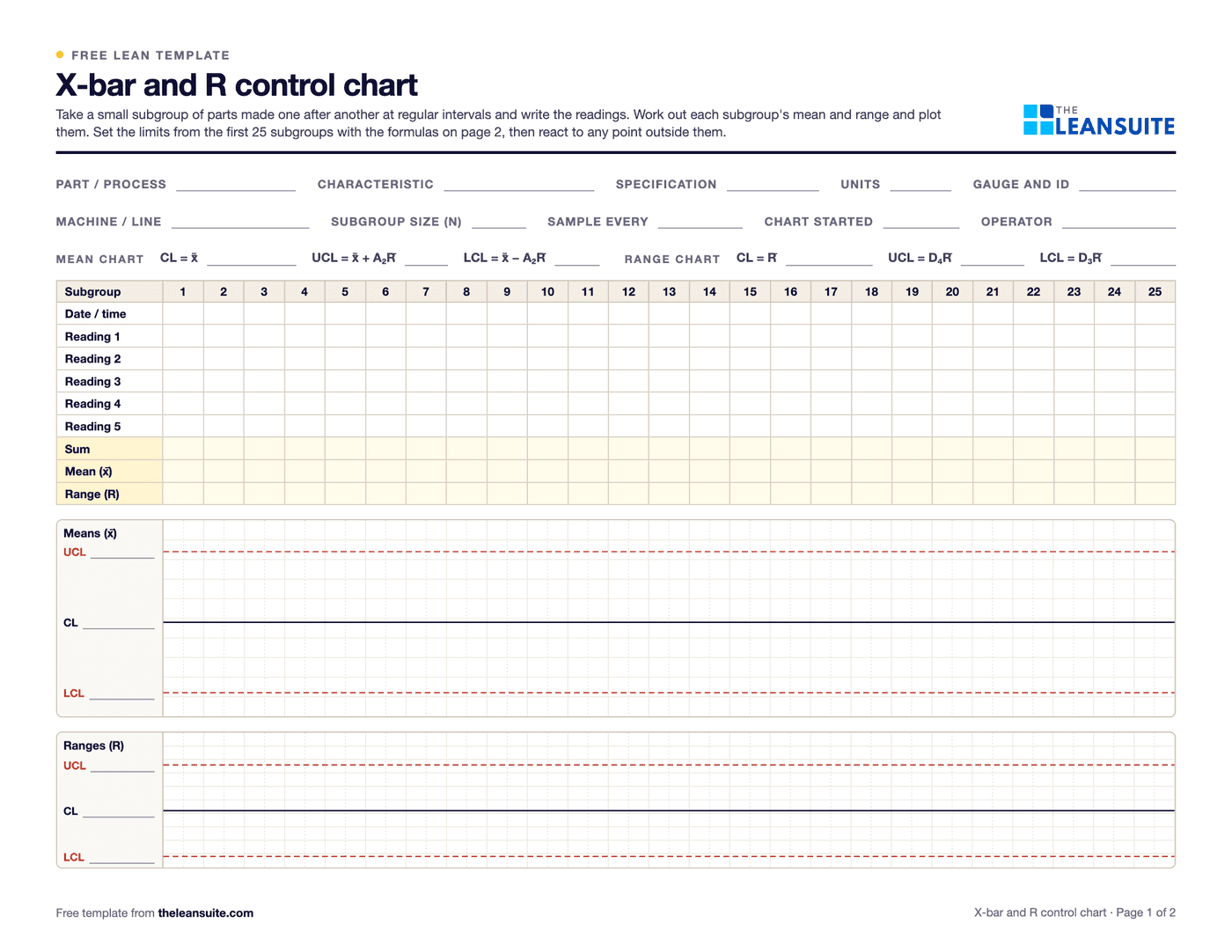 PDF and ExcelX-bar and R control chart template25 subgroups with means and ranges, control limits from A2, D3 and D4, signal flags, both charts and a reaction log.
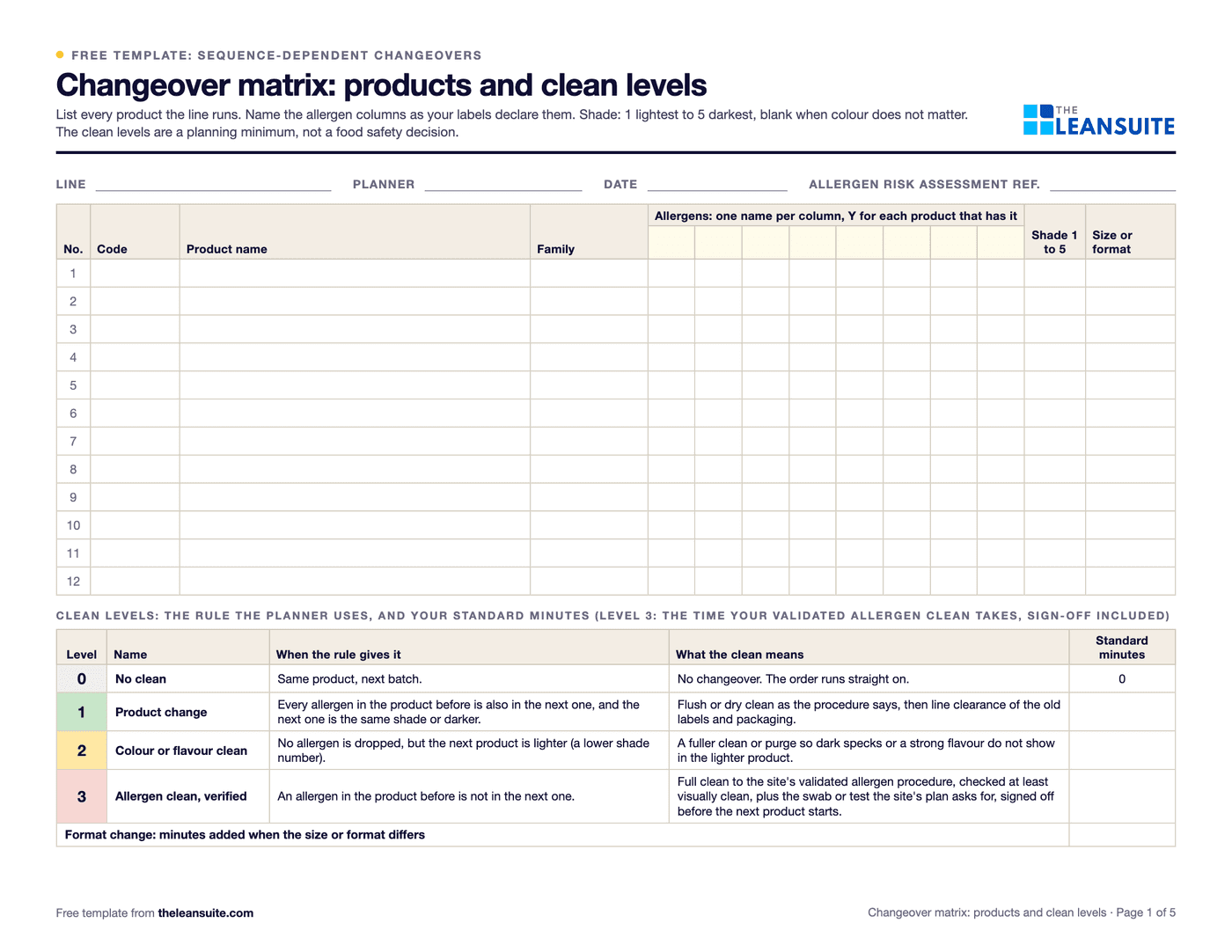 PDF and ExcelChangeover matrix templateA from-to matrix of changeover minutes with the clean each transition needs (allergen, colour, format), and a weekly planner that totals the order and suggests a shorter one.
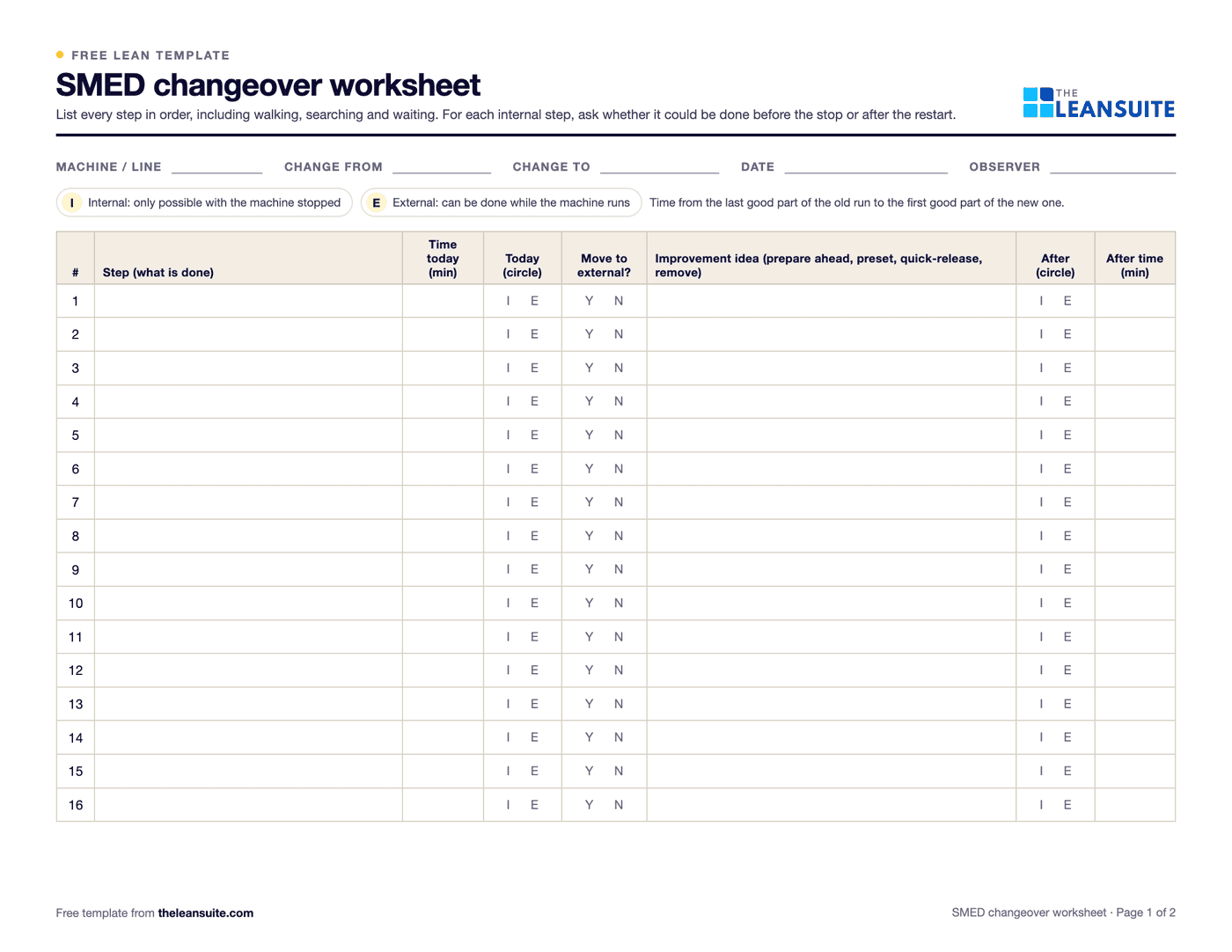 PDF and ExcelSMED changeover worksheetChangeover steps with times, internal or external, what can move, ideas and before/after totals.
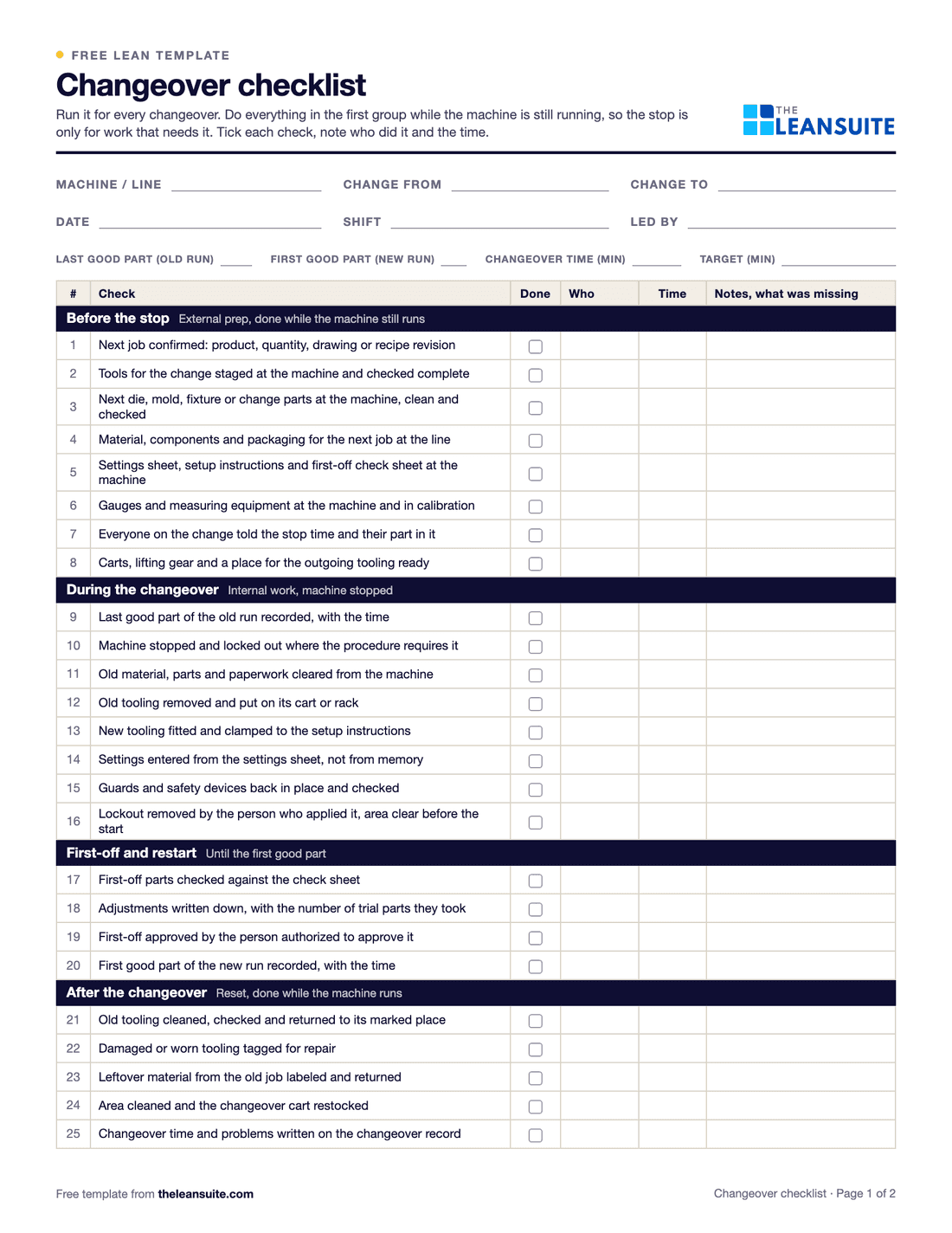 PDF and ExcelChangeover checklist25 checks for every changeover, a record of planned and actual times, and a log of changeover time against target.
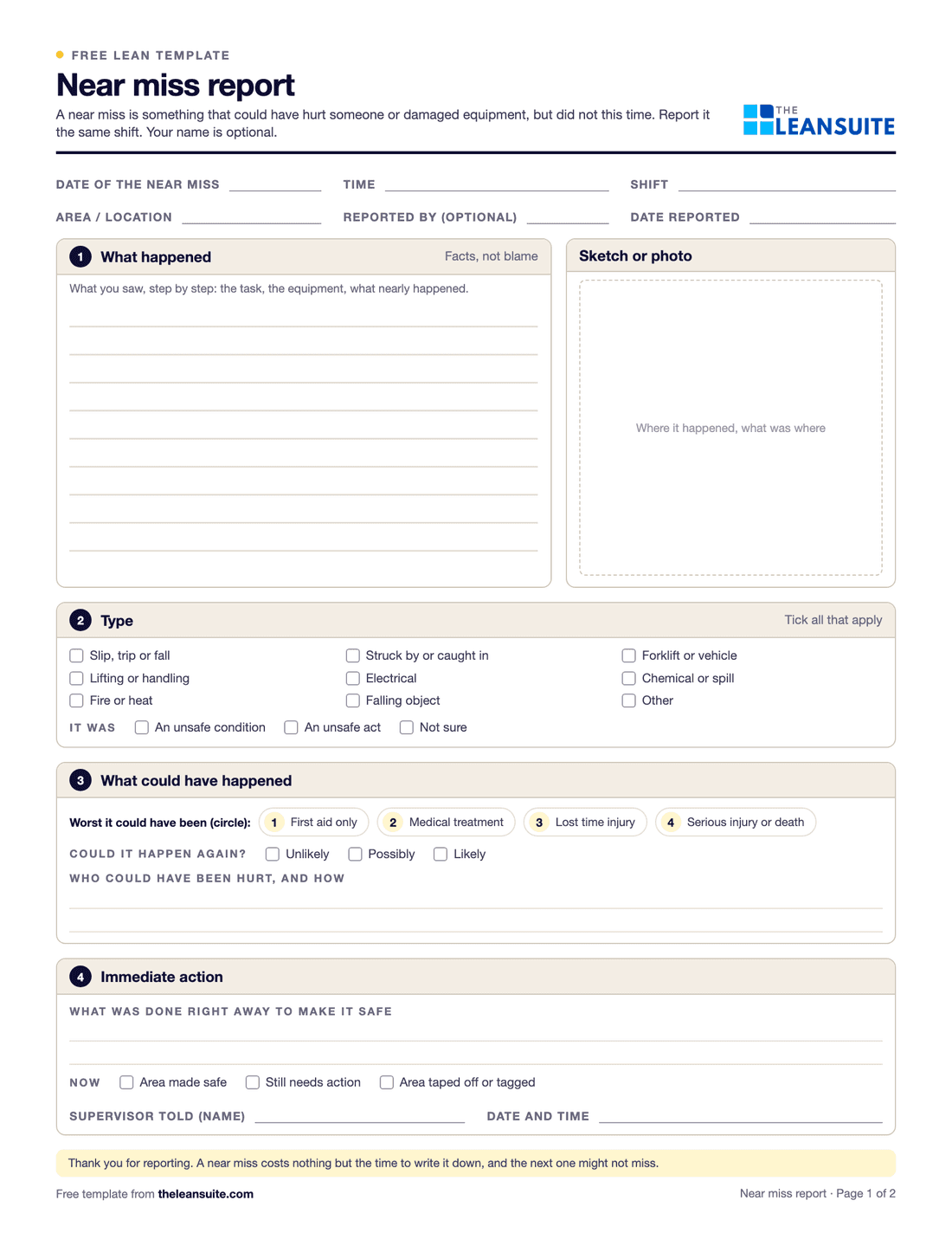 PDF and ExcelNear miss report formA two-page near miss report from the first report to closure, and an Excel log with status and days open.
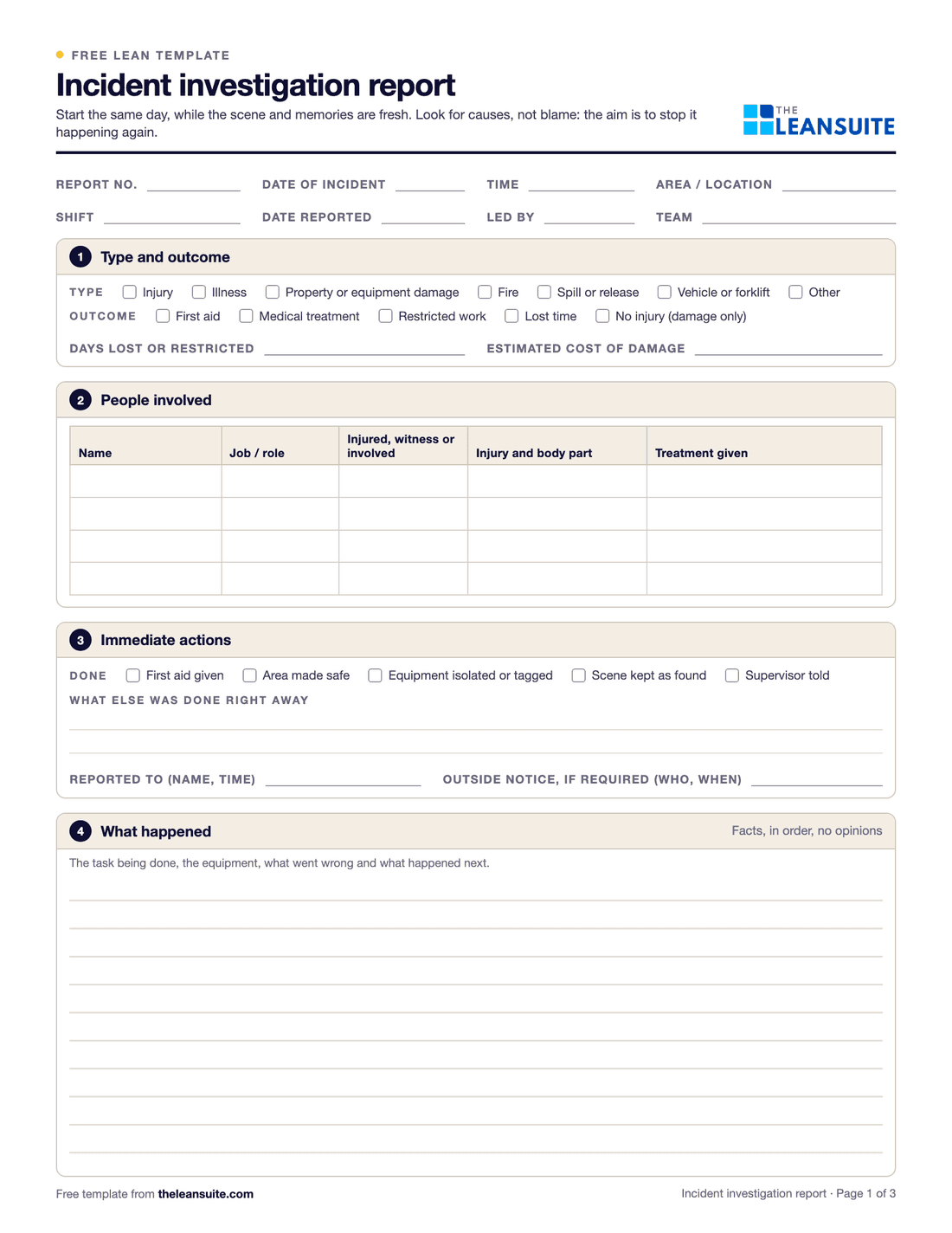 PDF and ExcelIncident investigation report templateFacts and a sourced timeline, causes at three levels, actions by the hierarchy of controls, a US recordkeeping screen and a closure check.
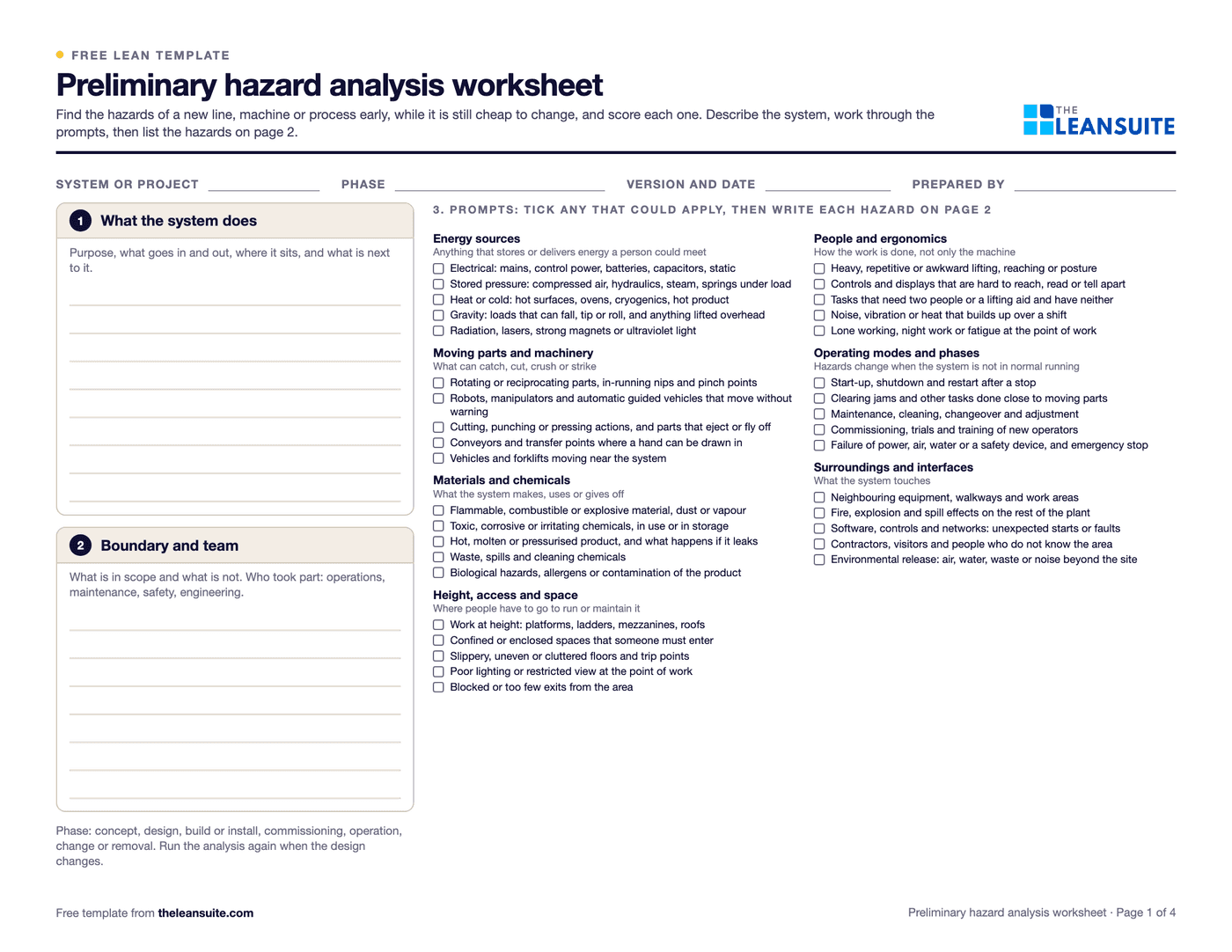 PDF and ExcelPreliminary hazard analysis (PHA) worksheetFind and score the hazards of a new line, machine or process before design is fixed, then choose controls and re-score.
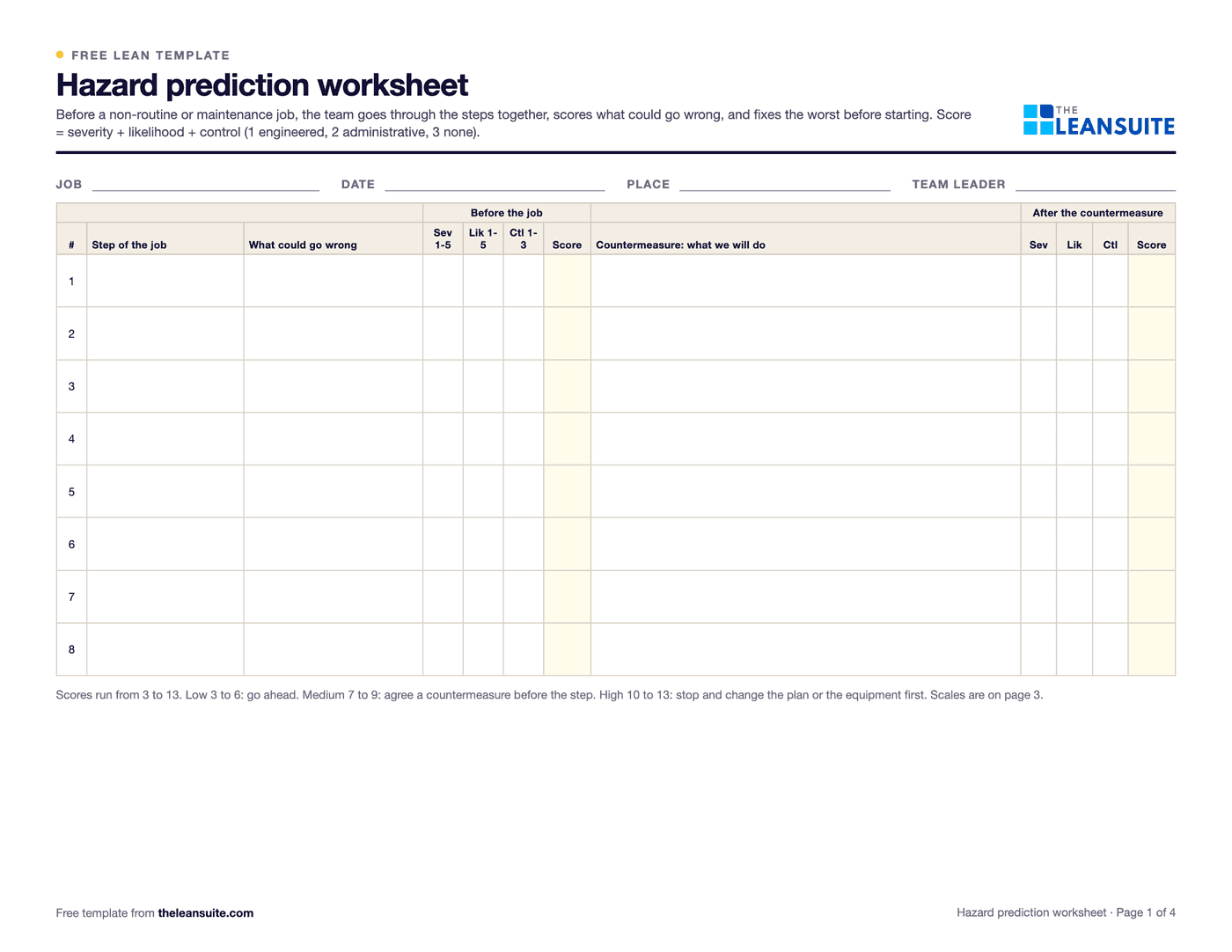 PDF and ExcelHazard prediction worksheetA pre-task worksheet: score what could go wrong at each step of a job, add a countermeasure and score again.
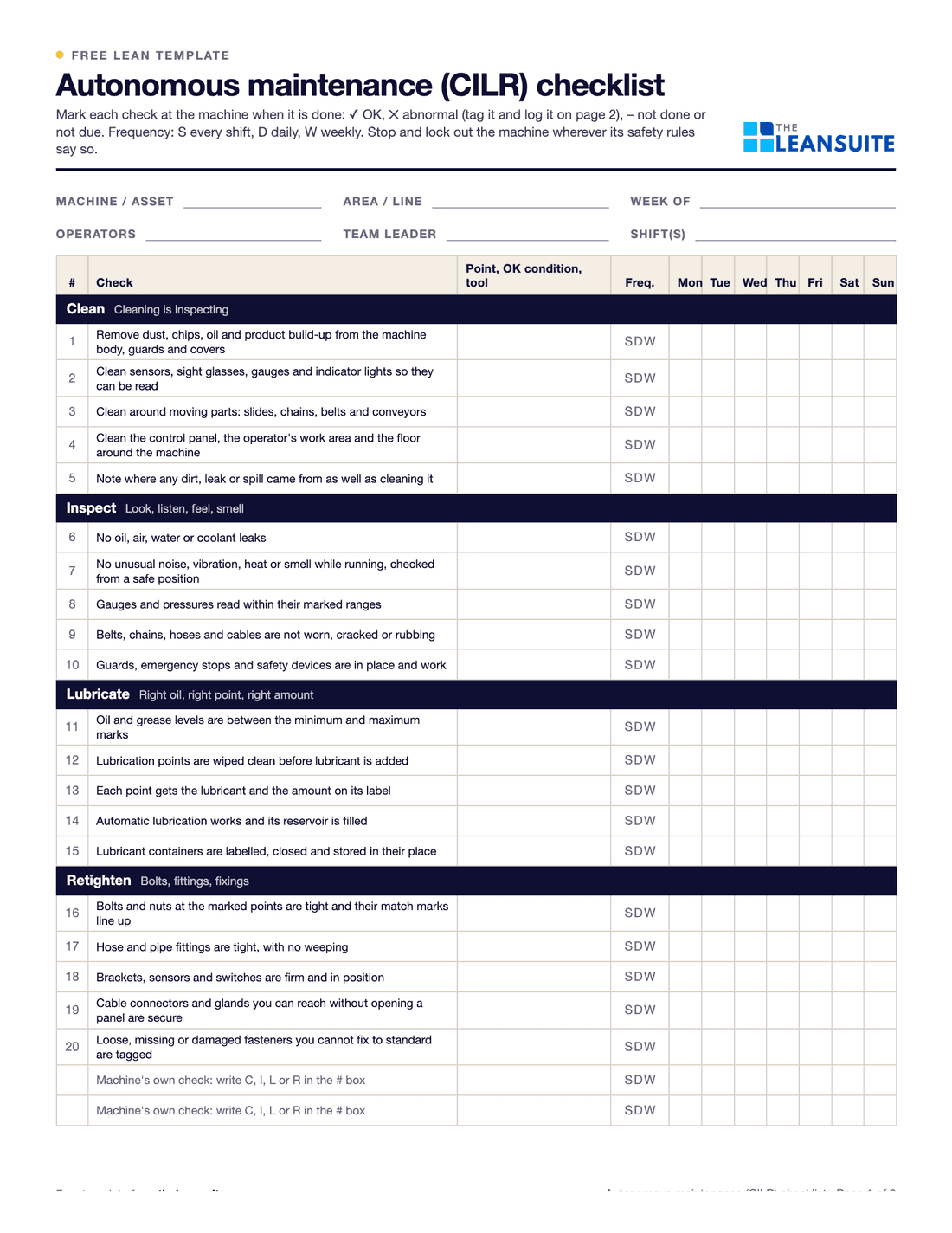 PDF and ExcelAutonomous maintenance (CILR) checklist20 clean, inspect, lubricate and retighten checks with a box per day, an abnormality log and sign-off.
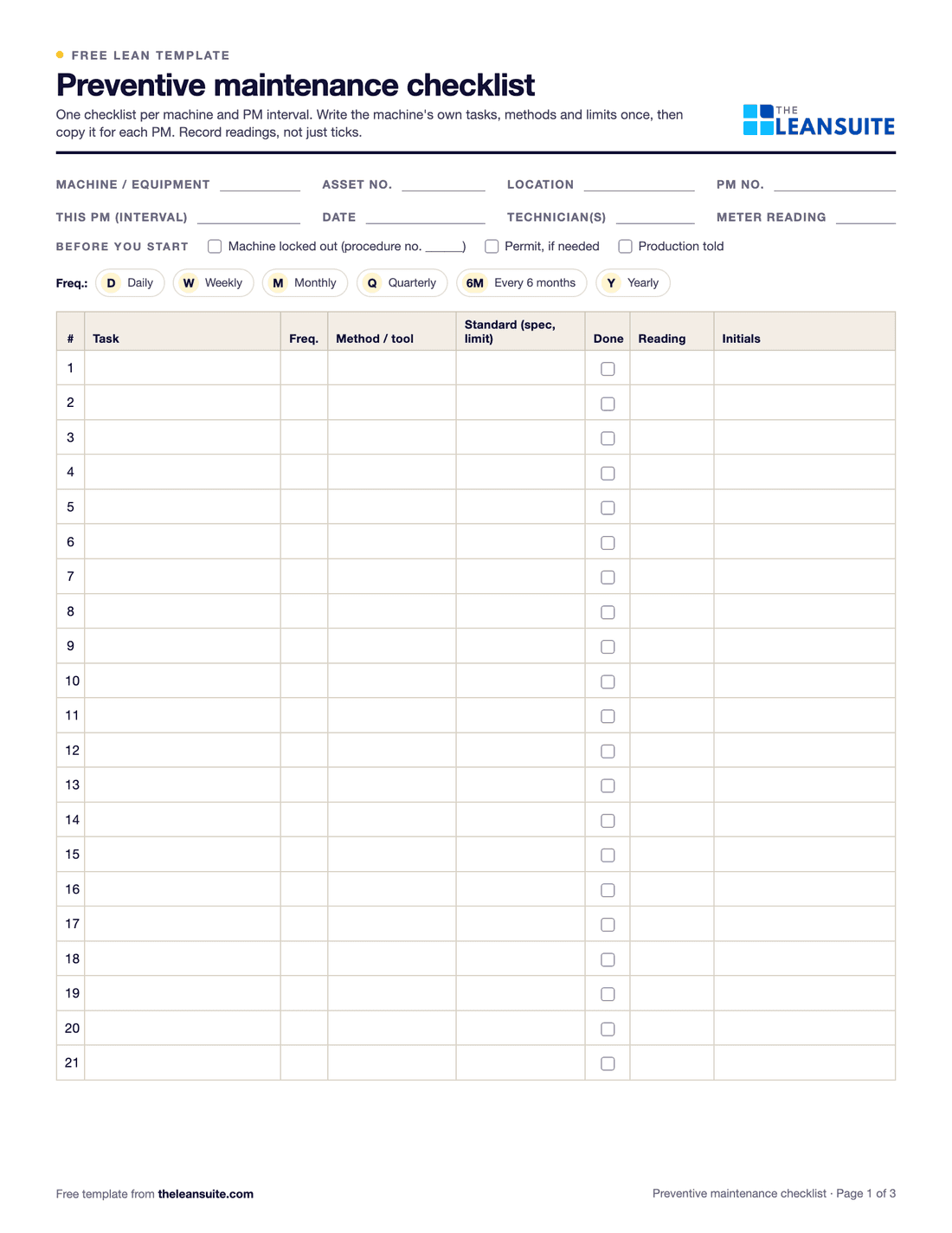 PDF and ExcelPreventive maintenance checklist templateA PM checklist per machine with readings and sign-off, and a PM schedule that works out the next due date.
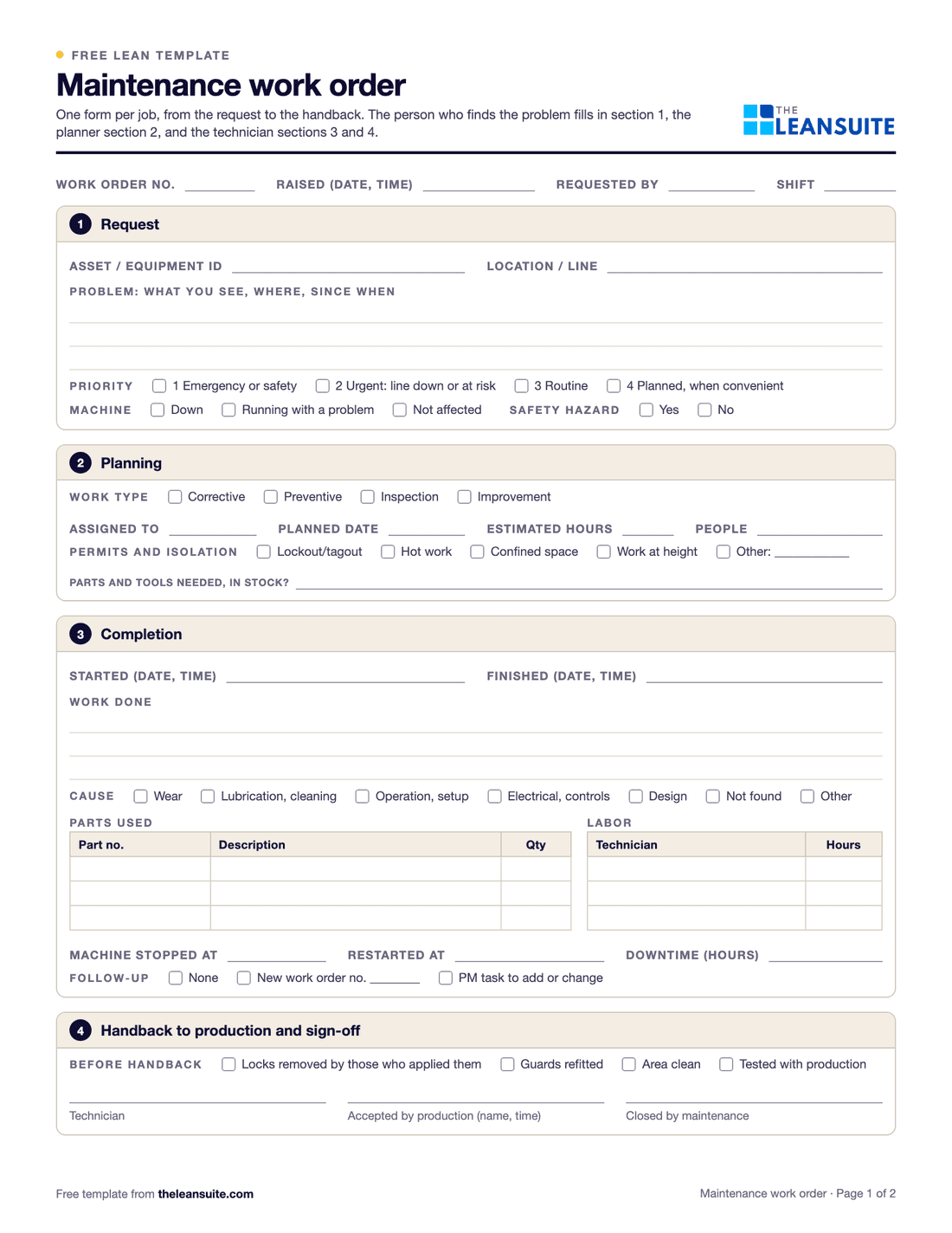 PDF and ExcelWork order template for maintenanceA work order template for maintenance: one form per job from request to handback, and a log of response, completion and backlog by priority.
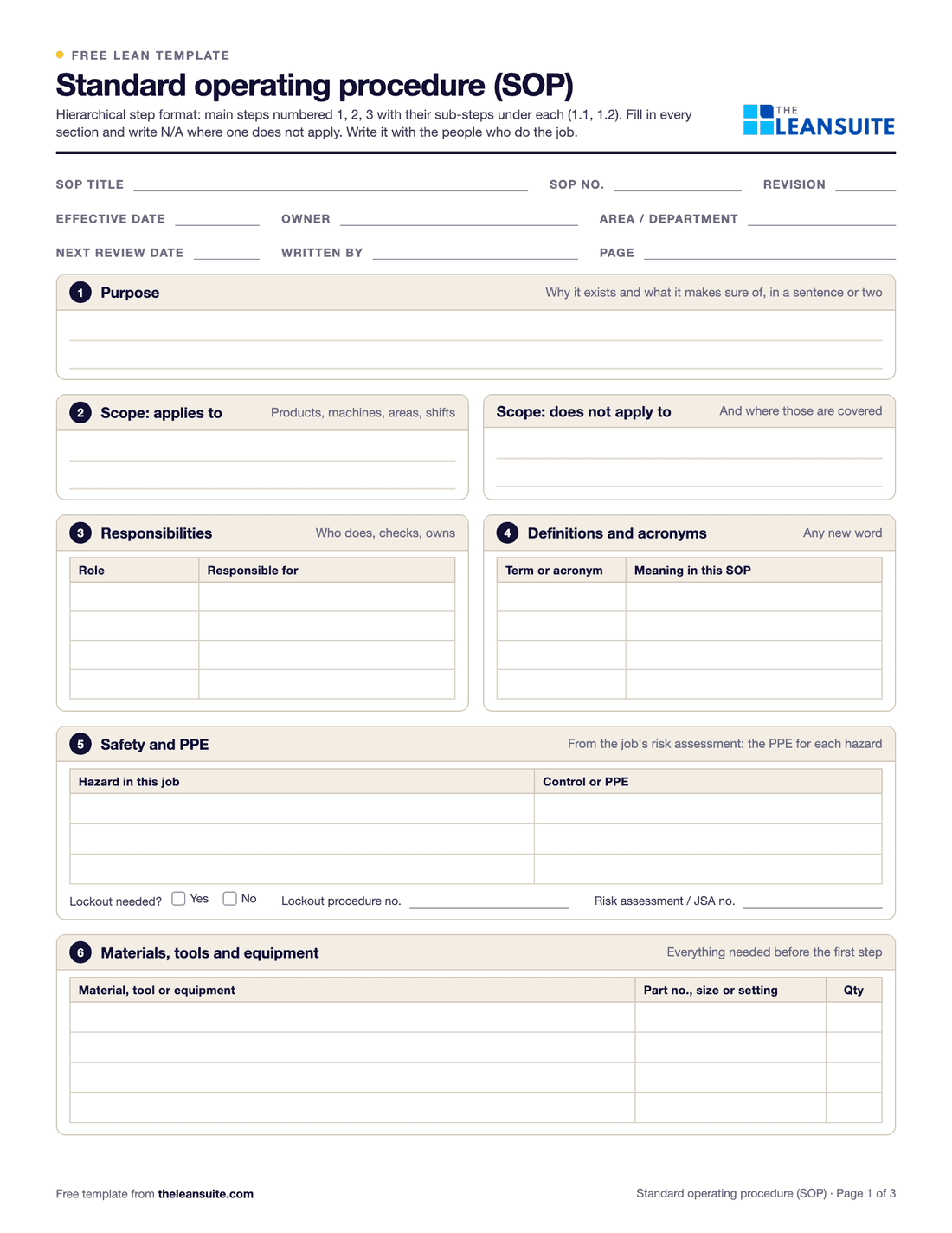 PDF and ExcelStandard operating procedure (SOP) templateA full SOP in the hierarchical step format, from purpose and scope to the steps, records, revision history and approvals, with review checks and an SOP register.
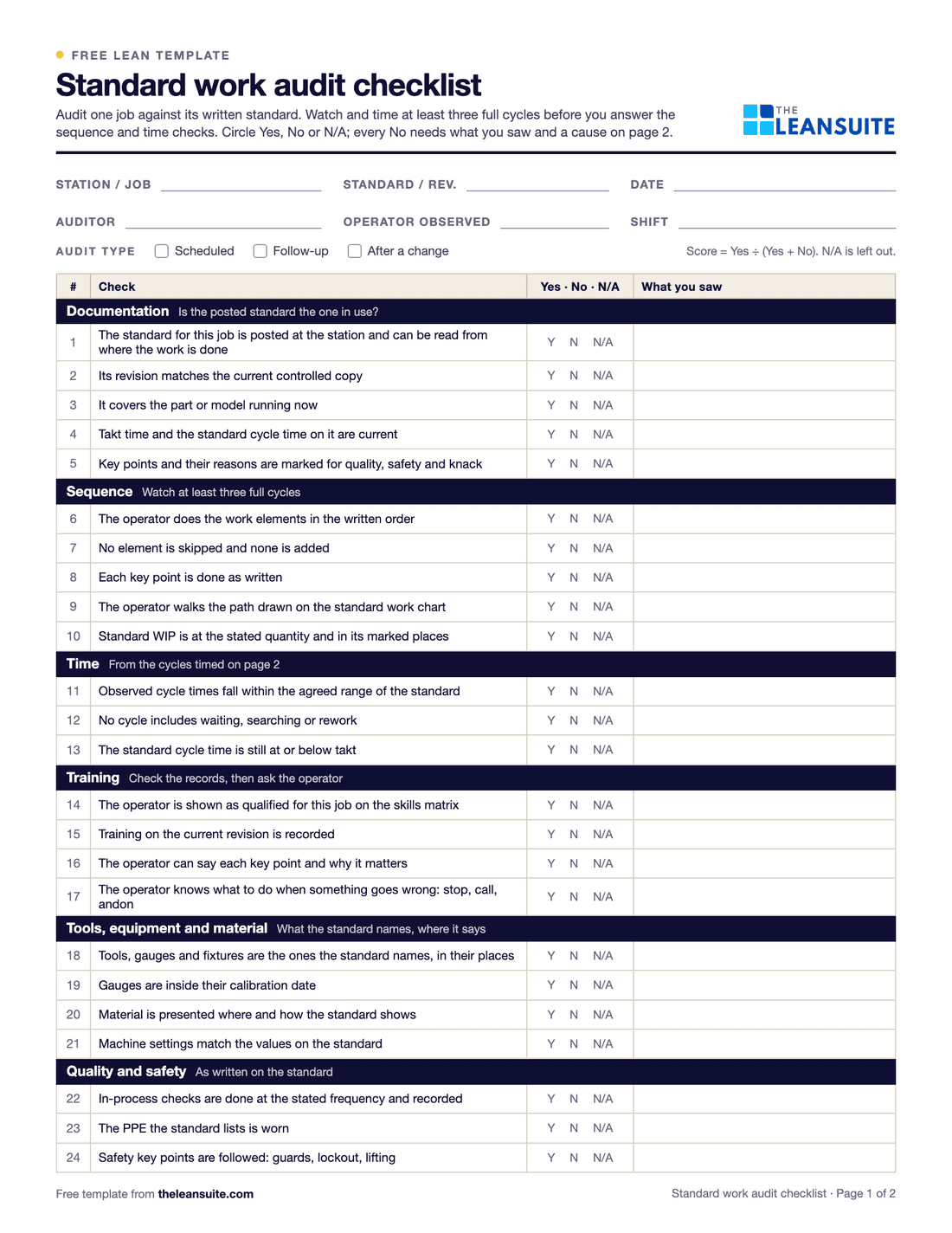 PDF and ExcelStandard work audit checklist24 checks of a job against its written standard, ten timed cycles, and each gap sorted by cause before anyone acts.
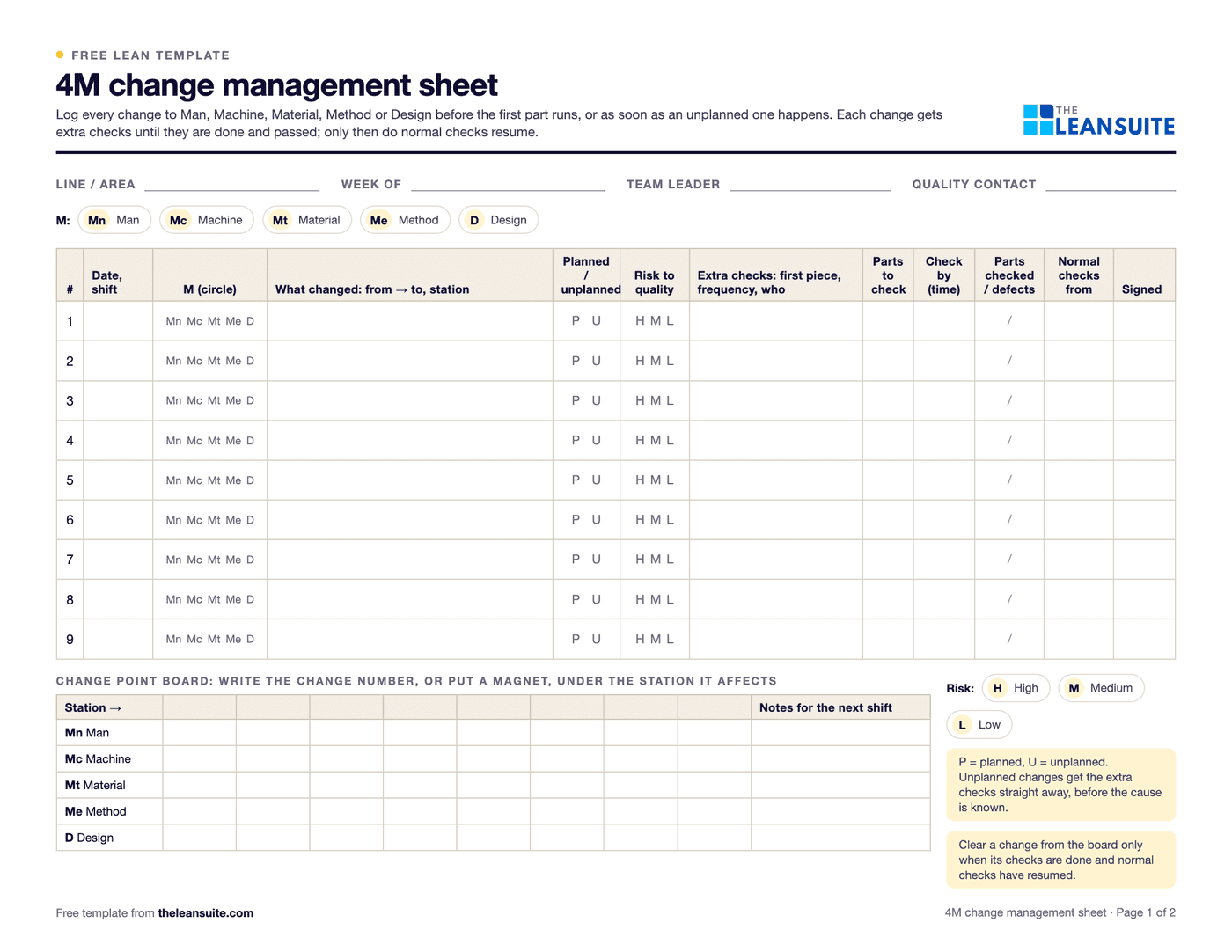 PDF and Excel4M change management sheet (change point)A shift log of every change to Man, Machine, Material, Method or Design, the extra checks after it and when normal checks resume, with a change point board.
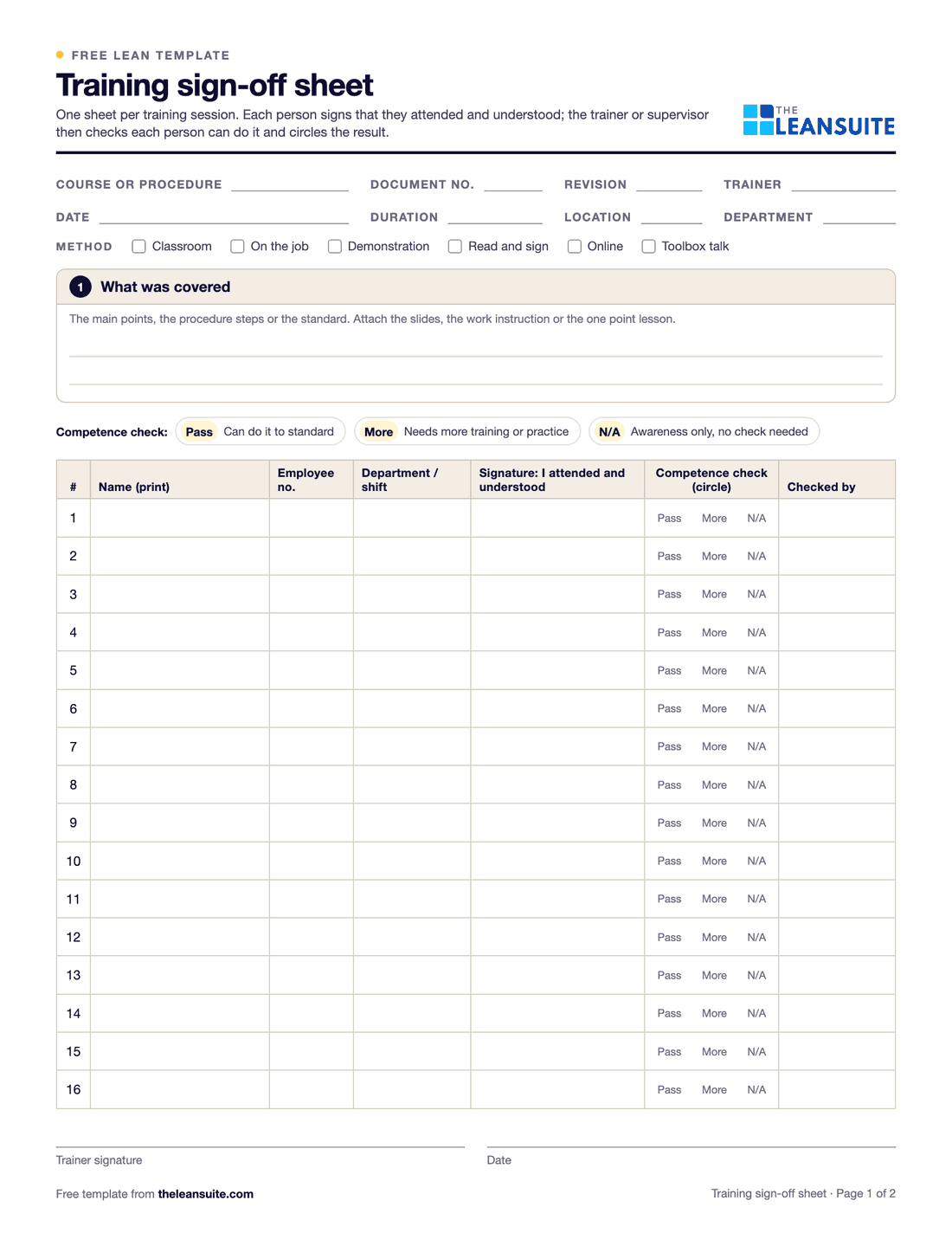 PDF and ExcelTraining sign-off sheetAn attendance and sign-off record where each person signs they understood, with a competence check and an Excel log.
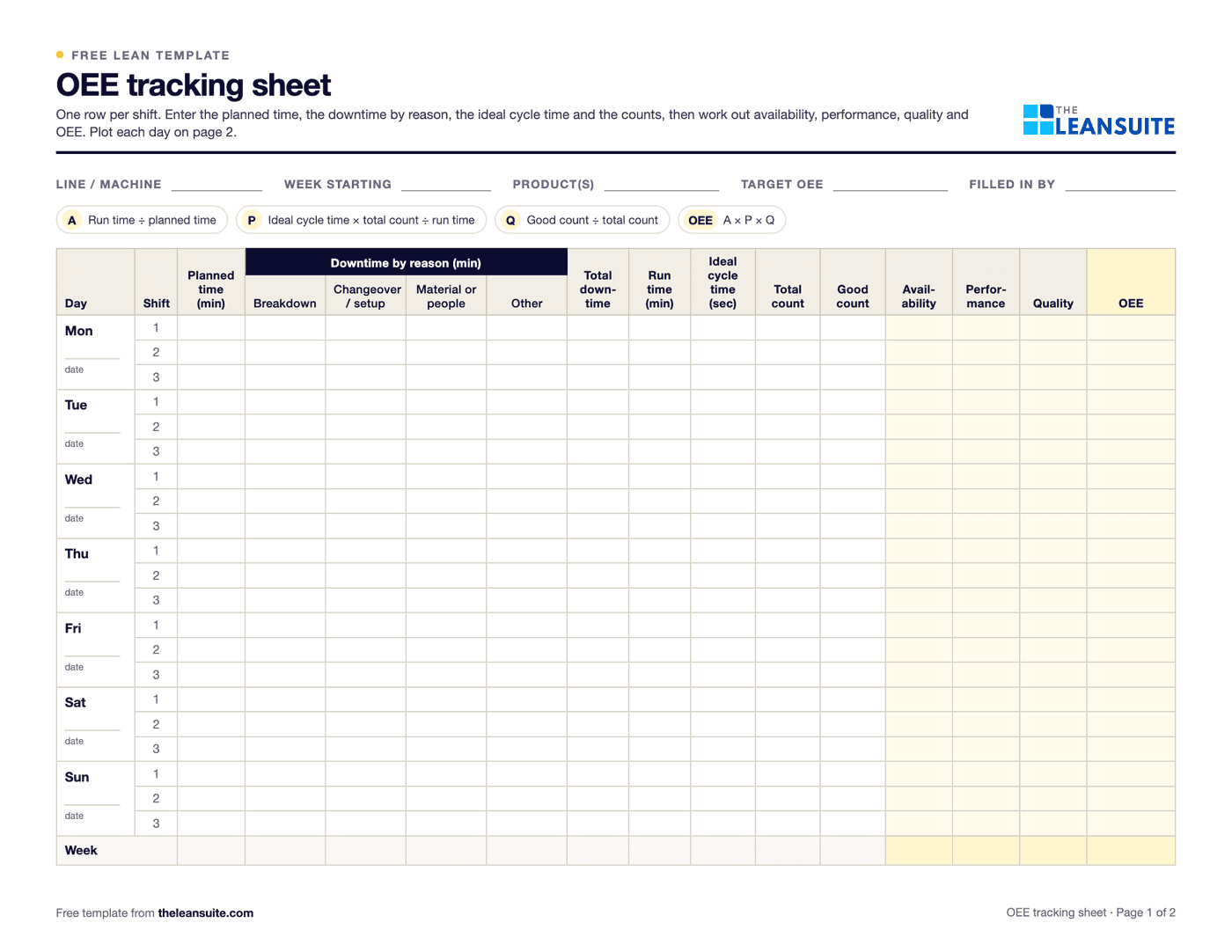 PDF and ExcelOEE tracking sheetOne row per shift for a week. The Excel version works out availability, performance, quality and OEE and charts the week.
Calculators (8)
- Free calculatorCycle time calculatorCycle time against takt, units per hour, capacity per shift and the gap to daily demand.
- Free calculatorBottleneck calculatorThe step that limits your line, from each step's cycle time, machines and uptime, with daily capacity and the gap to demand.
- Free calculatorSMED changeover calculatorTime saved by moving changeover steps from internal to external, capacity freed per week and the smaller batch it allows.
- Free calculatorRisk matrix calculatorSeverity times likelihood on a 3 x 3, 4 x 4 or 5 x 5 risk matrix, the band and its action, editable banding, and the score after further controls.
- Free calculatorMTBF and MTTR calculatorMean time between failures, mean time to repair and availability from operating time, failures and repair time.
- Free calculatorOEE calculatorOverall equipment effectiveness from shift time, downtime, ideal cycle time and part counts.
- Free calculatorDowntime cost calculatorWhat an hour, an event and a year of unplanned downtime cost, from lost output, idle labour, scrap and overtime.
- Free calculatorTRIR and DART rate calculatorOSHA recordable and DART incident rates from your 300A case counts and hours, and what one more case does to them.
Buyer's guides
LeanSuite pages for these problems
- Micro-stops
- Loss & Cost Management
- Kaizen & Projects
- Non-Conformance (NCR)
- Quality Prioritization Matrix
- Near Miss Reporting
- Lockout/Tagout (LOTO)
- Audit Management
- SMED
- Checklists
- AI SOPs
- Competency Management
- CILR Checklists
- Professional Maintenance Tags
- Autonomous Maintenance
How LeanSuite handles each of these is on the page for chemical plants.
Whirlpool tackled project visibility and continuous improvement across 14 manufacturing plants with LeanSuite. Read the Whirlpool case study.
FAQ
Lean in chemical plants: common questions
OSHA's standard for preventing catastrophic releases of highly hazardous chemicals, 29 CFR 1910.119. It applies to processes that hold listed chemicals, or flammable liquids or gases, above threshold quantities, and it has 14 elements, from process hazard analysis and operating procedures to mechanical integrity, management of change and incident investigation.
PSM is OSHA's rule and protects workers inside the plant. EPA's risk management program rule, 40 CFR 68, covers sites that hold listed substances above threshold quantities and looks at harm to the public and the environment outside the fence. It adds an off-site hazard assessment, an emergency response program and a risk management plan filed with EPA, and its prevention program for the highest tier closely follows PSM.
Record every step of every batch on the bottleneck reactor for a few weeks, including the waits. Compare the median batch with the best one step by step: the gap is usually waiting and different practice between shifts, not chemistry. Standardize the best practice, stage materials and cut the wait for lab results, and change the recipe only through your management of change.
Batches that meet specification at the first test, with no additions, blending or rework, divided by all batches made, per product. Record the reason for every batch that misses, by product and by step, so the most common causes stand out.
Yes, with the focus on the bottleneck vessel, batch consistency, cleanouts, filling-line losses and the care of pumps and seals. Lean never bypasses process safety: any change to equipment, chemistry or procedures goes through the plant's management of change before it is made.
Batch cycle time on the bottleneck, right-first-time batches, yield, filling-line OEE, process-safety events by tier, the recordable injury rate and PM compliance. Keep process-safety events separate from injuries: a low injury rate says little about the risk of a release.
See LeanSuite on your rounds, batches and near misses
Bring the routine you want to fix first. We will show you how LeanSuite handles it and what a 90-day pilot would cover.