

Lean playbook · Aerospace and defense
Lean playbook for aerospace and defense plants
Short answer
Start lean in an aerospace plant on one cell or assembly line, with losses you can count. Good ones are FOD findings, days that nonconformances wait for MRB, first pass yield and hours per unit against the learning curve. Clean-as-you-go and tool control prevent FOD. A fixed MRB rhythm clears the backlog, and standard work with job instruction brings hours per unit down. Change nothing under a frozen process, a first article or a customer approval without going through your quality system first.
Last updated:
7 problems on the floor, and the lean methods for each
Each problem says what it looks like, which methods address it, the first moves to make and the number to watch. Pick the one or two that cost your plant most; you do not need all of them at once.
Where an aerospace build from detail parts to buy-off loses time and quality
Detail parts: machining, sheet metal and composites
Special processes: heat treat, NDT and coating
Test, first article and buy-off
Across the whole line
Foreign object debris
Rivets, swarf, safety wire, caps and lost tools end up in assemblies, ducts and engine areas. FOD is found at inspection or, worse, in service, and the source is hard to trace once the area has moved on to the next unit.
Lean methods
In LeanSuite
Build the FOD walk in Lean Creator, or let the AI draft it, and schedule it in Daily Standard Work to a person, a role or a machine, with a repeat rule.
First moves
- Name the FOD-critical areas, mark their boundaries and post the rules at each entrance.
- Clean as you go: a sweep and a check at the end of each task and each shift, not only before inspection.
- Run a short FOD walk in each area every shift and photograph what is found.
- Trend findings by type and area, and fix the source of the top one each month.
Number to watch: FOD findings per walk by type and area, and FOD found at inspection or by the customer.
First article inspection (AS9102)
A new part number, a design change, a new source, process, location or tooling, or a long lapse in production calls for a first article inspection. Every characteristic on the drawing is ballooned and measured, and material and special process certifications are checked. The part waits while it is done, and one missed characteristic sends it back.
In LeanSuite
Build the first article check in Lean Creator as a checklist with number limits, required photos and signatures.
First moves
- Balloon the drawing first and number every characteristic, including notes, finishes and materials.
- Plan who measures what, and with which gauge, before the part is made, so the inspection does not wait for a gauge.
- Check material and special process certifications against the drawing as they arrive, not at the end.
- For a partial first article after a change, list the characteristics the change affects and inspect those.
Number to watch: First article pass rate first time, and days from first part made to first article accepted.
Nonconformances waiting for MRB
A nonconforming part is tagged and moved to the MRB area, where it waits for quality, engineering and sometimes the customer to agree a disposition: use as is, rework, repair or scrap. When the board meets irregularly, parts wait for days, and the same nonconformance returns on the next lot.
Lean methods
In LeanSuite
Each non-conformance is captured with photos and routed to quality and engineering.
First moves
- Hold a short MRB meeting at a fixed time, daily or several times a week, with quality and engineering present.
- Contain first: segregate, count and check work in progress and stock before looking for the cause.
- Record each disposition with its reason, and send repeat nonconformances to a corrective action, not just another disposition.
- Track every open NCR by age, and review the oldest at each meeting.
Number to watch: MRB cycle time, from NCR raised to disposition, and repeat NCRs per part number.
Missed steps on long travelers
A traveler can run to hundreds of operations, inspection points and stamps. Steps are missed, done out of order or stamped later from memory, and work instructions drift from the drawing after an engineering change.
In LeanSuite
Film the job once and LeanSuite drafts the work instruction with numbered steps, photos, tools, PPE and warnings from the video.
First moves
- Split long operations into short steps with a clear end point, so a stopped job restarts in the right place.
- Put key points, torque values and inspection holds in the instruction itself, where the mechanic reads them.
- Update the instruction in the same change as the drawing, and brief the people who do the work.
- Check a sample of open travelers each shift with a short layered audit.
Number to watch: Traveler errors found at inspection or audit, per unit.
Tool control and shadow boards
Every tool taken to the assembly has to come back before the job closes, and a missing one can stop work until it is found. Shadow boards, tool checks at shift start and end and calibration dates only work if the check is done every time.
Lean methods
In LeanSuite
Schedule tool checks at the start and end of every shift as checklists with pictures and videos for each step.
First moves
- Give each tool a place on a shadow board or a foam tray, with an ID on the tool.
- Check the board at the start and end of each shift and each job, and sign it off.
- Treat a missing tool as a stop: search before the area is closed up or the unit moves.
- Keep calibration due dates on the tool and on one list, and pull overdue tools from use.
Number to watch: Tool checks done on time, and missing-tool events per month.
Hours per unit above the learning curve
Each unit takes hundreds of labor hours and only a few are built each month, so people rarely repeat a job often enough to settle the best method. Hours per unit fall more slowly than the bid assumed, and no one can see which steps lose the time.
In LeanSuite
Film the process on a phone and LeanSuite times every element, splits value-added from waste and links each figure to its video frame.
First moves
- Plot actual hours per unit against the learning curve used in the bid, unit by unit.
- Time study the steps with the biggest gap, ideally from video, so the method can be watched again.
- Write the best method down as standard work and train it with job instruction before the next unit.
- Rebalance the work between stations or shifts when the build rate changes.
Number to watch: Hours per unit against the learning curve, by unit number.
Work held by a few certified people
Special processes, NDT, wiring, sealing and torque-critical tasks are limited to people with current certifications or stamps. When a certified mechanic or inspector is out, the job waits, and certificates that have lapsed are found at audit.
Lean methods
In LeanSuite
Competency Management keeps a live skills matrix whose levels update as people complete training and on-the-job sign-offs.
First moves
- List the tasks that need a certification or stamp and who holds each one, with expiry dates, by shift.
- Mark the tasks with fewer than two current holders per shift and plan training for those first.
- Pair trainees with certified people on real units and sign them off on the job.
- Put renewals on a calendar a few months before each certificate expires.
Number to watch: Tasks with at least two people holding a current certification on every shift.
More small fixes in the production, quality and safety sections of the kaizen idea bank.
A 90-day starting plan
One line or product family, two problems, measured before and after. The point of the first 90 days is a result the plant believes and a method it can repeat, not a plant-wide program.
The 90 days, with the gate that ends each stage
- Days 1 to 30See the losses on one cell or lineDone when: You have baseline numbers on the board and two problems with an owner each.
- Days 31 to 60Fix the top two lossesDone when: Each fix has a written standard and a before-and-after number.
- Days 61 to 90Make it stick, then spread itDone when: The gains have held for a month and the next cell or line has its baseline.
Days 1 to 30
See the losses on one cell or line
Pick one cell or assembly line and get a true baseline before changing anything.
- Choose one cell or assembly line, and name a lead and a sponsor.
- Measure for two weeks: FOD findings, open NCRs and their age, first pass yield, traveler errors and hours per unit against the learning curve.
- Start a 15-minute meeting at the area board at the start of each shift.
- Check the skills matrix: which certified tasks have fewer than two people per shift.
- Choose the two biggest losses to work on first.
Days 31 to 60
Fix the top two losses
Run focused improvements on the two problems and check them against the baseline.
- Start the shift FOD walk and the tool checks, and photograph every finding.
- Set a fixed MRB rhythm and work the oldest NCRs first.
- Time study the steps with the biggest gap to the learning curve and write the best method down as standard work.
- Bring quality into each change, so nothing under a frozen process or a first article changes without approval.
Days 61 to 90
Make it stick, then spread it
Check the new standards hold on every shift, then copy them to the next cell or line.
- Audit the new standards on every shift with short layered audits.
- Train and sign off mechanics on the changes, and close the certification gaps found in days 1 to 30.
- Compare the area's numbers with the baseline and share the result with the plant.
- Pick the next cell or line, copy what worked and start again at day one.
The KPIs to track
Track them per line and shift, on a board the team sees every day. Set targets from your own baseline, not from someone else's plant.
| KPI | What it tells you | How to measure it | Free help |
|---|---|---|---|
| First pass yield | The share of units or operations accepted at inspection the first time. | Units accepted first time divided by units inspected, per operation or per unit. | First pass yield (FPY) calculator |
| Escapes | Defects that got past your inspection and were found by the customer or in service. | Nonconformances reported by the customer each month, against the units delivered that month. | 8D report template |
| FOD incidents | Whether FOD prevention works where it matters, not just on the walks. | FOD found at inspection, test or by the customer each month, shown beside the walk findings. | Visual management audit checklist |
| MRB cycle time | How long nonconforming parts wait for a decision. | Days from NCR raised to disposition, as an average and as the age of the oldest open NCR. | Non-conformance report (NCR) form |
| Hours per unit against the learning curve | Whether labor hours fall as fast as the plan assumed. | Actual hours for each unit divided by the hours the learning curve gives for that unit number. | Learning curve and ramp-up workbook |
| On-time delivery | Whether the losses above reach the customer as late units. | Units or orders delivered by the contract date divided by those due, per month. | - |
| Certified coverage | Whether every certified task can be staffed on every shift. | Tasks with at least two people holding a current certification per shift, from the skills matrix. | Skills matrix template |
By the numbers
Public figures for this industry or for the wider sector it belongs to, each linked to the report or government table it comes from and checked against it on October 3, 2026. More in our lean manufacturing statistics and benchmark charts.
3.2
Transportation equipment manufacturing, the BLS group that includes aerospace products and parts, recorded 3.2 injury and illness cases per 100 full-time workers in 2024, against 2.7 for all manufacturing and 2.3 for all private industry.
Total recordable cases per 100 full-time workers, U.S. private industry, 2024 data from the Survey of Occupational Injuries and Illnesses. This BLS group (NAICS 336) also covers motor vehicles, ships and railroad equipment, not only aerospace.
Source: U.S. Bureau of Labor Statistics, Table 1. Incidence rates of nonfatal occupational injuries and illnesses by industry and case types, 2024 (2024 data, table updated January 22, 2026)
16×
Plants in the top quarter for relying on reactive maintenance had 3.3 times more downtime and 16 times more defects than plants in the bottom quarter.
Same NIST survey. NIST notes the link is an association, not proof of cause.
Source: NIST, Economics of Manufacturing Machinery Maintenance: A Survey and Analysis of U.S. Costs and Benefits (NIST AMS 100-34) (June 2020)
Injury and illness rate by industry, 2024
- Motor vehicles5.6
- Beverage and tobacco3.7
- Furniture3.5
- Food3.3
- Primary metals3.3
- Nonmetallic mineral products, incl. glass3.3
- Fabricated metal products3.2
- Transportation equipment3.2This industry
- Motor vehicle parts2.9
- Plastics and rubber products2.8
- HVAC and refrigeration2.4
- Paper2.4
- Machinery2.3
- All private industry2.3
- Electrical equipment and appliances2.0
- Printing1.6
- Chemicals1.6
Total recordable cases per 100 full-time workers, 2024: Motor vehicles 5.6, Beverage and tobacco 3.7, Furniture 3.5, Food 3.3, Primary metals 3.3, Nonmetallic mineral products, incl. glass 3.3, Fabricated metal products 3.2, Transportation equipment 3.2, Motor vehicle parts 2.9, Plastics and rubber products 2.8, All manufacturing 2.7, HVAC and refrigeration 2.4, Paper 2.4, Machinery 2.3, All private industry 2.3, Electrical equipment and appliances 2, Printing 1.6, Chemicals 1.6.
Free templates, calculators and buyer's guides
Templates (23)
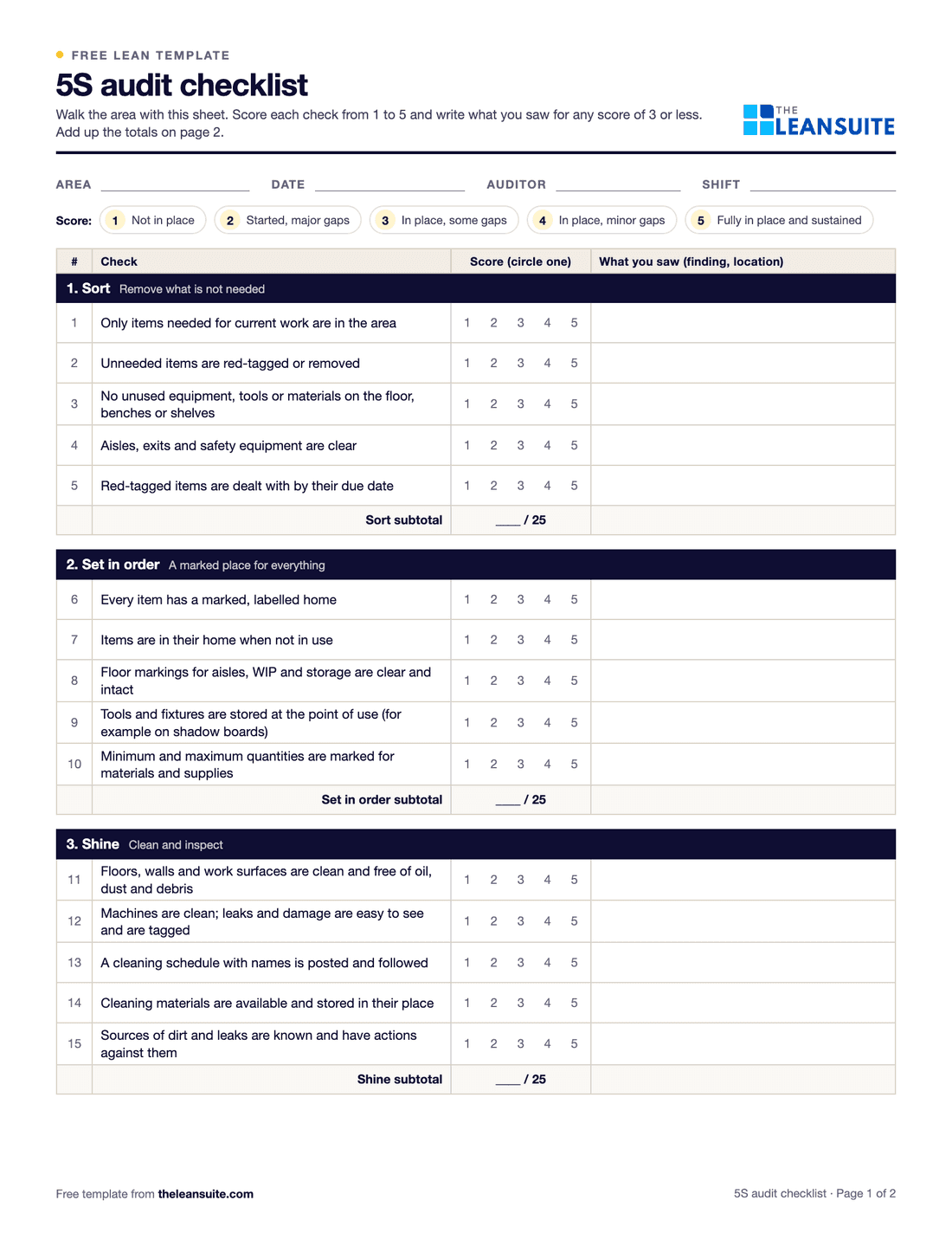 PDF and Excel and Word5S audit checklist template25 checks, five per S, scored 1 to 5, with a score summary and a chart of the five S's.
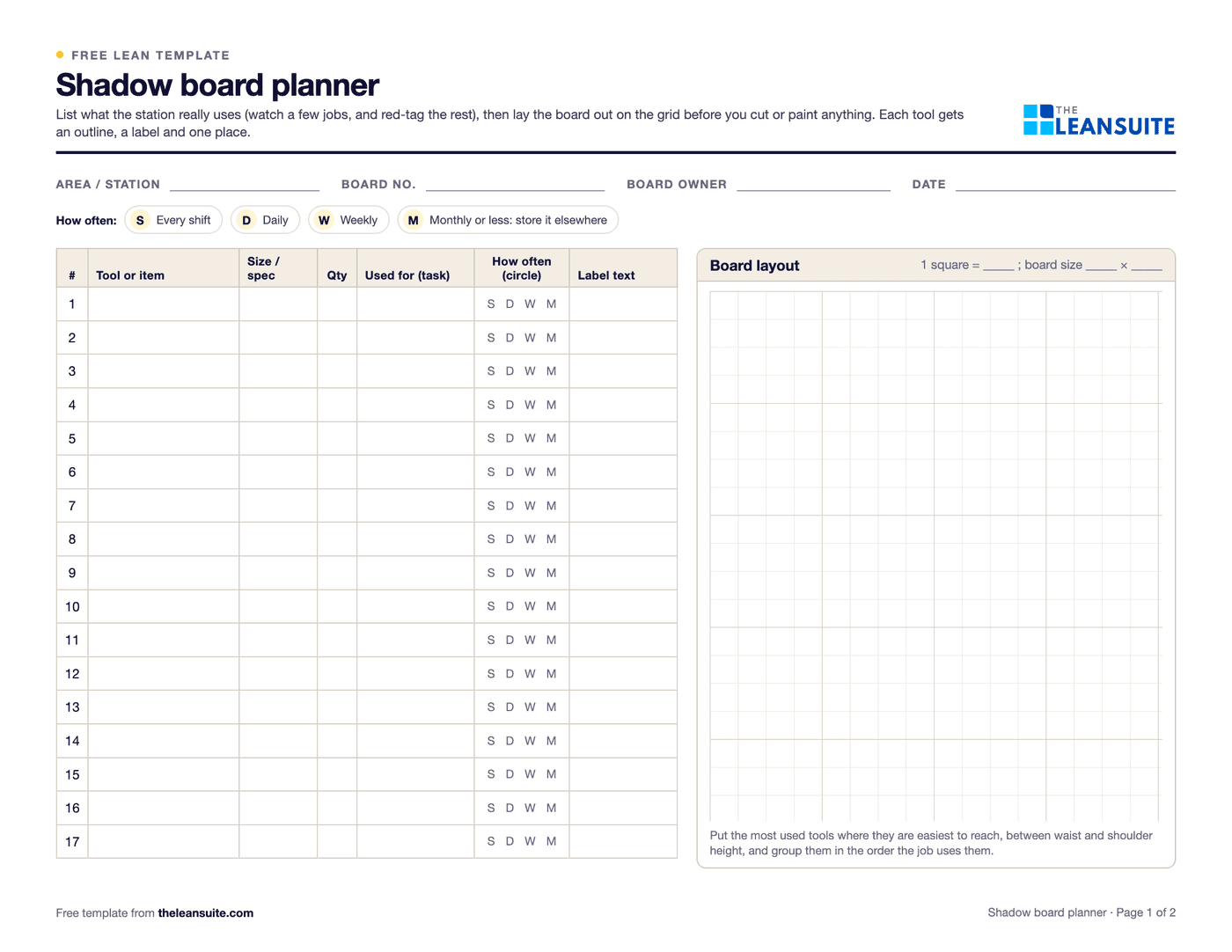 PDF and ExcelShadow board plannerTool inventory with fetch time, a layout planned from each tool's outline size, a month of daily checks with 5S audit evidence, and a missing tool log.
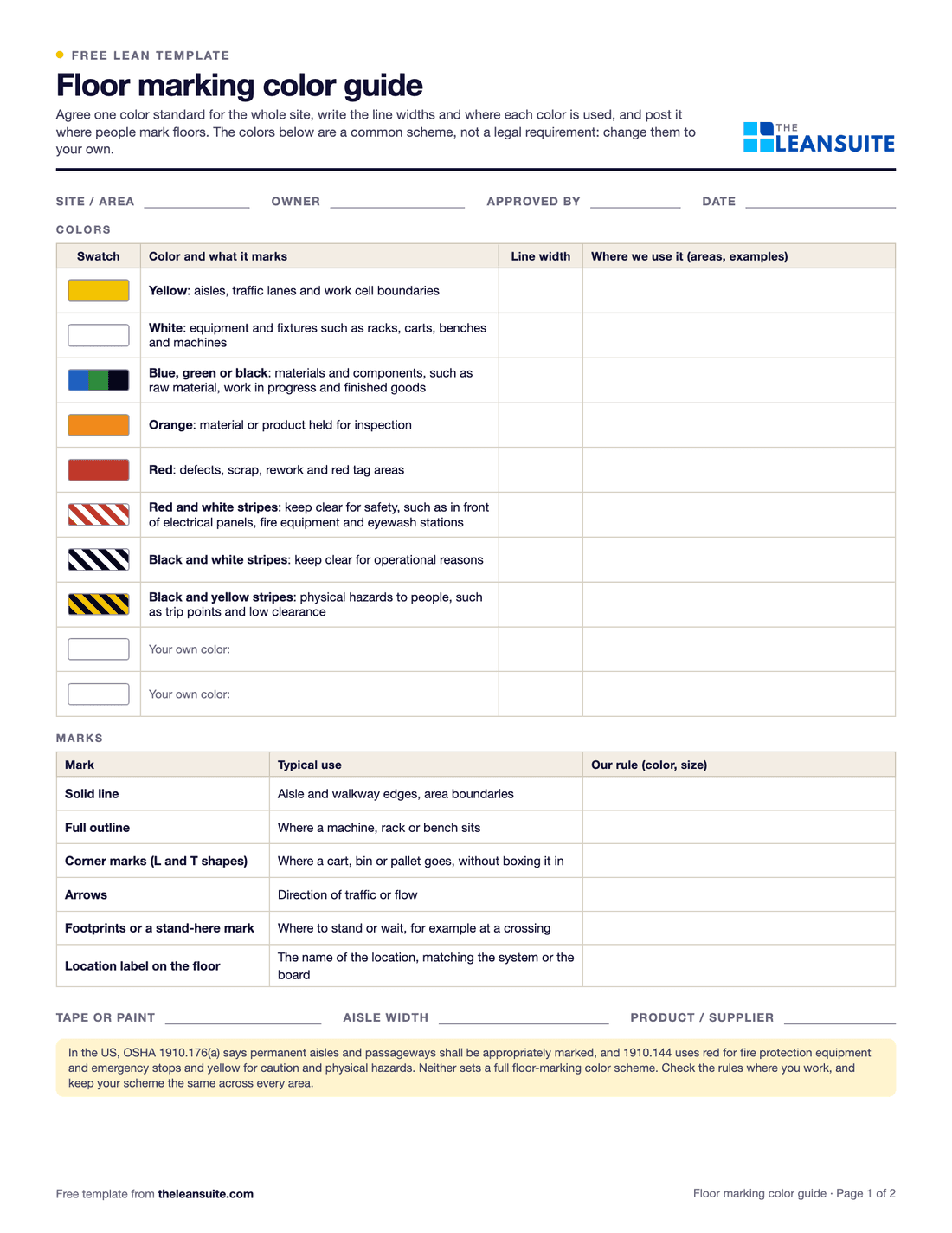 PDFFloor marking color guideA floor marking color standard with swatches, marks and line widths to fill in, and a floor marking check with a layout sketch.
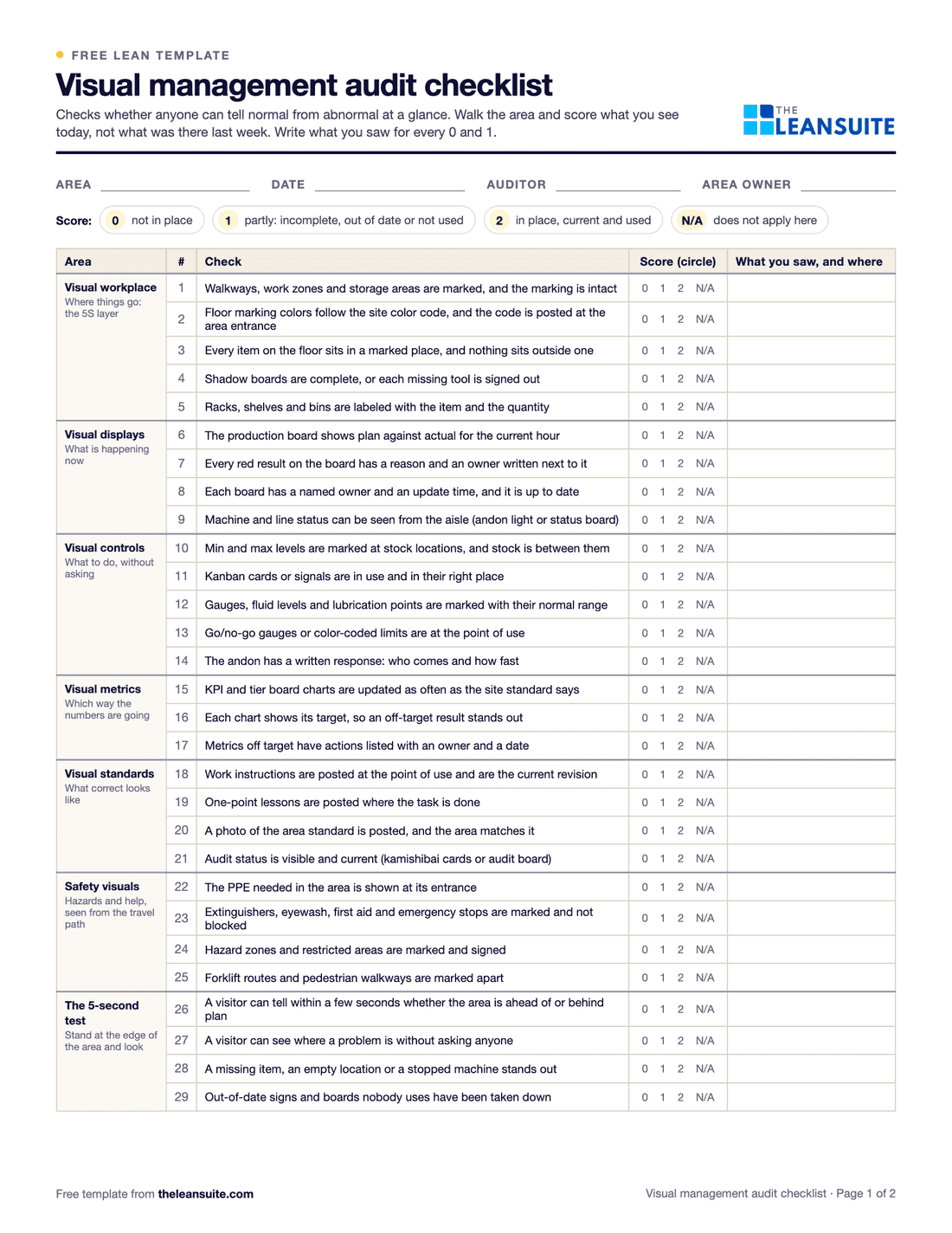 PDF and ExcelVisual management audit checklist29 checks of whether anyone can tell normal from abnormal at a glance, scored by group, with a trend and actions.
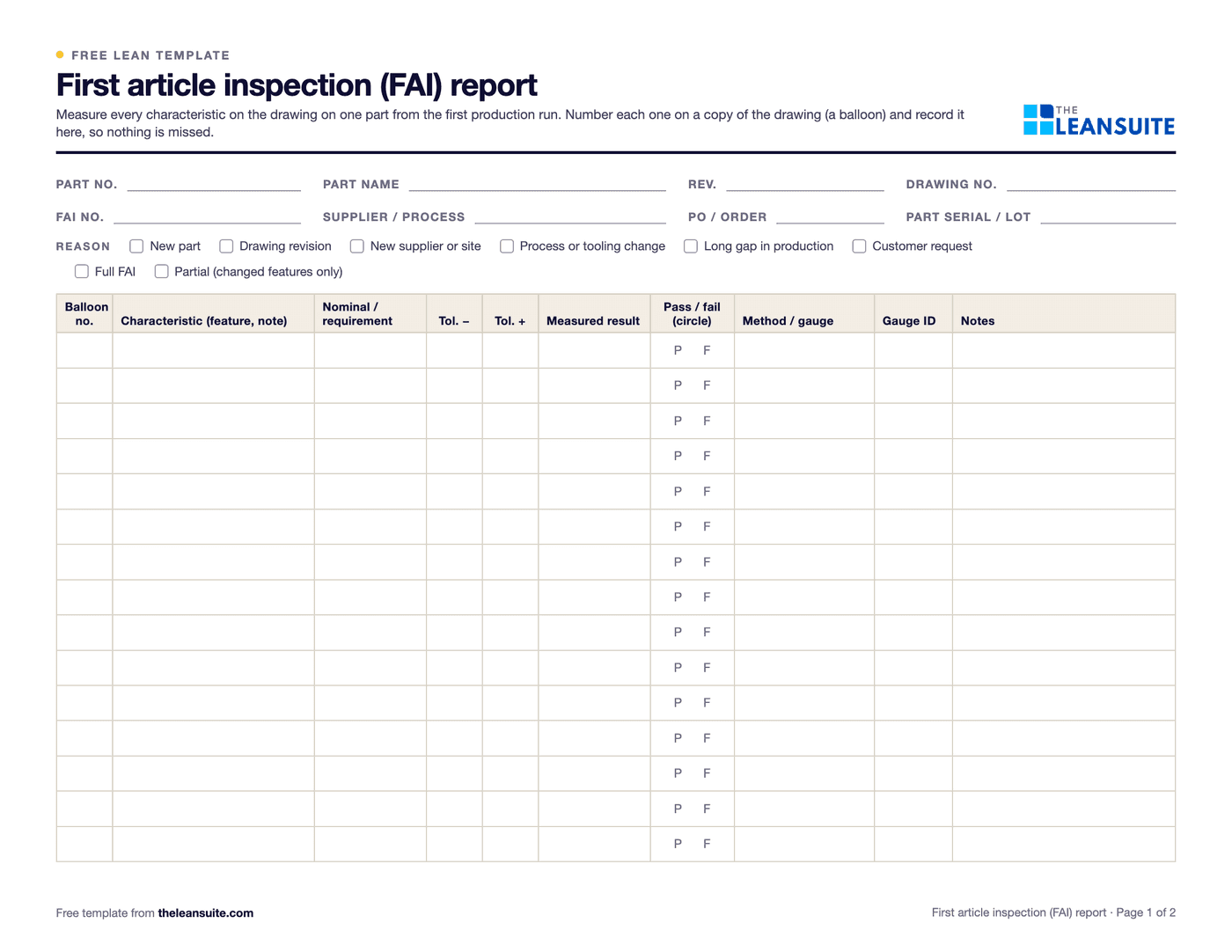 PDF and ExcelFirst article inspection (FAI) report templatePart information, a ballooned characteristic table with tolerances and results, material and process certificates, and sign-off.
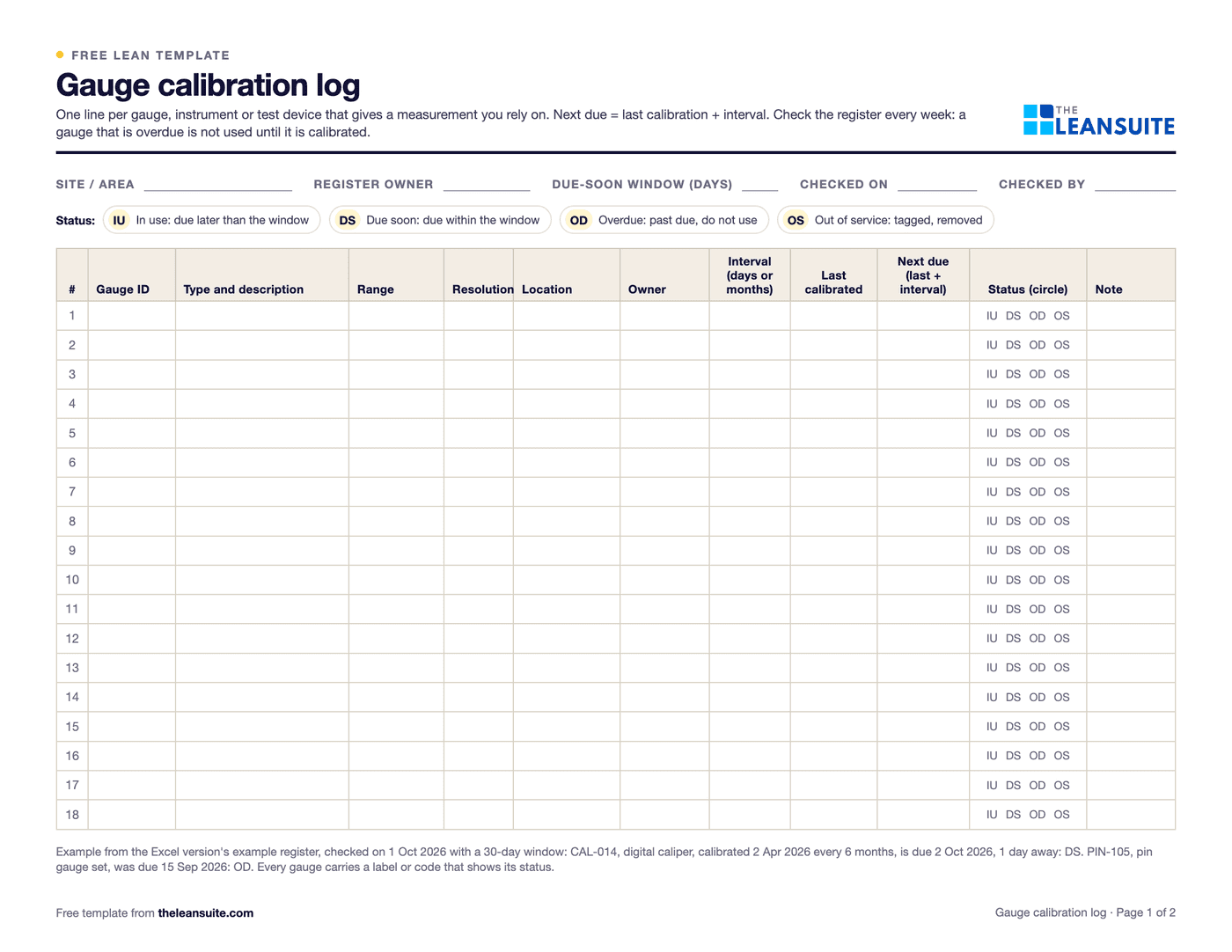 PDF and ExcelGauge calibration logA gauge register with next due dates and status, a calibration record with as-found and as-left readings, and the steps when a gauge fails.
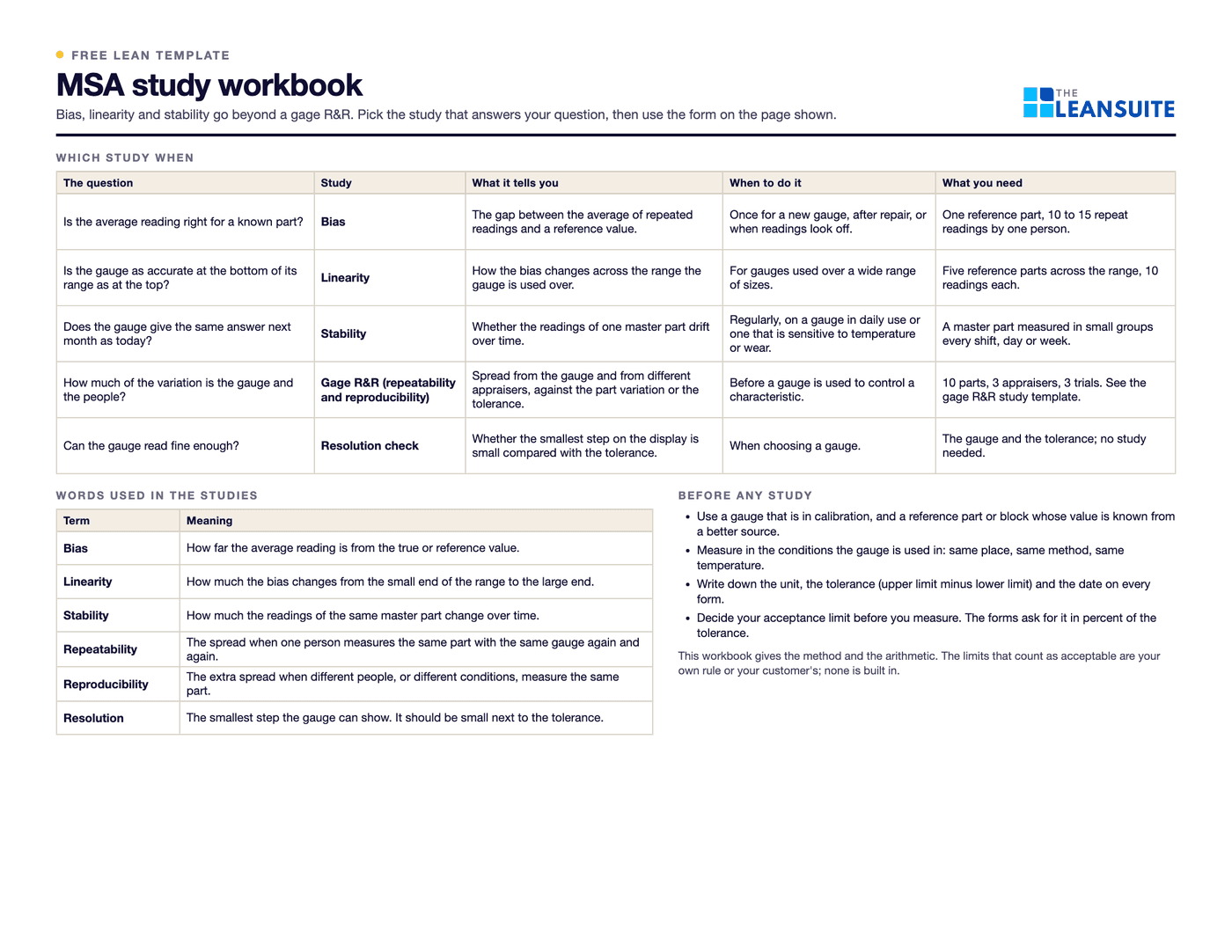 PDF and ExcelMSA study workbookBias, linearity and stability study sheets for a gauge, with the arithmetic done and a guide to which study when.
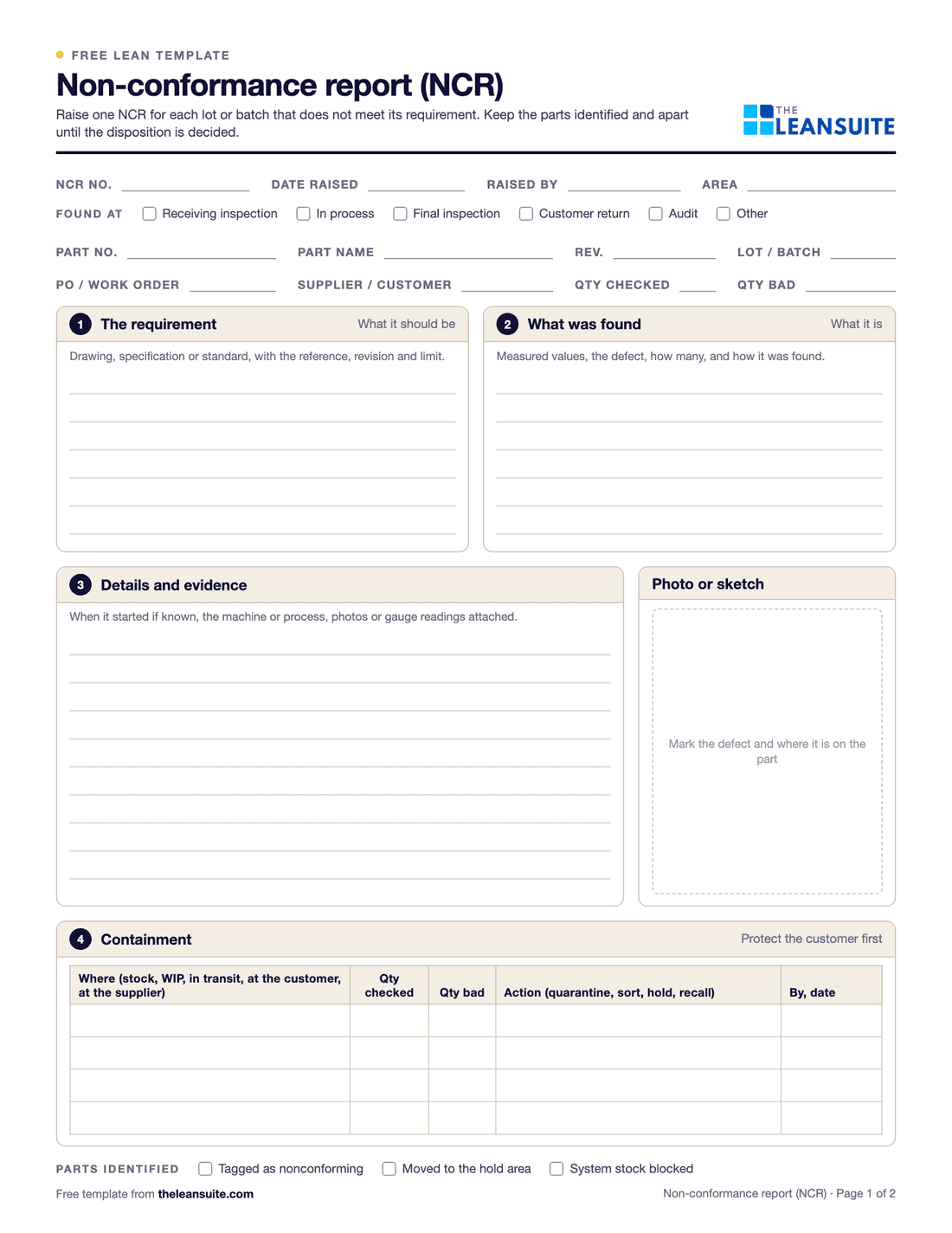 PDF and Excel and WordNon-conformance report (NCR) formA two-page NCR from the requirement against what was found to disposition and closure, and an Excel NCR log.
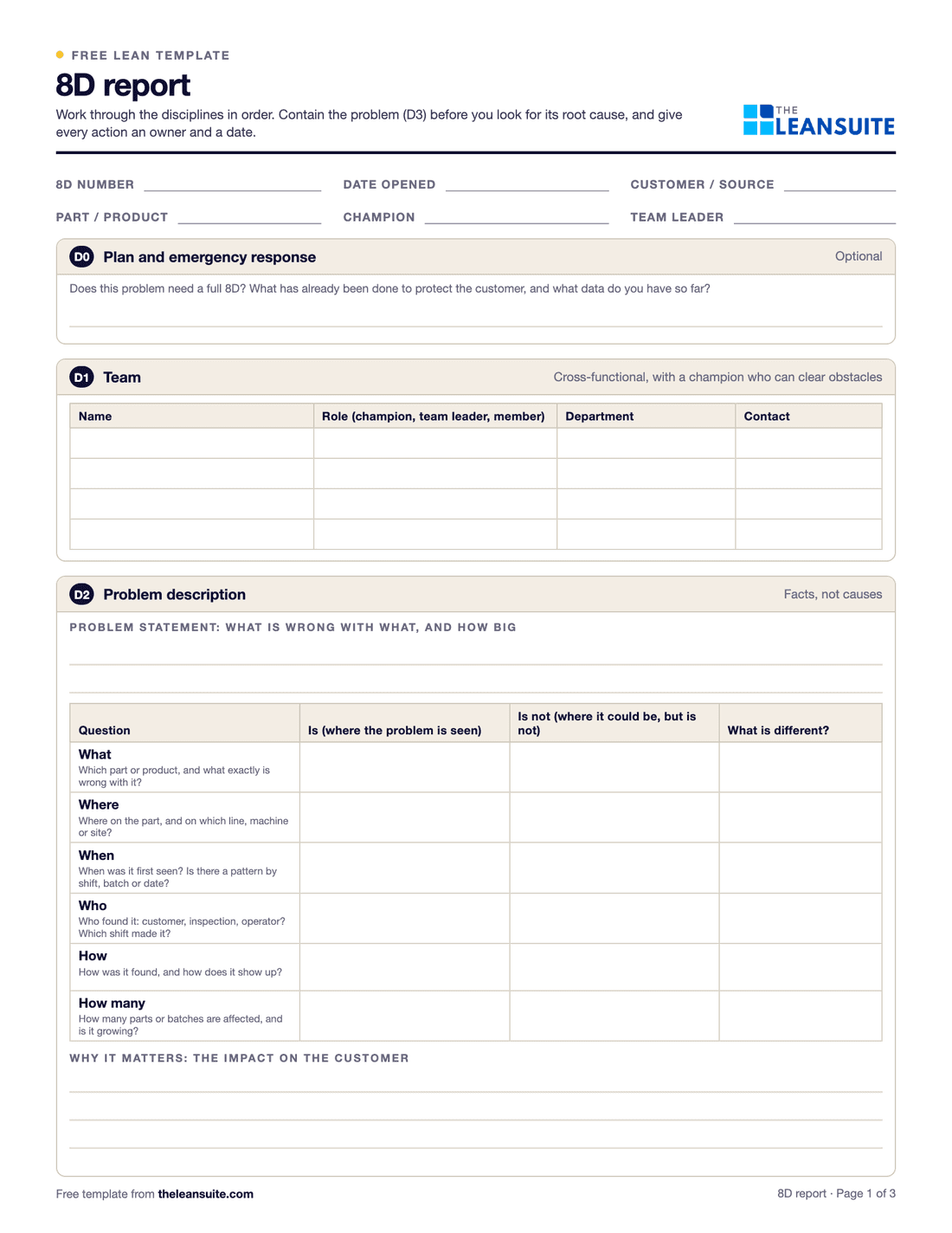 PDF and Excel and Word8D report templateD0 to D8 with targets, containment counts, occurrence, escape and systemic causes, verified actions and a worked example.
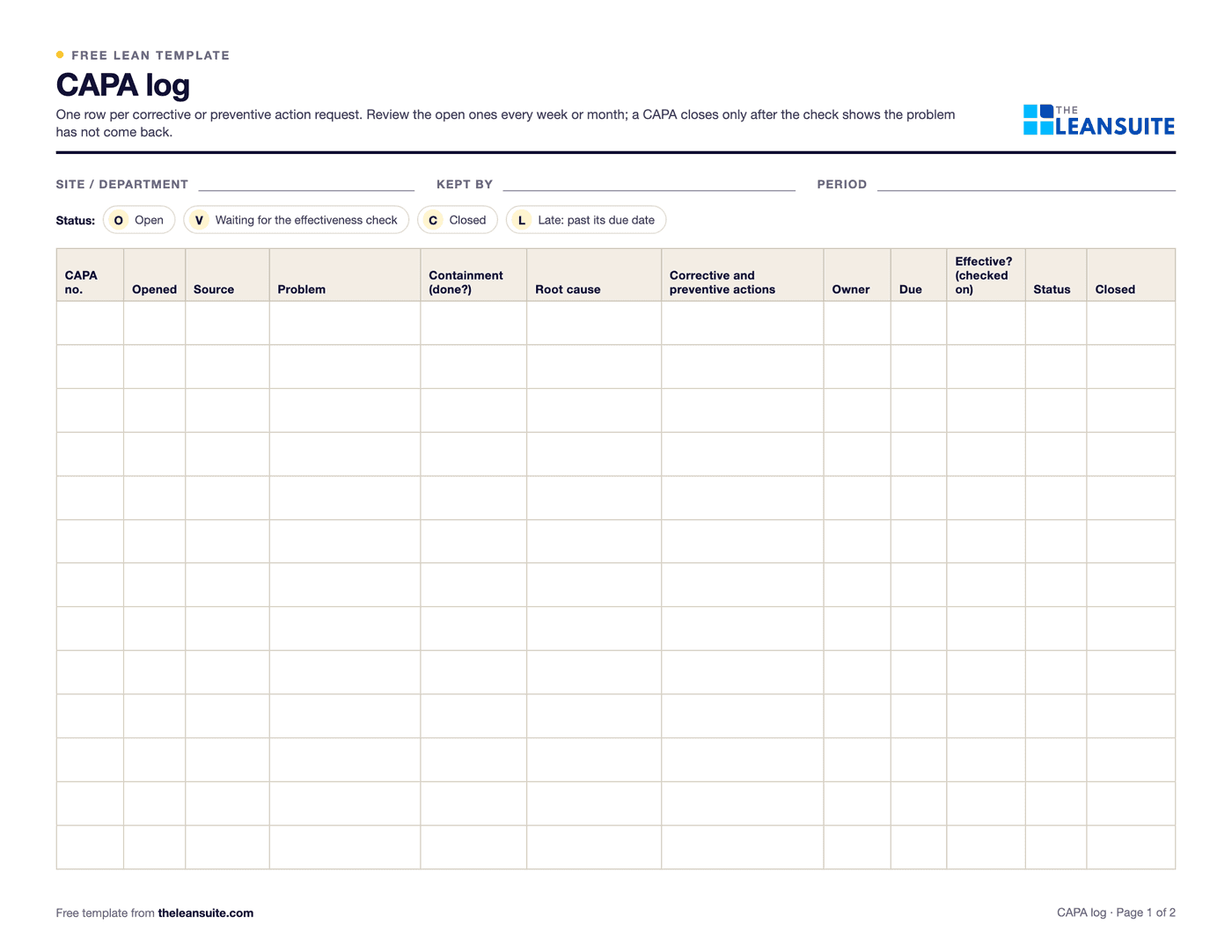 PDF and Excel and WordCAPA log templateAn Excel CAPA tracker with status, days open, late flags and counts by source, plus a printable log and monthly review.
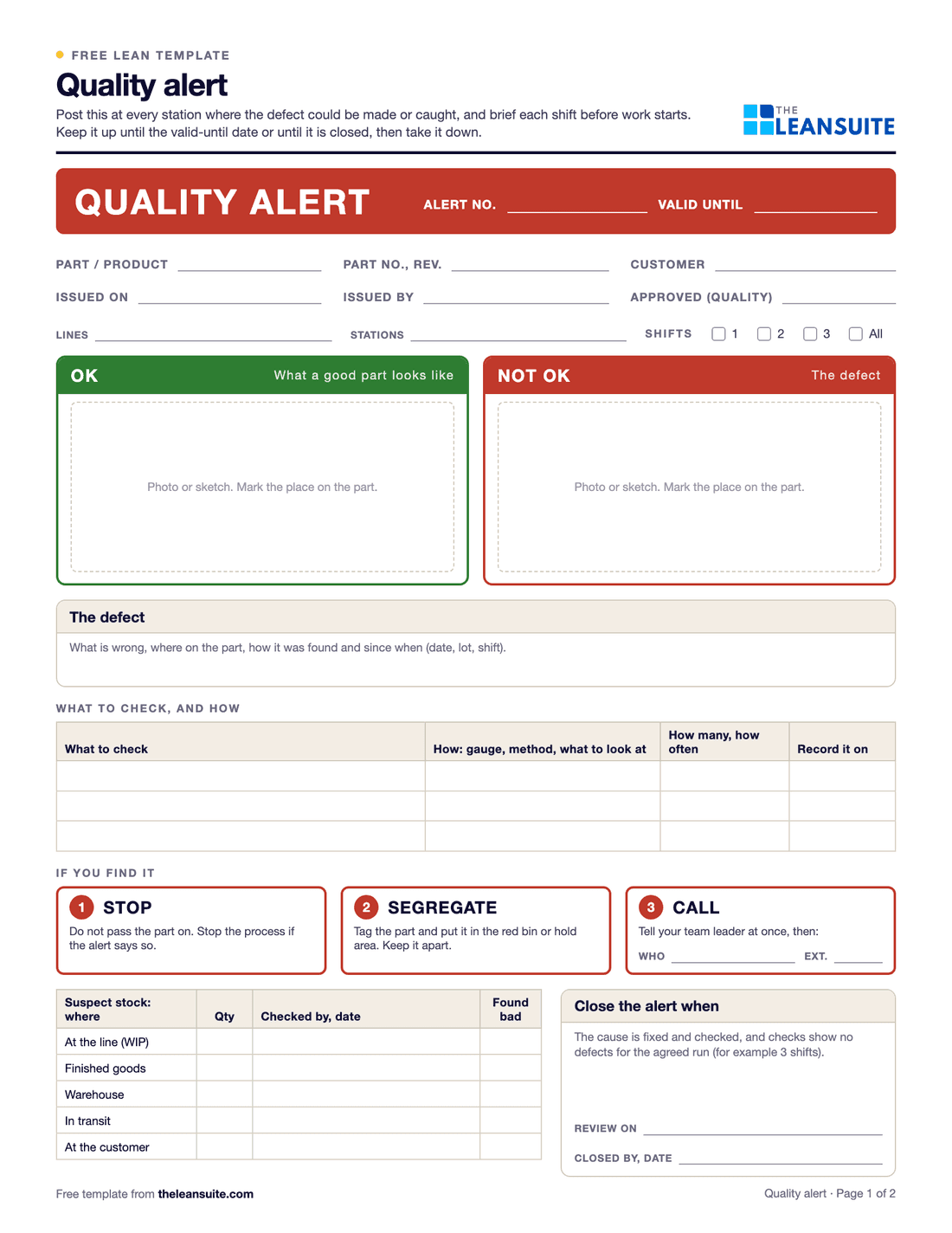 PDF and ExcelQuality alert formA quality alert to post at the line, a sign-off sheet for every shift, and a log of open, expired and closed alerts.
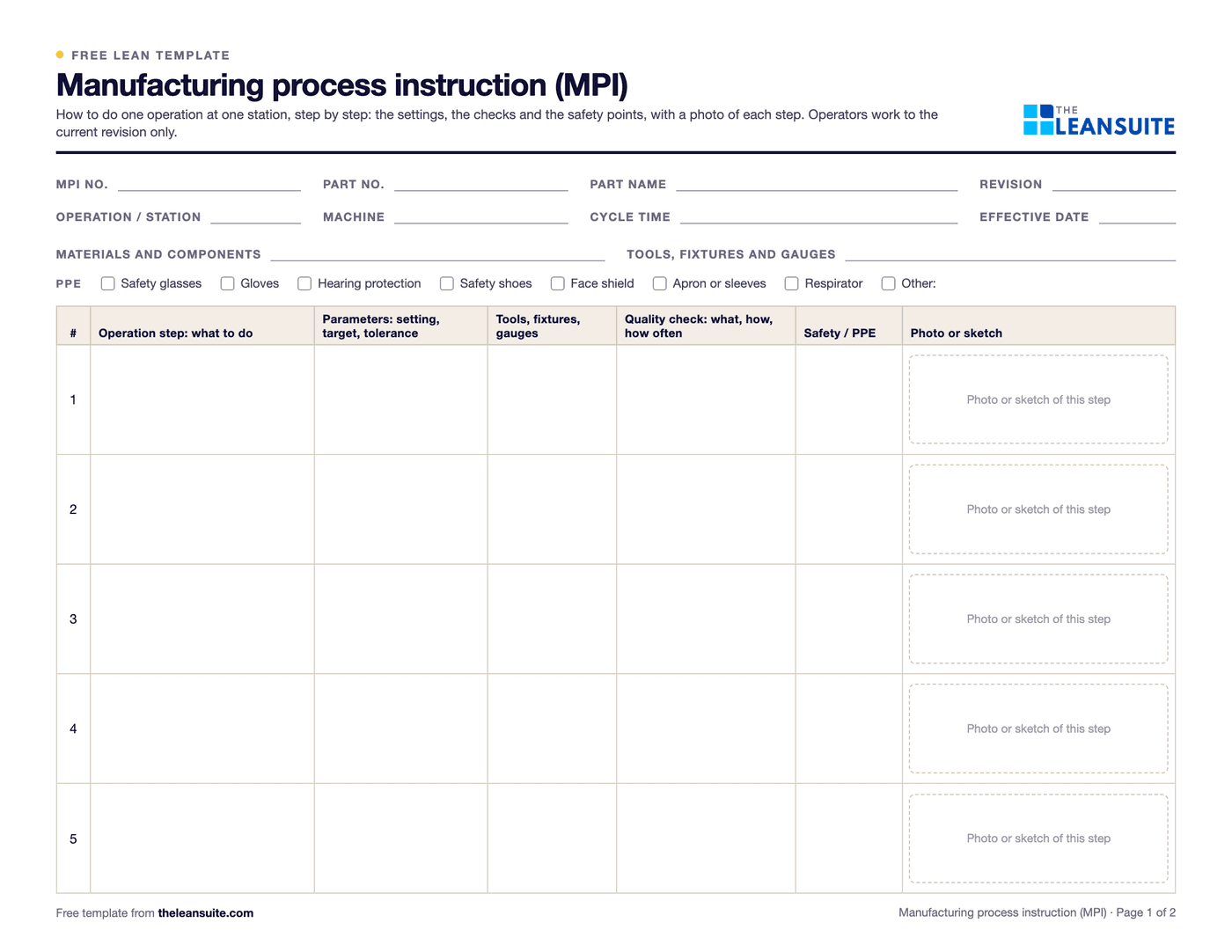 PDF and ExcelManufacturing process instruction (MPI) templateOperation steps with parameters, tools, quality checks, safety and a photo each, plus revision history and approval.
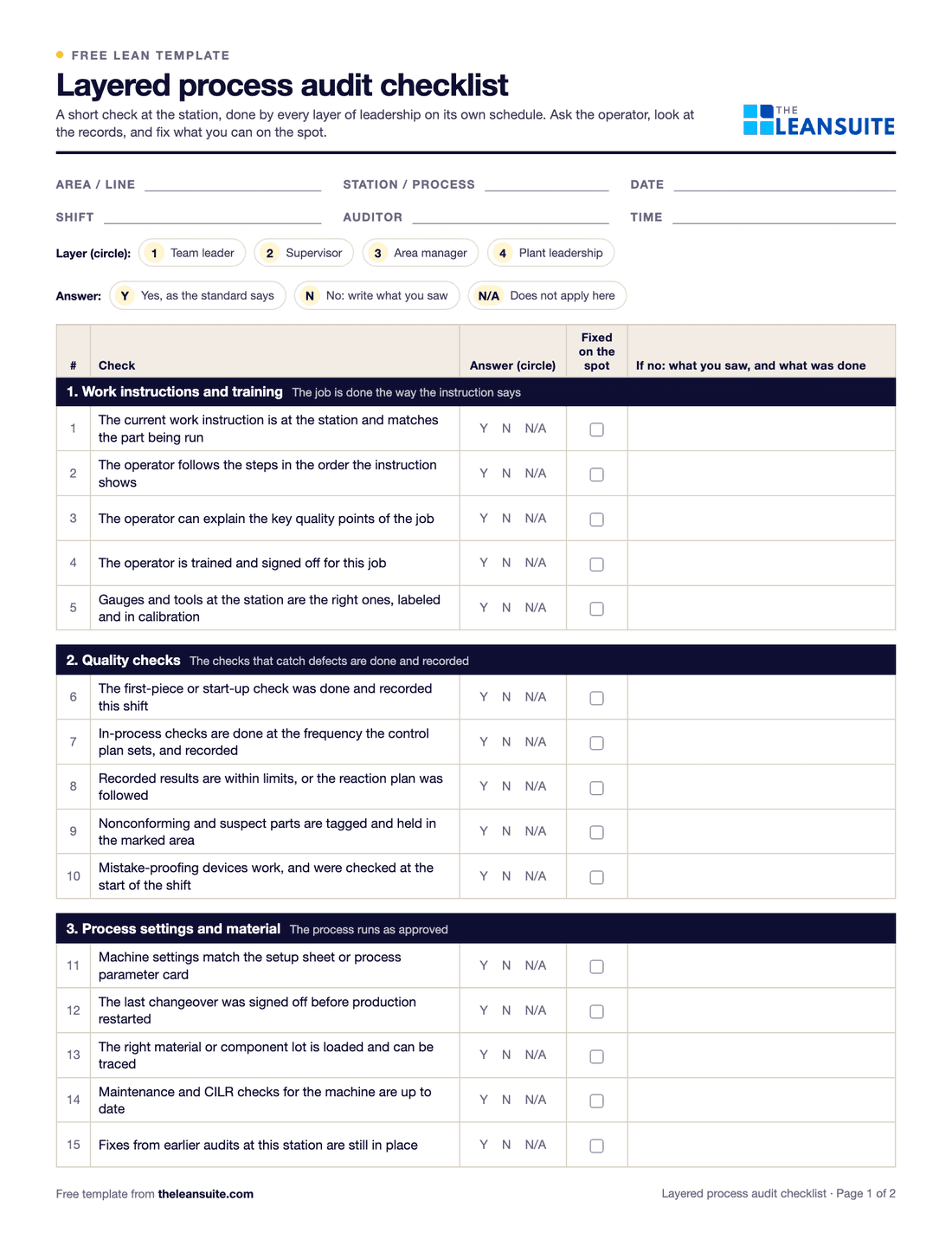 PDF and Excel and WordLayered process audit (LPA) checklist20 yes, no or N/A checks at the station, a fixed-on-the-spot box, scores by group and a findings table.
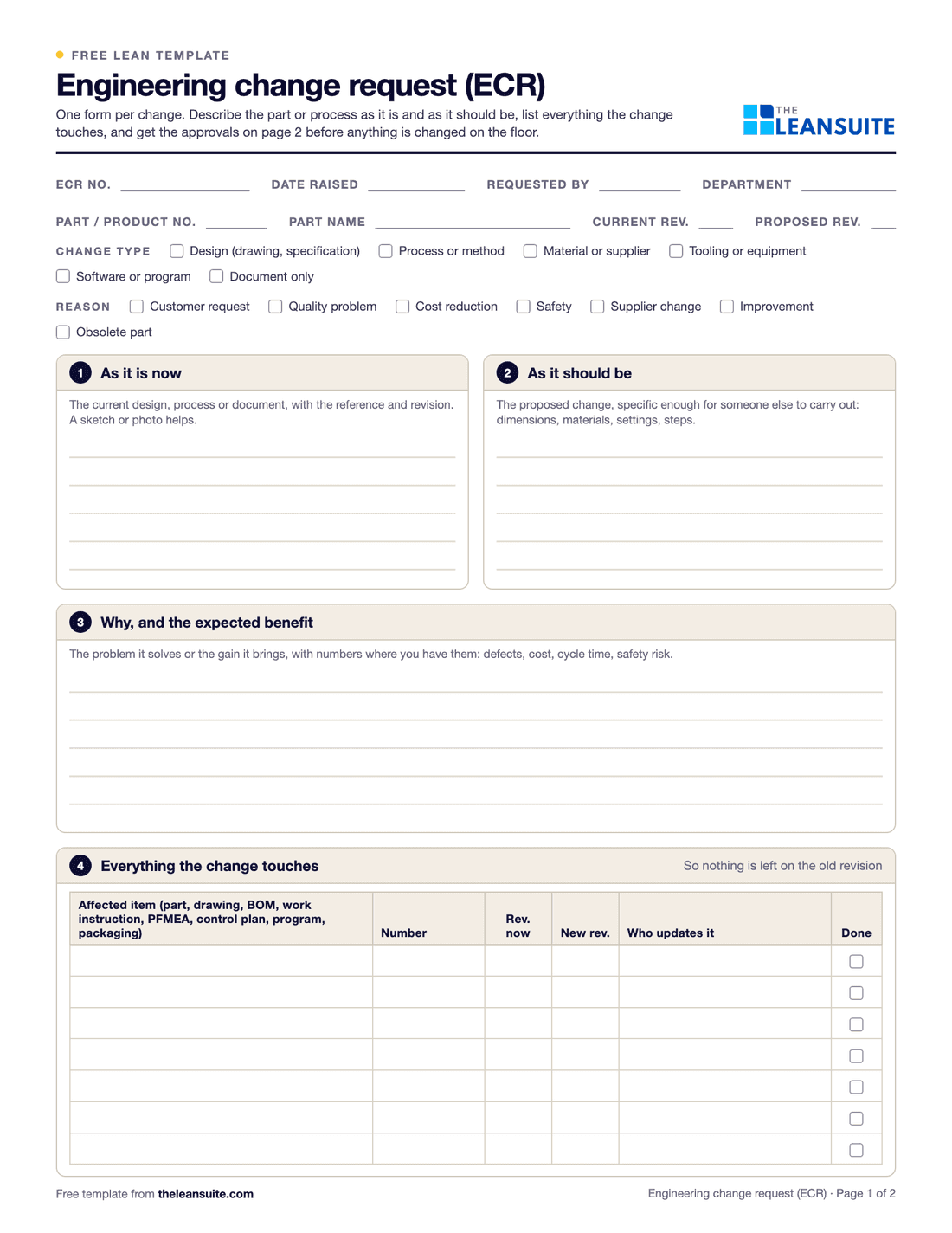 PDF and ExcelEngineering change request (ECR) formAn ECR form with the change, what it touches, risk and approvals, and an Excel log that tracks each change to done.
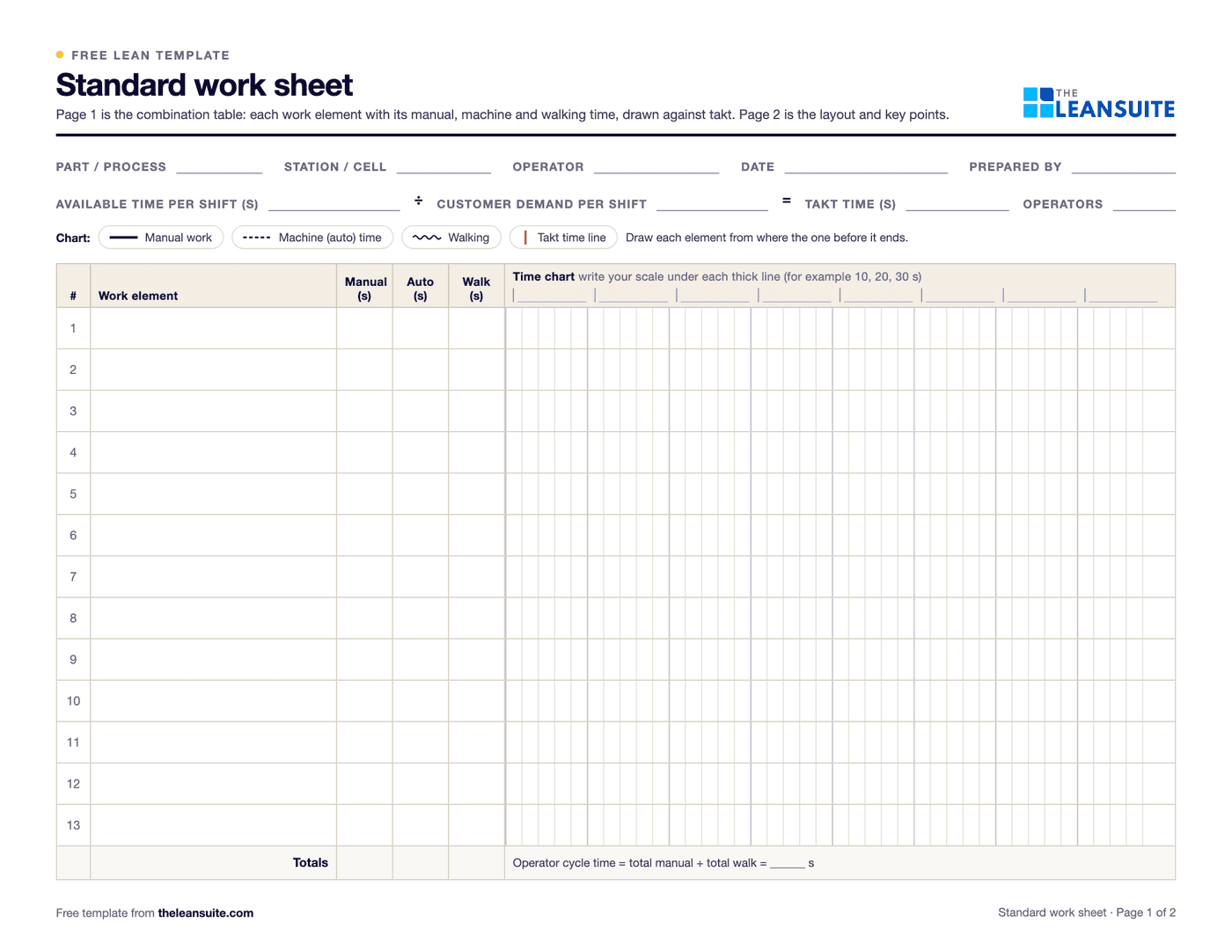 PDF and Excel and WordStandard work sheet templateTakt time, each element's manual, machine and walk time on a time chart, key points and standard WIP.
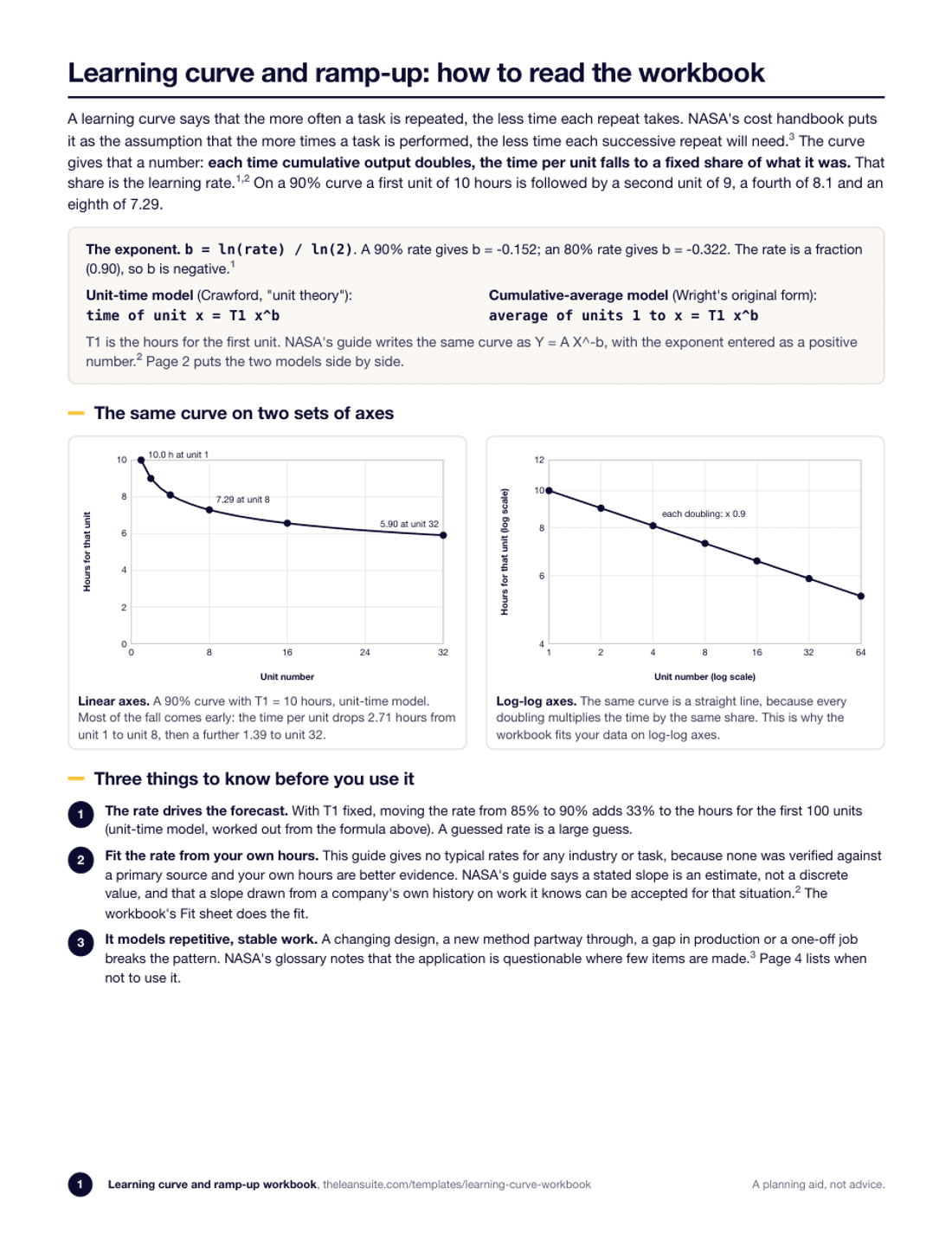 PDF and ExcelLearning curve and ramp-up workbookBoth learning curve models side by side, a fit from your own observed hours, batch hours, the unit that reaches standard and a weekly ramp plan.
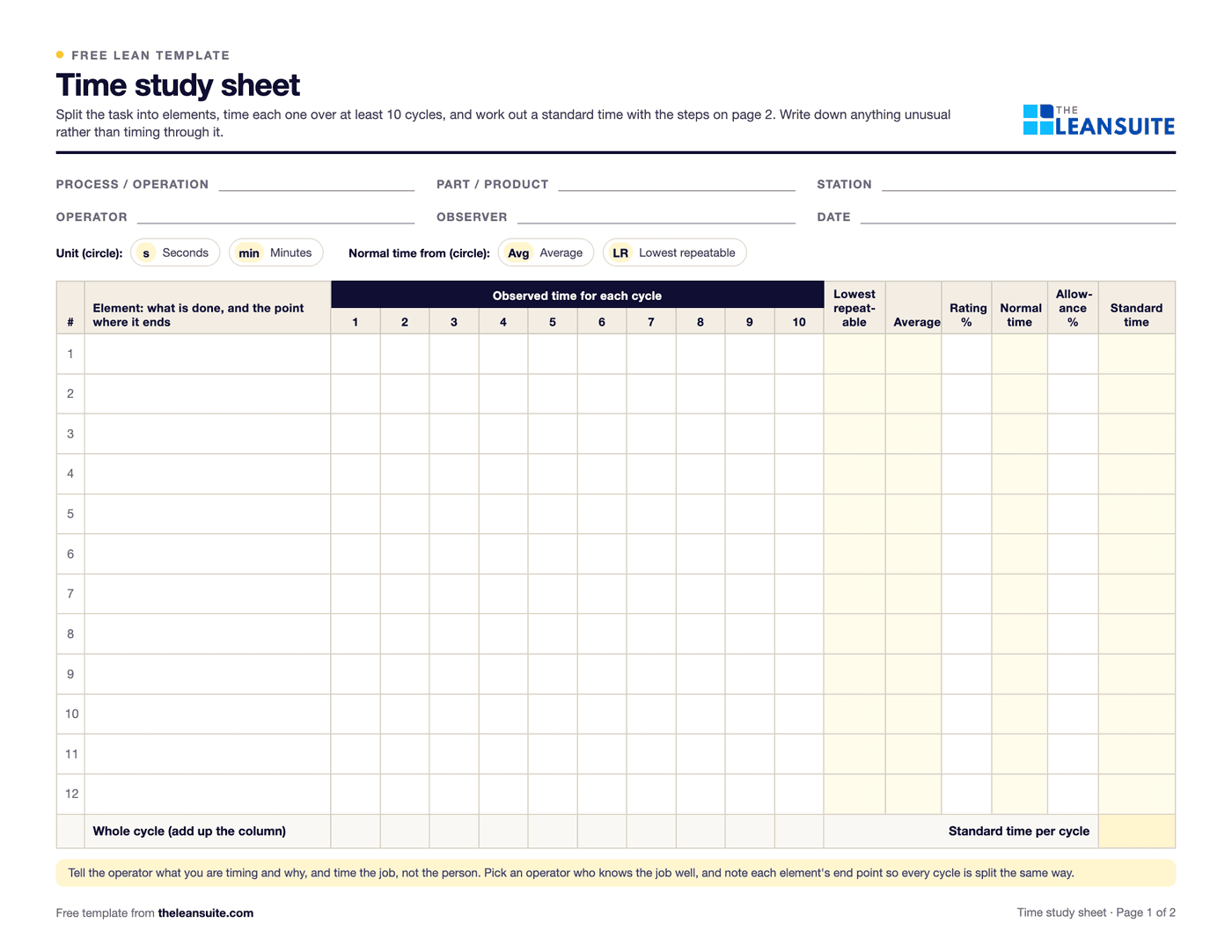 PDF and ExcelTime study sheetTime each element over 10 cycles and work out the average, lowest repeatable and standard time. Excel does the sums.
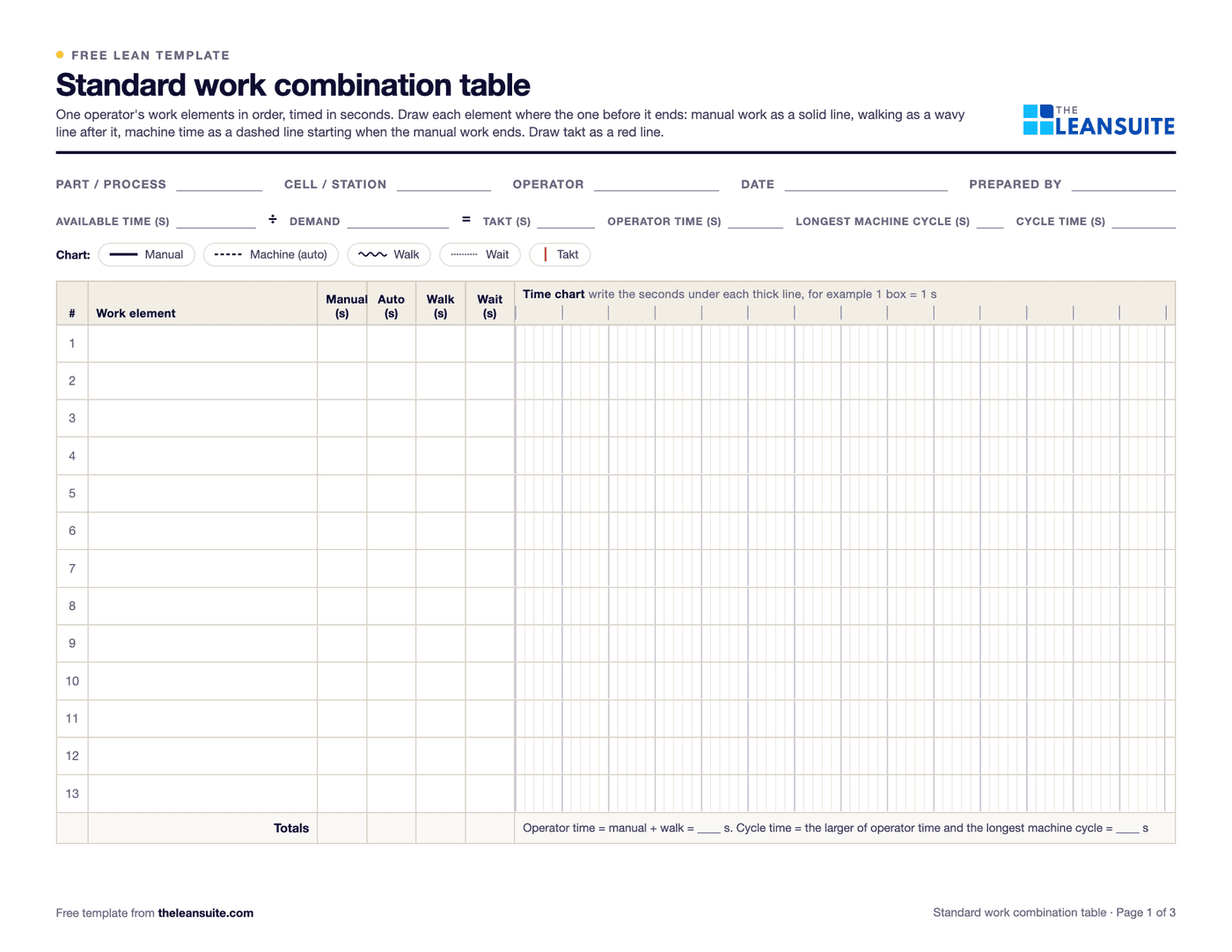 PDF and ExcelStandard work combination tableOne operator's manual, machine, walk and wait time on a time chart against takt, with machine cycles and a process capacity sheet.
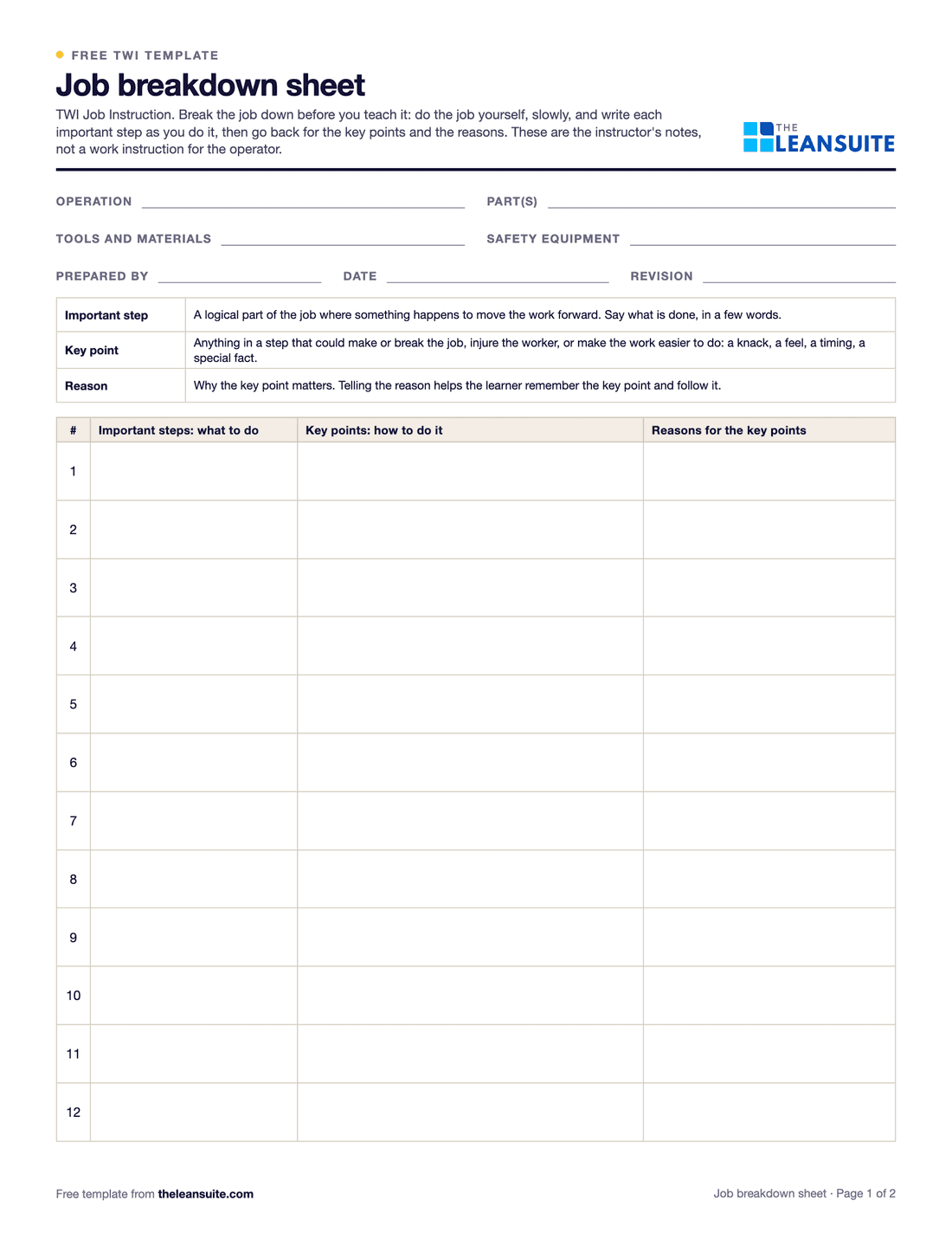 PDF and ExcelTWI job breakdown sheetThe TWI Job Instruction breakdown of a job into important steps, key points and reasons, with a worked example and the four steps.
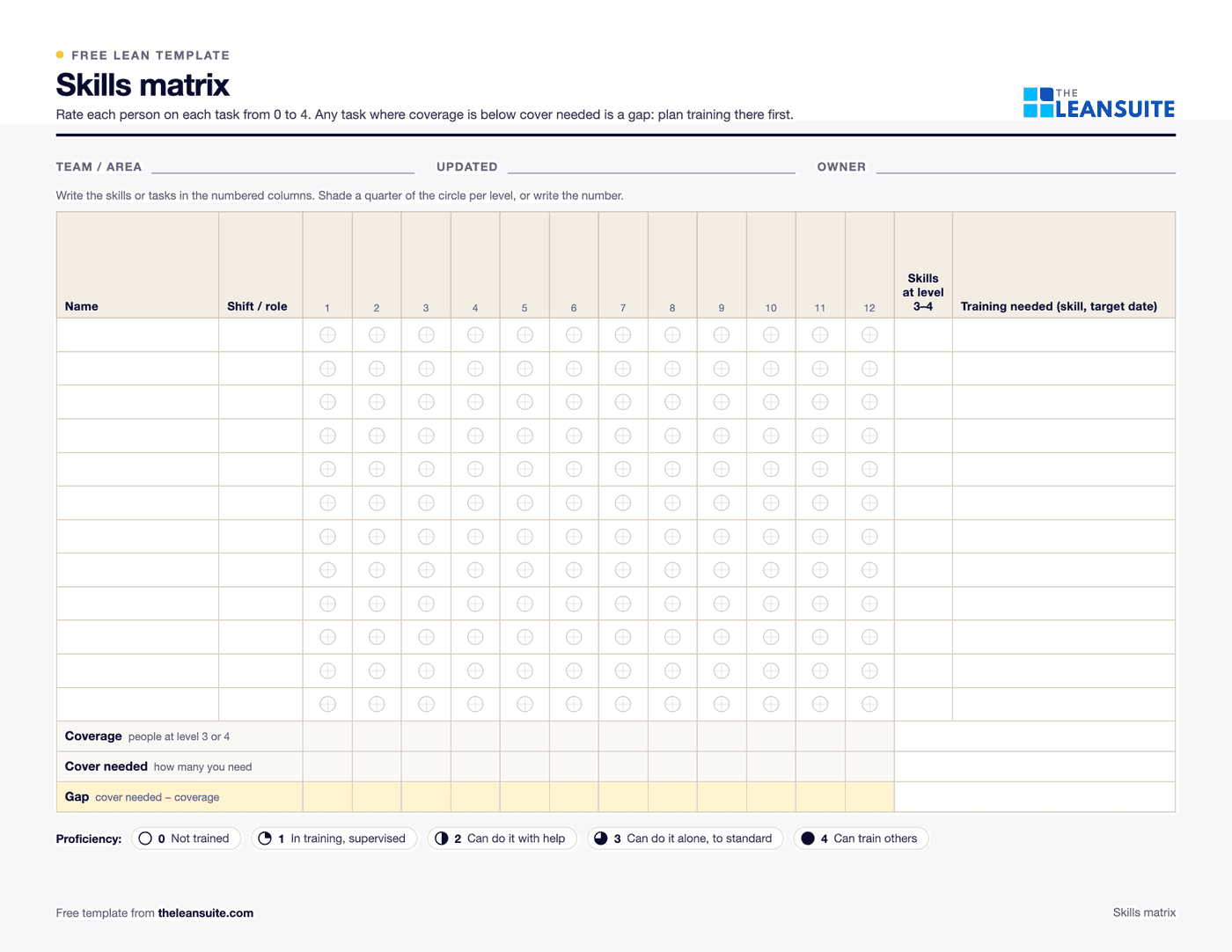 PDF and ExcelSkills matrix templatePeople by tasks on a 0 to 4 scale, coverage and gaps per task and shift, and a training plan that closes them.
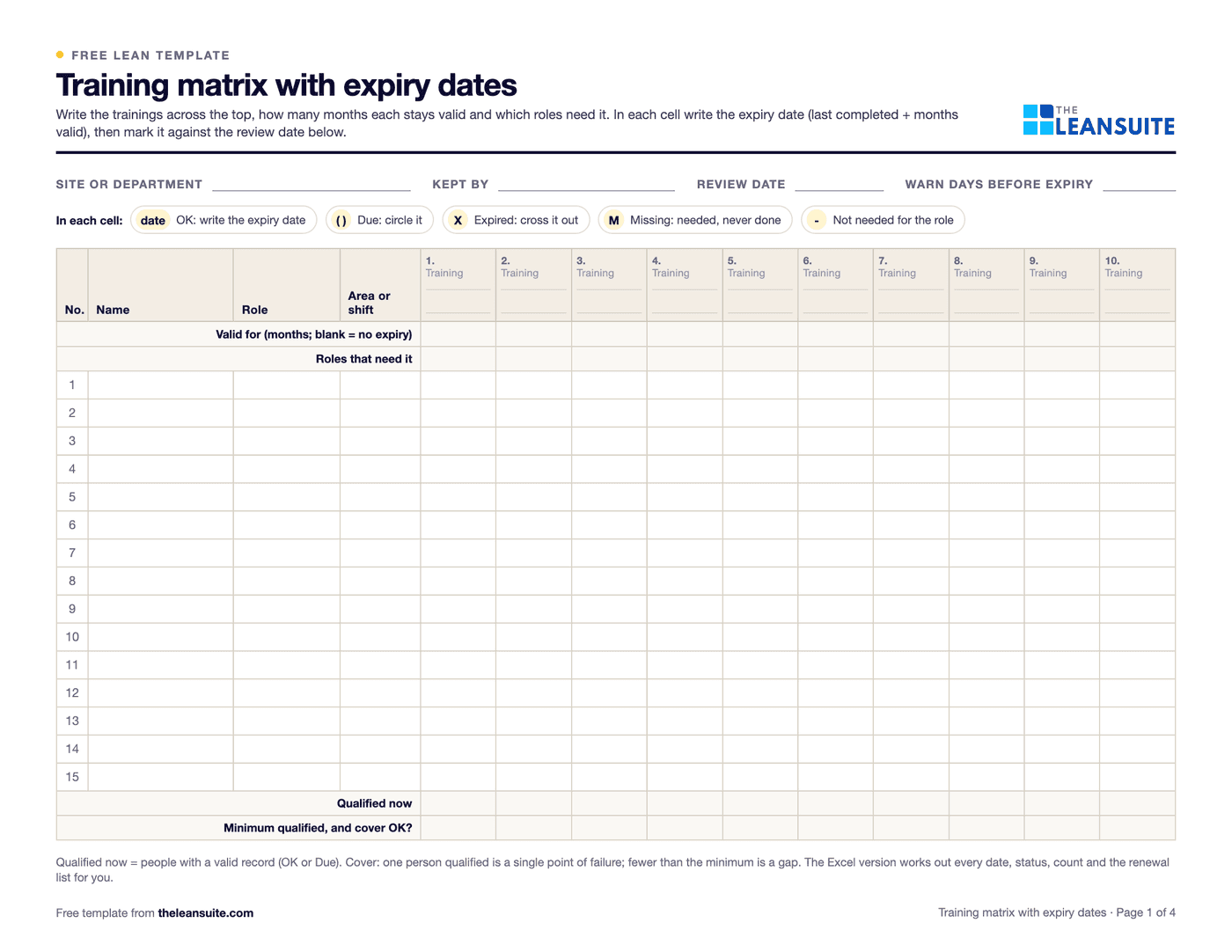 PDF and ExcelTraining matrix template with expiry datesPeople by required trainings with expiry dates, OK, due, expired and missing flags, compliance by person and area, cover per training and a renewal list.
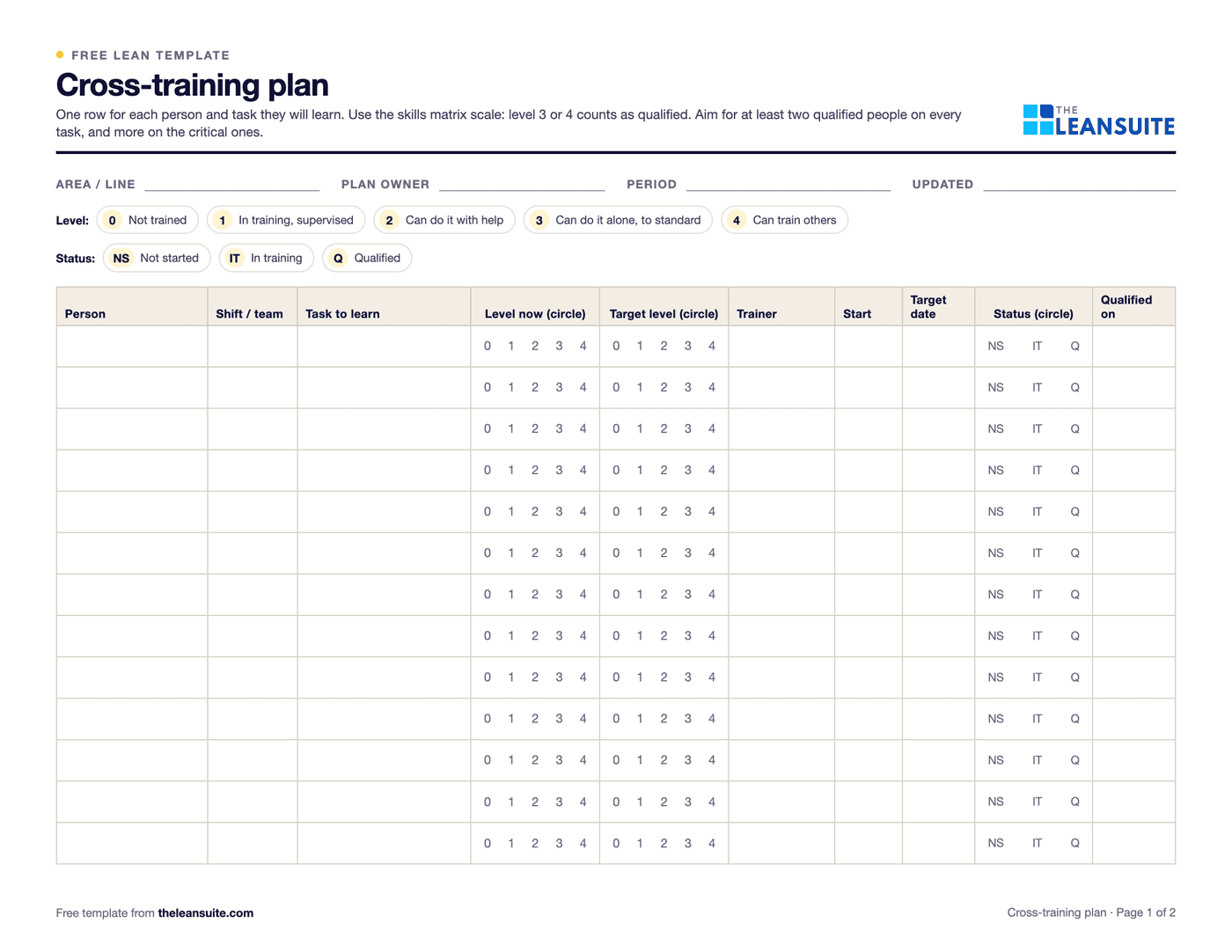 PDF and ExcelCross-training plan templateWho is learning which task, from and to which level, by when, and how many are qualified on each task.
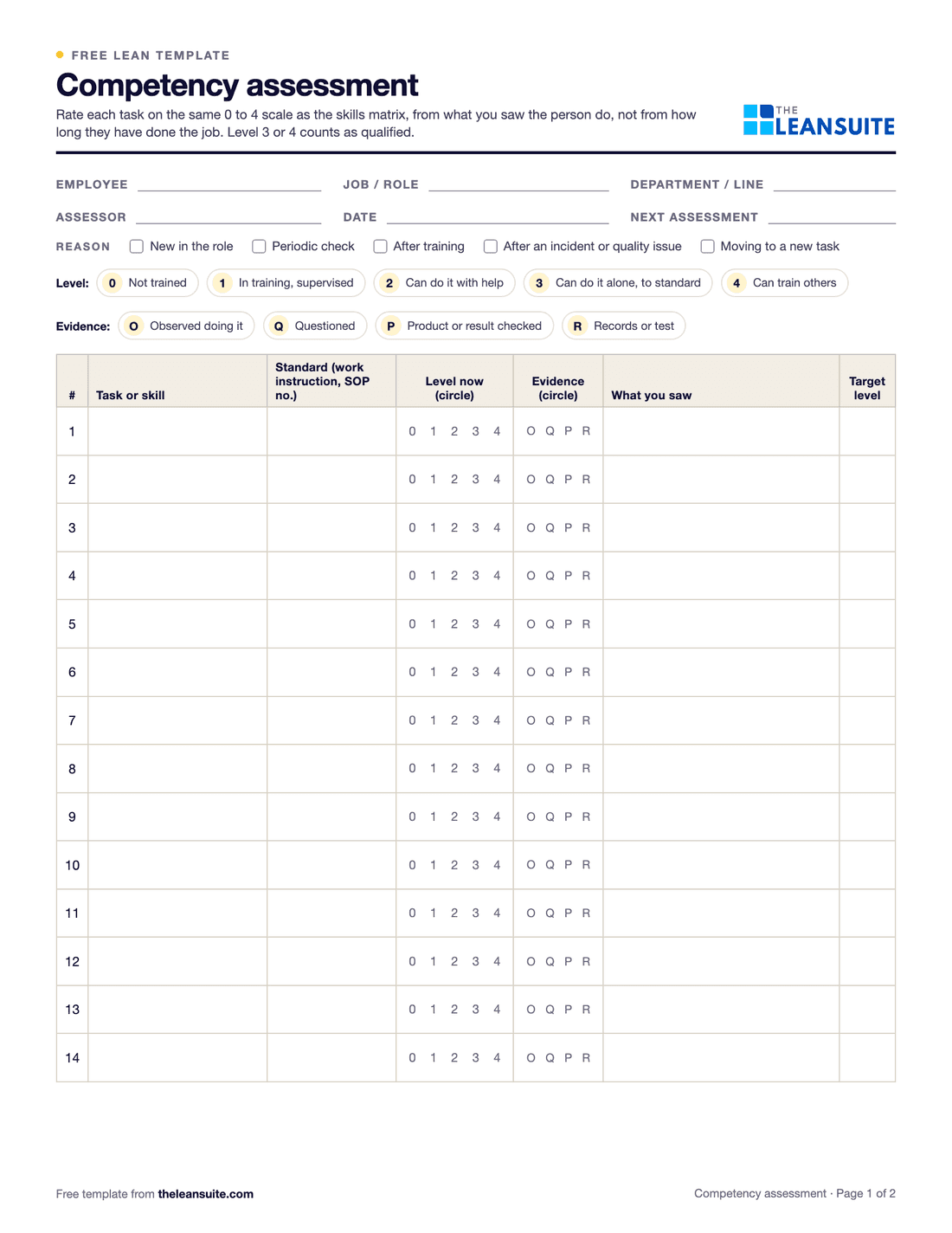 PDF and ExcelCompetency assessment formThe one-person assessment behind a skills matrix rating: each task rated 0 to 4 from evidence, checked, with a training plan for every gap.
Calculators (4)
- Free calculatorProcess capability (Cp, Cpk) calculatorCp and Cpk against your specification limits, plus Pp and Ppk from pasted measurements, with a distribution chart.
- Free calculatorTime study sample size calculatorHow many cycles of an element to time, from your first readings, with the t formula, the ILO formula and the range method.
- Free calculatorLine balancing calculatorLine efficiency, balance delay and the minimum number of stations from station times and takt.
- Free calculatorFirst pass yield (FPY) calculatorFirst pass yield at each step and rolled throughput yield (RTY) across the whole process.
Buyer's guides
LeanSuite pages for these problems
- Audit Management
- Checklists
- Quality Improvement
- Non-Conformance (NCR)
- AI Root Cause Analysis
- Digital Work Instructions
- AI SOPs
- CILR Checklists
- Time and Motion Study
- AI Video Analysis
- Competency Management
- Trainings (LMS)
- Job Cover Matrix
- Supplier Quality
How LeanSuite handles each of these is on the page for aerospace and defense plants.
Whirlpool tackled project visibility and continuous improvement across 14 manufacturing plants with LeanSuite. Read the Whirlpool case study.
FAQ
Lean in aerospace and defense plants: common questions
On one cell or assembly line, with a loss you can count: FOD findings, NCRs waiting for MRB, first pass yield or hours per unit against the learning curve. Measure it for two weeks, fix the biggest cause with the people doing the work, write the method down and only then move on.
A full, documented check that the production process makes a part to every requirement on the drawing and the purchase order. AS9102 sets out the record in three forms: part number accountability; product accountability for materials, special processes and functional tests; and characteristic accountability, where every ballooned characteristic is listed with its result. A partial first article covers only what a change affects. If a characteristic fails, the first article stays open until the cause is fixed and that characteristic is checked again.
Illustrative example: on an 80% curve, the hours for a unit fall to 80% each time the number of units built doubles. If unit 1 took 1,000 hours, the plan is 800 hours for unit 2, 640 for unit 4 and 512 for unit 8 (1,000 times 0.8 times 0.8 times 0.8). If unit 8 actually took 600 hours, it is 88 hours, or about 17%, above the curve, because 88 divided by 512 is 0.172. That gap is where to time study the job: the steps that did not get faster are the ones to standardize and train.
5S, shadow boards and clean-as-you-go for FOD and tool control, standard work and job instruction for long manual builds, time study against the learning curve, a skills matrix for certified tasks, and root cause analysis with 8D for nonconformances and escapes. AS9145 brings APQP and PPAP to new parts, and lean work should feed into it, not run beside it.
It should not, but many aerospace processes are frozen by a first article, a special process approval or a customer requirement. Any change to those goes through your quality system and, where needed, customer approval before it is made. Lean removes waiting, searching and rework around the controlled steps; it does not skip them.
See LeanSuite on your FOD walks and nonconformances
Bring the routine you want to fix first. We will show you how LeanSuite handles it and what a 90-day pilot would cover.