

Lean playbook · Furniture and cabinetry
Lean playbook for furniture manufacturing and cabinet shops
Short answer
Start lean in a furniture plant or cabinet shop where orders are late or reworked, usually finishing or final assembly. Count what you lose there: first pass yield at finishing, setup time on the saw, router and edgebander, material yield and short or damaged shipments. SMED shortens high-mix setups, defect tallies and an approved color sample cut finishing rework, and line balancing against takt evens out assembly. 5S and guarding checks keep dust and machines under control. Measure for two weeks, fix the top two losses, then move to the next area.
Last updated:
7 problems on the floor, and the lean methods for each
Each problem says what it looks like, which methods address it, the first moves to make and the number to watch. Pick the one or two that cost your plant most; you do not need all of them at once.
Where a furniture and cabinet plant loses time and quality
Edge banding and machining
Pack and ship
High-mix setups on saws, routers and edgebanders
Tooling, edge tape, glue pot and program change many times a day. Operators search for tools, try a test piece, adjust and try again, and a wrong program or tape is found only when a panel is scrapped.
In LeanSuite
Visual steps mean every operator runs the changeover the same way. Every checklist logs how long each step took, so the Kaizen module shows which steps to attack.
First moves
- Film one setup on the edgebander or router and list every step, marking which ones need the machine stopped.
- Put tooling, tapes and programs for the next jobs on a cart or shadow board at the machine before the current job ends.
- Group jobs by edge tape color and thickness so fewer changes are needed.
- Write the new setup as a checklist and time every setup against it.
Number to watch: Setup time, from the last good part of one job to the first good part of the next, by machine.
Finishing defects found at final inspection
Runs, orange peel, dust nibs, color mismatch and sand-through are found after the finish has cured. The part goes back for sanding and respraying, and the cause in the sanding room or the booth is not recorded.
In LeanSuite
Operators scan a QR code and flag the non-conformance with photos, straight from the floor. Systemic issues move straight into structured DMAIC or 8D projects, so the root cause gets fixed.
First moves
- Tally finishing defects by type and by product for two weeks on a check sheet at final inspection.
- Keep a signed color and sheen sample, and boundary samples for the defects inspectors disagree on, under the same light at the booth and at inspection.
- Check the top defect at its source: sanding grit and sequence, booth filters and airflow, gun setup, mix and cure.
- Run a 5 Whys with the finishing crew on the top defect and write the fix into the booth standard.
Number to watch: First pass yield at finishing: parts passed first time divided by parts inspected.
Wood dust, machine guarding and spray booths
Guards are taken off for awkward cuts and not put back, dust settles on beams and ledges, collector bins overflow and booth filters load up. Nobody owns these jobs on a busy day.
Lean methods
In LeanSuite
Auditors take before-and-after photos on a tablet, and the checklist can't be completed without them. Operators scan a QR code and log a hazard with a photo instantly, with no app download and no login.
First moves
- Add a guard and interlock check to the start-of-shift routine on every saw, shaper and router.
- Set a housekeeping standard for dust, with a photo of the clean condition and a set frequency for high surfaces and collectors.
- Run a weekly 5S and safety walk by area, and turn every finding into an action with an owner.
- Make reporting a near miss take under a minute, and tell the reporter what was fixed.
Number to watch: Guarding and housekeeping checks done on time, and near misses reported and closed.
Panel yield and offcuts
Sheets are nested one order at a time, recuts after damage or a machining error eat into the next sheet, and good offcuts pile up unused until they go to the dumpster.
In LeanSuite
Put a cost on defects by capturing scrap, rework, warranty claims and inspections, then rank quality projects by what they are worth.
First moves
- Measure material yield per shift: the area of good parts divided by the area of sheets used.
- Log every recut with its cause (damage, program, measurement, material defect) and chart the causes as a Pareto.
- Fix the top recut cause first, then set rules for storing and using offcuts by size.
Number to watch: Material yield and recuts per 100 orders.
Missing parts and shipping damage
An order goes out short a door, a shelf or a hardware bag, or a corner is crushed on the truck. A service visit or a reship costs far more than the part.
Lean methods
In LeanSuite
Make it required, flag an answer, ask a follow-up, require a photo, or raise a tag, idea or Kaizen. Answer rules on an audit or checklist can raise a tag or start a CAPA automatically when an item fails.
First moves
- Build a pack-out checklist per product family, with a photo of the packed order before it is closed.
- Kit hardware into counted bags or shadow trays so a missing item is seen before the box is sealed.
- Record every short-ship and damage claim with a photo and a cause, and review them weekly.
Number to watch: Short-ship and damage claims per 100 orders.
Unbalanced assembly and upholstery lines
With a different model every few units, one station is always waiting while another piles up work. The line runs at the pace of its slowest station, and the balance is redone by feel.
Lean methods
In LeanSuite
AI line balancing from video: film your line, get a Yamazumi chart against takt, and test rebalancing scenarios before you change anything. Balance multi-product lines by the real demand mix and see each station's combined load.
First moves
- Work out takt from the daily demand and the available time.
- Time each station's work elements for the main models, by video or stopwatch, and stack them in a Yamazumi chart against takt.
- Move elements from stations above takt to stations below it, keeping tooling and skill limits in mind.
- Check the new balance on the floor for a week before you write it down as standard work.
Number to watch: Balance efficiency: total work content divided by the number of stations times the longest station time.
Heavy lifts and awkward postures
Carcasses, tabletops and sofa frames are lifted, turned and carried by hand, and stapling and pulling fabric load the wrists and shoulders all shift. Strains build up long before anyone reports one.
In LeanSuite
An AI ergonomic study from ordinary video: LeanSuite maps 18 body joints, scores REBA and RULA automatically and flags the postures that need a fix.
First moves
- Score the heaviest and most awkward tasks with REBA or a lifting equation, starting where people complain.
- Fix the worst first with engineering controls: lift tables, turners, rollers and better work heights.
- Re-score after each change, and add the new method to standard work.
Number to watch: Tasks scored high risk, and strains and sprains per year.
More small fixes in the production, quality and safety sections of the kaizen idea bank.
A 90-day starting plan
One line or product family, two problems, measured before and after. The point of the first 90 days is a result the plant believes and a method it can repeat, not a plant-wide program.
The 90 days, with the gate that ends each stage
- Days 1 to 30See the losses in one areaDone when: You have baseline numbers on the board and two problems with an owner each.
- Days 31 to 60Fix the top two lossesDone when: Each fix has a written standard and a before-and-after number.
- Days 61 to 90Make it stick, then spread itDone when: The gains have held for a month and the next area has its baseline.
Days 1 to 30
See the losses in one area
Pick the area where orders are late or reworked, often finishing or final assembly, and get a true baseline.
- Choose the area and name a lead and a sponsor.
- Measure for two weeks: first pass yield at finishing, setup times on the main machines, material yield, on-time delivery and claims.
- Start a 15-minute meeting at a board in the area at the start of each shift.
- Walk the flow of one order from cutting to shipping with the people who build it, and list what slows them down.
- Choose the two biggest losses to work on first.
Days 31 to 60
Fix the top two losses
Run focused improvements on the two problems and check them against the baseline.
- Run a SMED workshop on the machine with the most setups, or a finishing defect study on the top defect.
- Rebalance the assembly line against takt if stations wait on each other.
- Start the guarding and housekeeping checks at the start of every shift.
- Write each new method down as standard work or a one-point lesson as soon as it works.
Days 61 to 90
Make it stick, then spread it
Check the new standards hold on every shift, then copy them to the next area.
- Audit the new standards every week with short walks and a 5S audit.
- Train every operator in the area on the changes and update the skills matrix.
- Compare the area's numbers with the baseline and share the result with the plant.
- Pick the next area, copy what worked and start again at day one.
The KPIs to track
Track them per line and shift, on a board the team sees every day. Set targets from your own baseline, not from someone else's plant.
| KPI | What it tells you | How to measure it | Free help |
|---|---|---|---|
| On-time delivery | Whether customers get their orders when promised, the number most furniture buyers judge you on. | Orders shipped complete on or before the promised date, divided by orders shipped. | - |
| First pass yield at finishing | How much finishing work is right first time, without sanding back and respraying. | Parts that pass final inspection first time, divided by parts inspected, per product family. | First pass yield (FPY) calculator |
| Material yield | How much of each sheet or board becomes good parts. | Area (or volume) of good parts divided by the area of sheets or boards used, per shift. | Scrap rate calculator |
| Setup time | How long the saw, router or edgebander stops between jobs. | Last good part of one job to first good part of the next, for every setup, by machine. | SMED changeover calculatorChangeover checklist |
| Balance efficiency | How evenly work is spread across the assembly line. | Total work content divided by the number of stations times the longest station time. | Line balancing calculator |
| Claims per 100 orders | How often an order arrives short or damaged. | Short-ship and damage claims in the month, divided by orders shipped, times 100. | Pre-shipment inspection checklist |
| TRIR | How often people get hurt badly enough to record it. | Recordable cases times 200,000, divided by the hours worked in the period. | TRIR and DART rate calculator |
Worked example: balancing a five-station cabinet assembly line
A made-up cabinet line has 450 minutes (27,000 seconds) of available time a shift and must build 120 cabinets. Station times are case clamping 210 seconds, back and rails 240, doors and hinges 260, drawers 180, and inspect and pack 150.
The calculation, step by step
Example numbersTakt time = available time ÷ demand
- Takt =27,000 ÷ 120= 225 seconds
Output is set by the slowest station
Doors and hinges, at 260 seconds, is above takt.
- Work content =210 + 240 + 260 + 180 + 150= 1,040 seconds
- Output =27,000 ÷ 260= 103.8, so 103 whole cabinets
- Balance efficiency =1,040 ÷ (5 × 260) = 1,040 ÷ 1,300= 80.0%
Short of demand17 cabinetsRebalance: move work from stations above takt to stations below it
Hinge pre-fitting (40 s) moves from doors to drawers; the hardware bag (20 s) moves from back and rails to pack.
- Doors and hinges =260 − 40= 220 s
- Drawers =180 + 40= 220 s
- Back and rails =240 − 20= 220 s
- Inspect and pack =150 + 20= 170 s
- Work content =210 + 220 + 220 + 220 + 170= 1,040 seconds
Longest station220 sOutput and balance after the move
- Output =27,000 ÷ 220= 122.7, so 122 whole cabinets
- Balance efficiency =1,040 ÷ (5 × 220) = 1,040 ÷ 1,100= 94.5%
Output after122 cabinets
By the numbers
Public figures for this industry or for the wider sector it belongs to, each linked to the report or government table it comes from and checked against it on October 9, 2026. More in our lean manufacturing statistics and benchmark charts.
3.5
Furniture and related product manufacturing recorded 3.5 injury and illness cases per 100 full-time workers in 2024, against 2.7 for all manufacturing and 2.3 for all private industry.
Total recordable cases per 100 full-time workers, U.S. private industry, 2024 data from the Survey of Occupational Injuries and Illnesses.
Source: U.S. Bureau of Labor Statistics, Table 1. Incidence rates of nonfatal occupational injuries and illnesses by industry and case types, 2024 (2024 data, table updated January 22, 2026)
2.1
Furniture makers also recorded 2.1 cases per 100 full-time workers with days away from work, job restriction or transfer, against 1.7 for all manufacturing.
DART cases per 100 full-time workers, same BLS table, 2024 data.
Source: U.S. Bureau of Labor Statistics, Table 1. Incidence rates of nonfatal occupational injuries and illnesses by industry and case types, 2024 (2024 data, table updated January 22, 2026)
Injury and illness rate by industry, 2024
- Motor vehicles5.6
- Beverage and tobacco3.7
- Furniture3.5This industry
- Food3.3
- Primary metals3.3
- Nonmetallic mineral products, incl. glass3.3
- Fabricated metal products3.2
- Transportation equipment3.2
- Motor vehicle parts2.9
- Plastics and rubber products2.8
- HVAC and refrigeration2.4
- Paper2.4
- Machinery2.3
- All private industry2.3
- Electrical equipment and appliances2.0
- Printing1.6
- Chemicals1.6
Total recordable cases per 100 full-time workers, 2024: Motor vehicles 5.6, Beverage and tobacco 3.7, Furniture 3.5, Food 3.3, Primary metals 3.3, Nonmetallic mineral products, incl. glass 3.3, Fabricated metal products 3.2, Transportation equipment 3.2, Motor vehicle parts 2.9, Plastics and rubber products 2.8, All manufacturing 2.7, HVAC and refrigeration 2.4, Paper 2.4, Machinery 2.3, All private industry 2.3, Electrical equipment and appliances 2, Printing 1.6, Chemicals 1.6.
Free templates, calculators and buyer's guides
Templates (20)
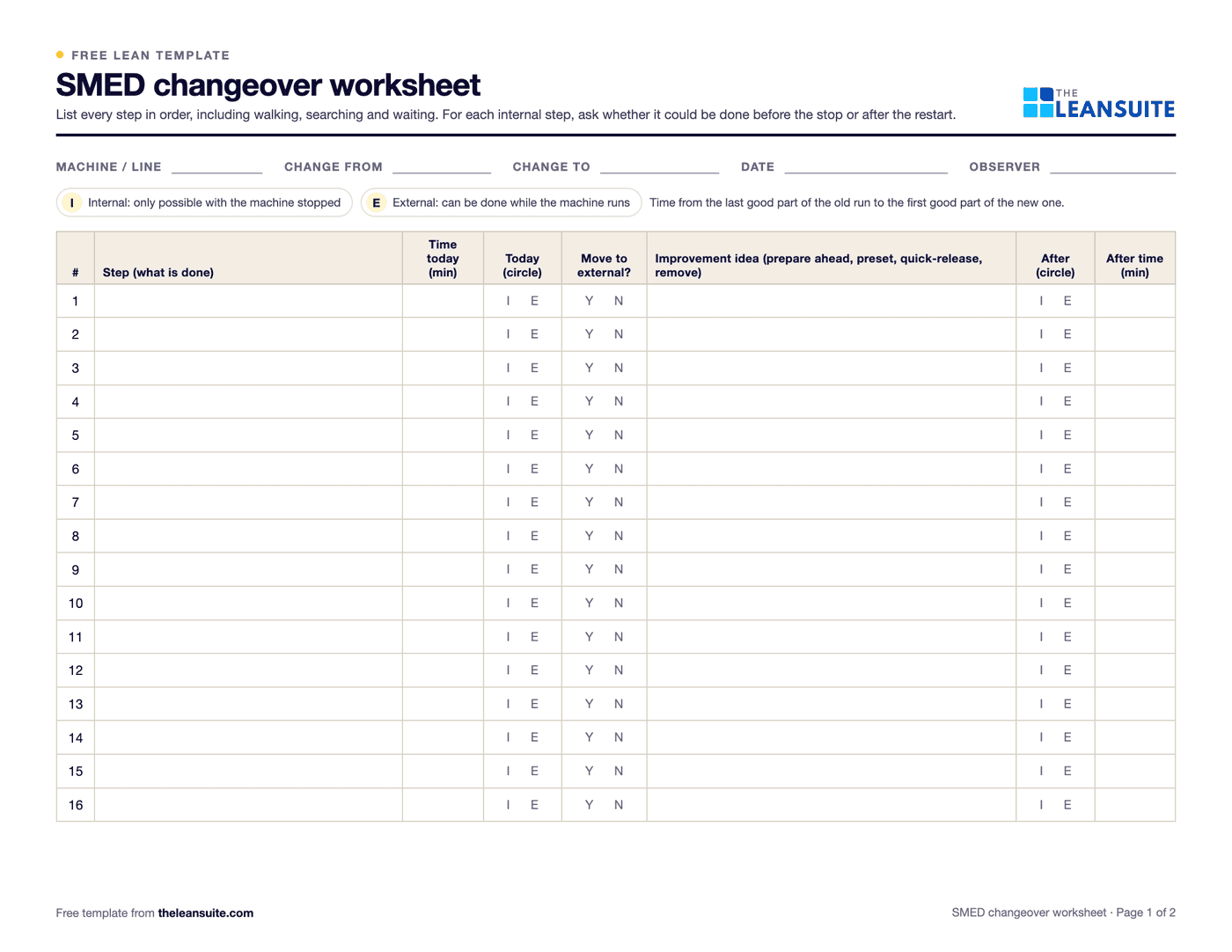 PDF and ExcelSMED changeover worksheetChangeover steps with times, internal or external, what can move, ideas and before/after totals.
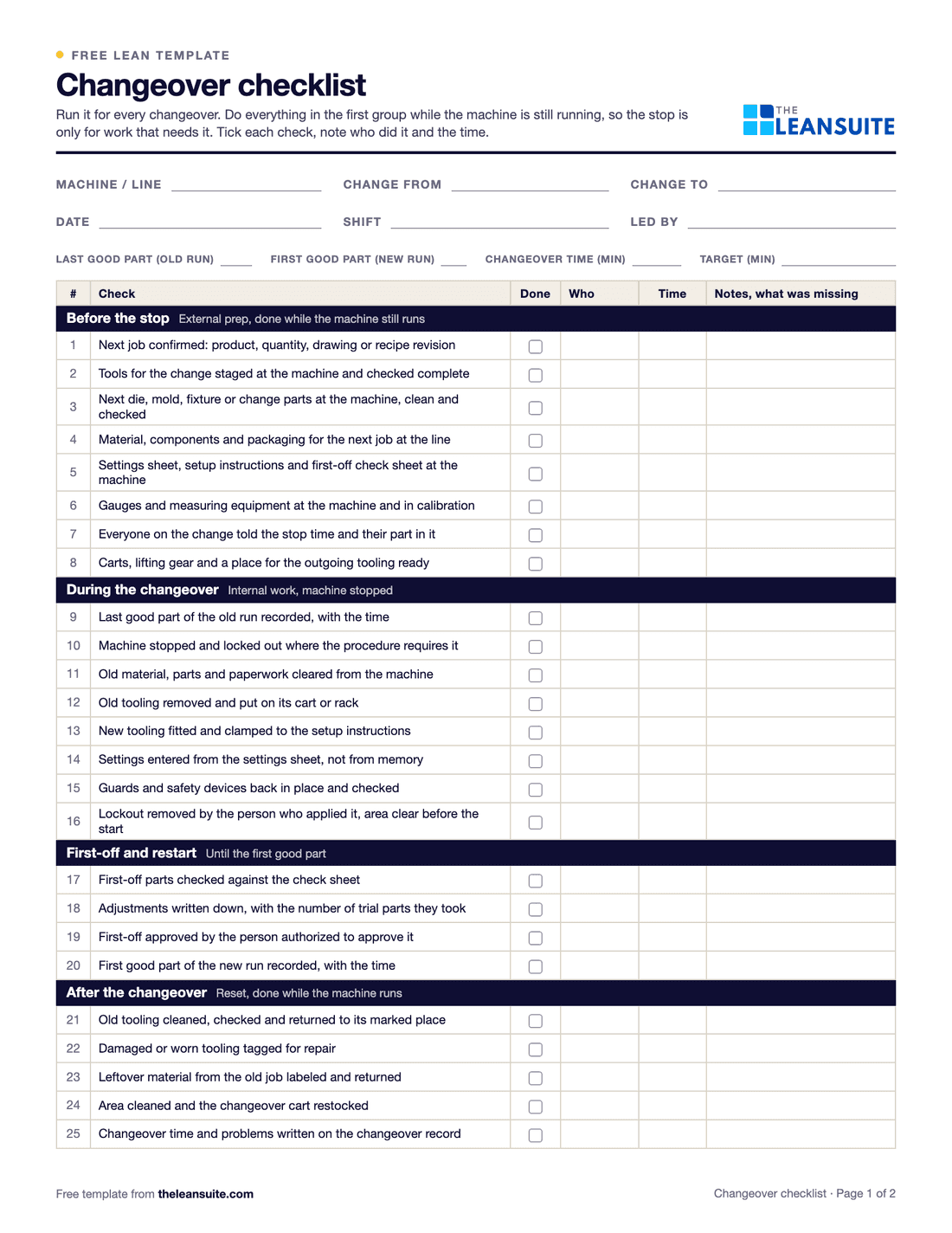 PDF and ExcelChangeover checklist25 checks for every changeover, a record of planned and actual times, and a log of changeover time against target.
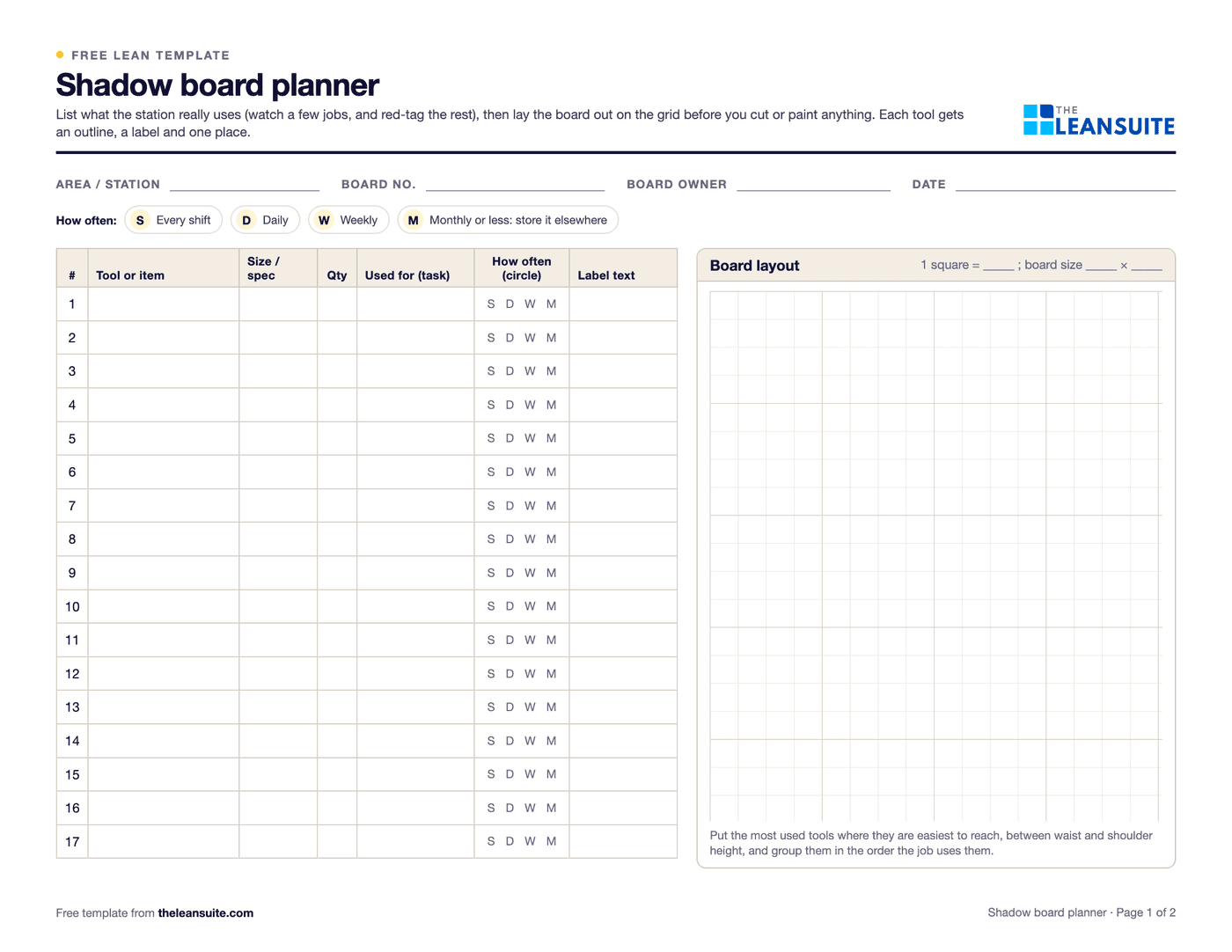 PDF and ExcelShadow board plannerTool inventory with fetch time, a layout planned from each tool's outline size, a month of daily checks with 5S audit evidence, and a missing tool log.
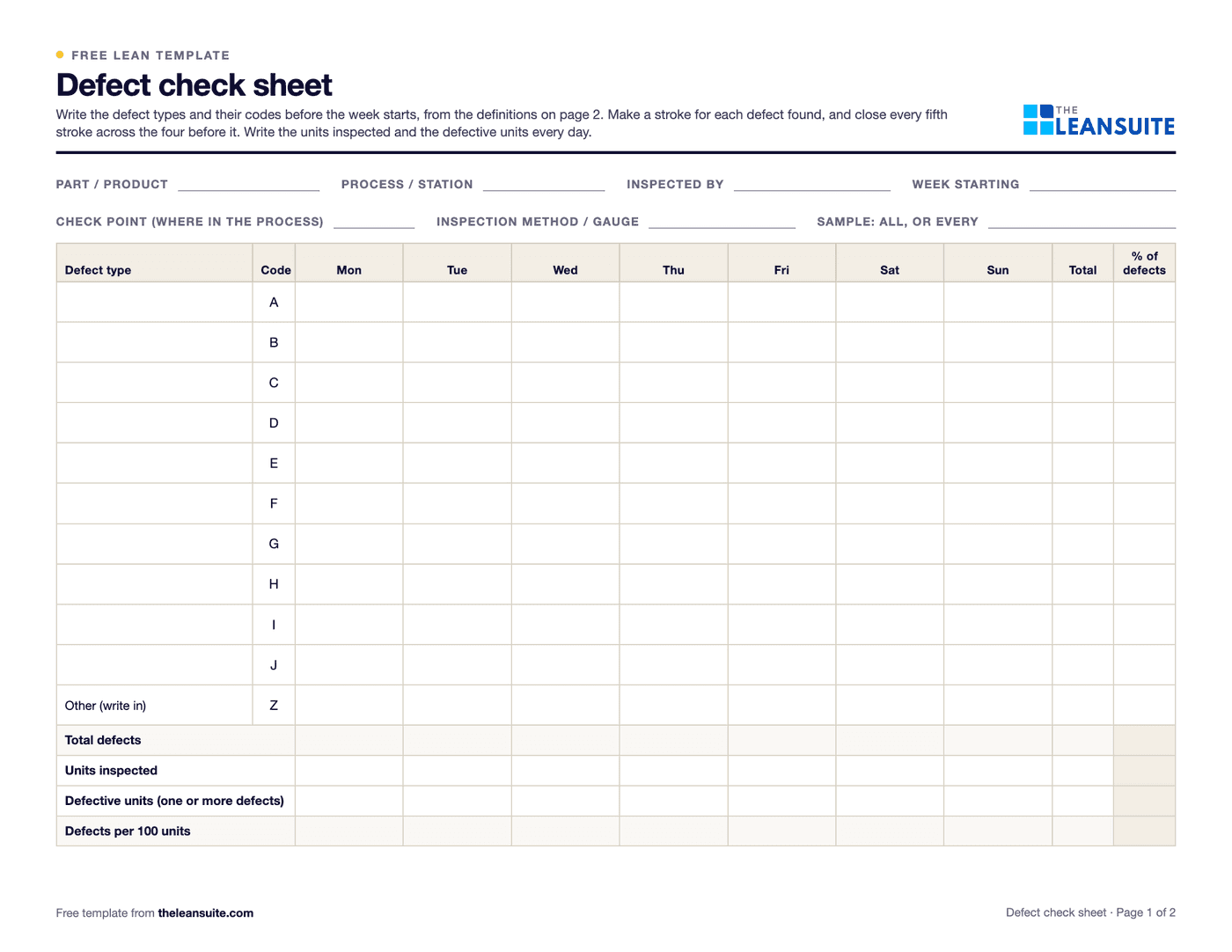 PDF and ExcelDefect check sheetTally defects by type and day, with units inspected, defect rates, a location sheet and the week's Pareto.
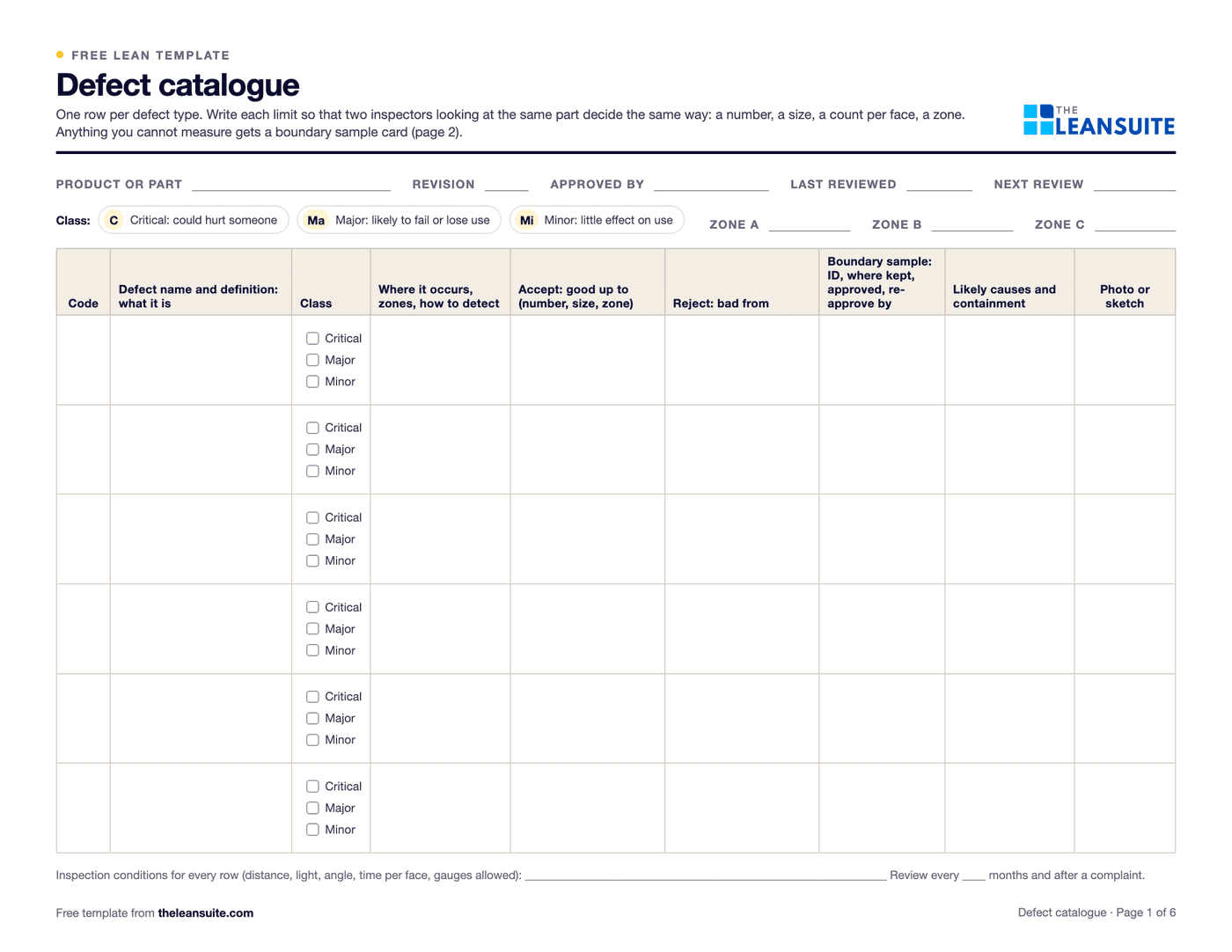 PDF and ExcelDefect catalogue template with boundary samplesEvery defect with a definition, a class and the reason for it, measured accept and reject limits by zone, boundary samples, a defect log with DPU and Pareto, and an inspector agreement check.
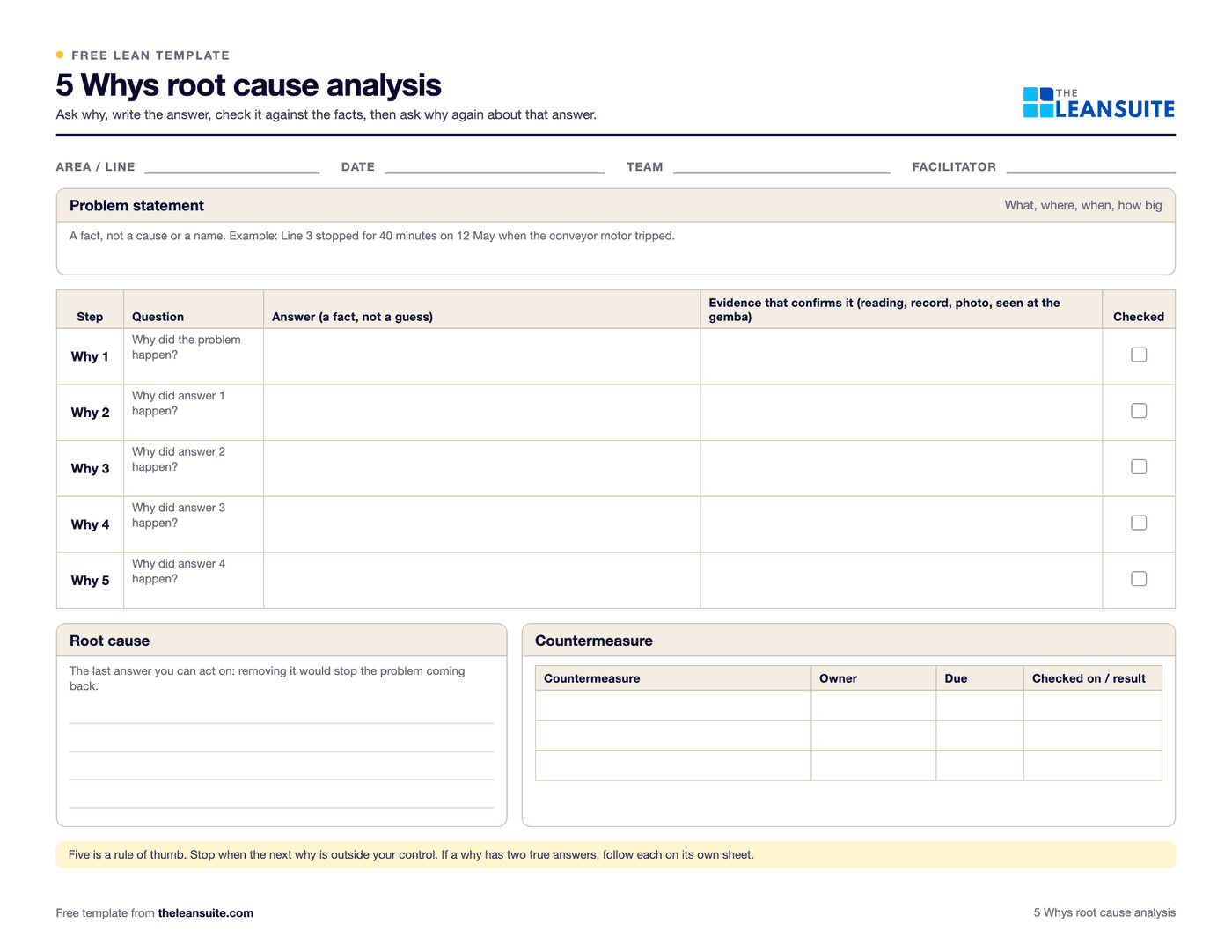 PDF and Excel and Word5 Whys templateA problem statement, a why chain that can branch, evidence for every answer, root causes and countermeasures that are checked.
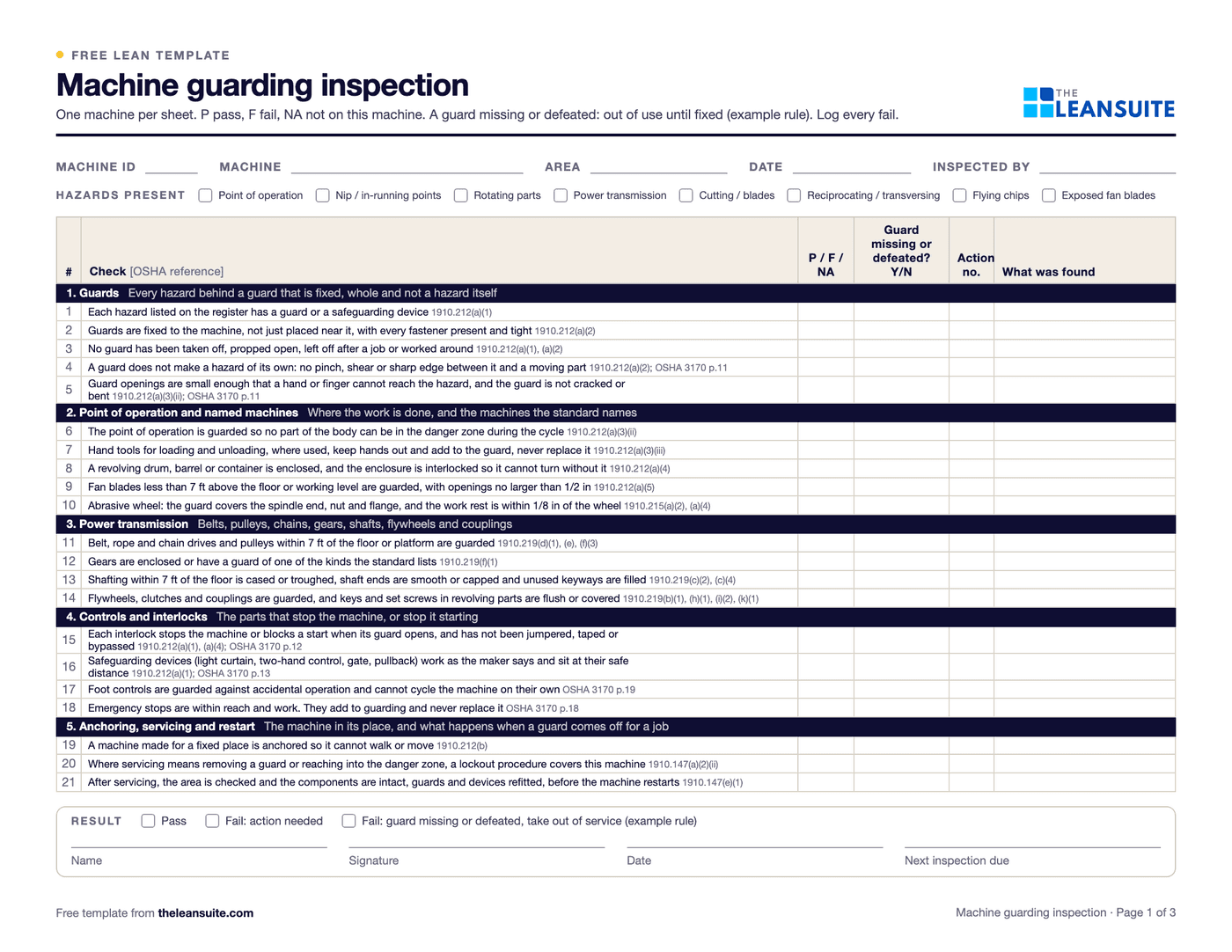 PDF and ExcelMachine guarding inspection sheetA machine register with due dates and a status per machine, 21 checks tied to OSHA 1910.212, .219 and .147, a guard opening check against Table O-10, and an action log.
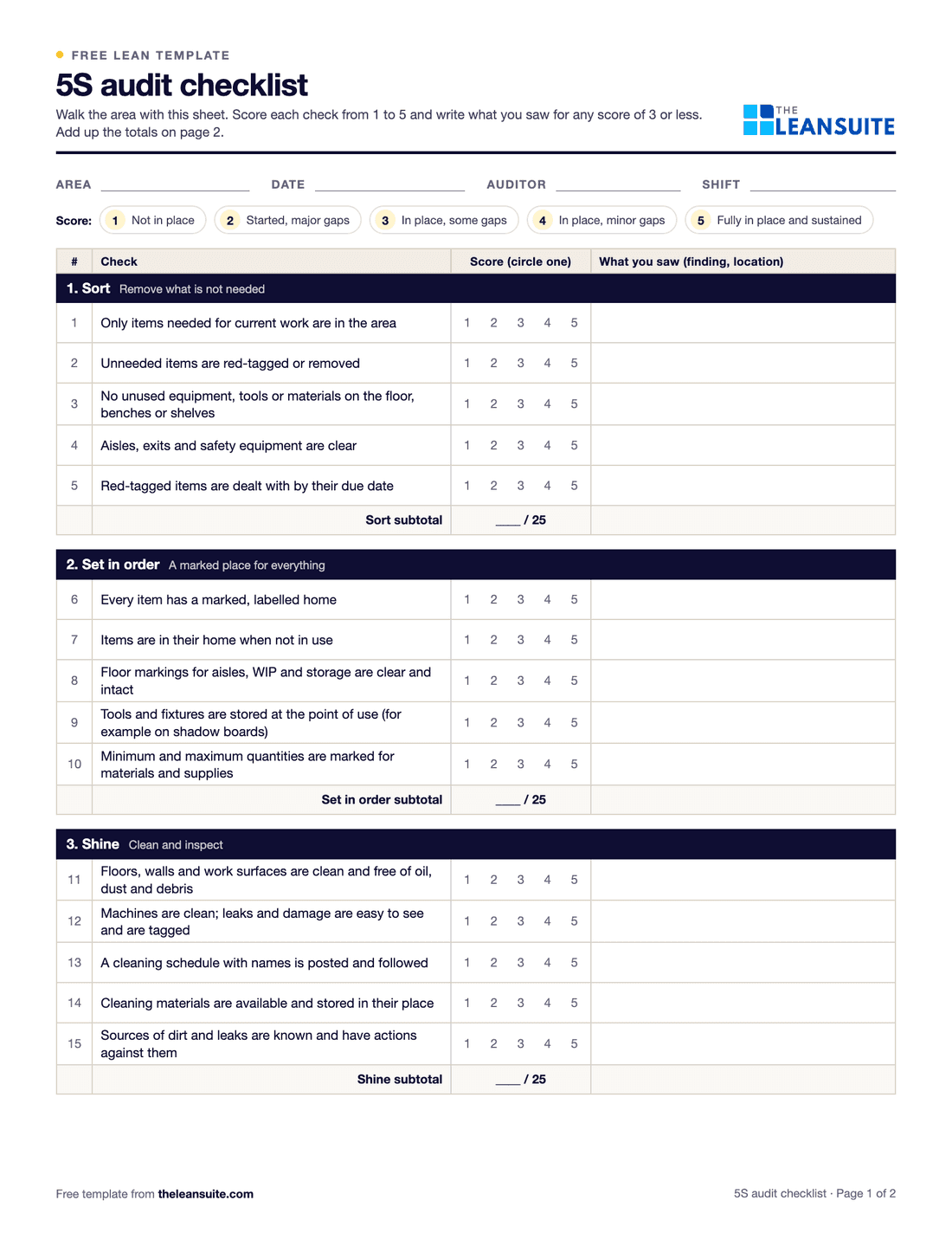 PDF and Excel and Word5S audit checklist template25 checks, five per S, scored 1 to 5, with a score summary and a chart of the five S's.
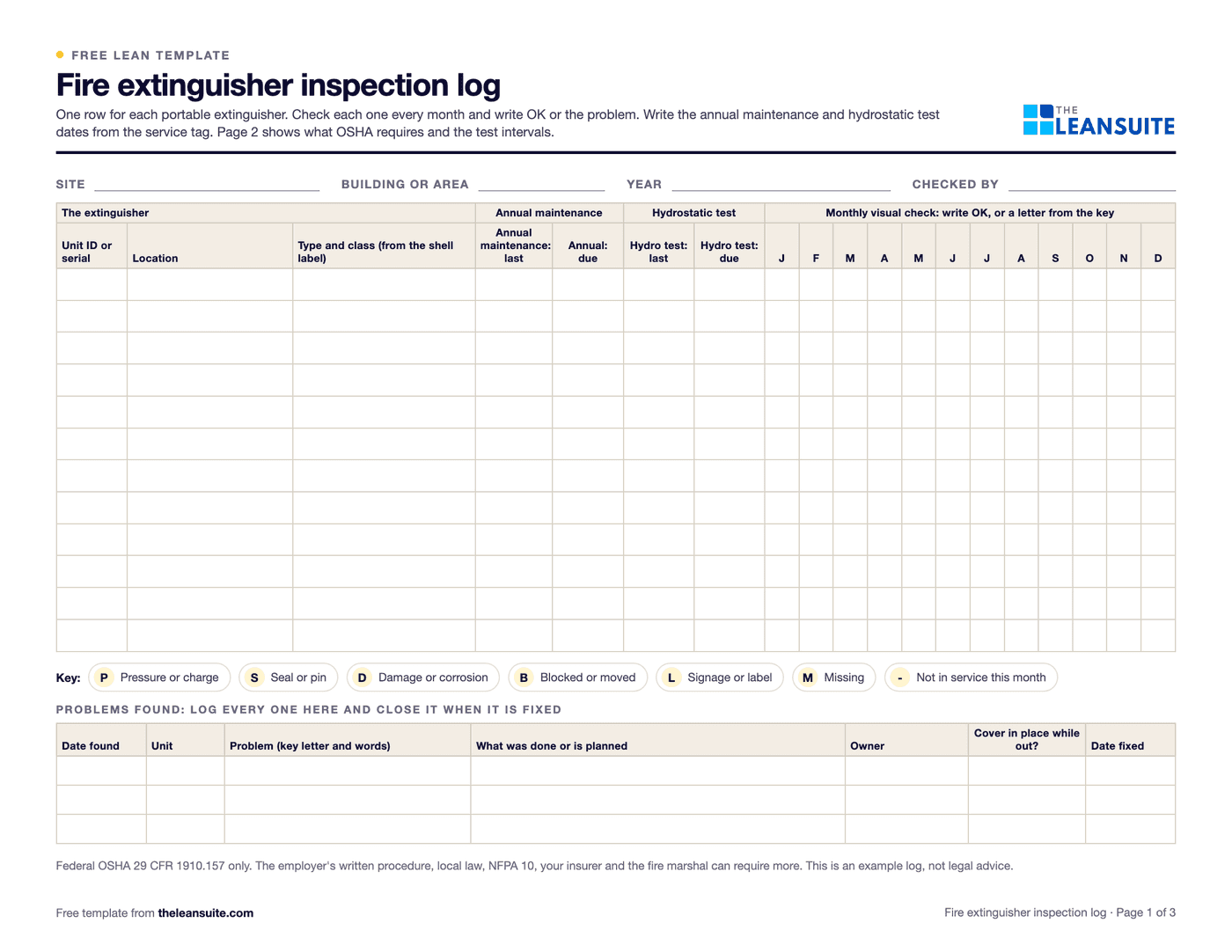 PDF and ExcelFire extinguisher inspection checklist and logThe 8 monthly checks for each portable extinguisher, plus a log with the hydro test interval from OSHA Table L-1, annual and 6-year due dates and open issues.
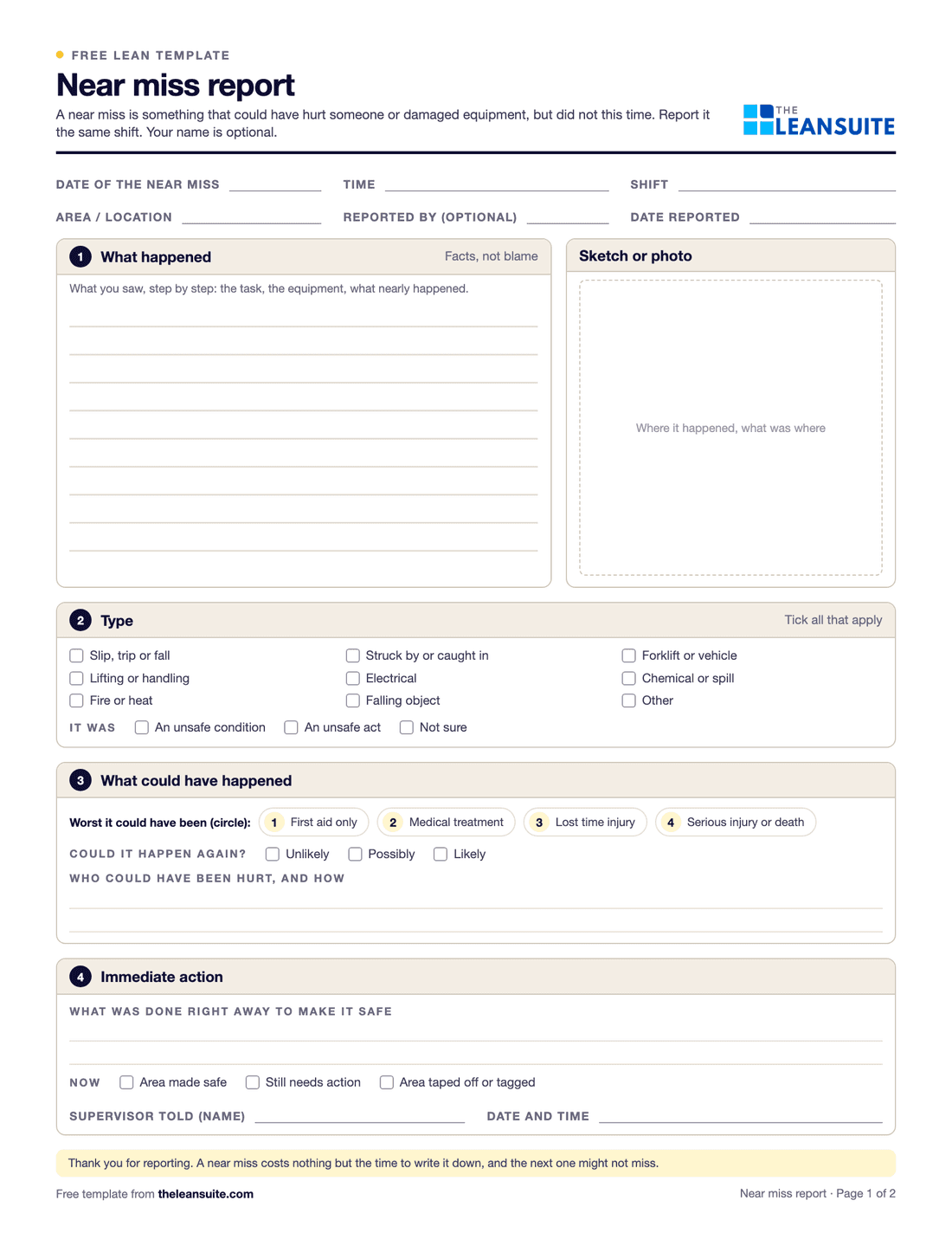 PDF and ExcelNear miss report formA two-page near miss report from the first report to closure, and an Excel log with status and days open.
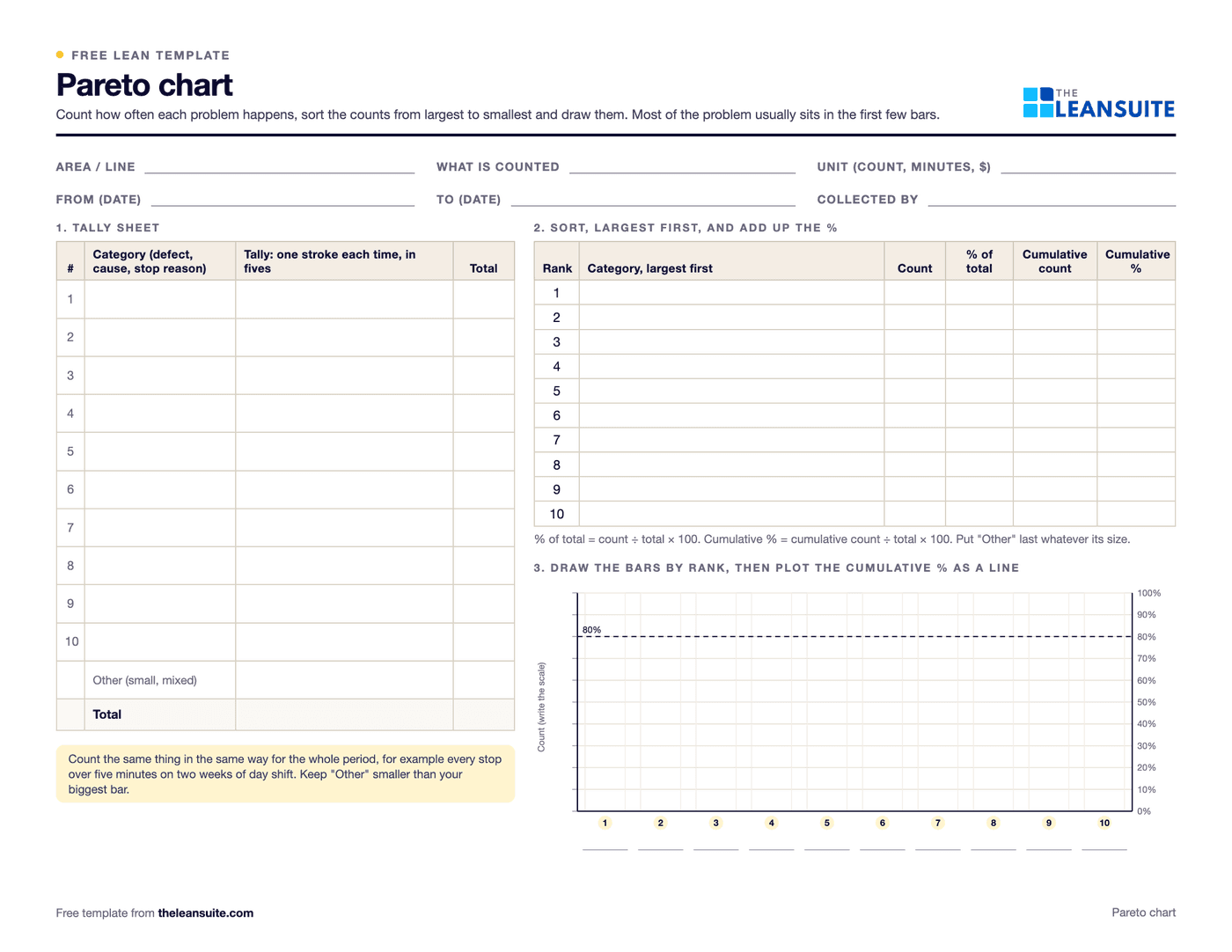 PDF and ExcelPareto chart templateA tally sheet, the Pareto by count and by cost with the cumulative line and the 80% cut, and a before and after comparison. Excel sorts and draws it.
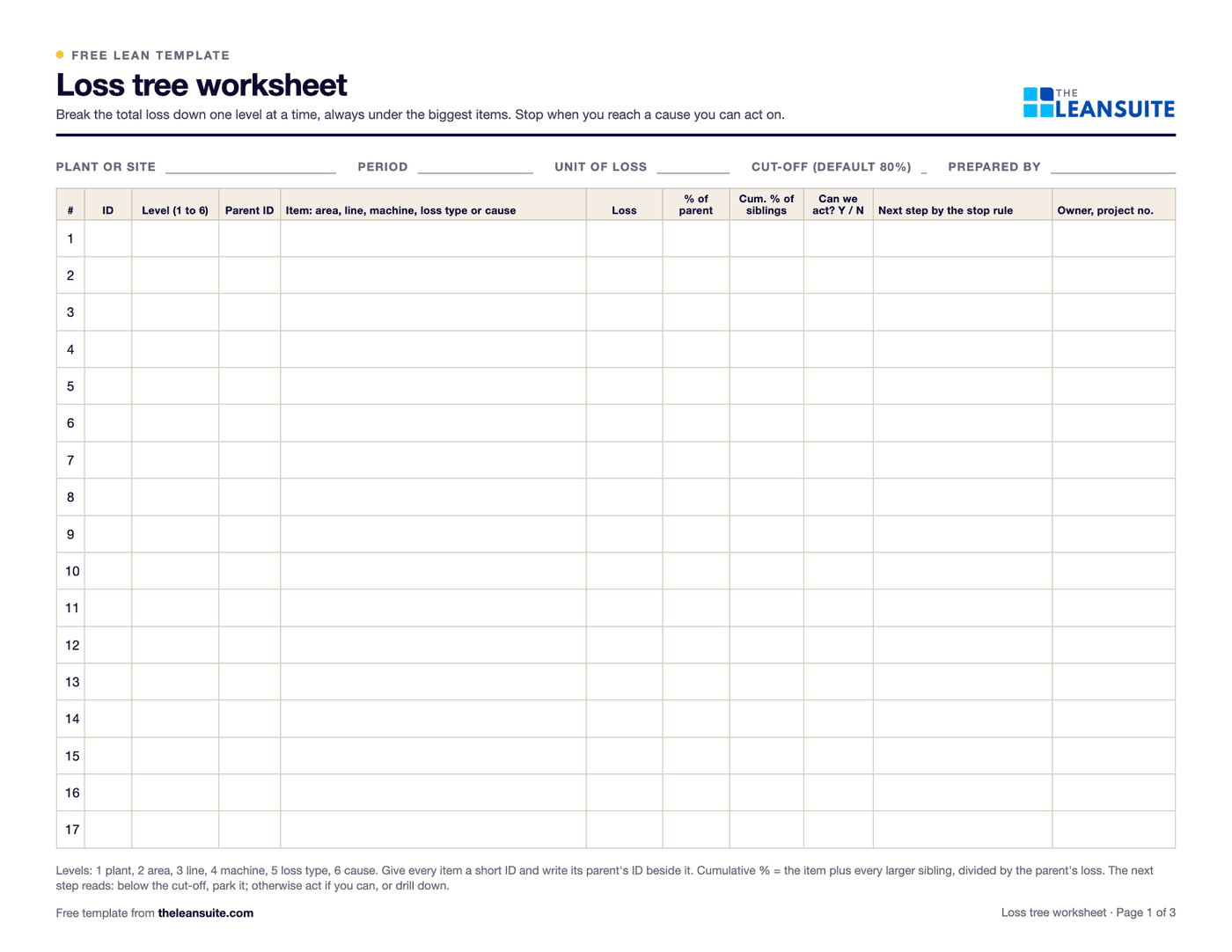 PDF and ExcelLoss tree worksheetBreak one big loss number into area, line, machine, loss type and cause, and stop at the cause a team can fix.
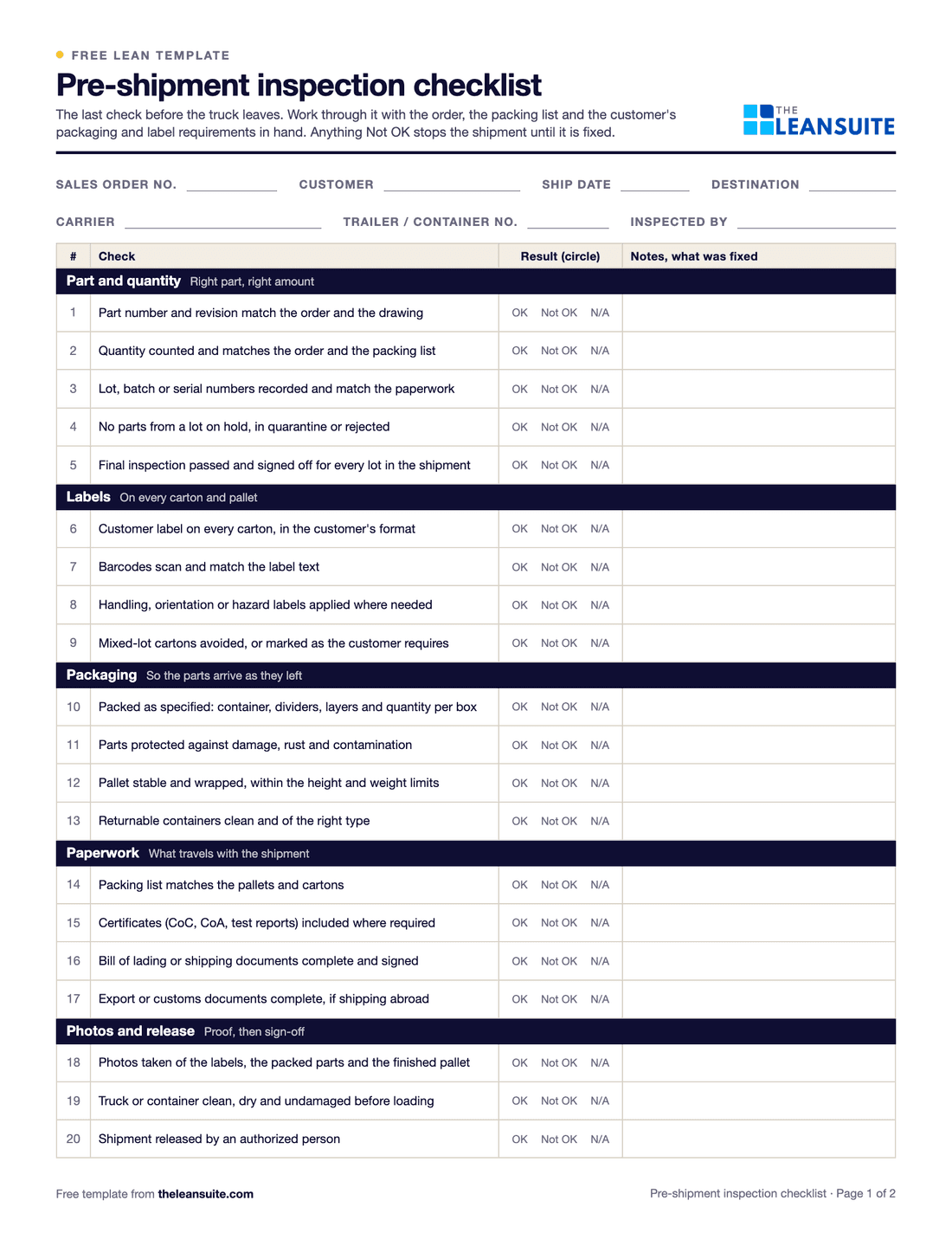 PDFPre-shipment inspection checklistThe last check before shipping: part, quantity, labels, packaging, paperwork and photos, then release.
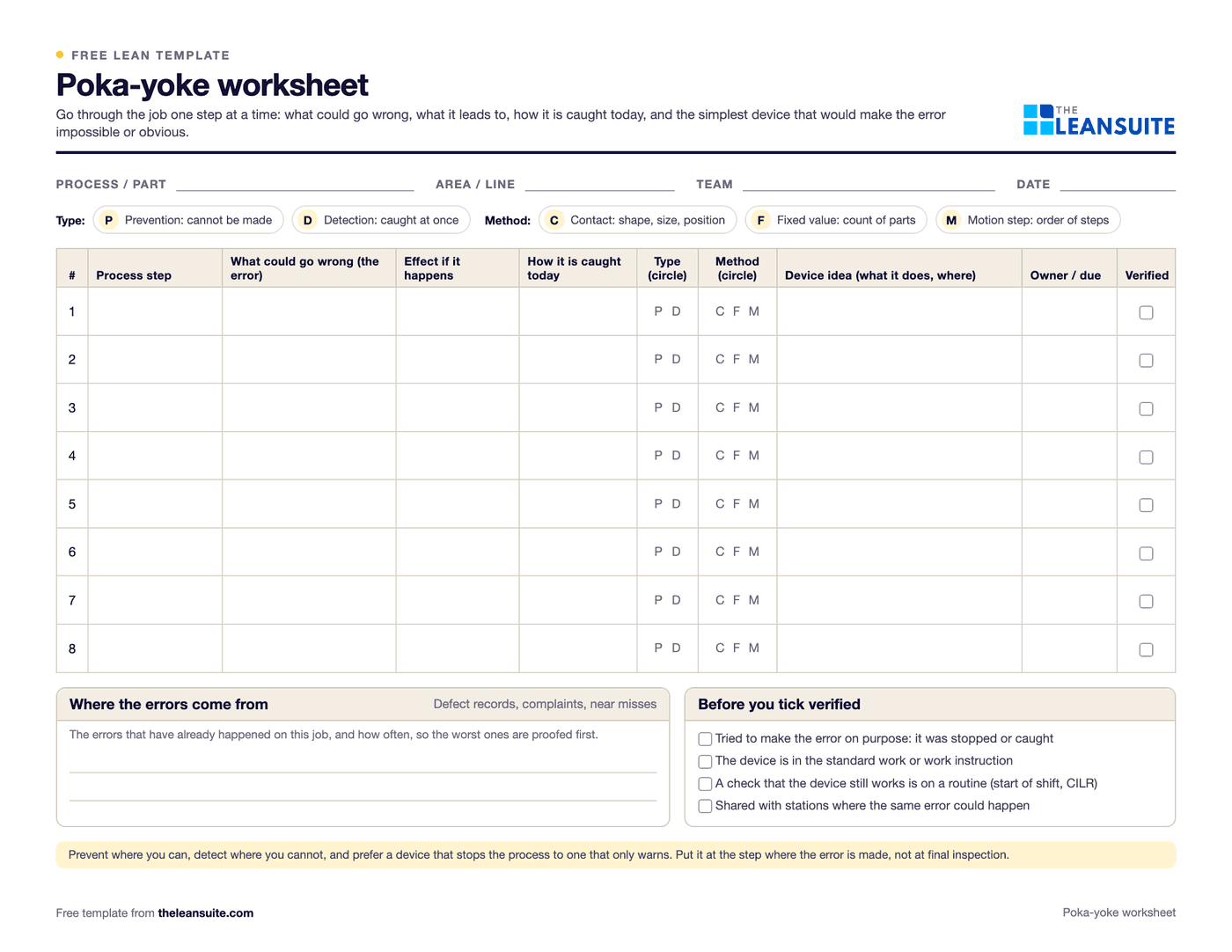 PDF and ExcelPoka-yoke worksheetEach step's errors and what they cost, the device (approach, function, method), payback, and a log that proves each device works.
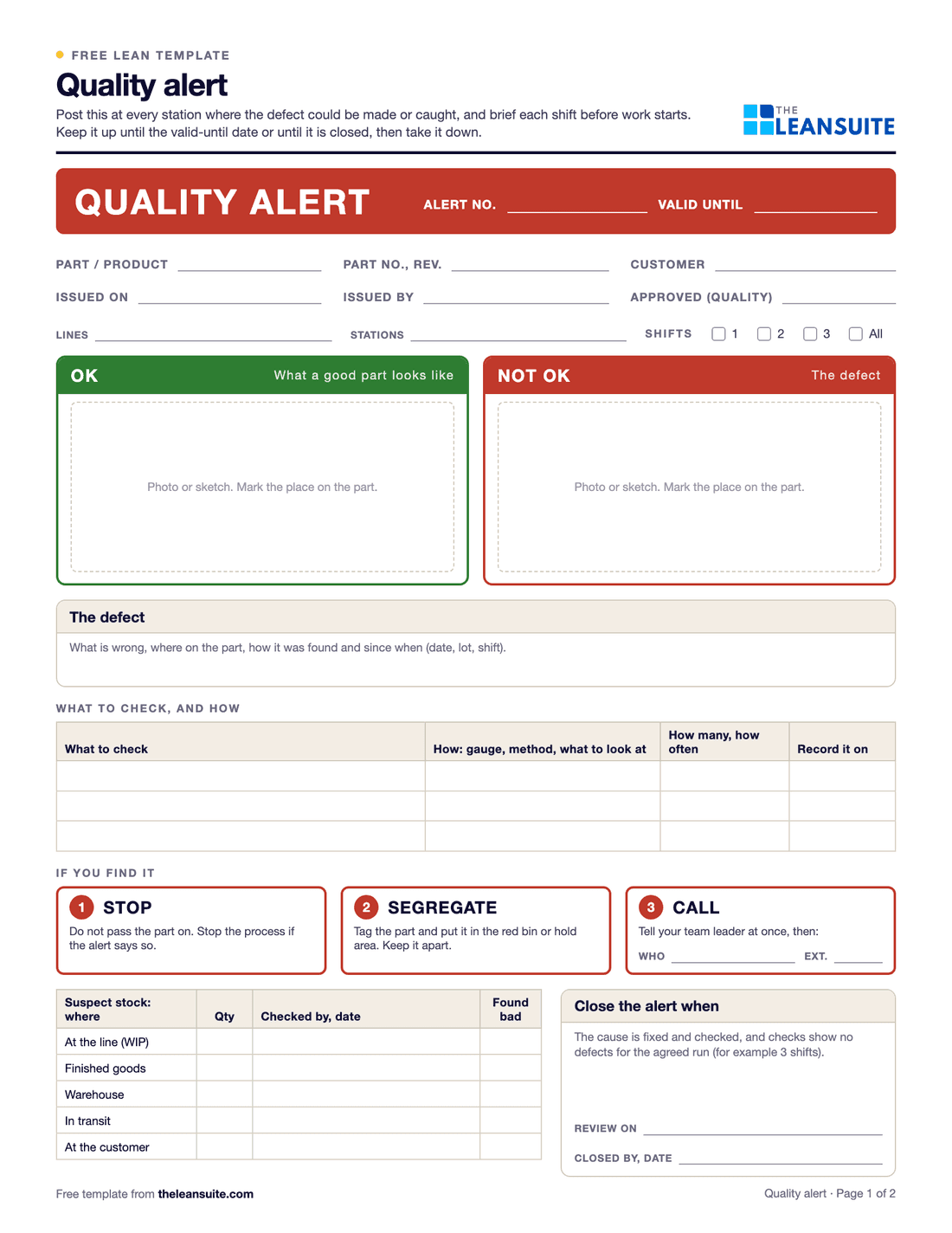 PDF and ExcelQuality alert formA quality alert to post at the line, a sign-off sheet for every shift, and a log of open, expired and closed alerts.
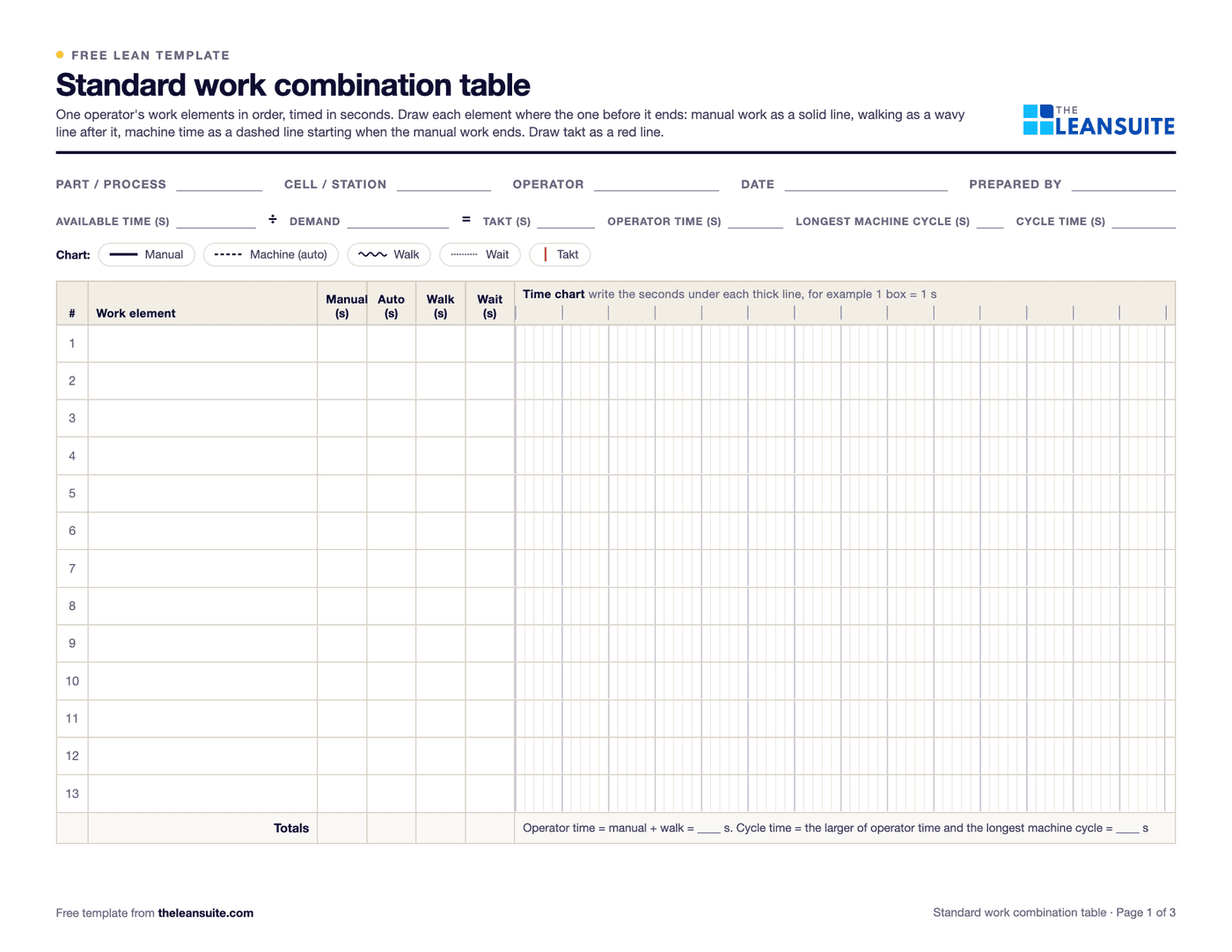 PDF and ExcelStandard work combination tableOne operator's manual, machine, walk and wait time on a time chart against takt, with machine cycles and a process capacity sheet.
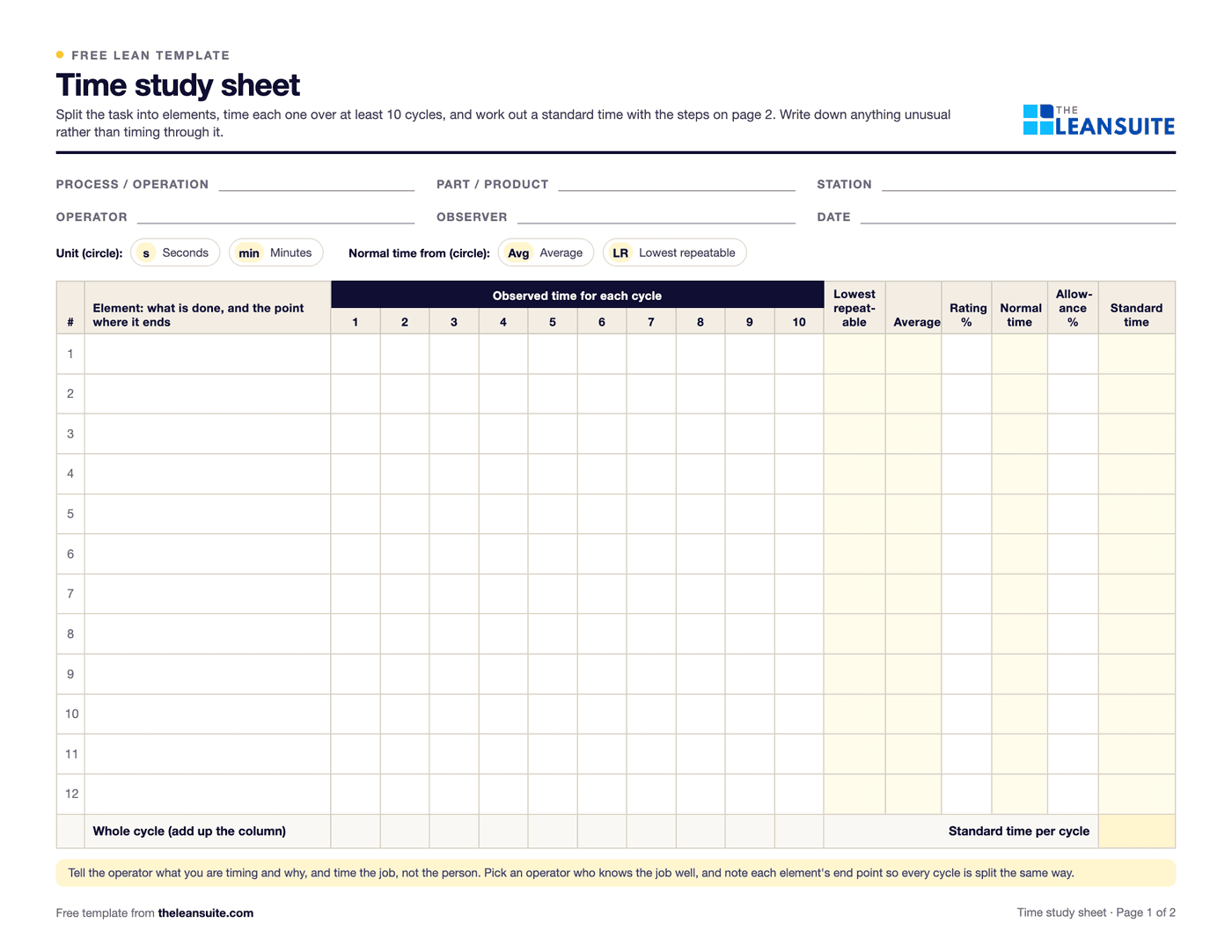 PDF and ExcelTime study sheetTime each element over 10 cycles and work out the average, lowest repeatable and standard time. Excel does the sums.
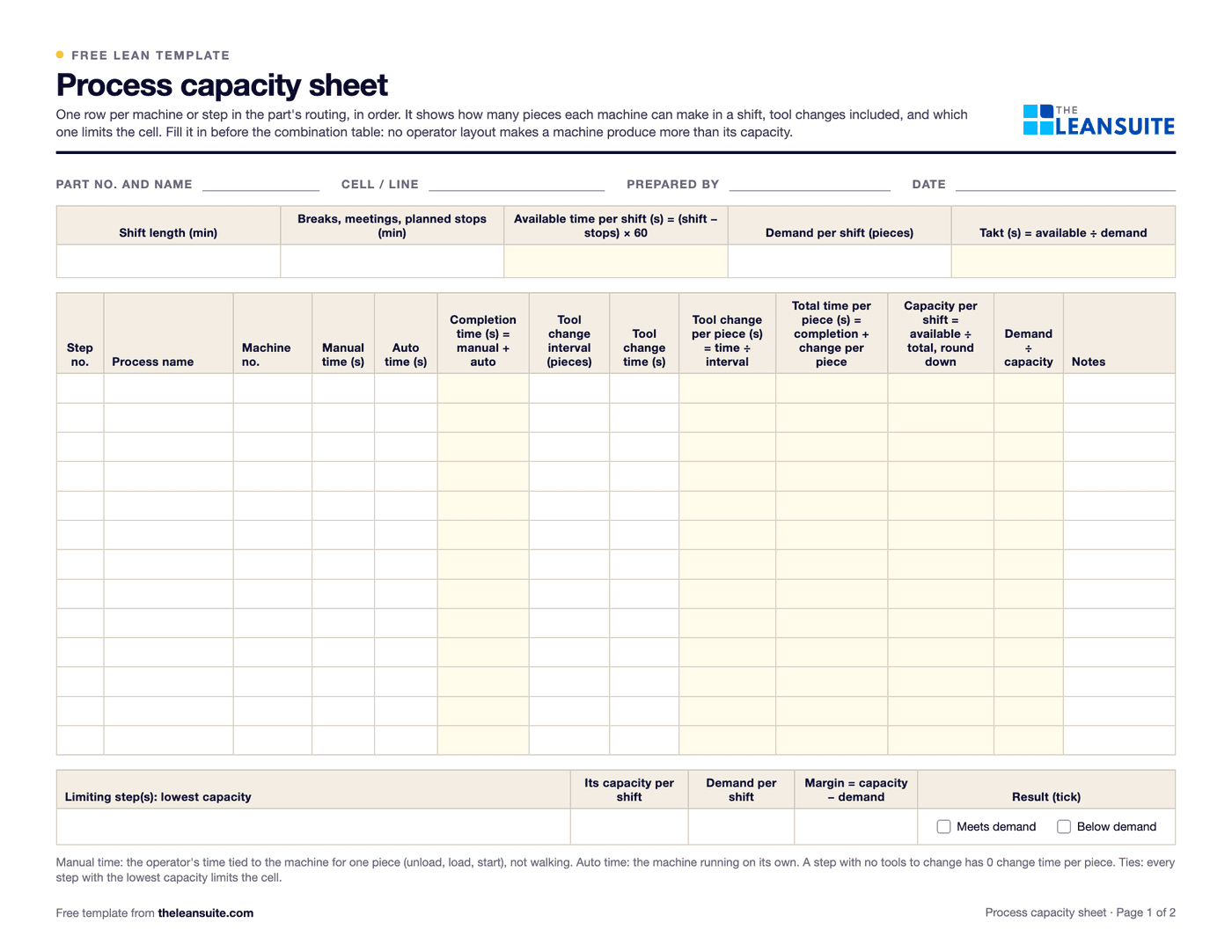 PDF and ExcelProcess capacity sheet templateEach machine in a part's routing with manual, auto and tool change time, its capacity per shift, and the step that limits the cell against demand.
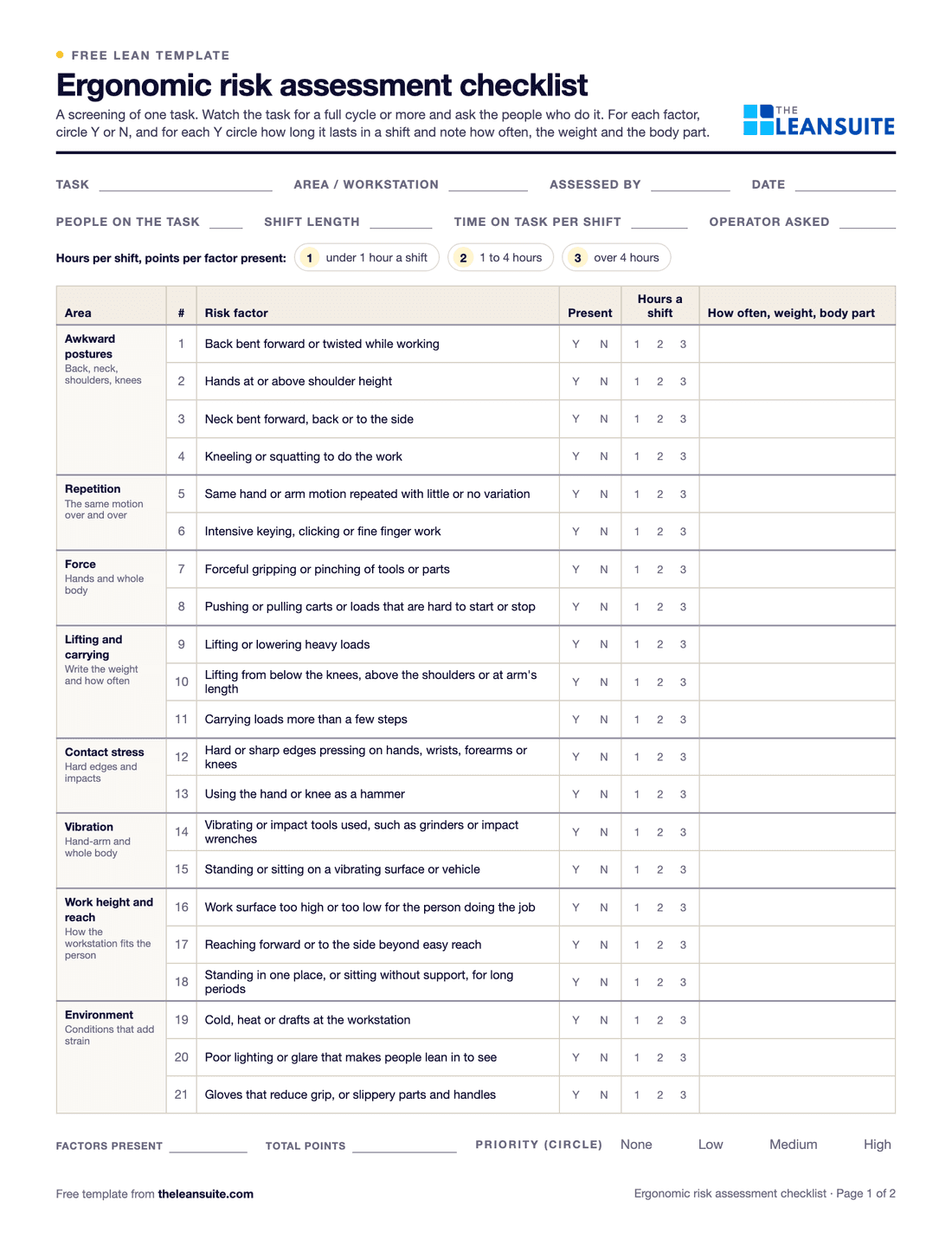 PDF and ExcelErgonomic risk assessment checklistScreen a task for 21 ergonomic risk factors, score how long each lasts, and rank tasks so the worst get controls first.
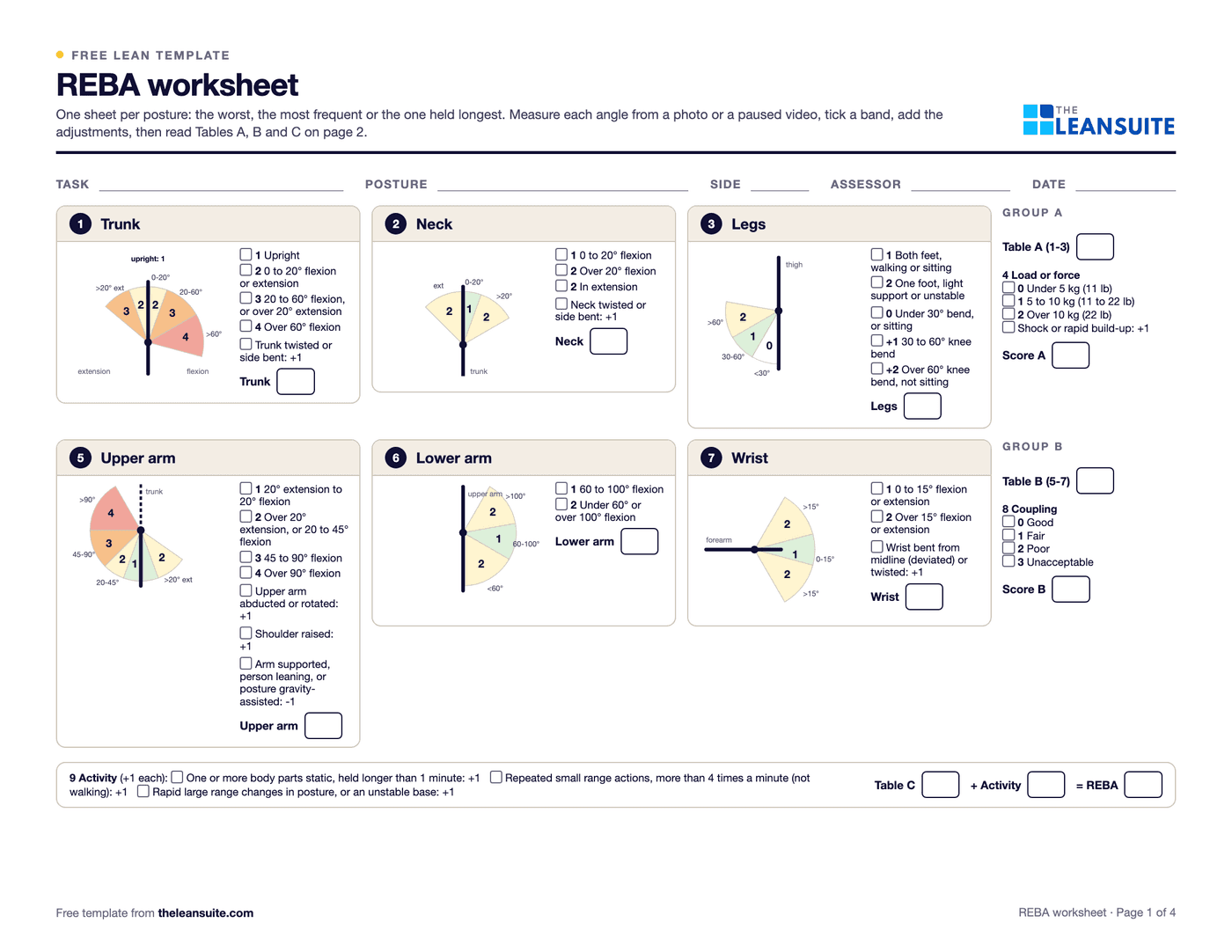 PDF and ExcelREBA worksheet (Rapid Entire Body Assessment)Score up to six postures with REBA: body-part drop-downs, Tables A, B and C as lookups, final score and action level, and a before and after comparison.
Calculators (8)
- Free calculatorSMED changeover calculatorTime saved by moving changeover steps from internal to external, capacity freed per week and the smaller batch it allows.
- Free calculatorFirst pass yield (FPY) calculatorFirst pass yield at each step and rolled throughput yield (RTY) across the whole process.
- Free calculatorCost of poor quality (COPQ) calculatorTotal COPQ and cost of quality, and each as a share of revenue, from the four quality cost categories.
- Free calculatorScrap rate calculatorScrap rate, the cost of scrap per period and per year, and what reaching a target rate would save.
- Free calculatorLine balancing calculatorLine efficiency, balance delay and the minimum number of stations from station times and takt.
- Free calculatorTakt time calculatorThe pace a line must hit to meet customer demand, from shift time, breaks and daily demand.
- Free calculatorNIOSH lifting equation calculatorRecommended weight limit and lifting index for a two-handed lift, with every multiplier shown so you can see what to redesign.
- Free calculatorTRIR and DART rate calculatorOSHA recordable and DART incident rates from your 300A case counts and hours, and what one more case does to them.
Buyer's guides
LeanSuite pages for these problems
- SMED
- AI SMED changeover analysis
- Non-Conformance (NCR)
- Cost of Poor Quality
- 5S Audits
- Audit Management
- Near Miss Reporting
- Loss & Cost Management
- Checklists
- Line Balancing
- Time and Motion Study
- Ergonomic Study
How LeanSuite handles each of these is on the page for furniture and cabinet plants.
Whirlpool tackled project visibility and continuous improvement across 14 manufacturing plants with LeanSuite. Read the Whirlpool case study.
FAQ
Lean in furniture and cabinet plants: common questions
Start with one area where orders are late or reworked and count the losses: setup time, first pass yield at finishing, material yield and short or damaged shipments. Then use the method that fits each loss: SMED for setups, defect tallies and an approved color sample for finishing, line balancing against takt for assembly, 5S for dust and tools. Fix two losses, write the new method down and move to the next area.
Find out which defect costs most before changing anything. Tally defects by type and product at final inspection for two weeks. Keep a signed color and sheen sample under the same light at the booth and at inspection. Then trace the top defect back to sanding, booth conditions, gun setup or cure, fix that cause and write it into the booth standard.
Contact with saw blades and cutters when guards are removed or bypassed, combustible wood dust, solvent vapour from spray finishing, and strains from lifting and handling heavy parts. Guard and housekeeping checks every shift, a dust housekeeping standard, lockout for blade and cutter changes, and lift aids for the heaviest tasks deal with most of them.
Yes. A custom shop rarely builds the same unit twice, so the focus moves from line speed to setups, first-time quality, material yield and getting complete orders out on time. Standardize the steps that repeat on every job, such as cutting, edge banding, hardware kitting and pack-out, and leave the craft where it adds value.
On-time delivery, first pass yield at finishing, material yield and setup time on the main machines. Add balance efficiency on assembly lines, claims per 100 orders and TRIR once those are in place.
See LeanSuite on your setups and finishing line
Bring the routine you want to fix first. We will show you how LeanSuite handles it and what a 90-day pilot would cover.