
Free training deck
Updated · About 40 minutes
Poka-yoke (mistake-proofing) training presentation
Poka-yoke is the Japanese lean term for mistake-proofing. It means designing a step so a mistake cannot be made, or is caught at once, instead of asking people to be more careful. This free deck teaches it to a team in about 40 minutes. Its 18 editable slides cover the difference between a mistake and a defect, why people make mistakes, control and warning devices, Shingo's three methods (contact, fixed-value and motion-step), the three kinds of inspection, a ranking of fixes from strongest to weakest, a six-step way to design one, how to keep it working, an illustrative worked example, the common mistakes, a 20-minute floor activity and four check questions with answers. Every slide has speaker notes.
Free to use: print it, copy it and edit it for your team. Enter your name and work email once to download.
 The title Poka-yoke, mistake-proofing the work, on a navy background with the LeanSuite logo.
A look inside
What is in the 18 slides
For operators, team leaders, supervisors, quality, process and maintenance engineers. Widescreen, in plain language, with speaker notes on every slide.
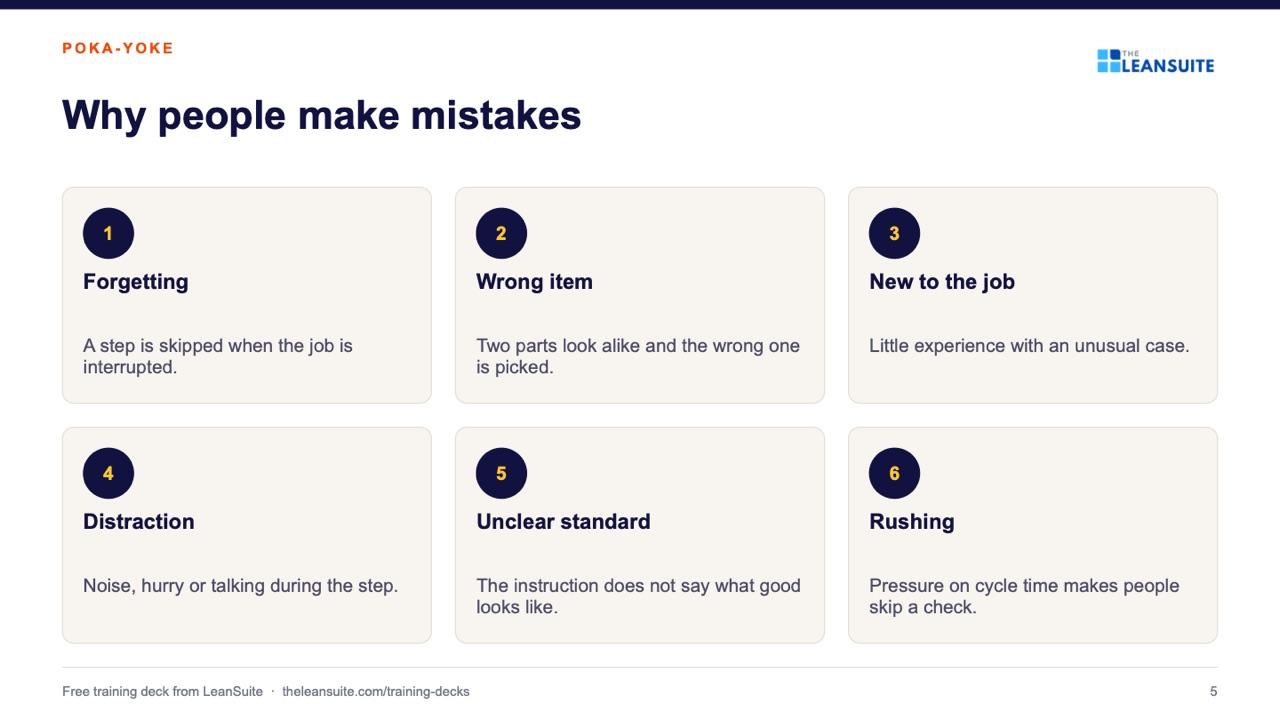
Slide 5: Why people make mistakes 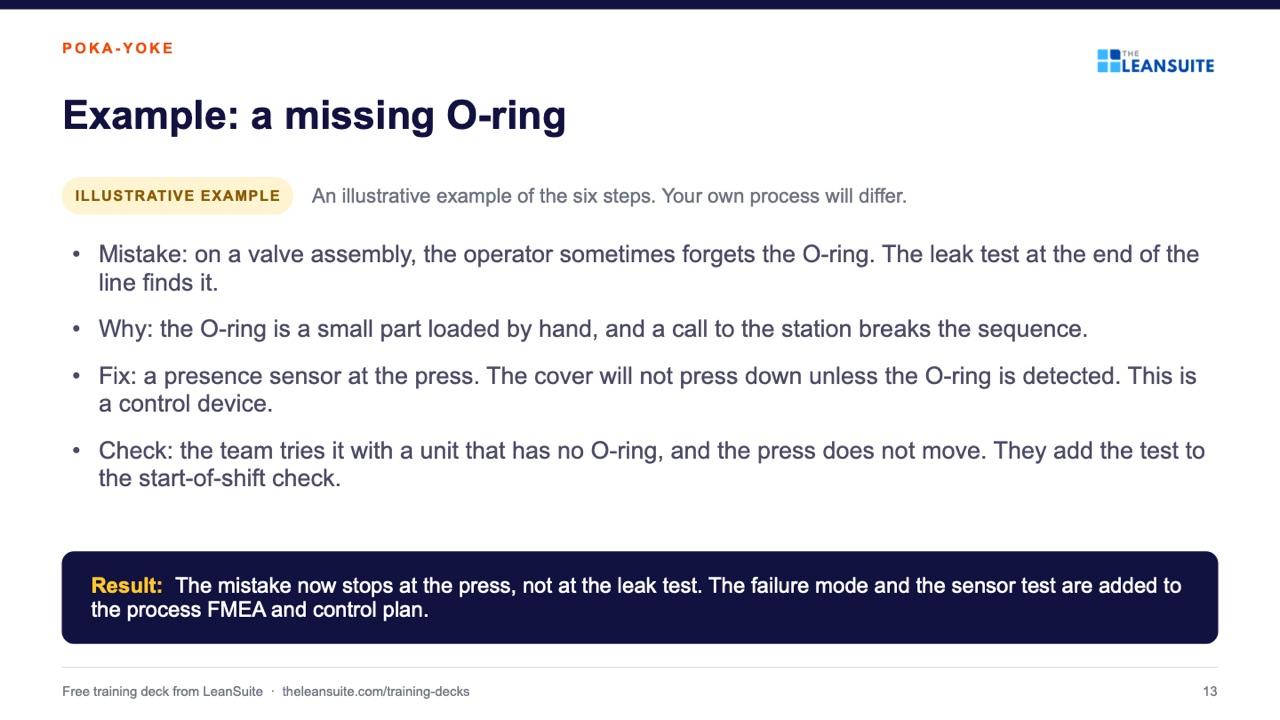
Slide 13: Example: a missing O-ring 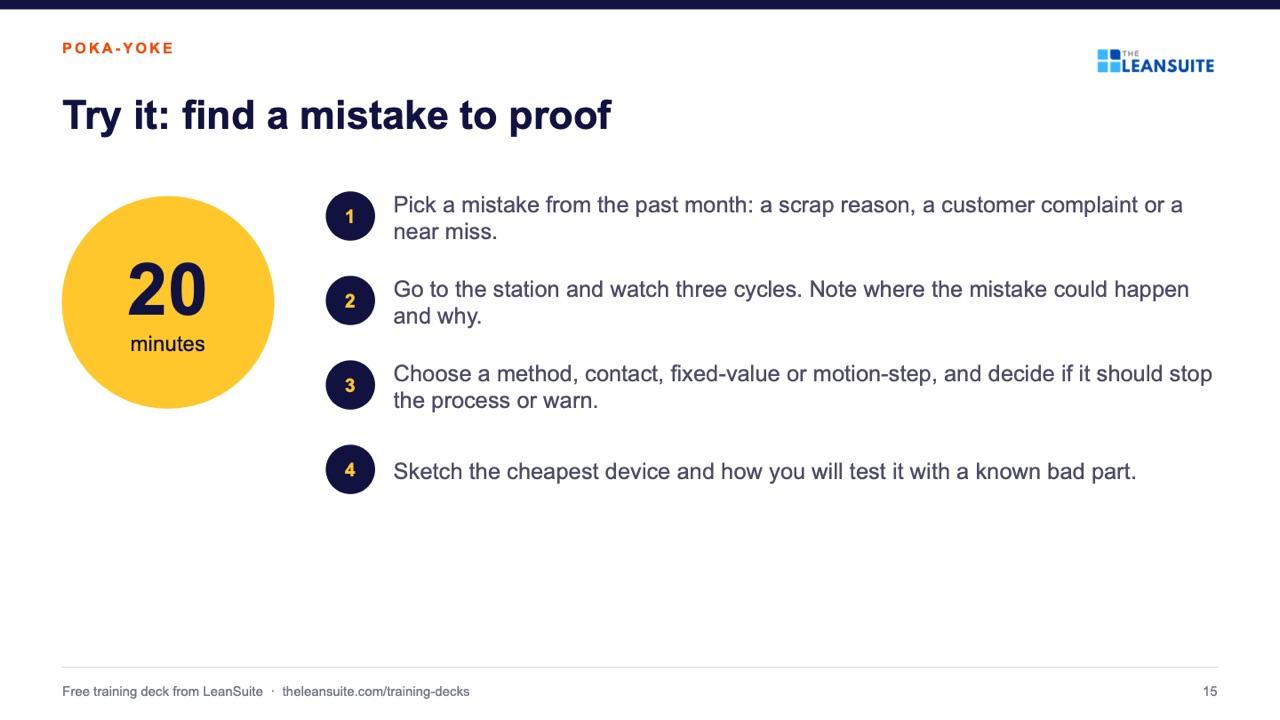
Slide 15: Try it: find a mistake to proof
- 1Poka-yoke: mistake-proofing the workCover
- 2AgendaMistakes, defects and why mistakes happen · Control and warning devices, and the three methods · Ranking fixes and designing a poka-yoke · Keeping it working, example and common mistakes · Floor activity and check questions
- 3What poka-yoke isPoka-yoke means error-proofing: a simple device or design that stops a mistake or catches it at once.
- 4A mistake is not a defectShingo separated the cause from the result. Stop the mistake becoming a defect and the customer never sees it.
- 5Why people make mistakesForgetting, Wrong item, New to the job, Distraction, Unclear standard, Rushing
- 6Control devices and warning devicesA poka-yoke either stops the process or tells someone. Stopping is stronger.
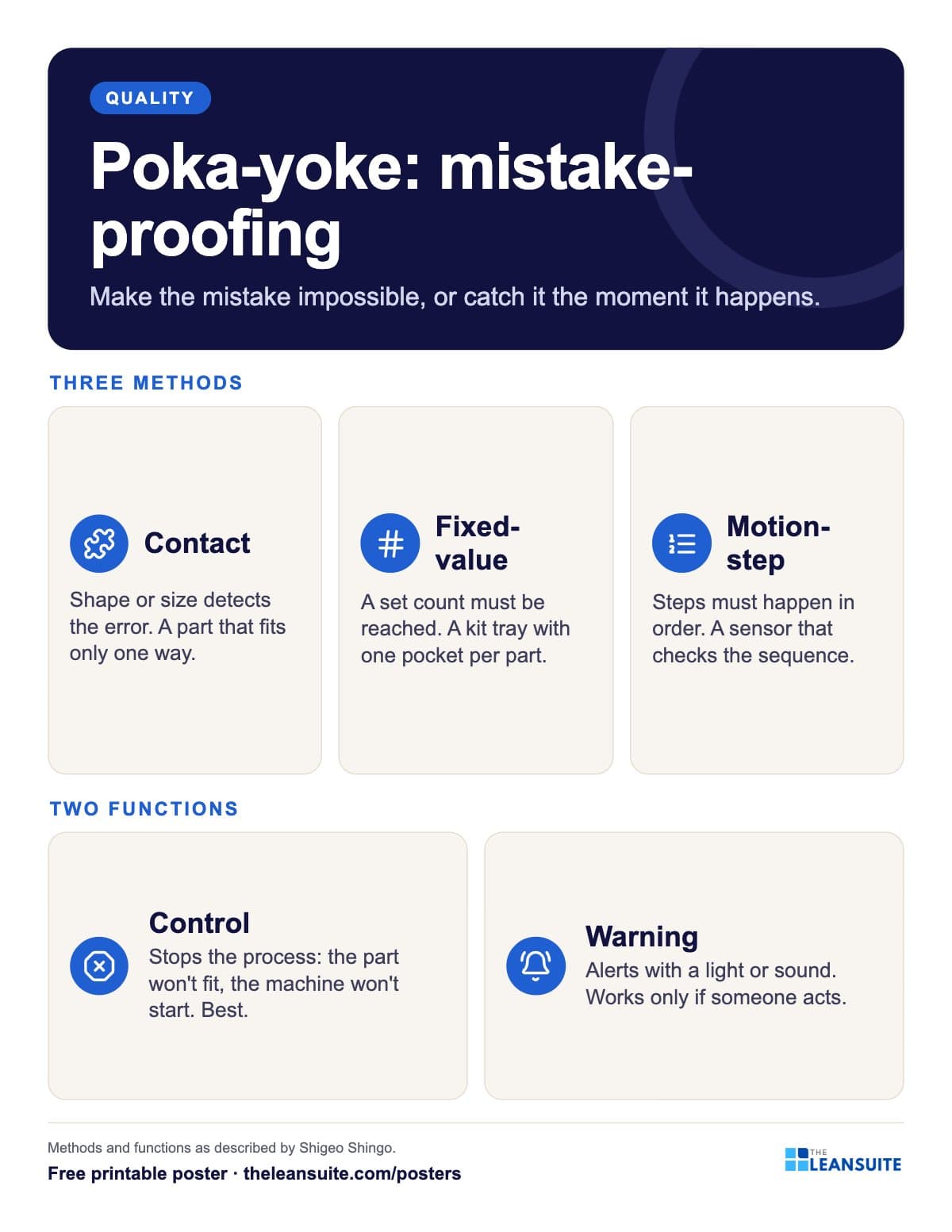
- 7The three methodsShingo grouped poka-yoke by what it checks.
- 8Where you catch the errorShingo described three kinds of inspection. The earlier you catch the problem, the better.
- 9Examples you can point atTypical examples. Yours will be different, but the idea is the same.
- 10Ranking the fix, strongest firstRemove the step, Make it impossible, Stop the process, Warn the person, Inspect afterwards, Remind or retrain
- 11How to design one in six stepsStart from a real mistake: scrap, a customer complaint, a near miss or a high-risk failure mode in the process FMEA.
- 12Keeping it workingA poka-yoke that fails without anyone knowing is worse than none, because people stop checking.
- 13Example: a missing O-ringAn illustrative example of the six steps. Your own process will differ.
- 14Common mistakesUsing a sign or a retraining session when a physical fix is possible.
- 15Try it: find a mistake to proofA 20-minute team activity
- 16Check your understanding4 check questions
- 17AnswersThe answers, to discuss
- 18Key points and next stepsNext: take one mistake from your area and run the six steps.
The 40-minute session, slide by slide
- Slides, about: 20 minutes
- Activity (slide 15): 20 minutes
Present · 14 slides
- 1Poka-yoke: mistake-proofing the work
- 2Agenda
- 3What poka-yoke is
- 4A mistake is not a defect
- 5Why people make mistakes
- 6Control devices and warning devices
- 7The three methods
- 8Where you catch the error
- 9Examples you can point at
- 10Ranking the fix, strongest first
- 11How to design one in six steps
- 12Keeping it working
- 13Example: a missing O-ring
- 14Common mistakes
Do the activity · 1 slide
- 15Try it: find a mistake to proof
Check and follow up · 3 slides
- 16Check your understanding
- 17Answers
- 18Key points and next steps
About 20 minutes of slides and 20 minutes of activity. Present: slides 1 to 14 (Poka-yoke: mistake-proofing the work; Agenda; What poka-yoke is; A mistake is not a defect; Why people make mistakes; Control devices and warning devices; The three methods; Where you catch the error; Examples you can point at; Ranking the fix, strongest first; How to design one in six steps; Keeping it working; Example: a missing O-ring; Common mistakes). Do the activity: slide 15 (Try it: find a mistake to proof). Check and follow up: slides 16 to 18 (Check your understanding; Answers; Key points and next steps).
How to run it
Running the session
- 1
Prepare
Read the speaker notes once and swap the illustrative example for one from your own area if you have it. Print the PDF if people like a handout.
- 2
Present
The slides take about 20 minutes. Every slide has notes, so you can talk from them rather than read the slide.
- 3
Do the activity
Pick a mistake from the past month: a scrap reason, a customer complaint or a near miss. The activity slide takes the team through it step by step; allow 20 minutes.
- 4
Check and follow up
Ask the check questions before showing the answers, then agree one next step with an owner and a date before people leave.
The check questions
- 1. What is the difference between a mistake and a defect?
- A mistake is an error made at the step. A defect is the result when it reaches the product. Poka-yoke stops the mistake becoming a defect.
- 2. What are the three poka-yoke methods?
- Contact (shape, size or colour), fixed-value (a set count) and motion-step (a set sequence).
- 3. Why is a control device stronger than a warning device?
- A control device stops the process, so it does not depend on anyone noticing. A warning works only if someone reacts.
- 4. Why test a poka-yoke regularly?
- A device that fails silently is worse than none. A known bad part shows it still works.
Templates and guides to go with it
- Poka-yoke worksheetEach step's errors and what they cost, the device (approach, function, method), payback, and a log that proves each device works.
- Error-proofing verification log (daily master-sample check)Each poka-yoke device proved every day or week with a known-bad sample, with missed checks counted and the hours and parts at risk worked out when one fails.
- PFMEA template (process FMEA)Failure modes, effects and causes rated for severity, occurrence and detection, with RPN before and after action.
- Jidoka worksheet (stop at abnormality)For one line or cell, every abnormality that should stop the work: how it is detected, how the work stops, who is called, the immediate fix and the root cause step, plus a log of real stops.
- Topic: Quality managementEvery guide we have on the subject, sorted.
After the session
Put it on the wall
Free printable poster on the same subject, so the team sees it every day: a PNG to download now, and print-ready PDFs from Letter to 24 x 36 in.
FAQ
Poka-yoke (mistake-proofing) training presentation: common questions
Poka-yoke is Japanese for mistake-proofing. Poka means an inadvertent error and yoke means prevention. It is a design or device that stops a mistake or catches it at once.
About 40 minutes: roughly 15 minutes of slides, a 20-minute floor activity and the check questions.
Shingo's three methods are contact (shape, size or colour), fixed-value (a set count) and motion-step (a set sequence). The deck also covers the two functions, control devices that stop the process and warning devices that alert someone.
No. The method applies to any process where a mistake can reach the product, from assembly to packing and food handling. The deck mentions IATF 16949 clause 10.2.4 for automotive suppliers, and you can drop that line if it does not apply.
Yes. The PowerPoint file is fully editable, including the speaker notes. Many teams replace the illustrative O-ring example with a mistake from their own plant.
More free training decks
- 5S training presentationSort, set in order, shine, standardize and sustain in 16 slides, with a 15-minute sort activity and a quiz.View deck
- Kaizen training presentationWhat kaizen is, its principles, PDCA and four steps to a first improvement in 17 slides, with an activity and a quiz.View deck
- Autonomous maintenance training presentation: the 7 stepsThe 7 steps of jishu hozen, who does what and how step audits work, in 19 slides with notes and a quiz.View deck
- 8 wastes of lean training presentationValue vs waste, the 8 wastes (TIMWOODS) with examples, muda, mura and muri and a waste walk, in 17 slides.View deck
- Gemba walk training presentationGo see, ask why, show respect: how to plan, run and follow up a gemba walk, in 16 slides with a practice walk.View deck
- Root cause analysis training presentation: 5 whys and fishboneDefine, contain, the 5 whys, the fishbone diagram and verifying the cause, in 18 slides with a team activity.View deck
- TPM training presentation: the 8 pillarsWhat TPM is, the six big losses, OEE and the 8 pillars, in 19 slides with a loss-spotting activity.View deck
- Manufacturing excellence pillars training presentationThe 20 pillars, cost deployment, the 7-step approach, model areas and audits, in 17 slides.View deck
- Obeya room training presentationWhat an obeya is, what goes on its walls and how to run the meetings, in 15 slides with a design activity.View deck
- DMAIC training presentationDefine, measure, analyze, improve and control, with the main tools of each phase, in 16 slides.View deck
- SMED training presentationInternal and external setup, the four SMED stages and how to halve a changeover, in 16 slides.View deck
- FMEA training presentationDFMEA and PFMEA, severity, occurrence and detection, RPN and action priority, in 16 slides.View deck
- Kanban training presentationPull instead of push: how a kanban loop works, the card types, the rules and how to size it, in 16 slides.View deck
- Lockout tagout (LOTO) training presentationHazardous energy, lockout versus tagout and the six steps in order, with a walk-round activity, in 17 slides.View deck
- Quality management system (QMS) training presentationWhat a quality management system is, the ISO 9001 clauses, procedures and records, corrective action and audits, in 18 slides.View deck
- SPC and Cpk training presentationCommon and special cause variation, X-bar and R limits, reading signals, Cp and Cpk, with worked numbers, in 19 slides.View deck
- MSA and Gage R&R training presentationThe five measurement properties, how a gage R&R study works, %GRR and ndc with worked numbers, and attribute gauges, in 19 slides.View deck
- PPAP and APQP training presentationThe five APQP phases, gates, the 18 PPAP elements, the five submission levels and the capability criteria, in 19 slides.View deck
- OEE training presentationHow to calculate OEE and read the six big losses in 19 slides, with one worked shift, a 20-minute exercise and a quiz.View deck
- Leader standard work training presentationWhat leader standard work is, the routine at each level, five steps to build it and how to keep it going, in 19 slides with an exercise and a quiz.View deck
- Daily management and tier meetings training presentationTier meetings, boards, huddles and escalation in 19 slides, with a worked example, a 20-minute huddle exercise and a quiz.View deck
- 5 Whys training presentationOhno's machine example, how to ask good whys, when to stop and where the method falls short, in 20 slides with a team exercise.View deck
- A3 problem solving training presentationThe seven boxes, the three kinds of A3, how to write and coach one, with two worked example slides and a 30-minute exercise, in 20 slides.View deck
- Layered process audit (LPA) training presentationWhat a layered process audit is, the layers, how to write and ask good questions, handle a no and read the results, in 19 slides.View deck
- Standard work training presentationTakt time, work sequence and standard WIP, how to write a standard with the operators and how to keep it alive, in 18 slides.View deck
- Value stream mapping (VSM) training presentationHow to map the current state, read lead time, design the future state with the eight questions and turn it into a plan, in 19 slides.View deck
- TWI job instruction training presentationThe four steps of TWI job instruction and the job breakdown sheet, from the original wartime card, with a worked example and a practice session.View deck
- 8D problem solving training presentationD0 to D8, containment, the root cause and the escape point, proving a fix and preventing repeats, in 20 slides with a team exercise.View deck
- Forklift safety training presentationOperator training rules, stability and load center, travel and dock rules and the daily exam, each tied to 29 CFR 1910.178, in 20 slides.View deck
- Hazard communication (HazCom, GHS) training presentationLabels, the eight GHS pictograms, the 16 SDS sections, employee training and the 2026 and 2028 dates, each tied to 29 CFR 1910.1200, in 20 slides.View deck
- New-hire safety orientation training presentationA day-one safety orientation for plants and warehouses: reporting, emergencies, PPE, chemicals, machines and trucks, with the OSHA paragraph behind each, in 17 slides.View deck
- 4M change management training presentationMan, machine, material and method changes, rating the risk, extra checks, the change point board and closing a change, in 19 slides.View deck
Training is the start. Keeping it going is the hard part.
See how plants run their audits, improvements and follow-ups in LeanSuite, on a call built around your own problem.
Book a 45-minute demo