
Practical guide · Kaizen and continuous improvement
PDCA: plan, do, check, act, with a worked shop-floor example
Short answer
PDCA is a four-step cycle for improving a process: plan a change, do it on a small scale, check the result against what you expected, then act by making it the standard or going round again. It is also called the Deming cycle.
PDCA stands for plan, do, check, act. In a plant it is used to test one change at a time. The plan names the problem, the baseline, the change and a predicted result. The do is a small trial. The check compares the result with the baseline, the prediction and the target. The act either writes the change into the standard or sends the team back to plan. The cycle only improves a process if the act ends in a standard, so the next turn starts from the new level.
Last reviewed:
What is PDCA?
The Lean Enterprise Institute defines PDCA as an improvement cycle based on the scientific method: propose a change in a process, implement it, measure the results and take appropriate action. It is also known as the Deming cycle or Deming wheel, and as PDSA when the third step is called study. It calls the cycle the foundation of kaizen.
On the shop floor that is one habit: write down what you expect, try the change small, look at the result, keep it only if it held. A kaizen event, an A3 report and a daily improvement board all run this loop under different names.
| PDCA | PDSA | |
|---|---|---|
| Third step | Check: did the plan meet its target? | Study: why did the result differ from the prediction? |
| Named for | Deming cycle or wheel, as taught in Japan in the 1950s | Called the Shewhart cycle by Deming, who wrote PDSA |
| Steps one, two and four | Plan, do, act | Plan, do, act |
Sources: Lean Enterprise Institute lexicon and Wikipedia, Plan-do-check-act.
The four phases of PDCA and what you write down in each
PDCA stands for plan, do, check, act, and the order matters. Plan names the problem, the change and a predicted result. Do runs the change as a small trial. Check compares what happened with the baseline and the prediction. Act makes the change the standard or sends the team back to plan.
The PDCA cycle
- P
Plan: What is wrong, why do we think so, and what do we expect a change to do?
- D
Do: Did the trial happen the way the plan said?
- C
Check: What happened, compared with the baseline, the prediction and the target?
- A
Act: Does the change become the standard, or do we go back to plan?
A wheel of four quarters running clockwise: plan, do, check and act. After act the wheel comes back to plan.
| Phase | The question | What you write down |
|---|---|---|
| Plan | What is wrong, why do we think so, and what do we expect a change to do? | The problem with a baseline number, the target, the suspected cause, the change, a predicted result, where and for how long the trial runs, and the measure. |
| Do | Did the trial happen the way the plan said? | What was actually done, on which line or shift, and every departure from the plan. |
| Check | What happened, compared with the baseline, the prediction and the target? | The result, the three comparisons, the result split by reason or shift, and any side effect. |
| Act | Does the change become the standard, or do we go back to plan? | The decision and why, the exact change to the standard work, who is trained, and the plan and prediction for the next turn. |
- 1
Plan: write a number for what the change should do
In the Japanese version of the cycle that Moen and Norman describe, planning means defining the problem and hypothesizing possible causes and solutions. Get the cause from data, with a 5 Whys or a fishbone, not from the loudest opinion. Then write a number for what the change should do. A plan with no prediction cannot fail, so it teaches nothing.
- 2
Do: a small trial, with departures noted
One machine, one line, one shift, for a set number of runs. If the change turns out to be wrong, a small trial is cheap to undo. Note what went differently from the plan, because a trial that drifted cannot be checked against it.
- 3
Check: a comparison, not a feeling
Put the result next to the baseline and the prediction, and split it by reason, because a total can hide a change that worked beside a side effect that did not.
- 4
Act: two exits, standardize or go round
Moen and Norman give them as returning to the plan step when the results are unsatisfactory and standardizing the solution when they are satisfactory. The Lean Enterprise Institute adds how: the team standardizes the new method by updating the standardized work, so the improvement is stable.
At the Check: standardize, or go round again?
Did the result beat the baseline?
If no
Go back to Plan. Write down what the check showed and change the plan, not the numbers.
Did it land near the predicted result?
If no
Find out why before you standardize. A gap between prediction and result means the cause was not what the plan assumed.
Did splitting the result by reason or shift show a side effect?
If yes
Put the side effect into the next plan, and standardize only what held.
Every answer right
Act: write the change into the standard work, train the people on it and use the result as the baseline for the next turn.
Three questions after a trial. If the result did not beat the baseline, go back to Plan. If it missed the predicted result, find out why before standardizing. If splitting the result showed a side effect, deal with it in the next plan. Answer all three well and Act writes the change into the standard work.
How PDCA loops: the second turn starts from a standard
The circle on the poster hides the point of the cycle. A turn that ends in a written standard raises the starting point for the next one, so the baseline for turn two is the result of turn one, not the number you started with.
One cycle rarely closes a problem. Turn one removes the biggest cause and its check shows the next biggest. Turn two goes after that one, measured against the new standard. The standard work guide covers what a written standard holds.
Stop when the check shows the target met and the standard written. Then pick the next problem.
A worked PDCA example: first-hour scrap after a die change
Illustrative example. Press 4 scraps parts in the first hour after every die change. The team logs eight changes, with the reason for each scrapped part, and runs two turns of PDCA. The baseline is first-hour scrap per die change, which was 46, 52, 40, 55, 48, 44, 51 and 44 parts: 380 parts in eight changes, or 47.5 a change. The target is under 25.
| Reason from the scrap log | Parts in 8 changes | Parts a change |
|---|---|---|
| Shut height or feed pitch set wrong | 190 | 23.75 |
| Die not lubricated before the first stroke | 76 | 9.50 |
| Everything else | 114 | 14.25 |
| Total | 380 | 47.50 |
Turn 1: a written setup sequence
Illustrative: turn 1 as it sits on the PDCA sheet
Example numbersPlan
- Entry
- Half of the scrap, 190 of 380 parts, is shut height or feed pitch set wrong, because each setter adjusts in their own order. Change: one written setup sequence with a gauge check of both before the first stroke. Prediction: two thirds of those parts go, so scrap falls to about (380 minus 127) / 8, which is 32 a change. Trial: the next six die changes on Press 4.
Do
- Entry
- Six die changes over two weeks. On the first the setter had to fetch the gauge from the tool crib, so it now lives at the press.
Check
- Entry
- Scrap per change: 33, 29, 35, 27, 31 and 30. That is 185 parts, 30.8 a change, down 35 percent from 47.5. Close to the prediction of 32, not under the target of 25. Shut height and feed pitch fell from 23.75 to 8.33 a change. Lubrication did not move: 9.50 to 10.33.
Act
- Entry
- The theory held, so adopt it. The sequence goes into the Press 4 setup standard and is taught on every shift. The target is still missed and the largest remaining cause is lubrication. Turn 2 starts from 30.8, not 47.5.
Turn 2: from the new standard
Illustrative: turn 2 as it sits on the PDCA sheet
Example numbersPlan
- Entry
- Baseline is the new standard, 30.8 a change. Lubrication is 62 of the 185 parts, 10.33 a change. Change: add a lubrication check as a line in the sequence, before the first stroke. Prediction: lubrication scrap falls by about 70 percent, to about 3 a change, so total scrap goes to about 30.83 minus 7.23, which is 23.6. Target: still under 25.
Do
- Entry
- The next six die changes, run by all three shifts from the written standard.
Check
- Entry
- Scrap per change: 24, 22, 27, 21, 25 and 23. That is 142 parts, 23.7 a change. Under the target, and close to the prediction of 23.6. Lubrication fell to 3.17 a change.
Act
- Entry
- Adopt. The lubrication check joins the standard and the new baseline is 23.7. Turn 3 would go after the 11.83 a change under everything else, which the log does not split yet. Other presses are a separate cycle, because one press is one test.
| Reason | Baseline (8 changes) | Turn 1 (6 changes) | Turn 2 (6 changes) |
|---|---|---|---|
| Shut height or feed pitch | 23.75 | 8.33 | 8.67 |
| Lubrication | 9.50 | 10.33 | 3.17 |
| Everything else | 14.25 | 12.17 | 11.83 |
| Total a change | 47.50 | 30.83 | 23.67 |
First-hour scrap per die change, before and after each turn
Example numbers47.5
30.8
23.7
Before PDCA
8 die changes, 380 parts
Standard after turn 1
6 die changes, 185 parts
Standard after turn 2
6 die changes, 142 parts
- Turn 1: A written setup sequence with a gauge check of shut height and feed pitch.
- Turn 2: A lubrication check added to the same sequence.
First-hour scrap per die change on Press 4: 47.5 before PDCA, 30.8 after turn 1, 23.7 after turn 2, against a target of under 25.
Turn 1 missed its target and still counted as a win, because the check split the result by reason. A pass or fail look at 30.8 against 25 would have thrown away a sequence that removed two thirds of its cause. Together the two turns took first-hour scrap from 47.5 to 23.7 a change, about half.
PDCA vs DMAIC vs A3 vs SDCA
They sit at different sizes and do different jobs.
PDCA next to DMAIC, A3 and SDCA
PDCA
- What it is
- A four-step loop for testing one change
- Use it when
- The cause is known well enough to try a fix small
- The check asks
- Did the change beat the baseline and the prediction?
- It ends with
- A new standard, or another turn
DMAIC
- What it is
- A five-phase project method: define, measure, analyze, improve, control
- Use it when
- The problem is large, the cause unclear and the data need real analysis
- The check asks
- Did the improvement hold?
- It ends with
- A control that keeps the gain
A3
- What it is
- A one-page report that carries a problem through a PDCA cycle
- Use it when
- One page is needed to think and coach on
- The check asks
- Did the countermeasure work, and what is left?
- It ends with
- A follow-up on the same sheet
SDCA
- What it is
- A loop that holds a standard in place: standardize, do, check, act
- Use it when
- A standard exists and you need to know it is being followed
- The check asks
- Is the process still running to the standard?
- It ends with
- A correction to the work or to the standard
A DMAIC project is the bigger frame, and an A3 is PDCA written on a page. To choose between them, see the problem solving methods guide or the lean method navigator.
SDCA is practitioner vocabulary. Training providers describe it as the maintenance loop that runs beside PDCA: PDCA moves a process to a better level and SDCA keeps it there. The term does not appear in the Lean Enterprise Institute entry or in Moen and Norman's history, so check how your own company uses it before you put it on a poster.
Common PDCA mistakes
Five PDCA mistakes and what to do about each
Mistake
Skipping Check
What goes wrong: The change is called a success because everyone worked hard. Nobody can say whether the number moved.
Do this instead
Block time for the check before the trial starts, and bring the baseline to it.
Mistake
A plan with no prediction
What goes wrong: Any result can be read as a win, so the team learns nothing about why the change worked or failed.
Do this instead
Write the expected number and the reason for it in Plan.
Mistake
Act ends with no standard
What goes wrong: The gain lives in people's heads and fades when they change shift.
Do this instead
Name the document that changes, the date, and who is trained.
Mistake
Changing several things in one Do
What goes wrong: If scrap falls, nobody knows which change did it.
Do this instead
One change per turn, or a trial design that separates them.
Mistake
Stopping at one good run
What goes wrong: A good week can be chance. The next shift brings the problem back.
Do this instead
Run enough repeats to see the spread, then test the other shift.
PDCA templates and software
The free PDCA template is a one-page PDF and an Excel cycle sheet that checks each result against the goal. Six more full cycles with their numbers are in the PDCA examples, and the PDCA poster is a printable cycle for the line-side board.
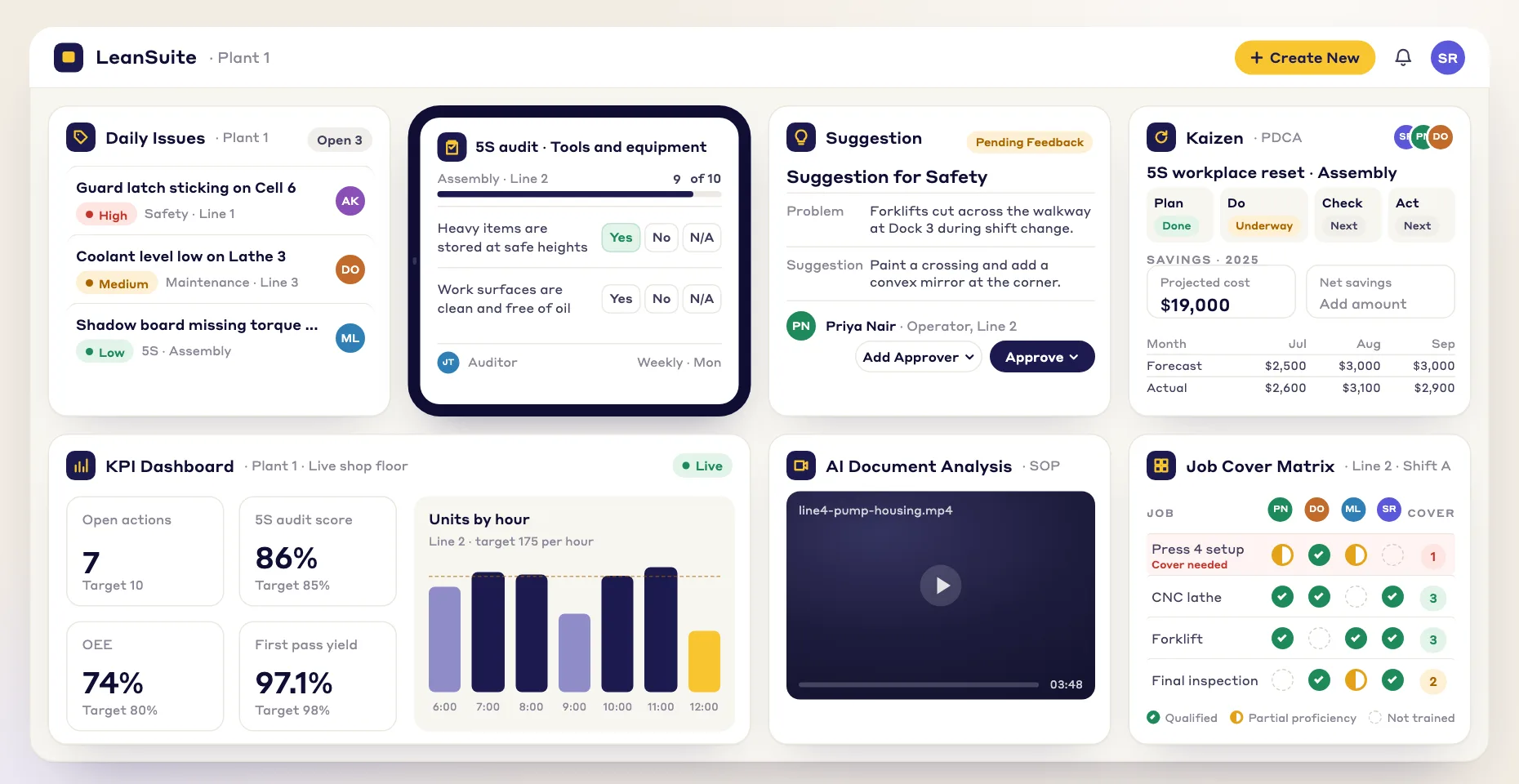
In LeanSuite, Kaizen & Projects manages every improvement project in one visual hub, from a small kaizen event to a full DMAIC project. Lean Studio has 30 ready-made boards, including the 5 Whys, A3 and 8D that feed the plan step.
Continuous Improvement Software
Run PDCA cycles in LeanSuite
Use A3, DMAIC, PDCA, PDSA or just-do-it templates, or define your own method and phases.
Go deeper
This page is the short version. These guides cover each part in full.
- PDCA Cycle: Plan, Do, Check, Act Steps ExplainedThe four steps at a gentler pace, and where the cycle fits in lean.
- What is DMAIC and PDCA in Lean Manufacturing?When a problem needs a full DMAIC project instead of a short cycle.
- A3 Problem Solving: The A3 Report and the 10-Step ProcessPDCA laid out on one page, with the background and current condition in front.
- Yokoten: What Horizontal Deployment Means and How to Do ItHow to spread a change that has passed its cycles to the other lines.
All our articles on this subject are in the kaizen and continuous improvement topic.
Free templates and tools
- PDCA templateOne improvement cycle on one page: plan, do, check against the goal, then standardize or adjust. PDF and Excel.
- A3 problem solving templateThe standard seven-box A3 from background to follow-up, with a filled-in worked example. PDF and Excel.
- Quick kaizen templateOne page for a small improvement: before and after, the cause, the countermeasure, the results and whether the standard changed.
- 5 Whys templateA problem statement, a why chain that can branch, evidence for every answer, root causes and countermeasures that are checked.
- Action plan templateA one-page action plan and an Excel tracker with percent done, status and a weekly timeline.
- Lean method navigatorSix questions about one problem, then the lean method to start with, the two that follow, why each fits, five steps for Monday and what it will not solve.
- Kaizen savings calculatorYearly savings, payback in months and first-year ROI of an improvement, from time saved, scrap avoided and its costs.
Doing this in LeanSuite
Kaizen & Projects
Manage every improvement project in one visual hub, from a small kaizen event to a full DMAIC project, and track each one through to results.
See Kaizen & ProjectsLean Studio
LeanSuite's whiteboard for lean teams, with 30 ready-made boards including the fishbone, 5 Whys, A3 and 8D.
See Lean Studio
See it on your own lines
Bring the problem you are working on to a 45-minute demo. Or look around with sample data first, or pilot LeanSuite on your own lines for 90 days, with the setup done by our team.
FAQ
Questions about pDCA
It is the improvement cycle that stands for plan, do, check, act (the order is plan, do, check, act). Plan a change and predict its result, do it on a small scale, check the result against the baseline and the prediction, then act by standardizing the change or going back to plan. It is also called the Deming cycle.
Plan, do, check, act. Some teams write PDSA, with study as the third step, as Deming preferred. The four steps are the same, and the Lean Enterprise Institute calls the cycle the foundation of continuous improvement, or kaizen.
Not quite. Kaizen is the habit of continuous improvement, and PDCA is the loop a team runs to do it. The Lean Enterprise Institute calls PDCA the foundation of continuous improvement, or kaizen, so a kaizen event, an A3 and a daily improvement board all run PDCA under other names.
The solution is identified in Plan, where the team picks the change and predicts its result, and implemented in Do, as a small trial. Act implements it for good, by writing it into the standard work, but only if Check showed the trial worked.
Plan: define the problem, set a target, find the cause and choose a change with a predicted result. Do: try the change on a small scale and note what went differently. Check: compare the result with the baseline, the prediction and the target. Act: standardize the change if it worked, or go back to plan if not.
Illustrative: Press 4 scrapped 47.5 parts in the first hour after each die change, half of them from wrong shut height or feed pitch. Turn 1 added a written setup sequence and predicted about 32. The trial gave 30.8, so the sequence became the standard. Turn 2 started from 30.8, added a lubrication check, predicted 23.6 and measured 23.7, under the target of 25.
The steps are the same. In PDCA the third step, check, asks whether the plan met its target. In PDSA the third step, study, compares the result with a written prediction to learn why. Deming preferred the name PDSA. The PDSA guide on this site has the history.
PDCA is a short loop for testing one change. DMAIC is a longer five-phase project method, define, measure, analyze, improve and control, used when the problem is large or the cause is unclear. Small PDCA trials often run inside the improve phase of a DMAIC project.
Until the check shows the target met and the standard is written. Most changes take two or three turns: the first removes the biggest cause, the next goes after what the check showed was left. Each turn starts from the standard the last one produced.
Related guides and tools
- PDSA cycle: the history, Deming's study step and PDSA versus PDCA
- PDCA examples: six more worked cycles with predictions and run charts
- PDCA template: one-page PDF and Excel cycle sheet
- Problem solving methods: where PDCA fits next to A3, 8D and DMAIC
- DMAIC: the five phases, with a gate for each
- Standard work: where a proven PDCA change ends up
- Continuous improvement: how PDCA cycles run day to day
More method guides
- The 6 Ms of production
- Poka-yoke
- Model area 90-day plans
- Moving from Excel to one system
- Reducing machine downtime: a worked month
- Andon
- Cycle time vs lead time, worked through
- Root cause analysis
- How many operators a line needs
- Reducing scrap and rework: a worked month
- Unsafe acts and unsafe conditions
- Just culture
- Stop-work authority
- Material review board (MRB)
- Nonconformance and NCRs
- Problem solving methods
- Quad chart
- OEE calculation
- Quality assurance vs quality control
- SOP meaning and format
- Job hazard analysis
- Near miss reporting
- Fishbone diagram
- Pareto chart
- Histogram
- Control chart
- What is a gemba walk
- What is lead time
- What is operational excellence
- How to improve product quality
- Preventive vs predictive maintenance
- Kanban
- FMEA
- PDSA cycle
- Safety moments
- Just-in-time manufacturing
- Kaizen
- 5S
- Total quality management (TQM)
- CAPA (corrective and preventive action)
- Layered process audit (LPA)
- Lean tools
- Lockout tagout (LOTO)
- A3 problem solving
- Preventive maintenance
- APQP
- High reliability organization (HRO)
- Manufacturing KPIs
- Quality metrics
- Practical problem solving
- CMMS
- Risk assessment
- Production efficiency
- Total productive maintenance (TPM)
- Reliability-centered maintenance (RCM)
- Hierarchy of controls
- Personal protective equipment (PPE)
- Emergency action plan
- Safety signs
- Warehouse safety
- ISO 9001
- SIPOC diagram
- Rolling action item list (RAIL)
- Pugh matrix
- Flowchart
- Project charter
- ISO 9001:2026
- Fleet maintenance
- IATF 16949
- AS9100
- ISO 14001
- ISO 45001
- One point lesson
- Standard work
- Lean manufacturing principles
- Toyota Production System
- 5W1H
- 5 Whys
- Continuous improvement
- Takt time
- DMAIC
- 8D problem solving
- Prioritization matrix
- Gemba walk questions
- 5W1H questions
- Layered process audit questions
- 5S audit questions
Or browse the topics, the full library and the lean glossary.
Rather see it on your own problem?
Bring the problem you are stuck on, and we will show you on a call how LeanSuite handles it.