A gemba walk is a leader's planned visit to the place where the work is done, to watch the process and ask the people doing it what gets in their way. Most leaders are told to go and then stand there not knowing what to ask, or ask in a way that sounds like an audit. This field guide fits a shirt pocket and answers both. Pages 3 to 6 are the method: the rules for the walker, and what to say and what not to say. Pages 7 to 12 are 48 open questions in six areas, from receiving to people and visual management, each with what a good answer sounds like and what a warning sign sounds like. After that come a one-page observation sheet, a 30-day route and rota for a plant manager, the loop that turns an observation into a closed action, and a card for the team being visited. The workbook has the route and rota, an action log with live status formulas, a summary and a filled-in example.
Free to use: print it, copy it and edit it for your team. Enter your name and work email once to download.
Preview of every page of the Gemba walk field guide. Use the previous and next buttons or the arrow keys to turn pages.
1 / 20. Cover
Rules for the walker48 questions in 6 areasGood and warning answersObservation sheet30-day route and rotaFollow-through loopCard for the team
When to use it
When to use the gemba walk field guide
When you are starting or restarting leader walks and want a pattern for the first month that survives a busy week.
When walks have been happening but nothing changes afterwards: the follow-through loop and the action log are built for that.
When a new plant manager, production manager or CI lead needs to learn an area quickly and wants better questions than "any problems?".
When the team on the floor has started treating the walk as an inspection: hand out the card on page 17 and change the questions.
How to fill it in
1
Print it pocket size
The PDF is 5.5 by 8.5 inches, half a Letter sheet and close to A5. Print 2-up on Letter or A4 with your printer's booklet setting, or choose fit to page for a full-size copy.
2
Read pages 3 to 6 once
What a walk is and is not, the five-minute preparation, the ten rules and the words that keep it from turning into an audit. Ten minutes.
3
Take the question bank to the area
Open the guide at the area you are standing in. Each page starts with where to stand. Watch first, then use three or four of the eight questions, not all of them.
4
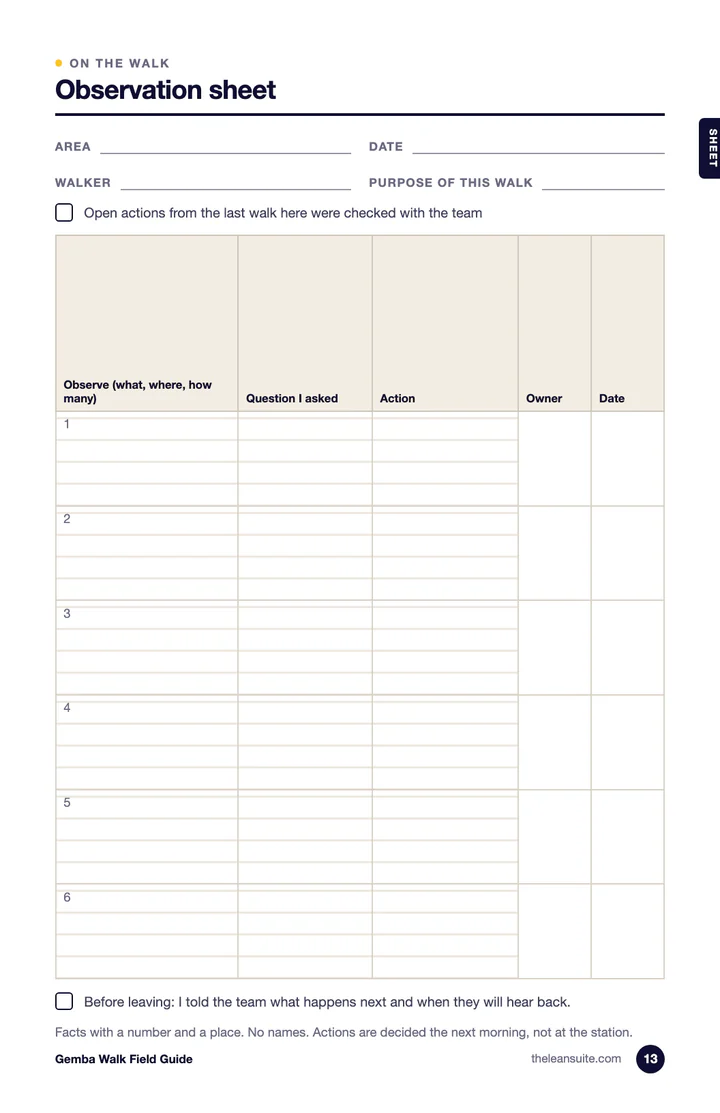
Write facts on the observation sheet
What, where and how many, the question you asked, and nothing in the action column yet. Actions are decided the next morning, away from the station.
5
Triage the next morning and log it
Each observation gets done this week, an owner and a date, or a no with a reason. Put it on the action log in the workbook, where days open, overdue and the loop step it is stuck at are calculated for you.
6
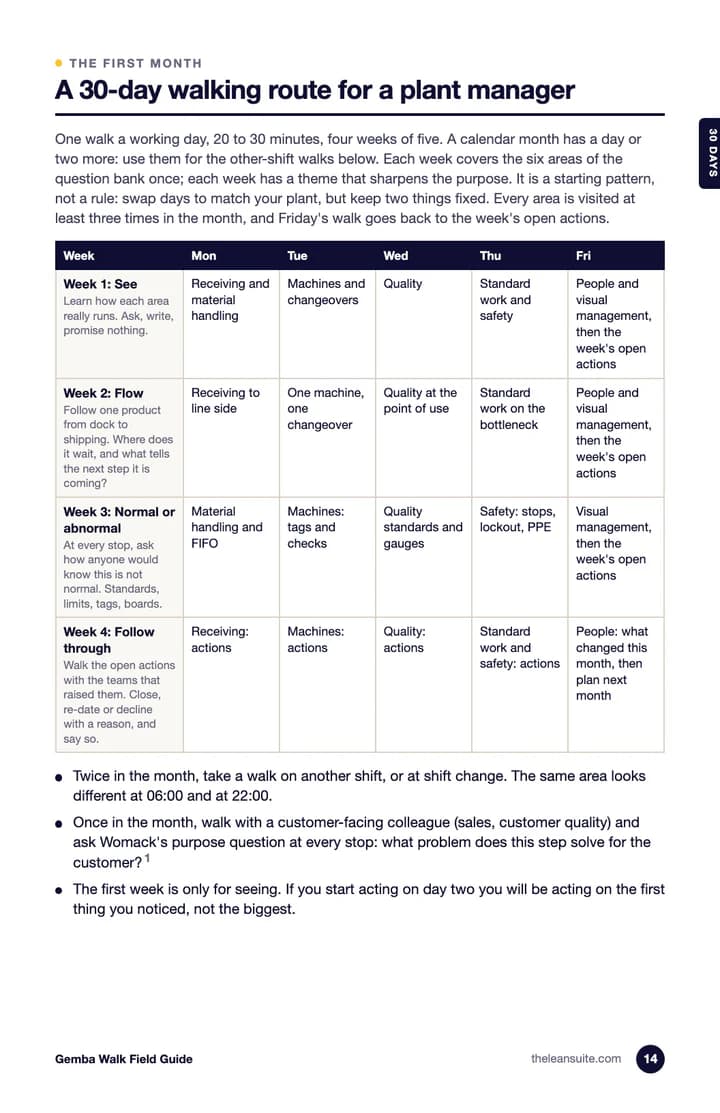
Follow the 30-day route
Four weeks of five walks, each week with a theme, every area at least three times, Friday back on the week's open actions. The rota shares the days without giving them all away.
Read before you download
The first 6 pages of the guide
The method pages, word for word as the PDF prints them. The question bank, the observation sheet, the 30-day route, the loop and the card for the team are in the download.
Before you start (page 2)
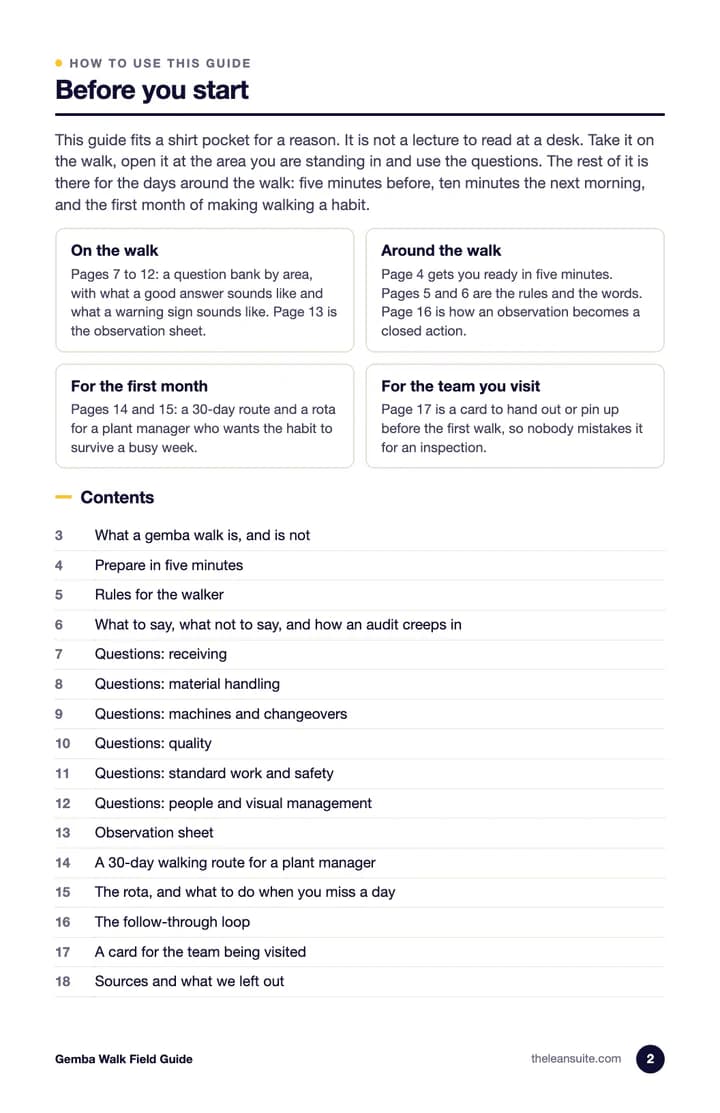
This guide fits a shirt pocket for a reason. It is not a lecture to read at a desk. Take it on the walk, open it at the area you are standing in and use the questions. The rest of it is there for the days around the walk: five minutes before, ten minutes the next morning, and the first month of making walking a habit.
On the walk
Pages 7 to 12: a question bank by area, with what a good answer sounds like and what a warning sign sounds like. Page 13 is the observation sheet.
Around the walk
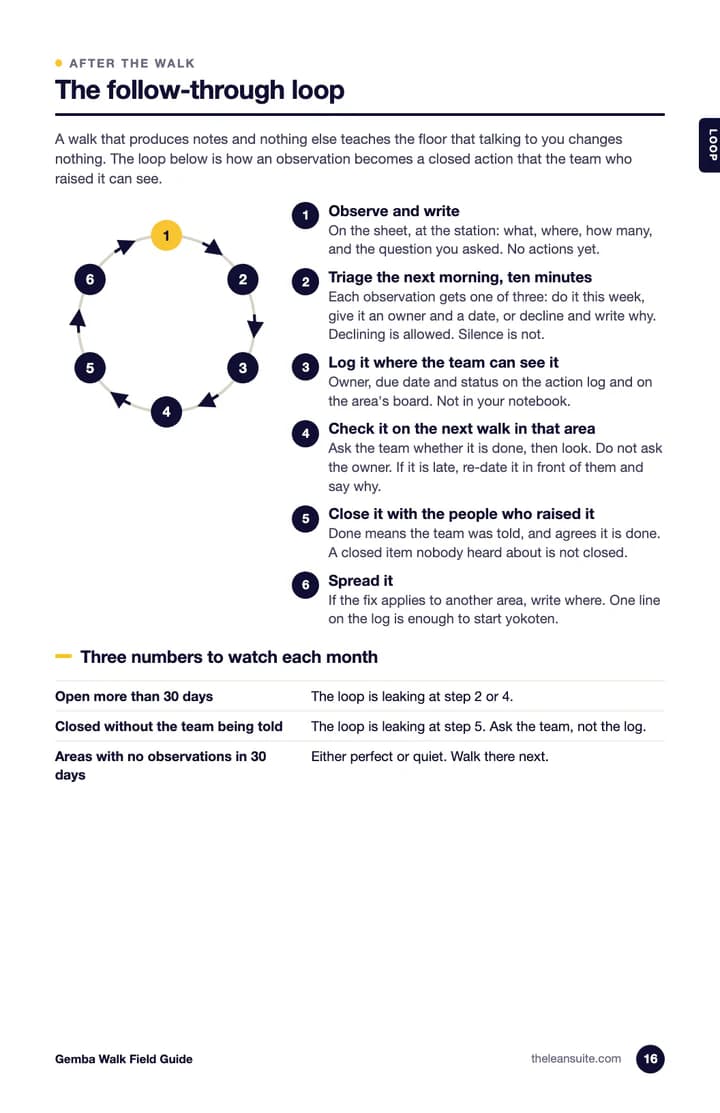
Page 4 gets you ready in five minutes. Pages 5 and 6 are the rules and the words. Page 16 is how an observation becomes a closed action.
For the first month
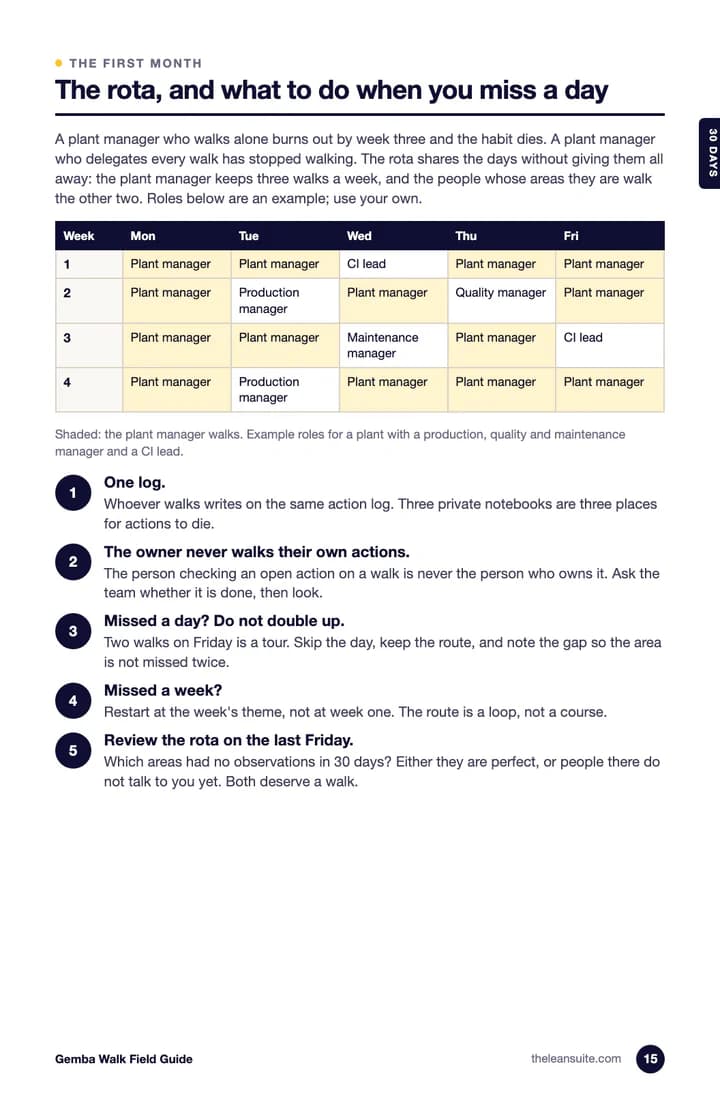
Pages 14 and 15: a 30-day route and a rota for a plant manager who wants the habit to survive a busy week.
For the team you visit
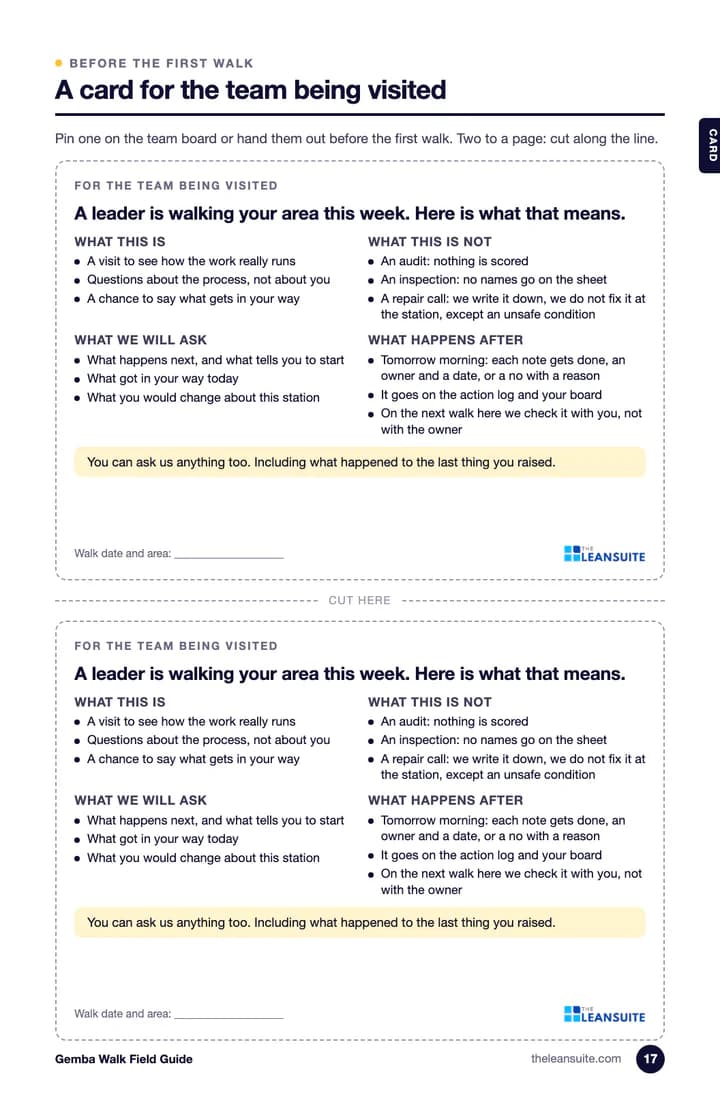
Page 17 is a card to hand out or pin up before the first walk, so nobody mistakes it for an inspection.
What a gemba walk is, and is not (page 3)
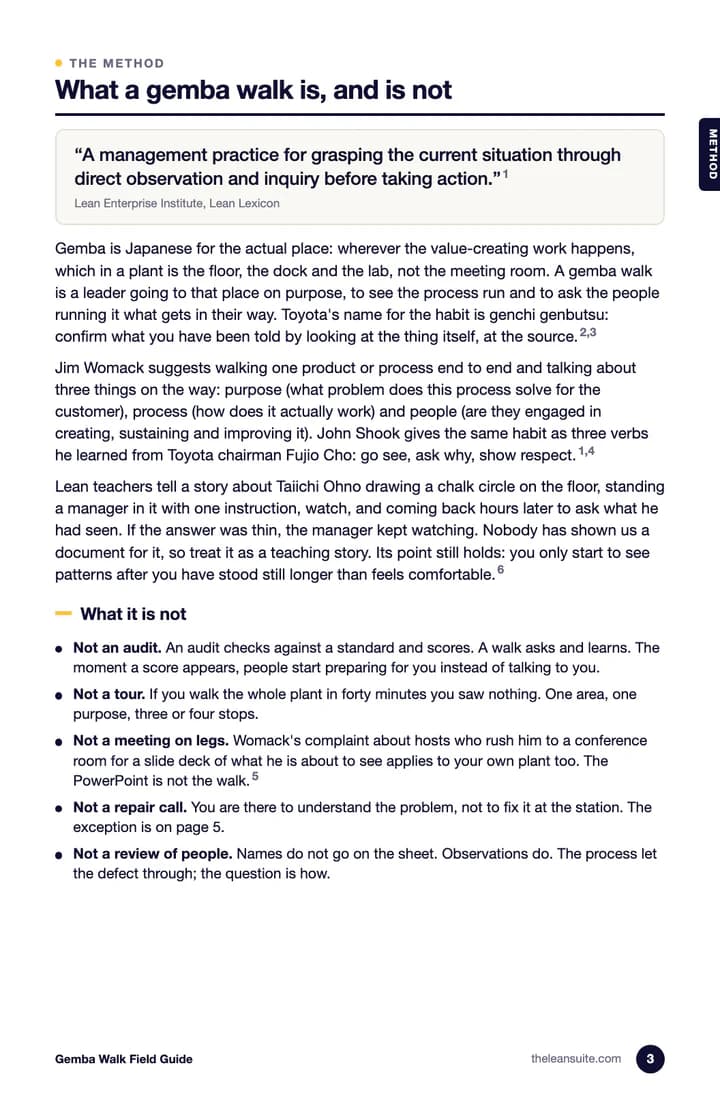
“A management practice for grasping the current situation through direct observation and inquiry before taking action.”1
Gemba is Japanese for the actual place: wherever the value-creating work happens, which in a plant is the floor, the dock and the lab, not the meeting room. A gemba walk is a leader going to that place on purpose, to see the process run and to ask the people running it what gets in their way. Toyota's name for the habit is genchi genbutsu: confirm what you have been told by looking at the thing itself, at the source.2,3
Jim Womack suggests walking one product or process end to end and talking about three things on the way: purpose (what problem does this process solve for the customer), process (how does it actually work) and people (are they engaged in creating, sustaining and improving it). John Shook gives the same habit as three verbs he learned from Toyota chairman Fujio Cho: go see, ask why, show respect.1,4
Lean teachers tell a story about Taiichi Ohno drawing a chalk circle on the floor, standing a manager in it with one instruction, watch, and coming back hours later to ask what he had seen. If the answer was thin, the manager kept watching. Nobody has shown us a document for it, so treat it as a teaching story. Its point still holds: you only start to see patterns after you have stood still longer than feels comfortable.6
What it is not
Not an audit. An audit checks against a standard and scores. A walk asks and learns. The moment a score appears, people start preparing for you instead of talking to you.
Not a tour. If you walk the whole plant in forty minutes you saw nothing. One area, one purpose, three or four stops.
Not a meeting on legs. Womack's complaint about hosts who rush him to a conference room for a slide deck of what he is about to see applies to your own plant too. The PowerPoint is not the walk.5
Not a repair call. You are there to understand the problem, not to fix it at the station. The exception is on page 5.
Not a review of people. Names do not go on the sheet. Observations do. The process let the defect through; the question is how.
Prepare in five minutes (page 4)
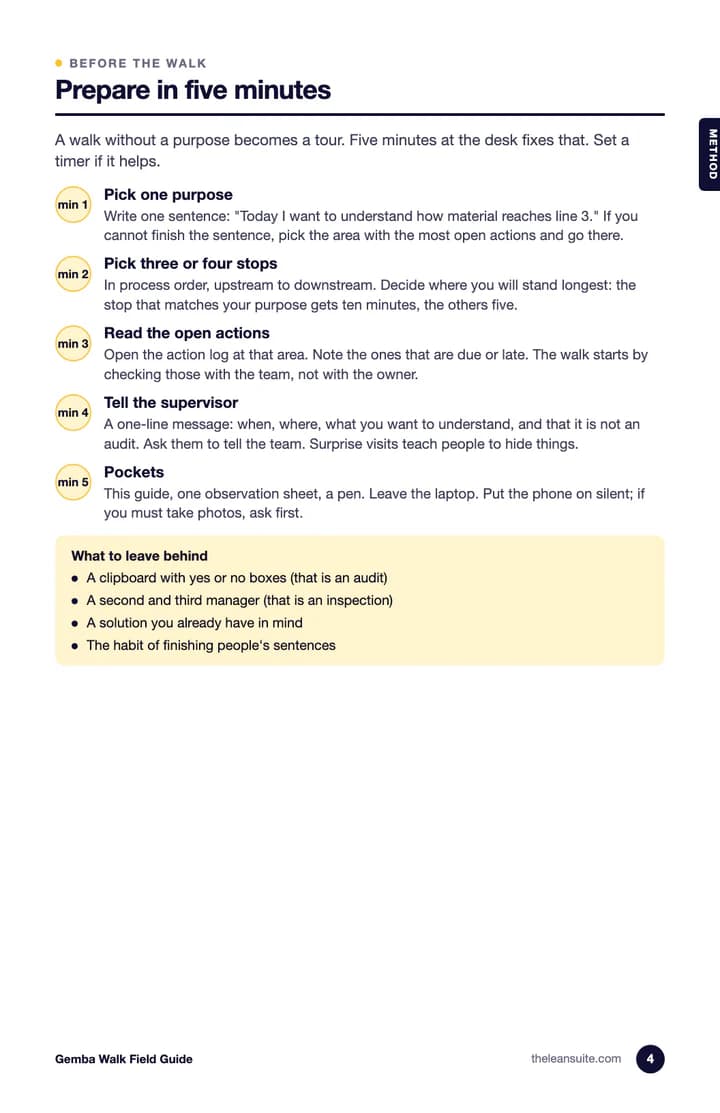
A walk without a purpose becomes a tour. Five minutes at the desk fixes that. Set a timer if it helps.
min 1
Pick one purpose
Write one sentence: "Today I want to understand how material reaches line 3." If you cannot finish the sentence, pick the area with the most open actions and go there.
min 2
Pick three or four stops
In process order, upstream to downstream. Decide where you will stand longest: the stop that matches your purpose gets ten minutes, the others five.
min 3
Read the open actions
Open the action log at that area. Note the ones that are due or late. The walk starts by checking those with the team, not with the owner.
min 4
Tell the supervisor
A one-line message: when, where, what you want to understand, and that it is not an audit. Ask them to tell the team. Surprise visits teach people to hide things.
min 5
Pockets
This guide, one observation sheet, a pen. Leave the laptop. Put the phone on silent; if you must take photos, ask first.
What to leave behind
A clipboard with yes or no boxes (that is an audit)
A second and third manager (that is an inspection)
A solution you already have in mind
The habit of finishing people's sentences
Rules for the walker (page 5)
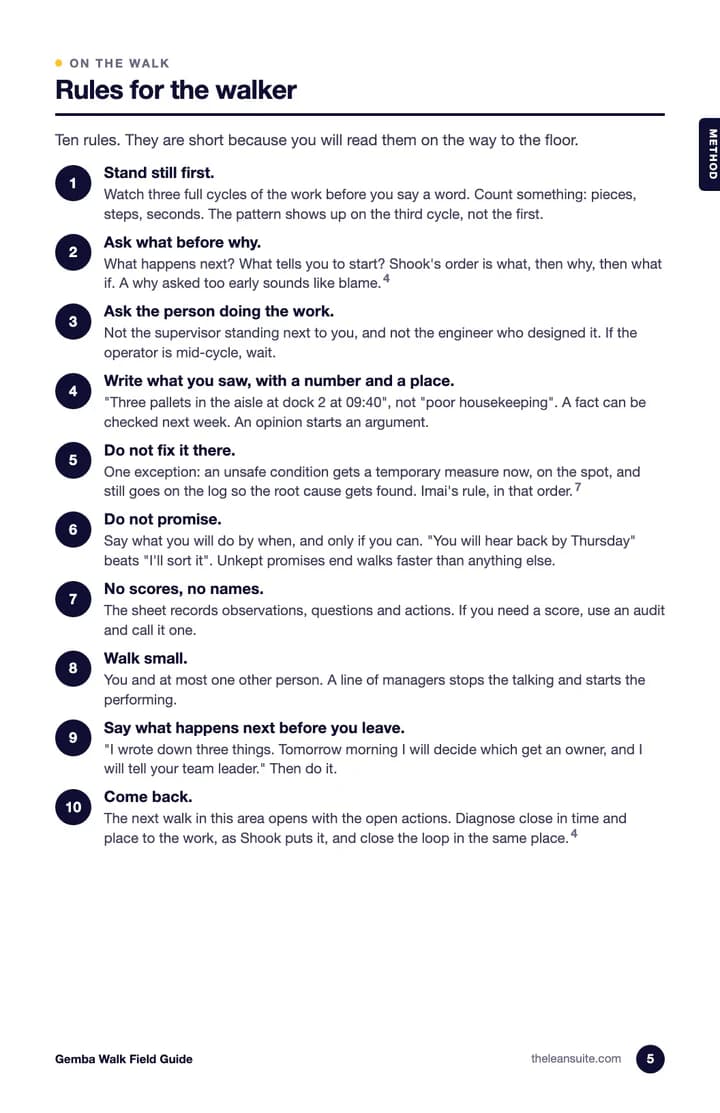
Ten rules. They are short because you will read them on the way to the floor.
1
Stand still first.
Watch three full cycles of the work before you say a word. Count something: pieces, steps, seconds. The pattern shows up on the third cycle, not the first.
2
Ask what before why.
What happens next? What tells you to start? Shook's order is what, then why, then what if. A why asked too early sounds like blame.4
3
Ask the person doing the work.
Not the supervisor standing next to you, and not the engineer who designed it. If the operator is mid-cycle, wait.
4
Write what you saw, with a number and a place.
"Three pallets in the aisle at dock 2 at 09:40", not "poor housekeeping". A fact can be checked next week. An opinion starts an argument.
5
Do not fix it there.
One exception: an unsafe condition gets a temporary measure now, on the spot, and still goes on the log so the root cause gets found. Imai's rule, in that order.7
6
Do not promise.
Say what you will do by when, and only if you can. "You will hear back by Thursday" beats "I'll sort it". Unkept promises end walks faster than anything else.
7
No scores, no names.
The sheet records observations, questions and actions. If you need a score, use an audit and call it one.
8
Walk small.
You and at most one other person. A line of managers stops the talking and starts the performing.
9
Say what happens next before you leave.
"I wrote down three things. Tomorrow morning I will decide which get an owner, and I will tell your team leader." Then do it.
10
Come back.
The next walk in this area opens with the open actions. Diagnose close in time and place to the work, as Shook puts it, and close the loop in the same place.4
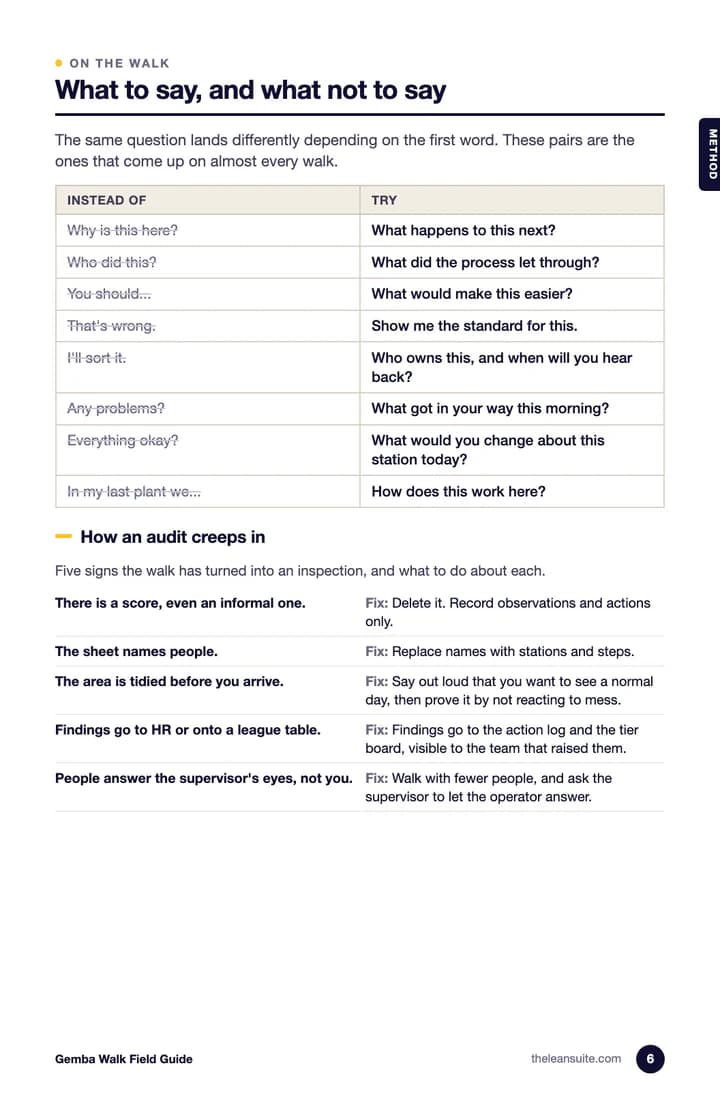
What to say, and what not to say (page 6)
The same question lands differently depending on the first word. These pairs are the ones that come up on almost every walk.
Instead of
Try
Why is this here?
What happens to this next?
Who did this?
What did the process let through?
You should...
What would make this easier?
That's wrong.
Show me the standard for this.
I'll sort it.
Who owns this, and when will you hear back?
Any problems?
What got in your way this morning?
Everything okay?
What would you change about this station today?
In my last plant we...
How does this work here?
How an audit creeps in
Five signs the walk has turned into an inspection, and what to do about each.
There is a score, even an informal one.
Fix: Delete it. Record observations and actions only.
The sheet names people.
Fix: Replace names with stations and steps.
The area is tidied before you arrive.
Fix: Say out loud that you want to see a normal day, then prove it by not reacting to mess.
Findings go to HR or onto a league table.
Fix: Findings go to the action log and the tier board, visible to the team that raised them.
People answer the supervisor's eyes, not you.
Fix: Walk with fewer people, and ask the supervisor to let the operator answer.
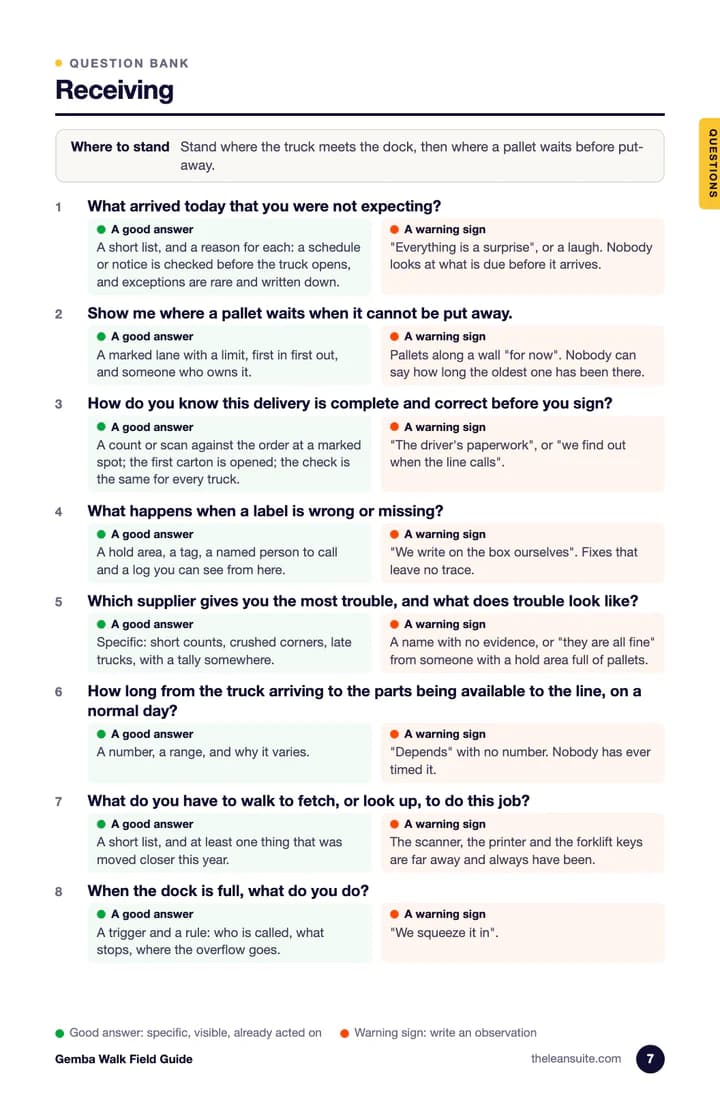
Each page of the bank starts with where to stand. The two columns under every question calibrate your ear: they are not a score. Watch first, then use three or four, not all eight.
Receiving
Where to stand: Stand where the truck meets the dock, then where a pallet waits before put-away.
1What arrived today that you were not expecting?
A good answerA short list, and a reason for each: a schedule or notice is checked before the truck opens, and exceptions are rare and written down.
A warning sign"Everything is a surprise", or a laugh. Nobody looks at what is due before it arrives.
2Show me where a pallet waits when it cannot be put away.
A good answerA marked lane with a limit, first in first out, and someone who owns it.
A warning signPallets along a wall "for now". Nobody can say how long the oldest one has been there.
3How do you know this delivery is complete and correct before you sign?
A good answerA count or scan against the order at a marked spot; the first carton is opened; the check is the same for every truck.
A warning sign"The driver's paperwork", or "we find out when the line calls".
4What happens when a label is wrong or missing?
A good answerA hold area, a tag, a named person to call and a log you can see from here.
A warning sign"We write on the box ourselves". Fixes that leave no trace.
5Which supplier gives you the most trouble, and what does trouble look like?
A good answerSpecific: short counts, crushed corners, late trucks, with a tally somewhere.
A warning signA name with no evidence, or "they are all fine" from someone with a hold area full of pallets.
6How long from the truck arriving to the parts being available to the line, on a normal day?
A good answerA number, a range, and why it varies.
A warning sign"Depends" with no number. Nobody has ever timed it.
7What do you have to walk to fetch, or look up, to do this job?
A good answerA short list, and at least one thing that was moved closer this year.
A warning signThe scanner, the printer and the forklift keys are far away and always have been.
8When the dock is full, what do you do?
A good answerA trigger and a rule: who is called, what stops, where the overflow goes.
A warning sign"We squeeze it in".
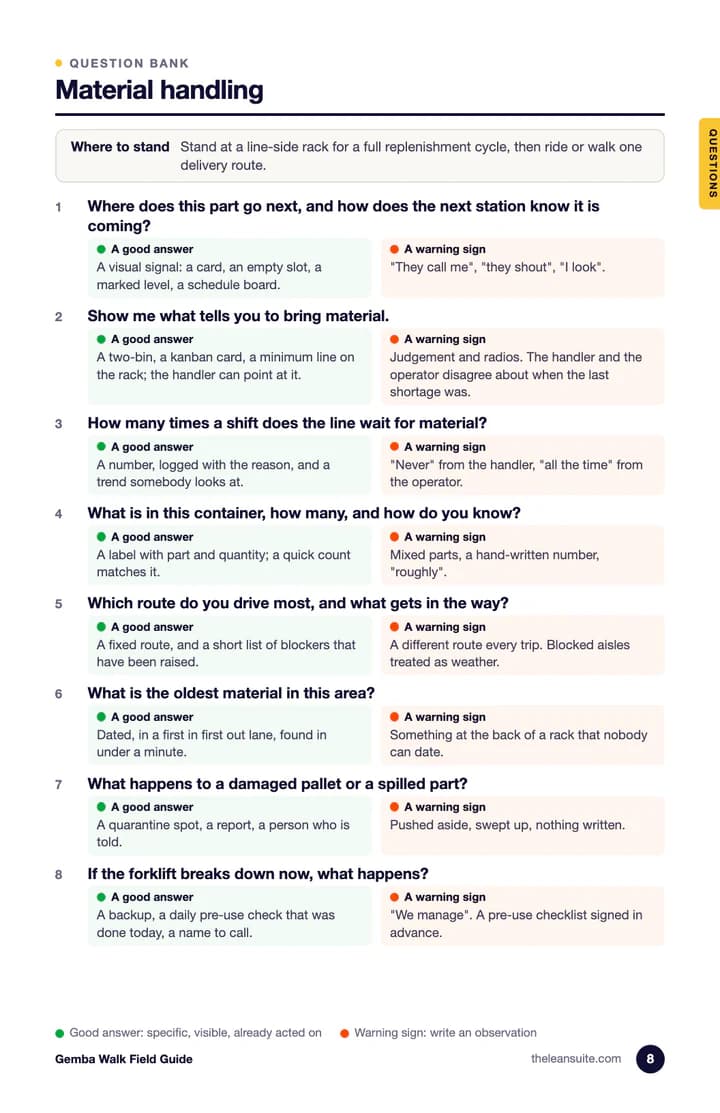
Material handling
Where to stand: Stand at a line-side rack for a full replenishment cycle, then ride or walk one delivery route.
1Where does this part go next, and how does the next station know it is coming?
A good answerA visual signal: a card, an empty slot, a marked level, a schedule board.
A warning sign"They call me", "they shout", "I look".
2Show me what tells you to bring material.
A good answerA two-bin, a kanban card, a minimum line on the rack; the handler can point at it.
A warning signJudgement and radios. The handler and the operator disagree about when the last shortage was.
3How many times a shift does the line wait for material?
A good answerA number, logged with the reason, and a trend somebody looks at.
A warning sign"Never" from the handler, "all the time" from the operator.
4What is in this container, how many, and how do you know?
A good answerA label with part and quantity; a quick count matches it.
A warning signMixed parts, a hand-written number, "roughly".
5Which route do you drive most, and what gets in the way?
A good answerA fixed route, and a short list of blockers that have been raised.
A warning signA different route every trip. Blocked aisles treated as weather.
6What is the oldest material in this area?
A good answerDated, in a first in first out lane, found in under a minute.
A warning signSomething at the back of a rack that nobody can date.
7What happens to a damaged pallet or a spilled part?
A good answerA quarantine spot, a report, a person who is told.
A warning signPushed aside, swept up, nothing written.
8If the forklift breaks down now, what happens?
A good answerA backup, a daily pre-use check that was done today, a name to call.
A warning sign"We manage". A pre-use checklist signed in advance.
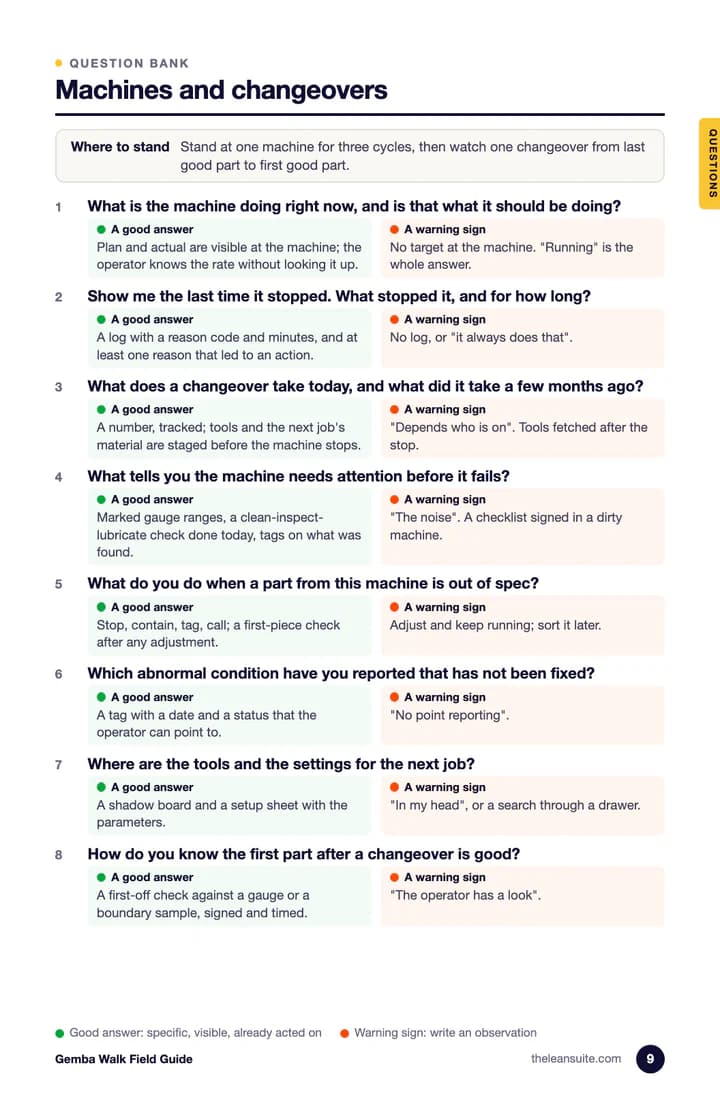
Machines and changeovers
Where to stand: Stand at one machine for three cycles, then watch one changeover from last good part to first good part.
1What is the machine doing right now, and is that what it should be doing?
A good answerPlan and actual are visible at the machine; the operator knows the rate without looking it up.
A warning signNo target at the machine. "Running" is the whole answer.
2Show me the last time it stopped. What stopped it, and for how long?
A good answerA log with a reason code and minutes, and at least one reason that led to an action.
A warning signNo log, or "it always does that".
3What does a changeover take today, and what did it take a few months ago?
A good answerA number, tracked; tools and the next job's material are staged before the machine stops.
A warning sign"Depends who is on". Tools fetched after the stop.
4What tells you the machine needs attention before it fails?
A good answerMarked gauge ranges, a clean-inspect-lubricate check done today, tags on what was found.
A warning sign"The noise". A checklist signed in a dirty machine.
5What do you do when a part from this machine is out of spec?
A good answerStop, contain, tag, call; a first-piece check after any adjustment.
A warning signAdjust and keep running; sort it later.
6Which abnormal condition have you reported that has not been fixed?
A good answerA tag with a date and a status that the operator can point to.
A warning sign"No point reporting".
7Where are the tools and the settings for the next job?
A good answerA shadow board and a setup sheet with the parameters.
A warning sign"In my head", or a search through a drawer.
8How do you know the first part after a changeover is good?
A good answerA first-off check against a gauge or a boundary sample, signed and timed.
A warning sign"The operator has a look".
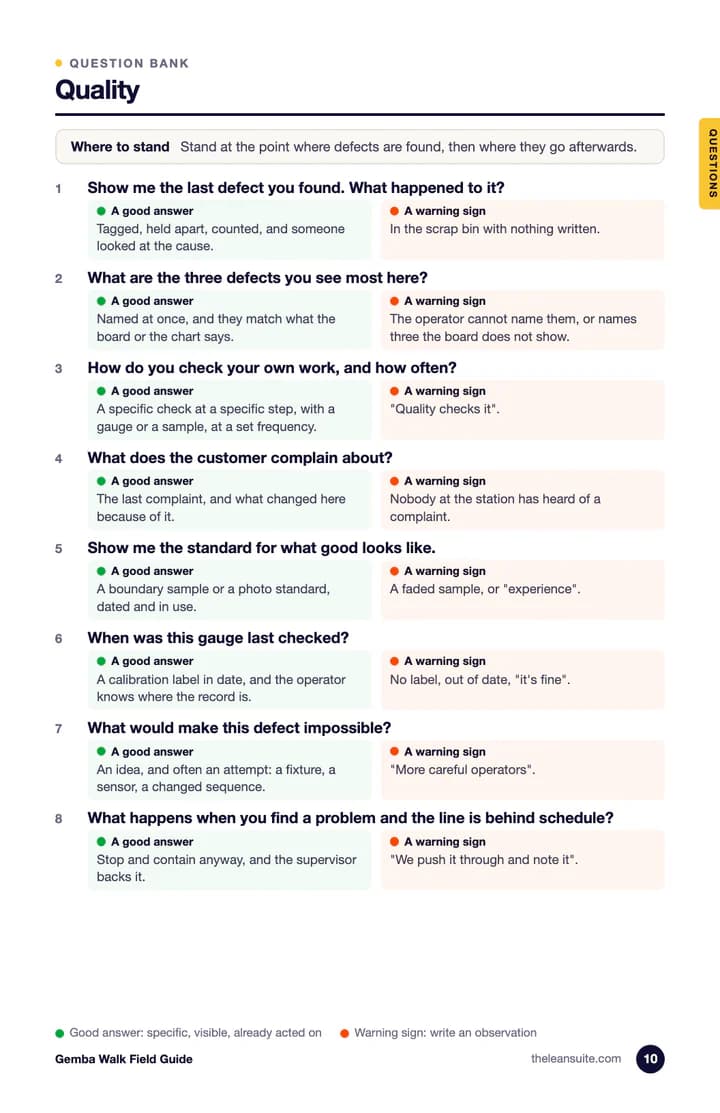
Quality
Where to stand: Stand at the point where defects are found, then where they go afterwards.
1Show me the last defect you found. What happened to it?
A good answerTagged, held apart, counted, and someone looked at the cause.
A warning signIn the scrap bin with nothing written.
2What are the three defects you see most here?
A good answerNamed at once, and they match what the board or the chart says.
A warning signThe operator cannot name them, or names three the board does not show.
3How do you check your own work, and how often?
A good answerA specific check at a specific step, with a gauge or a sample, at a set frequency.
A warning sign"Quality checks it".
4What does the customer complain about?
A good answerThe last complaint, and what changed here because of it.
A warning signNobody at the station has heard of a complaint.
5Show me the standard for what good looks like.
A good answerA boundary sample or a photo standard, dated and in use.
A warning signA faded sample, or "experience".
6When was this gauge last checked?
A good answerA calibration label in date, and the operator knows where the record is.
A warning signNo label, out of date, "it's fine".
7What would make this defect impossible?
A good answerAn idea, and often an attempt: a fixture, a sensor, a changed sequence.
A warning sign"More careful operators".
8What happens when you find a problem and the line is behind schedule?
A good answerStop and contain anyway, and the supervisor backs it.
A warning sign"We push it through and note it".
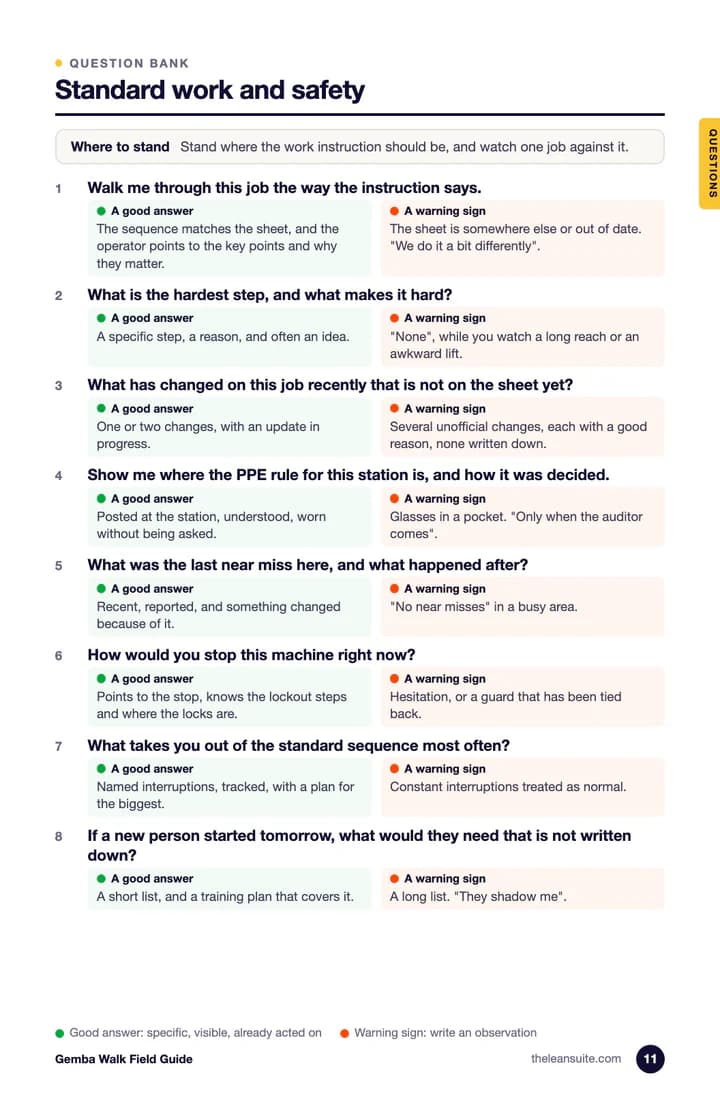
Standard work and safety
Where to stand: Stand where the work instruction should be, and watch one job against it.
1Walk me through this job the way the instruction says.
A good answerThe sequence matches the sheet, and the operator points to the key points and why they matter.
A warning signThe sheet is somewhere else or out of date. "We do it a bit differently".
2What is the hardest step, and what makes it hard?
A good answerA specific step, a reason, and often an idea.
A warning sign"None", while you watch a long reach or an awkward lift.
3What has changed on this job recently that is not on the sheet yet?
A good answerOne or two changes, with an update in progress.
A warning signSeveral unofficial changes, each with a good reason, none written down.
4Show me where the PPE rule for this station is, and how it was decided.
A good answerPosted at the station, understood, worn without being asked.
A warning signGlasses in a pocket. "Only when the auditor comes".
5What was the last near miss here, and what happened after?
A good answerRecent, reported, and something changed because of it.
A warning sign"No near misses" in a busy area.
6How would you stop this machine right now?
A good answerPoints to the stop, knows the lockout steps and where the locks are.
A warning signHesitation, or a guard that has been tied back.
7What takes you out of the standard sequence most often?
A good answerNamed interruptions, tracked, with a plan for the biggest.
A warning signConstant interruptions treated as normal.
8If a new person started tomorrow, what would they need that is not written down?
A good answerA short list, and a training plan that covers it.
A warning signA long list. "They shadow me".
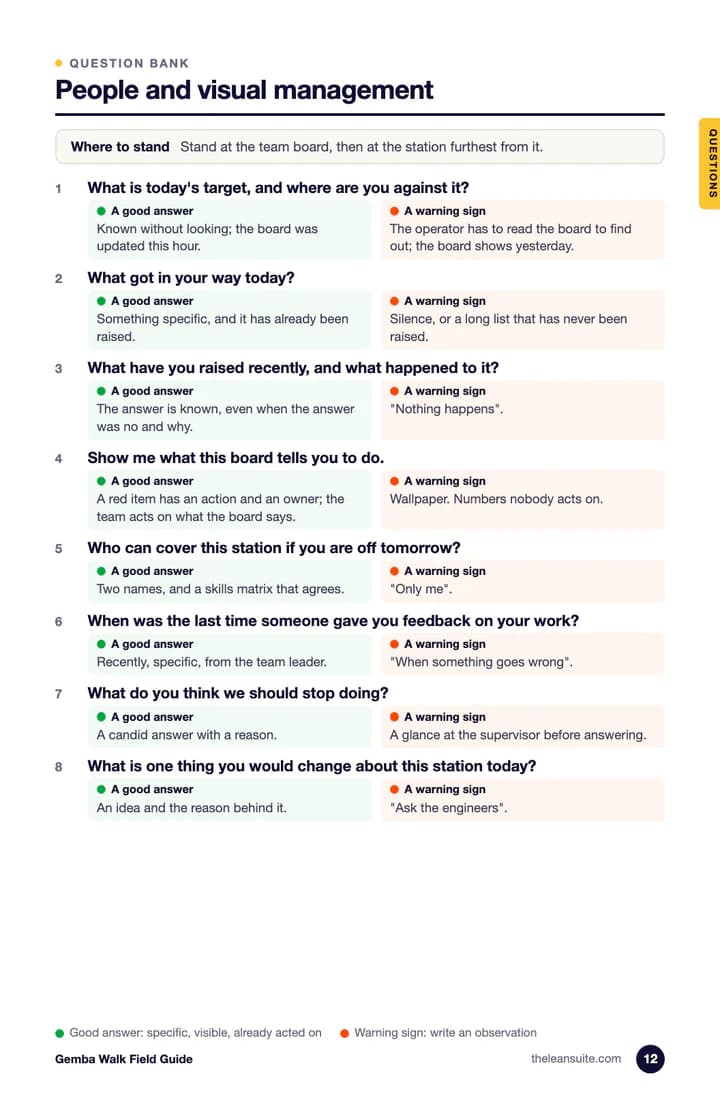
People and visual management
Where to stand: Stand at the team board, then at the station furthest from it.
1What is today's target, and where are you against it?
A good answerKnown without looking; the board was updated this hour.
A warning signThe operator has to read the board to find out; the board shows yesterday.
2What got in your way today?
A good answerSomething specific, and it has already been raised.
A warning signSilence, or a long list that has never been raised.
3What have you raised recently, and what happened to it?
A good answerThe answer is known, even when the answer was no and why.
A warning sign"Nothing happens".
4Show me what this board tells you to do.
A good answerA red item has an action and an owner; the team acts on what the board says.
A warning signWallpaper. Numbers nobody acts on.
5Who can cover this station if you are off tomorrow?
A good answerTwo names, and a skills matrix that agrees.
A warning sign"Only me".
6When was the last time someone gave you feedback on your work?
A good answerRecently, specific, from the team leader.
A warning sign"When something goes wrong".
7What do you think we should stop doing?
A good answerA candid answer with a reason.
A warning signA glance at the supervisor before answering.
8What is one thing you would change about this station today?
A good answerAn idea and the reason behind it.
A warning sign"Ask the engineers".
A filled-in example
Illustrative, not a benchmark
An example of a page of the question bank in use: a plant manager at receiving in week one, with no fixing allowed (illustrative).
Where to stand: where the truck meets the dock, then where a pallet waits before put-away. Ten minutes watching before a question.
Question 2, show me where a pallet waits when it cannot be put away: four pallets along a wall with no lane marking, the oldest label six days old. Warning sign, written as an observation with the count and the place.
Question 3, how do you know this delivery is complete before you sign: paperwork signed before the count. Second observation.
Question 8, when the dock is full what do you do: a clear rule, the supervisor is called and lane 5 is the overflow. Good answer, nothing written.
Next morning: the first two observations get an owner (the warehouse supervisor) and a date; the log shows them as in progress, and the next walk in receiving starts by asking the team whether the lane is marked.
Two observations, two owned actions, one good answer that did not need one. The Example sheet in the workbook carries a full illustrative month like this across all six areas.
Common mistakes
Asking all eight questions at every stop
The bank is a menu, not a script. Three or four questions after ten minutes of watching teach more than eight asked in a row.
Deciding actions at the station
Promising a fix in front of the team feels good and breaks the loop when the promise slips. Write it, decide tomorrow, tell them when they will hear back.
Keeping the log in your notebook
If the team cannot see the owner, the date and the status, the observation does not exist for them. One shared log, visible on the area's board.
Delegating the whole route
A rota that gives every walk away means the plant manager has stopped walking. Keep three of five days.
Scoring the answers
The good and warning columns calibrate your ear; they are not marks. The moment a score appears, the walk has become an audit.
Download the template
Free to use: print it, copy it and edit it for your team. Enter your name and work email once to download.
Run this template in LeanSuite
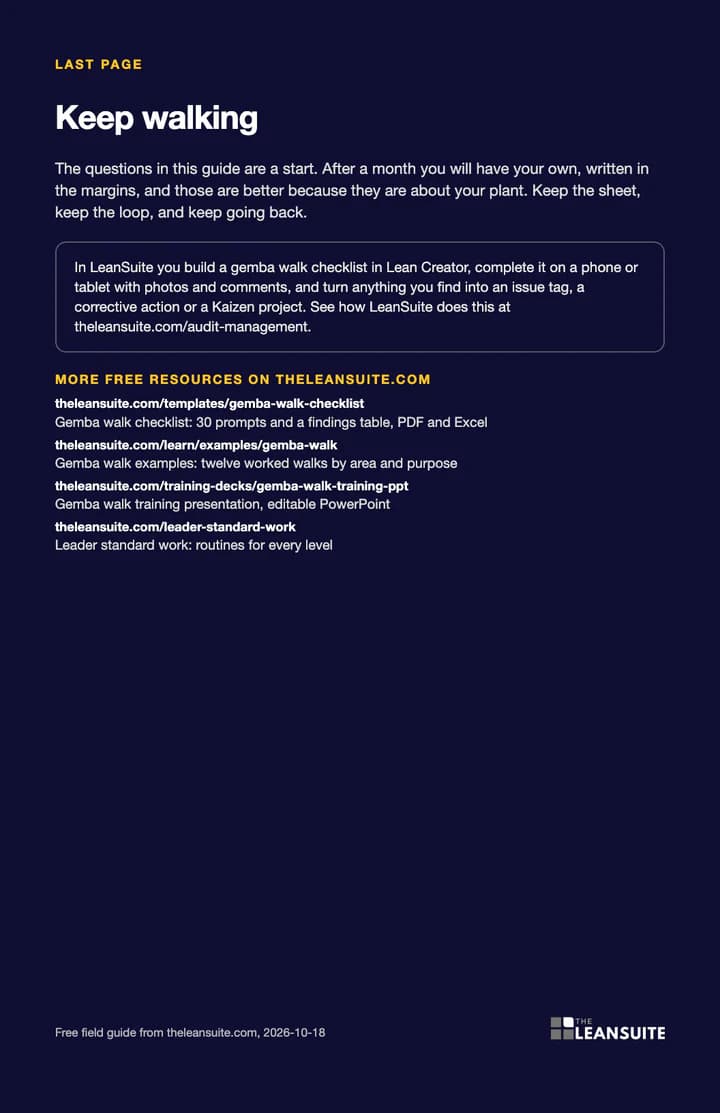
In LeanSuite you build a gemba walk checklist in Lean Creator, complete it on a phone or tablet with photos and comments, and turn anything you find into an issue tag, a corrective action or a Kaizen project.
The checklist is a three-page sheet of 30 prompts to tick and a findings table, for one walk. The field guide is a 20-page pocket booklet about how to walk: the rules, what to say, 48 open questions with what good and warning answers sound like, a 30-day route and rota, and the loop that closes actions. Many leaders carry both: the guide in the pocket, the checklist on the clipboard.
The pages are 5.5 by 8.5 inches, half a US Letter sheet and close to A5. Printed 2-up on Letter or A4 it makes a pocket booklet; printed with fit to page it becomes a normal full-size document. Everything is black-text-on-white or light tints, so it prints fine on a black-and-white printer.
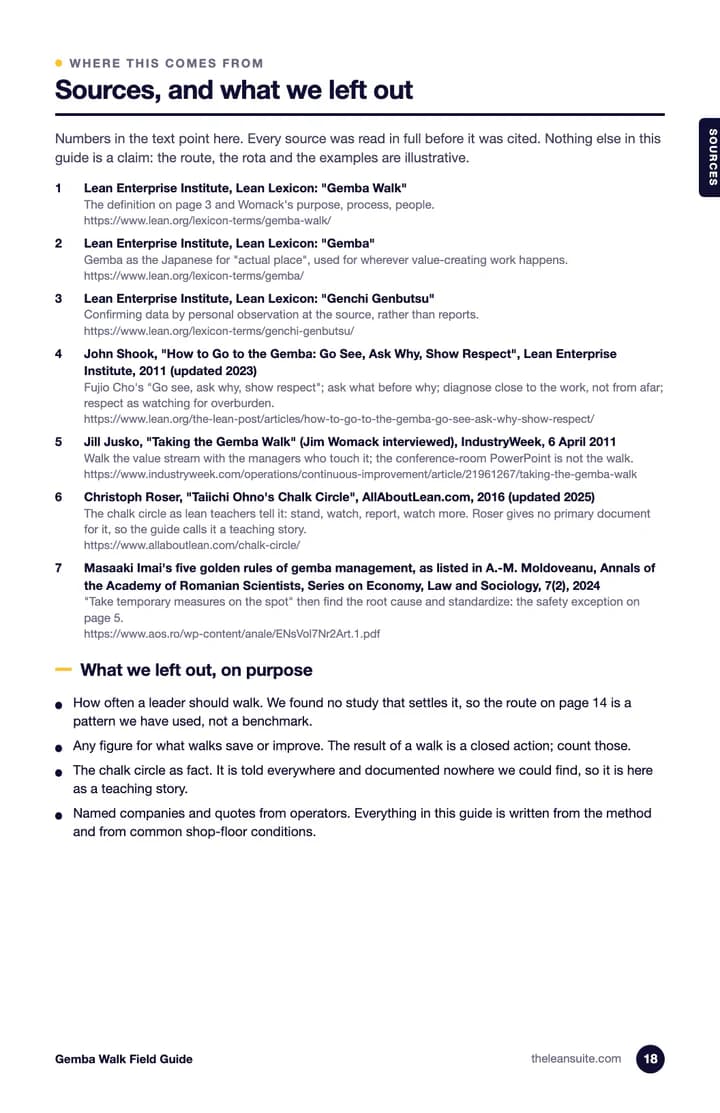
They are written from the method as the Lean Enterprise Institute describes it (direct observation and inquiry before acting; Womack's purpose, process and people; Shook's go see, ask why, show respect) and from common shop-floor conditions. None is a quote from a real plant, and the good and warning answers are calibration, not a score. Page 18 of the guide lists every source with what it supports.
We found no study that settles it, so the guide does not claim a number. The 30-day route is a pattern: one 20 to 30 minute walk per working day for four weeks, every area at least three times, Friday on the week's open actions, and a rota where the plant manager keeps three of the five days.
For each row of the action log: days open, whether it is overdue, and which step of the follow-through loop it is stuck at (no action decided, no owner or date, past due, done but the team not told). The summary counts by status and area and shows the three numbers the guide says to watch each month. Formula cells are locked without a password; it opens in Excel, Numbers and Google Sheets.
Tell us what you're looking for. We'll make it and send it to your inbox, free.
A shift handover sheet, a red tag log, a changeover checklist for one machine: if your team uses it on the floor, ask.
Pass it on
We want LeanSuite to be the best place on the internet for lean help. If this was useful, send it to someone on your team or in your network who needs it.