
Free template
Updated
Overhead crane inspection checklist: frequent and periodic
An overhead crane inspection checklist records the checks a bridge or gantry crane gets before use, every month and on a longer cycle, so no crane runs with a worn hook, a failed limit switch or a missed inspection. In the United States the rules are in OSHA 29 CFR 1910.179: frequent inspections at daily to monthly intervals, a complete periodic inspection every 1 to 12 months, signed monthly records for hooks, hoist chains and running ropes, and no use of a crane with an unsafe condition until it is corrected. This template has 34 checks, each tied to the paragraph it comes from and written in our own words: an operator's pre-shift card, the inspection record with a certification block, and a deficiency and out-of-service log. The Excel version keeps a crane register, reads the last signed records, works out the next frequent and periodic due dates (idle and standby cranes included) and gives each crane one status. It is not legal advice: follow the standard that applies to your crane and jurisdiction, the crane maker's manual and a qualified person.
Free to use: print it, copy it and edit it for your team. Enter your name and work email once to download.
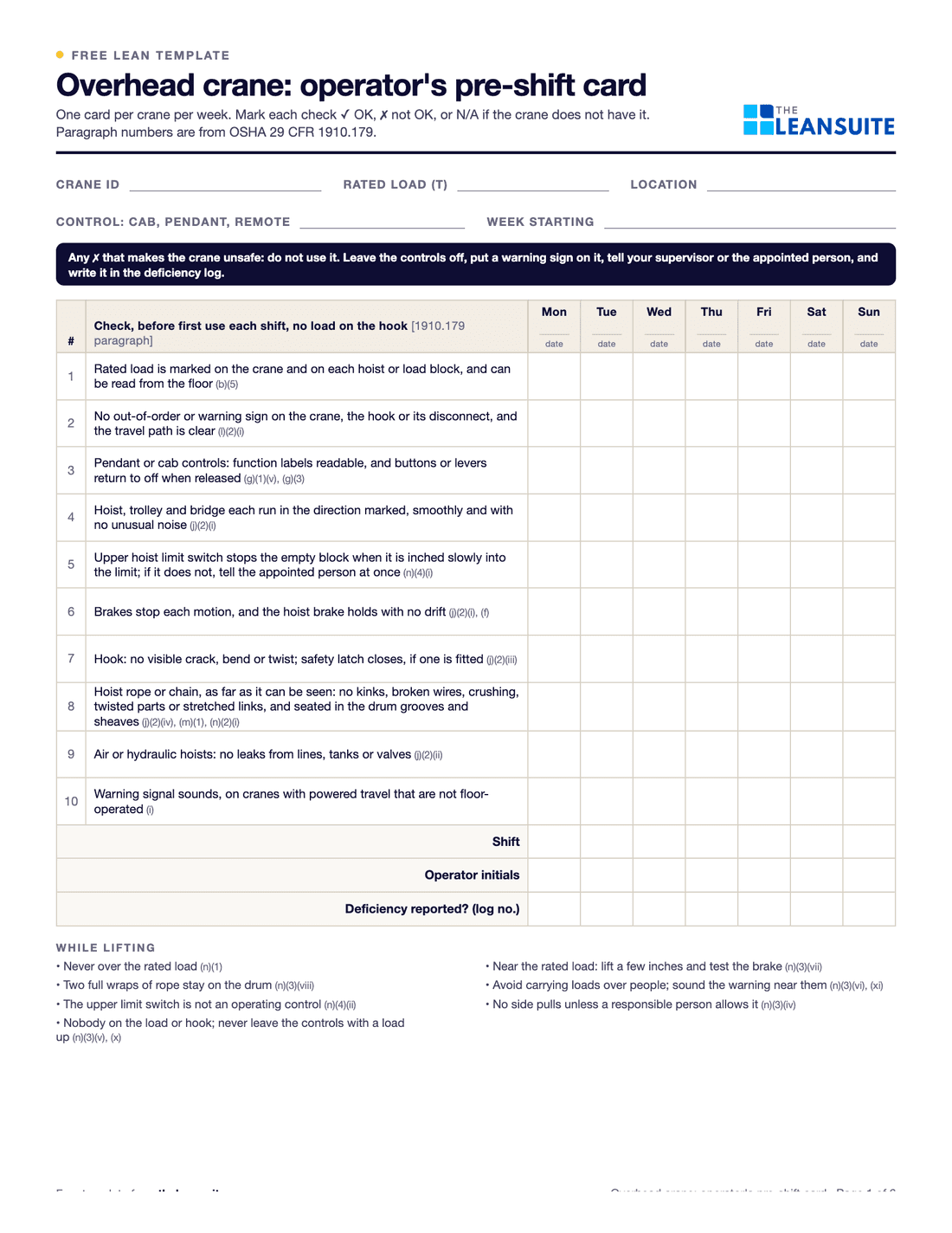 The operator's pre-shift card with fields for crane ID, rated load and week, a do-not-use rule, ten checks with their OSHA paragraphs, a column for each day and the rules while lifting.
When to use it
When to use an overhead crane inspection checklist
- For every overhead, gantry, semigantry and wall crane in regular service, as the daily, monthly and periodic record.
- Before a crane that has stood idle for a month or more is used again, and at least every 6 months for a standby crane.
- Before first use of a new crane, or of one that has been altered or rerated.
- Before an audit or an inspection visit, to show the signed monthly hook, chain and rope records and the date of each crane's last periodic inspection.
How to fill it in
- 1
Put every crane on the register
Crane ID, type, control, rated load, rope or chain hoist, service status and the periodic interval. Set the interval from 1 to 12 months by how hard and how often the crane works and where it runs, with the maker's manual and a qualified person.
- 2
Give operators the pre-shift card
Ten checks before first use each shift, including inching the empty block slowly into the upper limit switch. Anything that makes the crane unsafe: do not use it, put a sign on it and tell the appointed person.
- 3
Do the frequent inspection at least monthly
A designated person does groups 1 and 2, writes down the hook serial and the rope or chain ID, and signs. That signed, dated record is what 1910.179 asks for each month for hooks, hoist chains and running ropes.
- 4
Do the periodic inspection on its interval
All 34 checks, the frequent ones included. Where a defect cannot be seen from outside, the parts may need taking apart: OSHA's 2003 letter says a visual check is enough only when it would show the defect.
- 5
Judge every fail, log it and tag out hazards
Write each fail in the deficiency log with an owner and due date. A safety hazard means the crane is not used until it is corrected: switch locked open, signs on the crane and on the floor or hook, repair by designated people, and a name on the return to service.
- 6
Enter each signed record
The register takes the latest signed record for each crane and moves the next due dates. An unsigned record, or one without the hook and rope or chain IDs, does not count.
The inspections
Which inspection, how often and what record
From OSHA 29 CFR 1910.179, read on eCFR on 9 October 2026, in plain words. Read the standard for the exact wording.
| Inspection | How often | What it covers | Record | Paragraph |
|---|---|---|---|---|
| Initial | Before first use of a new or altered crane | Inspection against the whole section; operational tests of hoisting, lowering, trolley and bridge travel, limit switches, locking and safety devices | Keep it; rated load test reports on file (test load no more than 125% unless the maker says otherwise) | (j)(1)(i), (k) |
| Operator pre-shift | Start of each operator's shift | Upper limit switch tried with no load; the daily items on mechanisms, air or hydraulics, hooks and chains | The pre-shift card (this template's practice) | (n)(4)(i), (j)(2) |
| Frequent | Daily to monthly; some items daily | Operating mechanisms, air and hydraulic systems, hooks, hoist chains, rope reeving and ropes | Monthly, signed and dated, with the hook serial and the chain or rope ID | (j)(1)(ii)(a), (j)(2), (m)(1) |
| Periodic | 1 to 12 months, by activity, severity of service and environment | A complete inspection: the frequent items plus structure, bolts, sheaves and drums, pins and bearings, brakes, indicators, power plant and electrical apparatus | Not named in 1910.179; keep a signed one to show it was done | (j)(1)(ii)(b), (j)(3) |
| Idle 1 to 6 months | Before it is used again | The frequent inspection and a thorough rope inspection approved by an appointed person | Rope record with date, signature and rope ID | (j)(4)(i), (m)(2) |
| Idle over 6 months | Before it is used again | The complete inspection and the rope inspection | As above | (j)(4)(ii), (m)(2) |
| Standby | At least every 6 months | The frequent inspection and the rope inspection | As above | (j)(4)(iii) |
Initial
- How often
- Before first use of a new or altered crane
- What it covers
- Inspection against the whole section; operational tests of hoisting, lowering, trolley and bridge travel, limit switches, locking and safety devices
- Record
- Keep it; rated load test reports on file (test load no more than 125% unless the maker says otherwise)
- Paragraph
- (j)(1)(i), (k)
Operator pre-shift
- How often
- Start of each operator's shift
- What it covers
- Upper limit switch tried with no load; the daily items on mechanisms, air or hydraulics, hooks and chains
- Record
- The pre-shift card (this template's practice)
- Paragraph
- (n)(4)(i), (j)(2)
Frequent
- How often
- Daily to monthly; some items daily
- What it covers
- Operating mechanisms, air and hydraulic systems, hooks, hoist chains, rope reeving and ropes
- Record
- Monthly, signed and dated, with the hook serial and the chain or rope ID
- Paragraph
- (j)(1)(ii)(a), (j)(2), (m)(1)
Periodic
- How often
- 1 to 12 months, by activity, severity of service and environment
- What it covers
- A complete inspection: the frequent items plus structure, bolts, sheaves and drums, pins and bearings, brakes, indicators, power plant and electrical apparatus
- Record
- Not named in 1910.179; keep a signed one to show it was done
- Paragraph
- (j)(1)(ii)(b), (j)(3)
Idle 1 to 6 months
- How often
- Before it is used again
- What it covers
- The frequent inspection and a thorough rope inspection approved by an appointed person
- Record
- Rope record with date, signature and rope ID
- Paragraph
- (j)(4)(i), (m)(2)
Idle over 6 months
- How often
- Before it is used again
- What it covers
- The complete inspection and the rope inspection
- Record
- As above
- Paragraph
- (j)(4)(ii), (m)(2)
Standby
- How often
- At least every 6 months
- What it covers
- The frequent inspection and the rope inspection
- Record
- As above
- Paragraph
- (j)(4)(iii)
What's on the checklist
The 34 checks, grouped by who does them and how often
The operator does group 1 before first use each shift. A frequent inspection adds group 2; a periodic inspection covers all four. The paragraph in brackets is the part of OSHA 29 CFR 1910.179 each check comes from, written in our own words. On the sheet each check is Pass, Fail or N/A, and every fail is judged: is it a safety hazard?
Operator pre-shift check
Before first use each shift, no load on the hook
- 1Rated load is marked on the crane and on each hoist or load block, and can be read from the floor [(b)(5)]
- 2No out-of-order or warning sign on the crane, the hook or its disconnect, and the travel path is clear [(l)(2)(i)]
- 3Pendant or cab controls: function labels readable, and buttons or levers return to off when released [(g)(1)(v), (g)(3)]
- 4Hoist, trolley and bridge each run in the direction marked, smoothly and with no unusual noise [(j)(2)(i)]
- 5Upper hoist limit switch stops the empty block when it is inched slowly into the limit; if it does not, tell the appointed person at once [(n)(4)(i)]
- 6Brakes stop each motion, and the hoist brake holds with no drift [(j)(2)(i), (f)]
- 7Hook: no visible crack, bend or twist; safety latch closes, if one is fitted [(j)(2)(iii)]
- 8Hoist rope or chain, as far as it can be seen: no kinks, broken wires, crushing, twisted parts or stretched links, and seated in the drum grooves and sheaves [(j)(2)(iv), (m)(1), (n)(2)(i)]
- 9Air or hydraulic hoists: no leaks from lines, tanks or valves [(j)(2)(ii)]
- 10Warning signal sounds, on cranes with powered travel that are not floor-operated [(i)]
Frequent inspection
Daily to monthly by a designated person, with the checks above; hooks, chains and ropes need a signed monthly record
- 11Operating mechanisms adjusted so they work properly, with no excessive wear on their parts [(j)(2)(i), (j)(2)(vi)]
- 12Air and hydraulic systems: lines, tanks, valves and drain pumps not leaking or deteriorated [(j)(2)(ii)]
- 13Hooks: no cracks or deformation; throat opening no more than 15% over normal and twist under 10 degrees, or the maker's tighter limit; hook serial number recorded [(j)(2)(iii)]
- 14Hoist chain and end connections: no excessive wear, twist or distorted links, stretch within the maker's limit; chain ID recorded [(j)(2)(iv)]
- 15Rope reeving matches the crane maker's instructions [(j)(2)(vii)]
- 16Running ropes, full length: diameter not reduced below nominal, broken outside wires counted and located, outside wires not worn [(m)(1)(i) to (iii)]
- 17Rope ends and damage: no corroded or broken wires at end connections, end fittings sound and correctly applied, no severe kinking, crushing, cutting or unstranding; rope ID recorded [(m)(1)(iv) to (vi)]
- 18Each deficiency judged for whether it is a safety hazard; if it is, the crane is not used until it is corrected [(j)(2), (l)(3)(i)]
Periodic inspection
A complete inspection every 1 to 12 months, set by use, service and environment; includes every frequent check
- 19Structural members: none deformed, cracked or corroded [(j)(3)(i)]
- 20Bolts and rivets: none loose [(j)(3)(ii)]
- 21Sheaves and drums: none cracked or worn [(j)(3)(iii)]
- 22Pins, bearings, shafts, gears, rollers, and locking and clamping devices: none worn, cracked or distorted [(j)(3)(iv)]
- 23Brake linings, pawls, ratchets and other brake parts: no excessive wear [(j)(3)(v)]
- 24Load, wind and other indicators read correctly over their full range [(j)(3)(vi)]
- 25Power plant (electric, gasoline, diesel or other) performs properly and meets its safety requirements [(j)(3)(vii)]
- 26Chain drive sprockets not excessively worn, and drive chain not stretched [(j)(3)(viii)]
- 27Electrical apparatus: no pitting or deterioration of controller contactors, limit switches and pushbutton stations [(j)(3)(x)]
Other conditions the standard sets
From other paragraphs of 1910.179, checked at the periodic inspection
- 28Trolley stops, and bridge and trolley bumpers, in place and secure [(e)(1) to (e)(3)]
- 29Rail sweeps on the bridge trucks reach below the top of the rail in front of the wheels [(e)(4)]
- 30Guards on gears, chains, sprockets and other exposed moving parts secure; rope guards where ropes could foul or chafe [(e)(5), (e)(6)]
- 31Sheave guards in place on the bottom block and where ropes can go slack [(h)(1)(ii), (h)(1)(iii)]
- 32At least two wraps of rope left on the drum with the hook at its lowest point, and the rope end anchored by a clamp or approved socket [(h)(2)(iii)]
- 33Runway conductor disconnect can be locked open, the crane's own disconnect works, and the hoist has an upper overtravel limit switch [(g)(5)]
- 34Ladders, footwalks and cab: access clear, handrails and toeboards in place, no loose tools or articles in the cab [(c), (d), (o)(2)]
A filled-in example
Illustrative, not a benchmarkAn example: a made-up plant with 7 overhead and gantry cranes, as of 9 October 2026, and the periodic inspection of its 10-ton bridge crane BC-3 (illustrative).
- BC-3, periodic inspection: all 34 checks in scope, 26 pass, 2 fail and 6 N/A (no air or hydraulics, floor-operated so no warning signal needed, a wire rope hoist, no load indicator, no chain drive).
- Neither fail is a safety hazard: worn trolley labels on the pendant, due in 7 days, and pitting on the hoist-up contactor, due in 14. A note on the rope: 2 broken outside wires in one lay, within the rope maker's limit, to be rechecked at the next monthly.
- BC-2 is tagged out: its monthly inspection found the main hook's throat opening beyond the hook maker's limit. The hook is replaced, not welded or bent back.
- GC-1, the yard gantry crane on a 3-month interval, is overdue: its last monthly record was never signed, so the last signed check of the frequent items is its periodic inspection of 30 August. Its bent rail sweep is also past its due date.
- BC-1 and BC-4 have periodic inspections due within 30 days. SG-1 has been idle for 75 days and needs a frequent inspection and a rope check before it is used.
One status per crane: 1 out of service, 1 inspection overdue, 1 inspect before use, 2 due soon, 1 with deficiencies open and 1 OK. 4 deficiencies are open, 1 of them overdue, and 1 record does not count until it is signed.
Common mistakes
Monthly records with no signature or no IDs
The standard's monthly record for hooks, chains and ropes needs the date, the inspector's signature and the hook serial or chain or rope ID. A record missing any of them is not the record the standard describes, and the register does not count it, as with GC-1 in the example.
One interval for every crane
The periodic interval depends on activity, severity of service and environment. A yard crane in the weather or a crane used on every shift may need a much shorter interval than a tool room crane used twice a week.
Stopping the hook on the upper limit switch
The upper limit switch is a safety device, never an operating control (1910.179(n)(4)(ii)). Operators try it once at the start of the shift, inching the empty block into it slowly.
Repairing a cracked or opened-up hook
A hook with a crack, a throat opening more than 15% over normal or a twist over 10 degrees is discarded. Welding or reshaping is not generally recommended, and if it is tried the hook must be load tested first. The hook maker's limits may be tighter.
Logging a fail without judging it
Every deficiency gets a decision: is it a safety hazard? If yes, the crane is not used until it is corrected. If no, it still needs an owner and a due date, or it stays on the crane for years.
Download the template
Free to use: print it, copy it and edit it for your team. Enter your name and work email once to download.
Run this template in LeanSuite
In LeanSuite, near misses, unsafe acts and unsafe conditions are routed to the right owner with a due date, so resolution time comes down and each fix can become plant-wide best practice.
See it in a 45-minute demoIn the lean glossary
Free tools
FAQ
Overhead crane inspection checklist: frequent and periodic: common questions
More free templates
All templates- Autonomous maintenance (CILR) checklist20 clean, inspect, lubricate and retighten checks with a box per day, an abnormality log and sign-off.
- SMED changeover worksheetChangeover steps with times, internal or external, what can move, ideas and before/after totals.
- OEE tracking sheetOne row per shift for a week. The Excel version works out availability, performance, quality and OEE and charts the week.
- Near miss report formA two-page near miss report from the first report to closure, and an Excel log with status and days open.
- Safety observation card templateFour behavior-based safety cards per sheet, with safe and at-risk checks, the conversation and a tally sheet.
- Job safety analysis (JSA) templateJob steps, hazards, risk scored before and after the controls, the hierarchy of controls, PPE and sign-off.
- Risk assessment matrix template (5×5)A color-coded 5 × 5 severity and likelihood matrix, a scoring guide and a risk register.
- Incident investigation report templateFacts and a sourced timeline, causes at three levels, actions by the hierarchy of controls, a US recordkeeping screen and a closure check.
- Toolbox talk templateA record of a short safety talk: topic, key points, questions raised, actions and an attendee sign-in sheet.
- Lockout/tagout (LOTO) procedure templateA machine-specific LOTO procedure: energy sources and isolation points, the steps from shutdown to restart, and the annual review.
- Forklift inspection checklist23 pre-shift checks for a week on one page, a do-not-operate rule, and a defect and repair log.
- Preventive maintenance checklist templateA PM checklist per machine with readings and sign-off, and a PM schedule that works out the next due date.
- Equipment downtime log (MTTR and MTBF)A breakdown and downtime log, with MTTR, MTBF and downtime by machine and cause worked out in Excel.
- Lubrication schedule templateEvery lube point with lubricant, method, amount, frequency and who, with next due dates and a monthly sign-off record.
- TPM tag logEvery abnormality tag with type, who fixes it, priority and dates, with days open and counts by type and week.
- Autonomous maintenance step auditCriteria for each of the seven autonomous maintenance steps, scored 0 to 2, with the step result and the decision to move on.
- Warehouse safety inspection checklistThirty warehouse safety checks from aisles to fire exits, marked OK or Not OK, with an action for every finding.
- Pallet racking inspection checklistRack checks per aisle with a green, amber and red damage rating, and a damage log with repair dates.
- Safety audit checklistThirty-four plant-wide safety checks answered Yes, No or N/A, scored by area, with a risk rating and an action for every No.
- Ergonomic risk assessment checklistScreen a task for 21 ergonomic risk factors, score how long each lasts, and rank tasks so the worst get controls first.
- Maintenance work order formOne form per maintenance job from request to handback, and a log that tracks response, completion and backlog by priority.
- Six big losses worksheetWhere a machine's planned time goes: the six big losses in minutes, ranked, with A, P, Q and OEE worked out.
- Maintenance KPI trackerMTBF, MTTR, availability and PM compliance per asset and month, plant figures from the totals, planned maintenance % and backlog in weeks.
- Equipment criticality analysisAssets scored 1 to 5 on six criteria with your own weights, ranked and sorted into classes A, B and C with a safety override and a suggested maintenance strategy.
- Fault tree analysis templateA drawing area with the FTA symbols, an event table with probabilities and minimal cut sets, and the gates worked out bottom-up in Excel.
- Breakdown analysis reportOne equipment breakdown from the stop to the 90-day check, plus a breakdown log with repeat flags, MTBF and MTTR by asset and a Pareto of causes.
- Safety cross calendarA month drawn as the green cross, colored each day by the most serious safety event, with totals and days since the last injury.
- Weekly maintenance schedule templateNext week's maintenance jobs, scheduled only when ready, loaded against each craft's hours by day, with schedule compliance and break-ins at week end.
- Safety pillar 90-day model area planThirteen weeks from the incident pyramid to safety standards on one model area, a KPI board, the day-90 gate and expansion waves.
- Autonomous maintenance 90-day model area planAM steps 0 to 3 on one model machine in 13 weeks, a KPI board, the day-90 gate and expansion waves for months 4 to 12.
- Professional maintenance (PM) 90-day model area planThirteen weeks from breakdown analysis to a running PM calendar on one model machine, a KPI board, the day-90 gate and expansion waves.
- Early equipment management 90-day model area planThirteen weeks from lessons on current machines to a tracked start-up on one model equipment project, a KPI board, the day-90 gate and expansion waves.
- RCM worksheet (failure mode and task selection)Failure modes classed as hidden, safety, operational or non-operational, then a task chosen for each: condition-based, discard, failure-finding, redesign or run to failure.
- Training matrix template with expiry datesPeople by required trainings with expiry dates, OK, due, expired and missing flags, compliance by person and area, cover per training and a renewal list.
- Downtime reason codes template26 starter codes mapped to the six big losses, a log with drop-downs, a Pareto by code and by loss, and a code card for the line.
- Critical spare parts list and stocking levelsAssets ranked by consequence, each part classed and given a stocking policy, and min and max worked out from usage and lead time, with the downtime each stock-out would cost.
- HACCP plan template: hazard analysis and CCP worksheetThe Codex 12 steps in one workbook: team and product, process steps checked on site, hazard analysis with the CCP decision tree, the CCP table with completeness checks, an allergen matrix and a verification schedule.
- Forklift operator training and evaluation recordPer-operator training and evaluation record, a register with three-year due dates and refresher triggers, and a weighted practical evaluation scoresheet.
- REBA worksheet (Rapid Entire Body Assessment)Score up to six postures with REBA: body-part drop-downs, Tables A, B and C as lookups, final score and action level, and a before and after comparison.
- ISO 45001 internal audit checklist44 audit questions for the plant floor in 16 safety topics, each with its ISO 45001:2018 clause, the evidence to look for and the sample to take, plus 12 worker interview prompts, a findings log and a summary by clause.
- Maintenance job plan templateOne job planned on one sheet: steps and craft hours, parts checked against stock, tools, lockout and permits, documents, a ready check for the schedule, and technician feedback.
- 5S audit checklist template25 checks, five per S, scored 1 to 5, with a score summary and a chart of the five S's.
- 1-1-90 method worksheetOne page: score areas 1 to 5, write the pain point with a before and target number, check days 30, 60 and 90, and plan the next three areas.
- Gemba walk checklistA walk plan and route, 30 prompts in six groups and a findings table with owners and due dates.
- Leader standard work templateA team leader's daily, weekly and monthly routine with a box per day, follow-ups and a weekly review.
- Supervisor leader standard work templateA supervisor's daily, weekly and monthly routine with a box per day, an escalation log and a weekly review.
- Production manager leader standard work templateA production or value stream manager's routine by day, week and month, with an escalation log and a weekly review.
- Plant manager leader standard work templateA plant manager's short routine by day, week and month, with an escalation log and a weekly review.
- A3 problem solving templateThe standard seven-box A3 from background to follow-up, with a filled-in worked example. PDF and Excel.
- PDCA templateOne improvement cycle on one page: plan, do, check against the goal, then standardize or adjust. PDF and Excel.
- 5 Whys templateA problem statement, a why chain that can branch, evidence for every answer, root causes and countermeasures that are checked.
- 5W1H templateWho, what, when, where, why and how: a problem statement built from checked facts, and an action plan with nothing left open.
- 8D report templateD0 to D8 with targets, containment counts, occurrence, escape and systemic causes, verified actions and a worked example.
- Poka-yoke worksheetEach step's errors and what they cost, the device (approach, function, method), payback, and a log that proves each device works.
- Skills matrix templatePeople by tasks on a 0 to 4 scale, coverage and gaps per task and shift, and a training plan that closes them.
- Standard work sheet templateTakt time, each element's manual, machine and walk time on a time chart, key points and standard WIP.
- One point lesson (OPL) templateOne topic on one page: wrong way and right way pictures, checkable key points, the standard it belongs to and a sign-off record.
- Kaizen event charter templateProblem, goal, scope in and out, boundaries, metrics from baseline to target, team and roles, and sign-off before day one.
- RACI matrix template17 kaizen project tasks by 10 roles, with R, A, C, I drop-downs and a check for one accountable per task.
- Layered process audit (LPA) checklist20 yes, no or N/A checks at the station, a fixed-on-the-spot box, scores by group and a findings table.
- PFMEA template (process FMEA)Failure modes, effects and causes rated for severity, occurrence and detection, with RPN before and after action.
- 5S red tag log and red tagsA log of every red-tagged item with its decision, and six printable red tags to cut out.
- Shift handover templateSafety, production against plan, holds, downtime events, materials and people, and the open actions the next shift takes over.
- Kanban card templateSix production and six withdrawal kanban cards to print and cut out, with loop sizing and a card register.
- Pareto chart templateA tally sheet, the Pareto by count and by cost with the cumulative line and the 80% cut, and a before and after comparison. Excel sorts and draws it.
- Control plan templateWhat is checked at each step, against which limits, how, how often, and what to do when a result is out.
- Corrective action request (CAPA) formOne problem from containment to proof the fix worked, with occurrence and escape causes and a closure check that tells you when it can close.
- Idea suggestion formA one-page idea form with the supervisor's answer and points, and an idea log that tracks days to answer.
- Just Do It (JDI) card templateSix Just Do It cards per sheet for quick fixes, with the rules for what counts and a log of every card.
- Quick kaizen templateOne page for a small improvement: before and after, the cause, the countermeasure, the results and whether the standard changed.
- Time study sheetTime each element over 10 cycles and work out the average, lowest repeatable and standard time. Excel does the sums.
- Spaghetti diagram templateSquared paper to trace every trip, a trip log that turns grid squares into feet, meters and walking time, and a before and after comparison.
- Non-conformance report (NCR) formA two-page NCR from the requirement against what was found to disposition and closure, and an Excel NCR log.
- CAPA log templateAn Excel CAPA tracker with status, days open, late flags and counts by source, plus a printable log and monthly review.
- Supplier corrective action request (SCAR) formA SCAR from the problem and containment asked for to the supplier's 8D-style response, verification and closure.
- First article inspection (FAI) report templatePart information, a ballooned characteristic table with tolerances and results, material and process certificates, and sign-off.
- Environmental aspects and impacts registerAn ISO 14001-style register of aspects and impacts, with significance scoring, legal requirements, controls and owners.
- Manufacturing process instruction (MPI) templateOperation steps with parameters, tools, quality checks, safety and a photo each, plus revision history and approval.
- Engineering process instruction (EPI) templateScope, parameters and limits, equipment and materials, validation steps, acceptance criteria, change history and approvals.
- Training sign-off sheetAn attendance and sign-off record where each person signs they understood, with a competence check and an Excel log.
- On-the-job training (OJT) checklistThe training record for one trainee on one job: the four TWI steps signed, every try judged, qualified when your rule is met, then tapering follow-up checks.
- New hire onboarding checklist (manufacturing)29 onboarding items from before day 1 to the 90-day review, with owners, dates and review notes.
- Competency assessment formThe one-person assessment behind a skills matrix rating: each task rated 0 to 4 from evidence, checked, with a training plan for every gap.
- Cross-training plan templateWho is learning which task, from and to which level, by when, and how many are qualified on each task.
- Absenteeism tracker templateA monthly attendance grid with codes, absence rate by person and team, and an optional Bradford factor.
- Engineering change request (ECR) formAn ECR form with the change, what it touches, risk and approvals, and an Excel log that tracks each change to done.
- Design FMEA (DFMEA) templateA design FMEA worksheet with S, O, D and RPN before and after action, a class column and a design rating guide.
- Process flow diagram templateA squared sheet to draw the flow with a symbol key, and a step table that counts operations, moves, checks, waits and storage.
- PPAP checklistThe 18 PPAP elements with owner, due date and status, the five submission levels and a readiness count.
- Process capability (Cpk) study sheet25 subgroups of readings with Cp, Cpk, Pp and Ppk worked out, control limits to check stability, and a histogram.
- Office 5S audit checklist25 checks written for offices and shared areas, five per S, scored 1 to 5, with a score summary and actions.
- Floor marking color guideA floor marking color standard with swatches, marks and line widths to fill in, and a floor marking check with a layout sketch.
- Shadow board plannerTool inventory with fetch time, a layout planned from each tool's outline size, a month of daily checks with 5S audit evidence, and a missing tool log.
- Inventory cycle count sheetA blind count sheet with variance and tolerance, an ABC count schedule and record accuracy, worked out in Excel.
- Hour-by-hour production boardHourly plan against actual with running totals and the reason for each miss, plus a shift summary by reason.
- Cost savings trackerA savings log with hard and soft savings, payback and Finance's sign-off, plus a glide path against the year's target.
- CapEx request formA capital request with options, costs, benefits, payback and NPV, and the approval levels the amount needs.
- Cost-benefit analysis templateUp to three options side by side with costs, hard and soft benefits, payback, NPV and the benefit-cost ratio.
- Cost of poor quality (COPQ) worksheetCost of quality by prevention, appraisal, internal and external failure, with COPQ as a share of sales.
- Incoming inspection checklistReceiving inspection checks from paperwork to sample, the sampling plan, the decision, and an Excel log by supplier.
- Supplier audit checklistA supplier process audit of 32 questions scored 0 to 3, with section scores, a rating and the findings.
- Supplier scorecardMonthly PPM, on-time delivery and SCAR measures turned into points, a weighted score and a rating per supplier.
- Receiving logA dock receiving log with quantities, damage, QC holds and putaway, plus a discrepancy report and dock-to-stock time.
- Pre-shipment inspection checklistThe last check before shipping: part, quantity, labels, packaging, paperwork and photos, then release.
- Material shortage logEvery part short with its need date, line impact, ETA and escalation, and counts by reason and supplier.
- Andon response logEvery andon call with response and fix times, flags against your targets, and counts by type and station.
- Changeover checklist25 checks for every changeover, a record of planned and actual times, and a log of changeover time against target.
- Kanban sizing calculatorHow many kanban cards each loop needs, per part, with the change from today's cards and what the loop holds in days.
- Kaizen event trackerEvery kaizen event on one sheet: status, roles, the metric against target, open actions and the 30, 60 and 90 day checks.
- Standard work audit checklist24 checks of a job against its written standard, ten timed cycles, and each gap sorted by cause before anyone acts.
- Defect check sheetTally defects by type and day, with units inspected, defect rates, a location sheet and the week's Pareto.
- TWI job breakdown sheetThe TWI Job Instruction breakdown of a job into important steps, key points and reasons, with a worked example and the four steps.
- Standard work combination tableOne operator's manual, machine, walk and wait time on a time chart against takt, with machine cycles and a process capacity sheet.
- Lead time worksheetProduction lead time from the inventory waiting at each step, value-added time and process cycle efficiency, plus an order traced from order to delivery.
- Waste walk checklist (TIMWOODS)32 things to look for across the eight wastes, with where and how much, and a findings log with dot votes, owners and dates.
- Daily huddle agendaA 15-minute start-of-shift stand-up in six timed blocks, with yesterday's SQCDP results, today's plan, actions and escalations.
- DMAIC project charter templateThe Define-phase charter on one page: problem and goal, metrics, scope, team and phase dates, with savings and a tollgate checklist.
- Water spider route plan (mizusumashi)A water spider's fixed route: stops with arrival times, what is delivered and collected, route time against the cycle, cart load and a trip log.
- Cost deployment matrixCost deployment on paper and in Excel: loss quantities by process, causal and resultant losses, the cost of each loss, a Pareto and the projects that recover them.
- Bottleneck analysis worksheetEffective capacity per station from cycle time, parallel units, availability and yield, the bottleneck, takt and utilization, a queue cross-check and the five focusing steps.
- QA matrix templateDefect modes against stations in flow order: where each is made and first caught, a weight × occurrence × detection score, an AA to C class and the escapes flagged.
- Is / is not analysis templateWhat, where, when and extent with is, is not, distinctions and changes, then each possible cause tested against every pair and ranked.
- 5G investigation sheetConfirm the facts before naming a cause: 5W1H, the five G's with 20 prompts, the gap against the principle and the standard, and the countermeasures.
- Yokoten tracker (horizontal deployment)Copy a proven improvement line by line: the source result, each candidate's own before and after, its share of the source's improvement and the standard updated.
- Coaching kata template (improvement kata storyboard)The learner's storyboard (target condition, current condition, obstacles, PDCA cycles) and a fold-over card with the coach's five questions.
- SMART goals templateWrite a goal, test it against the five SMART letters, then track progress toward the target against the time used.
- Lean readiness assessment templateTwenty statements in four factors, scored 1 to 5 by several people on their own, with averages, the spread between them and the actions.
- Nemawashi template (stakeholder plan)Plan the one-to-one conversations before a decision: who to talk to in what order, their concerns, what changed and where they stand.
- Heijunka box planner (production leveling)Weekly demand turned into containers a day, takt, pitch and slots, a leveled sequence of products and the heijunka box, with a check that the changeovers fit.
- 4M change management sheet (change point)A shift log of every change to Man, Machine, Material, Method or Design, the extra checks after it and when normal checks resume, with a change point board.
- Future state value stream map worksheetThe eight future-state questions worked through in order: takt, pitch, flow, supermarkets, the pacemaker and the mix, with an EPEI check and current against future lead time.
- Value stream plan (VSM action plan)The future-state map cut into loops, each with an objective and a measurable goal, and its kaizen bursts turned into owned, dated projects on a 12-month timeline.
- Kaizen project plan (Gantt chart)One improvement project as a Gantt chart: tasks by phase with owners, predecessors and working days, a 16-week grid, milestones and a status from planned against actual % done.
- Histogram templateReadings, bins set by the square root rule, a tally and counts, the spec limits drawn and the share out of spec, with the common shapes explained.
- Scatter diagram templateUp to 50 pairs with a group code, r and R², the least squares line, the quadrant count and r for each group.
- Gauge calibration logA gauge register with next due dates and status, a calibration record with as-found and as-left readings, and the steps when a gauge fails.
- Escalation matrix templateWho is called for each type of issue and after how long, with severity rules, contacts and an escalation log.
- Visual management audit checklist29 checks of whether anyone can tell normal from abnormal at a glance, scored by group, with a trend and actions.
- Quality alert formA quality alert to post at the line, a sign-off sheet for every shift, and a log of open, expired and closed alerts.
- TQM self-assessment templateThe eight TQM principles in 24 statements you can check on the floor, scored 0 to 4 by several people, with the spread, the top 3 gaps and an action plan.
- Employee recognition program templateDesign a recognition program on one page, then run it: points per action, prizes, budget, a points ledger, a monthly leaderboard and a fairness check by team and shift.
- Lean transformation roadmapA plant-wide lean program on one sheet: six phases with exit criteria, six workstreams by quarter over 24 months, the model line, metrics with baseline and target, cadence and risks.
- Obeya room plannerPlan the walls, owners, cadence, agenda and rules of an obeya, then run the weekly review of KPIs, problems, actions and milestones.
- Paper forms inventory (paperless manufacturing worksheet)Every paper form, checklist and log in one list: hours a month, who acts on it, how long the paper waits, and which forms to move first.
- Continuous improvement software evaluation scorecardCompare CI software vendors: a must-have gate, eight weighted criteria scored 1 to 5, points out of 100 and a rank, with a demo script and reference questions.
- Lean principles assessment templateThe five lean principles as 25 things you can see on one value stream, answered yes, partly or no on a walk, with a score per principle, the next step and a trend over walks.
- Employee engagement survey templateA short anonymous pulse survey for shop floor staff: 14 statements in six drivers, two open questions, results by driver and team, and the actions.
- Hansei reflection sheet (lessons learned)A written look back at one finished project, event or launch: goals against results in numbers, causes rather than blame, lessons to keep or change, and where else they apply.
- Daily kaizen routine boardA team's 10 to 15 minute daily routine at the board: one problem from each person, small fixes with one owner, counted every week.
- Quality circle meeting recordA circle's charter, a one-page record for each meeting and a problem register that follows every problem from selected to closed or escalated.
- Operational excellence assessment templateThe ten principles of operational excellence as 30 behaviors and practices you can see, scored 1 to 5 by several people, with the spread, the three lowest principles and an action plan.
- Scrum meeting agenda templateTimed agendas for the five scrum meetings, a sprint planning sheet, a retrospective sheet, and an Excel sprint backlog with a burndown.
- Toyota Production System (TPS) house templateThe TPS house for one plant or value stream: roof, two pillars and foundation, with what you do today, the evidence, a status and the next step for each element.
- EPEI and batch size calculatorHow often each part can come round on a shared machine (EPEI) and how big each batch must be, from demand, cycle times and changeovers, now and after SMED.
- People, process, technology (PPT) assessmentCheck one change before go-live: 18 people, process and technology statements scored 1 to 4 by the people who will use it, the lowest element and the actions.
- Process capacity sheet templateEach machine in a part's routing with manual, auto and tool change time, its capacity per shift, and the step that limits the cell against demand.
- Jidoka worksheet (stop at abnormality)For one line or cell, every abnormality that should stop the work: how it is detected, how the work stops, who is called, the immediate fix and the root cause step, plus a log of real stops.
- Team charter templateA one-page charter for a standing team: purpose, scope, roles, the KPIs it owns, which decisions it makes itself, norms and cadence.
- Chaku-chaku line plannerPlan a load-load cell: time each machine, load and walk, check that every machine is ready when the operator comes back, compare the cell cycle with takt and size the crew.
- Standard operating procedure (SOP) templateA full SOP in the hierarchical step format, from purpose and scope to the steps, records, revision history and approvals, with review checks and an SOP register.
- Process improvement method selectorEight questions about one problem, an example rule that suggests a method and a matrix of nine methods: when each fits, the usual team and time, and the template to start with.
- X-bar and R control chart template25 subgroups with means and ranges, control limits from A2, D3 and D4, signal flags, both charts and a reaction log.
- Gage R&R study sheet10 parts, 2 or 3 appraisers, 2 or 3 trials: EV, AV, GRR, PV, %GRR and ndc by the average and range method.
- Root cause analysis templateOne report from problem statement to proof: containment, evidence, analysis, verified causes, actions and the effectiveness check.
- Quality control pillar 90-day model area planThirteen weeks from the QA matrix to the QM matrix on one model area, a KPI board, the day-90 gate and expansion waves.
- Environment and energy pillar 90-day model area planThirteen weeks from waste and energy maps to area standards on one model area, a KPI board, the day-90 gate and expansion waves.
- Focused improvement 90-day model area planThirteen weeks from the loss Pareto to standardized fixes on one model line, a KPI board, the day-90 gate and expansion waves.
- Logistics and customer service pillar 90-day model area planThirteen weeks from the current-state map to pull on one model value stream, a KPI board, the day-90 gate and expansion waves.
- People development pillar 90-day model area planThirteen weeks from the skills matrix to trained cover on critical tasks in one model area, a KPI board, the day-90 gate and expansion waves.
- Cost deployment pillar 90-day model area planThirteen weeks from the loss map to costed, ranked projects in one model area, a KPI board, the day-90 gate and expansion waves.
- Moving from Excel to one system checklistA 34-point checklist and a file inventory for moving trackers from spreadsheets to one system: keep, move, connect or retire, clean, pilot, run both, retire.
- Prioritization matrix templateScore up to 20 improvement ideas on weighted criteria, rank them, test the ranking with equal weights and place each one on an effort and benefit grid.
- Cost per unit worksheet (manufacturing cost per good unit)One product's cost per good unit by materials, labor, machine and overhead, the gap to target, and which cost lever is worth most a year.
- Digital manufacturing readiness assessmentScore 24 statements on process, technology and people from 0 to 4, check the balance between them and rank the gaps by what matters in your plant.
- Manufacturing KPI dashboard templateWeekly plant numbers in, 14 KPIs out: OEE and its parts, first pass yield, scrap, on-time delivery, recordable rate, cost and absence, each against a target.
- Error-proofing verification log (daily master-sample check)Each poka-yoke device proved every day or week with a known-bad sample, with missed checks counted and the hours and parts at risk worked out when one fails.
- Defect catalogue template with boundary samplesEvery defect with a definition, a class and the reason for it, measured accept and reject limits by zone, boundary samples, a defect log with DPU and Pareto, and an inspector agreement check.
- I-MR chart template (individuals and moving range)Up to 100 single readings with moving ranges, limits from a baseline, five run-rule flags, both charts, a second phase and a reaction log.
- Kaizen event preparation checklistEverything that has to be ready before a kaizen event and done after it: 44 items with owners and due dates from 6 weeks before day 1 to 30 days after, five go or no-go gates and a day-by-day agenda.
- Attribute control chart template (p, np, c and u charts)p, np, c and u charts in one workbook: a chart selector, a sample size check, limits for each subgroup, signal flags and four worked examples.
- Tier 2 meeting agenda and escalation sheetA 15-minute tier 2 agenda in ten timed blocks, fixed roles and rules, escalation triggers with time limits, and a log that ages every escalation and sends the answer back down.
- Mock recall template: traceability exercise worksheetTrace a finished lot back to every input lot and forward to every first customer, reconcile the quantities against a tolerance and time it against your target.
- ISO 9001 internal audit checklist (production area)46 audit questions for the production floor in 11 processes, each with its ISO 9001:2015 clause, what evidence to look for and the sample to take, plus five defined grades, a findings log, a finding report and a summary by clause.
- Plan for every part (PFEP) templateOne row per part: supplier, pack, container, usage, lead time and locations, with ABC classes, market and line kanban counts and a lineside space check.
- Food plant GMP inspection checklist (21 CFR 117 subpart B)55 checks in the order of 21 CFR 117 subpart B, each citing its paragraph and saying what to look at, with a grade, finding, owner and due date; results by section and grade, a walk route and a bakery example.
- Master sanitation schedule with pre-op verificationA master list of cleaning tasks by area and equipment with frequency, chemical, lockout, who and next due date, a weekly on-time count, and the pre-operational verification log with a release step.
- Changeover matrix templateA from-to matrix of changeover minutes with the clean each transition needs (allergen, colour, format), and a weekly planner that totals the order and suggests a shorter one.
- Measurement uncertainty budget templateA GUM uncertainty budget: Type A and B rows, divisors by distribution, sensitivity coefficients, uc, νeff, k from the t-table, U, TUR and a guard band check.
Can't find the template you need?
Tell us what you're looking for. We'll make it and send it to your inbox, free.
A shift handover sheet, a red tag log, a changeover checklist for one machine: if your team uses it on the floor, ask.